Exam 1 Psych
 Call Kai
 Learn
Learn Practice Test
 Spaced Repetition
 Match
Match Flashcards
 Knowt Play
1/104

Earn XP
Description and Tags
Ch 1,2,3
Name | Mastery | Learn | Test | Matching | Spaced | Call with Kai | Chat |
|---|
No analytics yet
Send a link to your students to track their progress
105 Terms

Study this
Learn labels
body’s decision maker
central nervous system
gathers info from body parts and transmits CNS decisions to rest of body
peripheral nervous system
Whare are the names of the 3 types of neurons?
sensory neurons, motor neurons, interneurons
Sensory Neurons
carry messages from your body’s tissues and sensory receptors inward to your spinal cord and brain for processing
Motor neurons
carry instructions from your central nervous system outward to your body’s muscles and glands
Interneurons
within your brain and spinal cord communicate with one another and process information between the sensory input and motor output
What are the two parts of the peripheral nervous system (aka the passer of instructions)
Somatic and Autonomic
Somatic Nervous System (Skeletal Nervous System)
Monitors sensory input and triggers motor output, controlling skeletal muscles
Autonomic Nervous System
Controls glands and muscles of internal organs, as well operates on its own (autonomously)
What are the two subdivsions of the autonomic nervous system?
Sympathetic NS and Parasympathetic NS
Sympathetic NS
Occurs when something alarming or challenging approaches you, as a result it arouses you, makes you more alert, energetic, andd ready for action. Increases BP, blood sugar, and heart rate, slow your digestion, and cool you with perspiration
Parasympathetic NS
After stress dies down, this system calms you, conserving energy as heartbeat decreases, lowers blood sugar, and enables you to “rest and digest”
What nervous system is the one that enables our humanity-thinking,feeling, acting
Central NS
Individual neurons form into work groups called _____ ______
neural networks
Just like people network with people, _______ network with neighboring neurons using short, fast connections.
neurons
Spinal cord connects ______ and _______
Peripheral NS and Brain
A spinal reflex pathway consists of _____ and ______ neuron
sensory and motor
The endocrine system controls….
The glands and fat tissue in this system secrete hormones, another form of chemical messenger.
Where do hormones travel in our body?
Bloodstream
What do hormones effect?
Growth, reproduction, metabolism, and mood

Study this
Learn these
True or False: Some hormones are chemically identical to neurotransmitters
True
How do the two neighboring systems (endocrine and nervous) conduct their speed differently?
Endocrine trudge along in the bloodstream, taking several seconds or more to travel from the gland to the target tissue and Nervous zips messages from eyes to brain to hand in a fraction of a second.
Endocrines control center is _______ gland
Pituitary
The pituitary gland relases what hormones?
Growth hormone stimulating physical development and oxytocin (enables orga**, labor contractions, and if nursing, milk flow
Pituitary gland triggers _____ glands to release sex _______
sex; hormones
What is the feedback system between nervous and endocrine systems?
(brain → pituitary → other glands → hormones → body and brain)
Even though slower, endocrine effects tends to have a longer lasting effect long term than nervous
True
The pituitary releases hormones that trigger other endocrine ________ to ________ __________
glands; secrete; hormones
Where the brain is active, _____ goes
Blood
How does EEG work?
Electrodes placed on the scalp measure electrical activity in neurons.
How does MEG work?
A head coil records magnetic fields from the brain’s natural electrical currents.
How does PET work?
Tracks where in the brain a temporarily radioactive form of glucose goes while the person given it performs a task
How does MRI work?
People sit or lie down in a chamber that uses magnetic fields and radio waves to map brain structure.
How does fMRI work?
Measures blood flow to brain regions by comparing continuous MRI scans.
How many divisions do vertebrae brains have?
3: hindbrain, midbrain, forebrain
Hindbrain function
contains brainstem structures that direct essential survival functions, such as our breathing, sleeping, arousal, coordination, and balance
Midbrain function
connects the hindbrain with the forebrain; it also controls some movement and transmits information that enables our seeing and hearing.
forebrain function
manages complex cognitive activities, sensory and associative functions, and voluntary motor activities
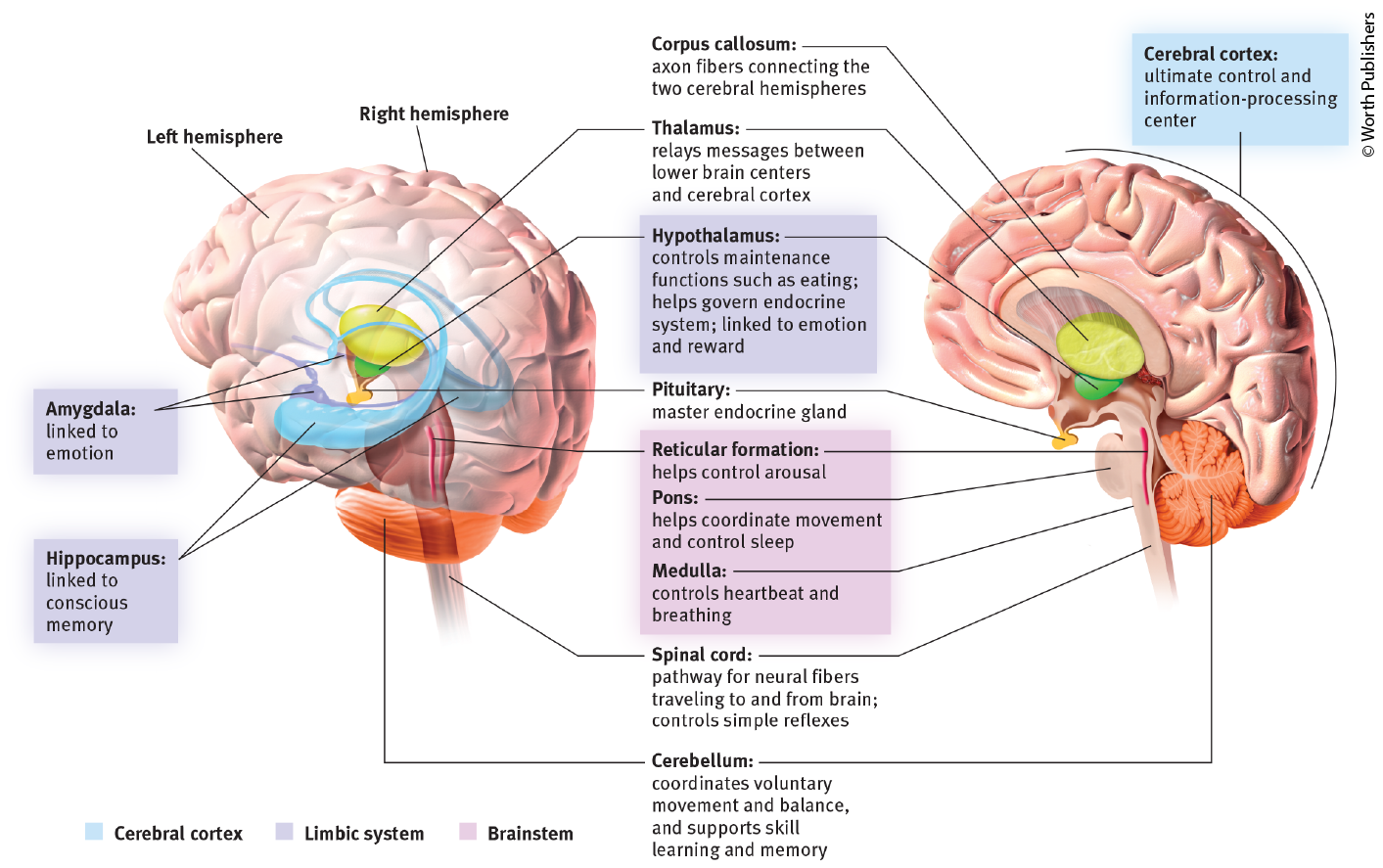
Brainstem
Brain’s innermost region and base which handles autonomic survival tasks such as heartbeat and breathing
Medulla
slight swelling in the spinal cord just after it enters the skull that houses controls for heartbeat and breathing
Pons
Right above medulla and helps coordinate movements and control sleep
The ________ is a crossover point where nerves from left side of brain are mostly linked to right side of body and vice versa
brainstem
Thalamus
Sits at top of brainstem, acts as brain’s sensory control center, recieves info from all senses but smell, forwards messages to final destination for processing
What is reticular formation?
This nerve network extends upward from your spinal cord, through your brainstem, and into your thalamus, acts as a filter, relaying important information to other brain areas, as well arousal
Cerebellum
At the rear of brainstem, It helps you judge time, discriminate textures and sounds, control your emotions, aids your vocabulary, reading, and ability to store information, coordinates voluntary movement, and process and store memories
Limbic System
wonderful emotion we feel when we enjoy a joke, associated with emotions and drives, contains the amygdala, the hypothalamus, and the hippocampus
Amygdala
enables aggression and fear
Hypothalamus
Just below thalamus, helps body main internal state, hunger, thirst, body temperature, sexual behavior, provides pleasurable rewards
Hippocampus
processes conscious, explicit memories.
Study this
Learn this
Cerebrum
two large hemispheres that contribute 85 percent of the brain’s weight — enables our perceiving, thinking, and speaking
a thin surface layer of interconnected neurons on the two large hemispheres of our brain
cerebral cortex
Motor cortex
the cerebral cortex area at the rear of the frontal lobes; controls voluntary movements, sends messages out to the body.
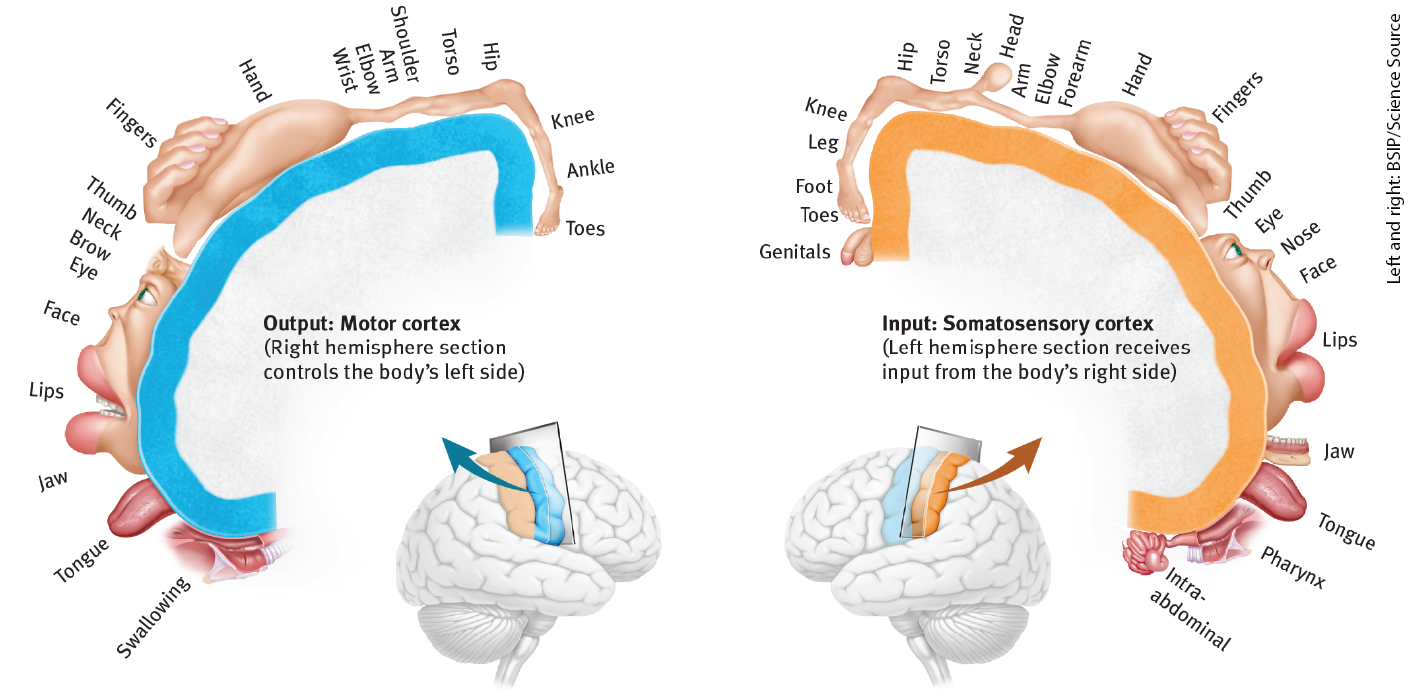
Somatosensory Cortex
the cerebral cortex area at the front of the parietal lobes; registers and processes body touch and movement sensations.
Visual cortex
region of the brain at the back of the head that receives and processes visual information from your eyes.
Auditory cortex
Any sound you hear processed in temporal lobes
The forward part of the frontal lobes, the______ cortex, enables our forward thinking — our planning, judgment, social interactions, and processing of new memories
prefrontal
Association Areas
cerebral cortex areas involved primarily in higher mental functions, such as learning, remembering, thinking, and speaking, involved in higher mental functions - interpreting, integrating, and acting on info processed in other areas
Corpus Callosum
a large band of neural fibers connecting the two brain hemispheres and carrying messages between them.
Split Brain
a condition resulting from surgery that separates the brain’s two hemispheres by cutting the fibers (mainly those of the corpus callosum) connecting them.
Conscious Awareness
product of coordinated, cortex-wide activity
Sequential Processing
processing one aspect of a stimulus or problem at a time; generally used to process new information or to solve difficult problems.
Consciousness
Awareness of ourselves and environment
Processing info at conscious level
Sequential processing of whatever requires focused attention
Processing info at unconscious level
Parallel processing of routine business
Inattentional Blindness
failure to notice an entirely unexpected object in plain sight because your attention is elsewhere
Change Blindness
Failure to notice an obvious alteration between two states or views of a scene
Circadian Rhythm
Internal biological clock; regulates our daily cycles of alertness and sleepiness
Nightly sleep cycle- N1
First non REM sleep stage is the brief near waking sleep w irregular brain waves we enter; hallucinations may occur
Nightly sleep cycle- N2
Which we spend half of our sleep time , characteristic bursts of rhythmic brain waves; stage lengthens as night goes on
Nightly sleep cycle- N3
Deep sleep in which large slow deta waves are emitted; this stage shortens as night goes on
REM Sleep
Paradoxical sleep stage because of internal arousal but external calm
How does sleep loss affect us?
Sleep loss causes fatigue and irritability, and impairs concentration, productivity, and memory consolidation. It also predicts bad moods and intrusive bad memories, and can lead to depression, suicidal thinking, obesity, joint inflammation, poor academic outcomes, increased risk for heart disease, a suppressed immune system, and slower reaction times (with greater vulnerability to accidents).
What are sleep disorders?
insomnia (recurring problems in falling or staying asleep); narcolepsy (sudden, uncontrollable sleepiness, sometimes lapsing directly into REM sleep); sleep apnea (the repeated stopping of breathing while asleep); sleepwalking and sleeptalking; and night terrors.
What do we dream about?
Our dreams often include ordinary events and everyday experiences, but with a vivid, emotional, and often bizarre flavor. Most dreams are bad dreams - of personal failures, dangers, or misfortunes.
5 explanation why we dream
Freud's wish fulfillment: Dreams provide a psychic "safety valve," with manifest content (story line) acting as a censored version of latent content (unconscious drives and wishes that would be threatening if expressed directly).
Information processing: Dreams help us sort out the day's events and consolidate them in memory.
Physiological function: Regular brain stimulation may help us develop and preserve neural pathways in the brain.
Neural activation: The brain attempts to make sense of neural static by weaving it into a story line.
Cognitive development: Dreams reflect dreamers' cognitive development
their knowledge and understanding.
What are the three major issues studied by developmental psychologists?
Nature and nurture - how our genetic inheritance (our nature) interacts with our experiences (our nurture) to influence our development.
Continuity and stages — which parts of development are gradual and continuous and which change relatively abruptly.
Stability and change - which traits persist through life and which change as we age.
How does conception occur? What are chromosomes, DNA, genes, and the human genome? And how do genes and the environment interact?
At conception, one sperm cell fuses with one egg cell.
Genes are the basic units of heredity that make up chromosomes, the threadlike coils of DNA. The human genome is the shared genetic profile that distinguishes humans from other species.
The interaction between heredity and environment influences development.
Epigenetics is the study of environmental influences on gene expression (making genes active or inactive) that occur without a DNA change.
How does life develop before birth, and how do teratogens put prenatal development at risk?
From conception to 2 weeks, the zygote is in a period of rapid cell development.
By 6 weeks, the embryo's body organs begin to form and function.
By 9 weeks, the fetus is recognizably human.
Teratogens are potentially harmful agents that can pass through the placenta and harm the developing embryo or fetus, as happens with fetal alcohol syndrome.
What are some abilities and traits of newborns?
Newborns' sensory systems and reflexes aid their survival and social interactions with caregivers.
Newborns smell and hear well, see what they need to see, and begin using their sensory equipment to learn.
Inborn temperament -emotional reactivity and intensity - heavily influences our developing personality.
How do twin and adoption studies help us understand the effects of nature and nurture?
Identical (monozygotic) twins develop from a single fertilized egg that splits into two; fraternal (dizygotic) twins develop from two separate fertilized eggs.
Studies of separated identical twins allow researchers to test the effects of different home environments on people with the same genes. Studies of adoptive families let researchers test the effects of heredity by observing how the same home environment affects people who are genetically different from each other.
During infancy and childhood, how do the brain and motor skills develop?
Most brain yells form before birth. With maturation and experience, their interconnections multiply rapidly and become more complex. A pruning process strengthens heavily used links and weakens unused ones (but due to neuroplasticity, our neural tissue is ever changing and reorganizing in response to new experiences). We seem to have a critical period for some skills, such as language.
Complex motor skills — sitting, standing, walking - develop in a predictable sequence. Timing may vary with individual maturation and with culture.
We have few conscious memories of events occurring before age 4, a blank space in our conscious memory that psychologists call infantile amnesia.
How did Piaget broaden our understanding of the way a child's mind develops, and how have today's researchers built on his work?
As he studied children's cognitive development, Jean Piaget proposed that they actively construct and modify an understanding of the world through the processes of assimilation and accommodation. They form schemas that help them organize their experiences.
Piaget believed children construct an understanding of the world by interacting with it while moving through four cognitive stages:
Sensorimotor stage - first two years; object permanence develops.
Preoperational stage - about age 2 to 6 or 7; preschoolers are egocentric and unable to perform simple logical operations.
Concrete operational stag - about 7 to 11 years; mastery of conservation and simple math.
Formal operational stage - about age 12 and up; reasoning expands to abstract thinking.
How did Vygotsky view children's cognitive development?
Lev Vygotsky's studies of child development focused on the ways a child's mind grows by interacting with the social environment. Parents and other caregivers provide temporary scaffolds from which children can step to higher levels of thinking.
What does it mean to develop a theory of mind?
As preschoolers, most children begin to develop a theory of mind, a sense of their own and others' mental states.
How do the bonds of attachment form between caregivers and infants?
Infants develop stranger anxiety soon after object permanence.
Infants form attachments with caregivers who satisfy nutritional needs but, more importantly, who are comfortable, familiar, and responsive.
Why do attachment differences matter, and how does an infant's ability to develop basic trust affect later relationships?
Attachment styles differ (secure or insecure) due to the child's individual temperament and the responsiveness of the child's caregivers.
Securely attached children develop basic trust and tend to have healthier adult relationships.
Neglect or abuse can disrupt the attachment process and put children at risk for physical, psychological, and social problems.
How does experiencing adversity affect children's social development?
Most children growing up under adversity are resilient, and they may be hardier when facing future stresses. But extreme trauma in childhood can alter the brain, affecting stress responses or leaving epigenetic marks. Children who experience severe or prolonged abuse, neglect, bullying, poverty, or wartime atrocities are at increased risk for health problems, psychological disorders, substance abuse, and criminality.
What are the four main parenting styles?
Parenting styles - authoritarian, permissive, neglectful, and authoritative - reflect how responsive and how demanding parents are.
Child-raising practices reflect both individual and cultural values.
What outcomes are associated with each parenting style?
Children with the highest self-esteem, self-reliance, self-regulation, and social competence tend to have authoritative parents. Less positive outcomes are associated with authoritarian, permissive, and negligent parents.
However, correlation does not equal causation (it's possible that children with positive characteristics are more likely to bring out positive parenting methods).
How is adolescence defined, and how do physical changes affect developing teens?
Adolescence, the transition period from childhood to adulthood, begins with puberty, a time of sexual maturation.
The brain's frontal lobes mature during adolescence and the early twenties, enabling improved judgment, impulse control, and long-term planning.
3-16: How did Piaget, Kohlberg, and later researchers describe cognitive and moral development during adolescence?
In Jean Piaget's view, the capacity for formal operations (abstract reasoning) develops in adolescence, and this development is the basis for moral judgment.
Lawrence Kohlberg proposed a stage theory of moral thinking: preconventional morality (self-interest), conventional morality (gaining others' approval or doing one's duty), and postconventional morality (basic rights and self-defined ethical principles). Kohlberg's critics note that the postconventional level is culturally limited (representing morality only from the perspective of an individualist society) and male-focused (since women more often emphasize care for those in need over what is "fair").
Other researchers believe that morality lies in moral intuition and moral action as well as thinking. Life success can grow from the ability to delay gratification.
What are the social tasks and challenges of adolescence?
Erik Erikson proposed eight stages of psychosocial development across the life span. He believed we need to achieve trust, autonomy, initiative, competency, identity (in adolescence), intimacy (in young adulthood), generativity, and integrity.
Each life stage has its own psychosocial task, with the chief task of adolescence being solidifying one's sense of self, one's identity. This often means trying out a number of different roles. Social identity is the part of the self-concept that comes from a person's group memberships.
How do parents and peers influence adolescents?
During adolescence, parental influence diminishes and peer influence increases, in part because of the selection effect - the tendency to choose similar others as friends.
Parents influence our manners, attitudes, values, faith, and politics. Language and other behaviors are shaped by peer groups, as children adjust to fit in.
What is emerging adulthood?
Emerging adulthood is the period from age 18 to the mid-twenties, when many young people in Western cultures are no longer adolescents but have not yet achieved full independence as adults.
What physical changes occur from early to late adulthood?
Muscular strength, reaction time, sensory abilities, and cardiac output begin to slightly decline in the late twenties. The decline accelerates through middle adulthood (to age 65) and late adulthood (after 65), varying considerably with personal health and exercise habits.
Women's fertility ends with menopause around age 50; men experience a more gradual decline.
In late adulthood, the immune system also weakens, but healthful habits may enable good health even in later life.
How does memory change with age?
Recall begins to decline, especially for meaningless information. Recognition memory remains strong. Cognitive decline typically increases with the nearness of a natural death.