Chapter 5: Chemical Energetics
 Call Kai
 Learn
Learn Practice Test
 Spaced Repetition
 Match
Match Flashcards
 Knowt Play
1/3

There's no tags or description
Looks like no tags are added yet.
Name | Mastery | Learn | Test | Matching | Spaced | Call with Kai | Chat |
|---|
No analytics yet
Send a link to your students to track their progress
4 Terms
Enthalpy VS Enthalpy Changes
Enthalpy:
It is the total chemical energy of a substance (heat content)
Chemical energy consists of:
Kinetic energy
Potential energy (main component of C.E.)
Main component due to electrostatic attraction between the particles
Enthalpy Change:
It is the energy change
During a chemical reaction, bonds are broken and new bonds are formed
Bond breaking → requires energy
Bond forming → releases energy
Symbol of enthalpy change: ΔH
Units of ΔH: J mol–1 or kJ mol–1
Endothermic VS Exothermic
Endothermic:
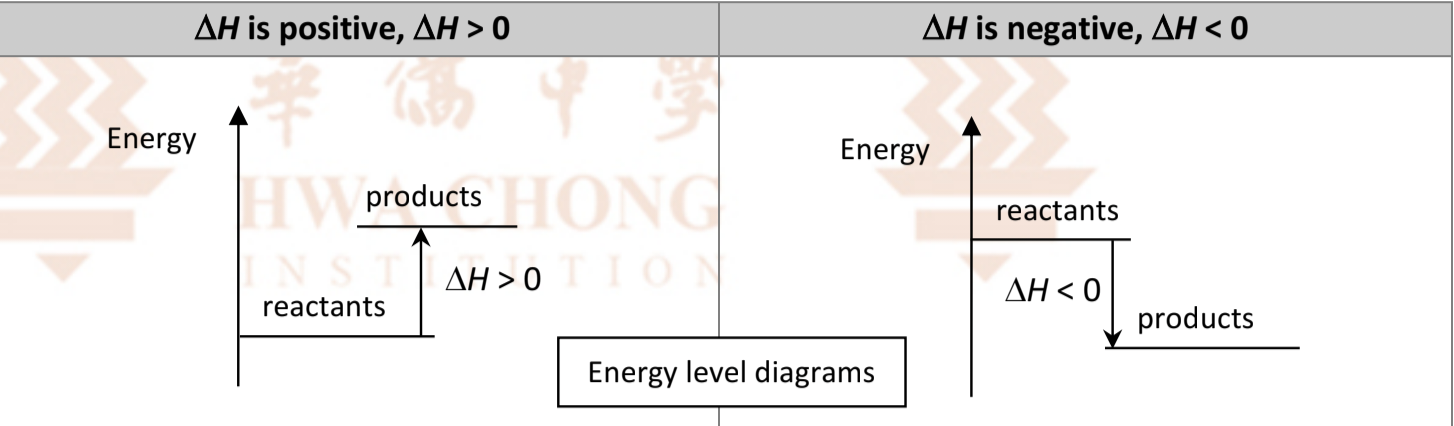
ΔH → +ve (ΔH>0)
Products have higher energy content than the reactants
Absorbs heat from the surroundings
Temperature of the surroundings decreases
Exothermic:
ΔH → -ve (ΔH<0)
Products have lower energy content than the reactants
Products are more energetically stable than reactants (energy level of products is lower than the reactants)
Releases heat to the surroundings.
Temperature of the surroundings increase
*Don't say: “heat energy" → wrong!!
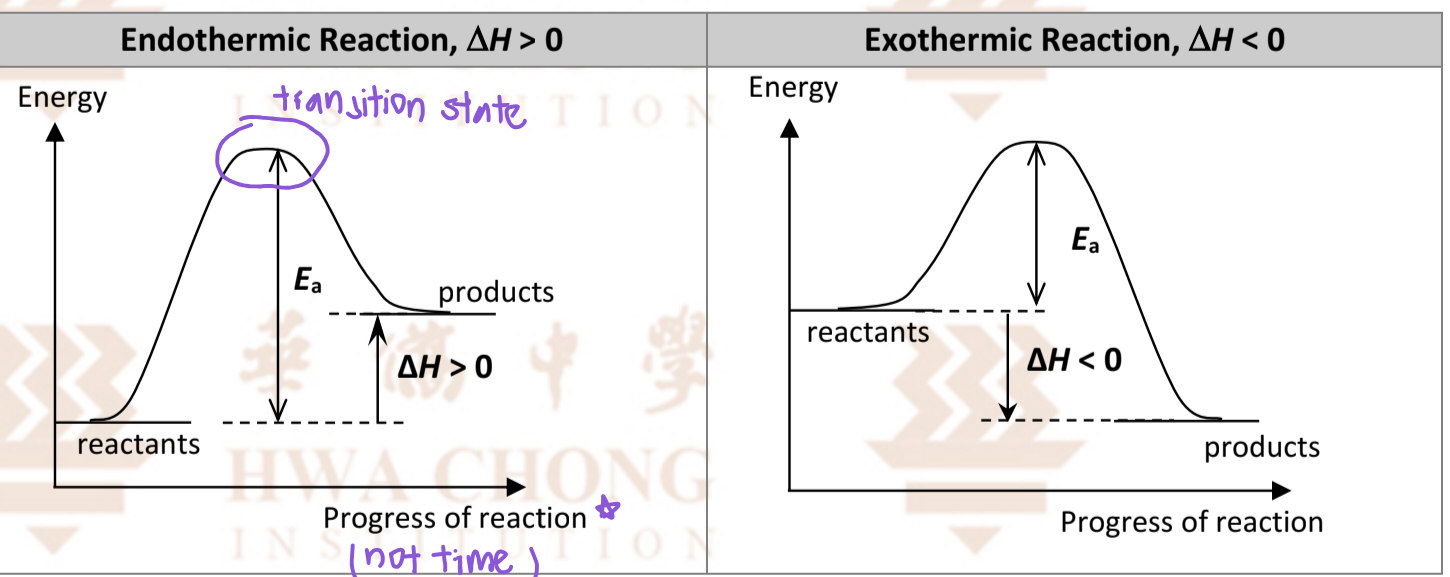
Energy Profile Diagram
*Different from energy level diagram
Activation energy (Ea)
It is the minimum energy which the reacting particles must possess in order to overcome the energy barrier before becoming products
Thermochemical Equation