MATH 121 Final Exam Questions fully solved & verified for accuracy(A+graded)
 Call Kai
 Learn
Learn Practice Test
 Spaced Repetition
 Match
Match Flashcards
1/232

There's no tags or description
Looks like no tags are added yet.
Name | Mastery | Learn | Test | Matching | Spaced | Call with Kai |
|---|
No analytics yet
Send a link to your students to track their progress
233 Terms
How do you solve for | x-c | < R?
1. -R < x-c < R
2. c-R < x < c+R
What is the distance formula?
√(x₂-x₁)² + (y₂-y₁)²
If the center of a circle is at (x₁, y₁) and it has radius r, what is the equation of the circle?
(x-x₁)² + (y-y₁)² = r²
T/F: For a function, for each input there is only one output but one output can have multiple inputs AKA one x can only have one y, but one y can have multiple x values
T
All functions MUST pass the ______ ______ test.
vertical line
What is the domain for all polynomials?
- ∀x (for all x)
What is a rational function? What is the domain of a rational function?
- f(x) = P(x) / Q(x) where P(x) and Q(x) are polynomials
- When Q(x) ≠ 0
What is the domain of an algebraic function (roots)?
when the inside of the root ≥ 0
What is the range of an exponential function?
For f(x) = aˣ, when a > 0
What is the domain for f(x) = sinx and f(x) = cosx?
∀x
What is the domain for tanx?
tanx = sinx / cosx ∴ the domain is anywhere cosx ≠ 0
What do the following translate to?
1. (f+g)(x)
2. (f-g)(x)
3. (fg)(x)
4. (f/g)(x)
1. f(x) + g(x)
2. f(x) - g(x)
3. f(x)g(x)
4. f(x) / g(x)
How is (f∘g)(x) read?
f(g(x))
What does 𝛑 = in degrees?
180°
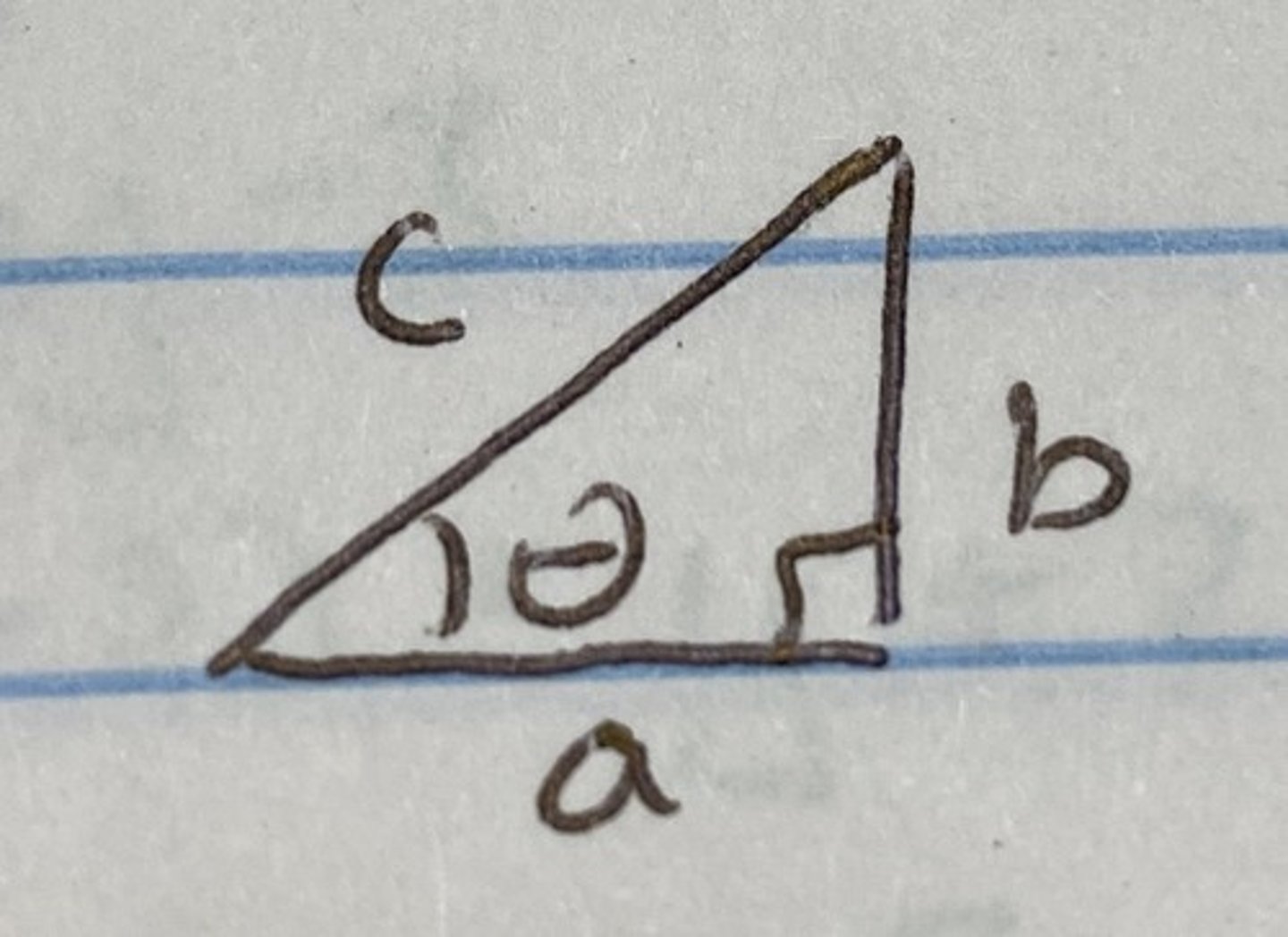
Using the following image, use the letters to find the following:
1. sinθ
2. cosθ
3. tanθ
4. cotθ
5. secθ
6. cscθ
1. sinθ = b/c
2. cosθ = a/c
3. tanθ = b/a
4. cotθ = a/b
5. secθ = c/a
6. cscθ = c/b
**
Finish the following trig identities:
1. sin²x + cos²x =
2. tan²x + 1 =
3. cot²x + 1 =
4. sin(x+y) =
5. sin(2x) =
6. sin²x =
7. cos²x =
1. 1
2. sec²x
3. csc²x
4. sinxcosy + cosxsiny
5. 2sinxcosx
6. (1-cos2x) / 2
7. (1+cos2x) / 2
How do you know if f(x) and g(x) are inverse functions?
1. If f(g(x)) = x and g(f(x)) = x
2. Must be a one-to-one function AKA f(a)≠f(b) unless a =b
3. Passes the horizontal line test
How do you find the inverse of a function?
1. switch the x and y variables
2. solve for y
What is the inverse of ...
1. f(x) = sinx
2. f(x) = cosx
3. f(x) = tanx
1. arcsinx
2. arccosx
3. arctanx
What is the domain and range of:
1. sinx
2. arcsinx
1. domain: ∀x
range: (-1, 1)
2. domain: (-1, 1)
range: ∀y
What is the domain and range of:
1. cosx
2. arccosx
1. domain: ∀x
range: (-1, 1)
2. domain: (-1, 1)
range: ∀y
Describe the domain and range of (AKA what the graph looks like):
1. tanx
2. arctanx
1.
- There are vertical asymptotes starting at 0 and additions of 𝛑/2 on the x axis
- range goes to infinity
2.
graph of tanx flipped horizontally
(therefore domain is ∀x)
What do the following translate to?
1. bˣbʸ =
2. bˣ/bʸ =
3. (bˣ)ʸ =
1. bˣ⁺ʸ
2. bˣ⁻ʸ
3. bˣʸ
How can you rearrange y = LOGbX?
bʸ = x
What does the following =?
1. LOGb(bˣ)
2. b^(LOGbX)
1. x
2. x
What does the following equal?
1. ln(eˣ) =
2. e^(lnx) =
1. x
2. x
eˣ and lnx are ______
inverses
**
What do the following hyperbolic functions equal?
1. sinhx
2. coshx
1. sinhx = [eˣ - e⁻ˣ] / 2
2. coshx = [eˣ + e⁻ˣ] / 2
What does cosh²x - sinh²x = ?
1
What does the following =?
1. tanhx
2. cothx
1. sinhx / coshx
2. coshx / sinhx
What is average velocity?
Δ distance / Δ time
If you S(t), what does average velocity =?
[S(t₁) - S(t₀)] / t₁ - t₀
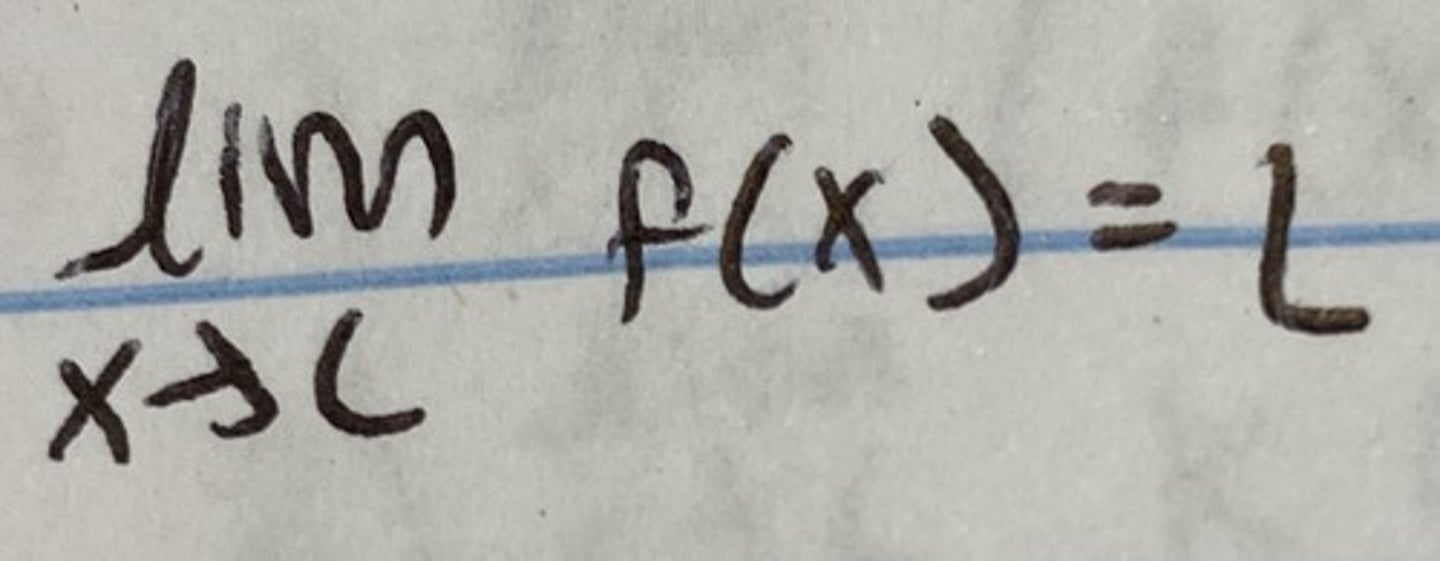
What's the definition of a limit?
When x "gets close" to c, f(x) "gets close" to L
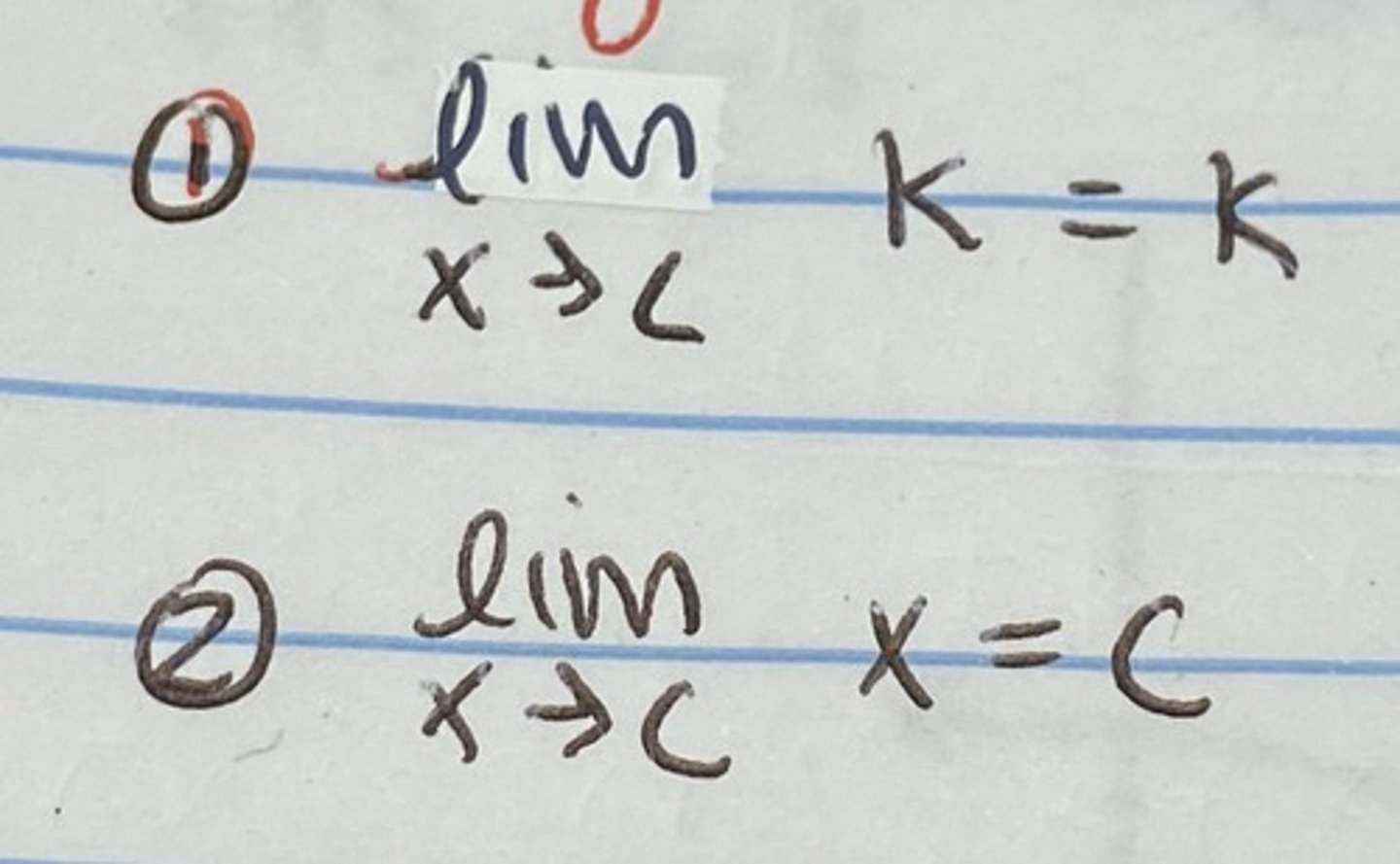
What are the 2 rules of limits?
If the lim x→c f(x) = L and lim x→c g(x) = M then . . .
1. lim x→c (f(x) ± g(x)) =
2. lim x→c k(fx) =
3. lim x→c f(x) ∙ g(x) =
4. lim x→c f(x) / g(x) =
5. lim x→c (f(x))ᴺ =
6. lim x→c ᴺ√f(x) =
1. L ± M
2. kL
3. L ∙M
4. L/M , M ≠ 0
5. Lᴺ
6. ᴺ√L , L>0
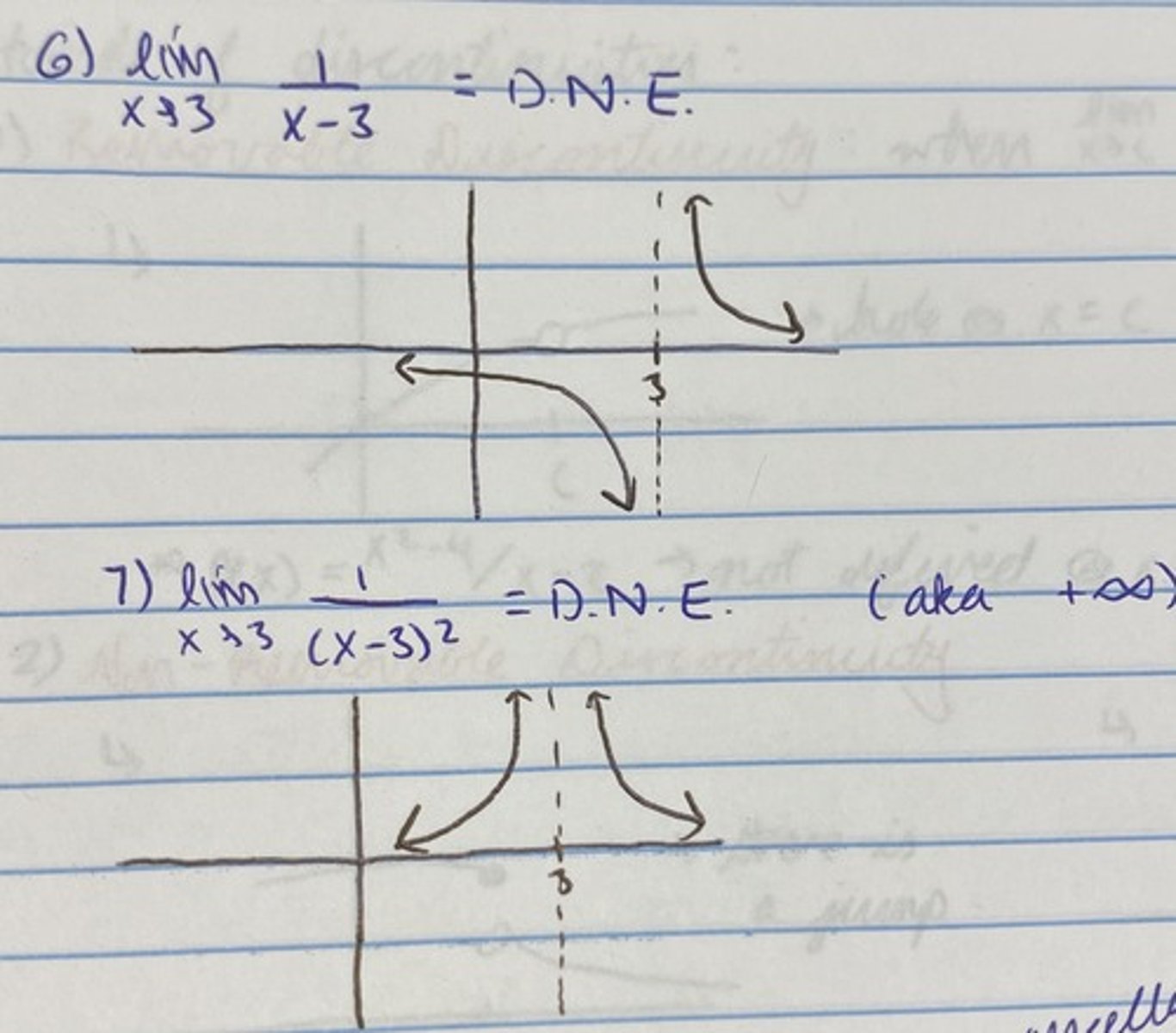
If the limit of a graph goes to infinity or negative infinity (AKA asymptotes are involved), what are the limits?
DNE
What3 things must be true in order for a function to be continuous?
1. lim x→c f(x) must exist
2. f(c) must exist
3. lim x→c f(x) = f(c)
What are the 2 kinds of discontinuities?
1. removable discontinuity
2. non-removable discontinuity
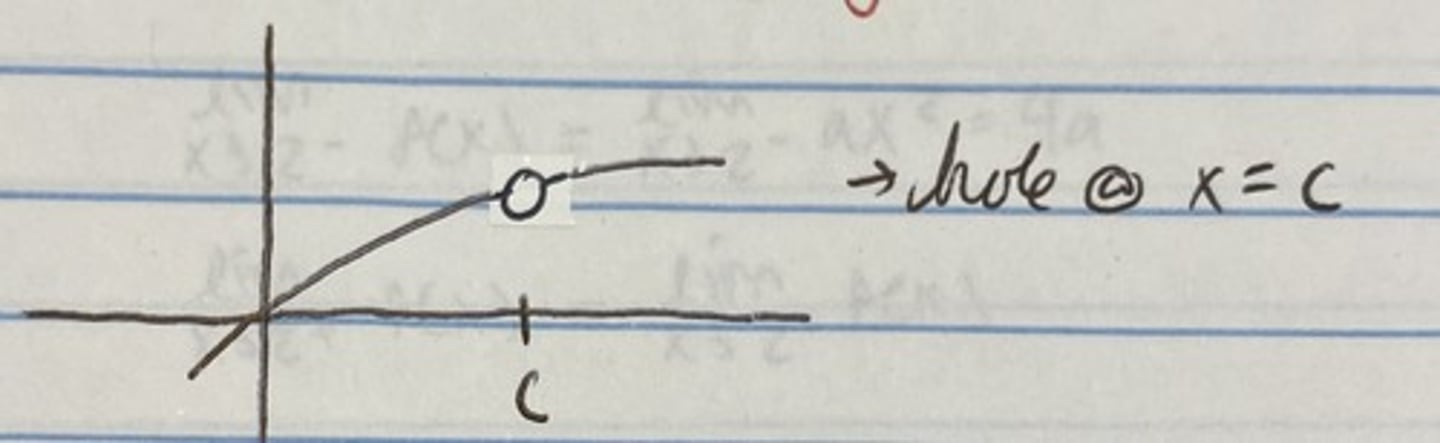
What is a removable discontinuity?
1. When lim x→c f(x) must exists but lim x→c f(x) ≠ f(c)
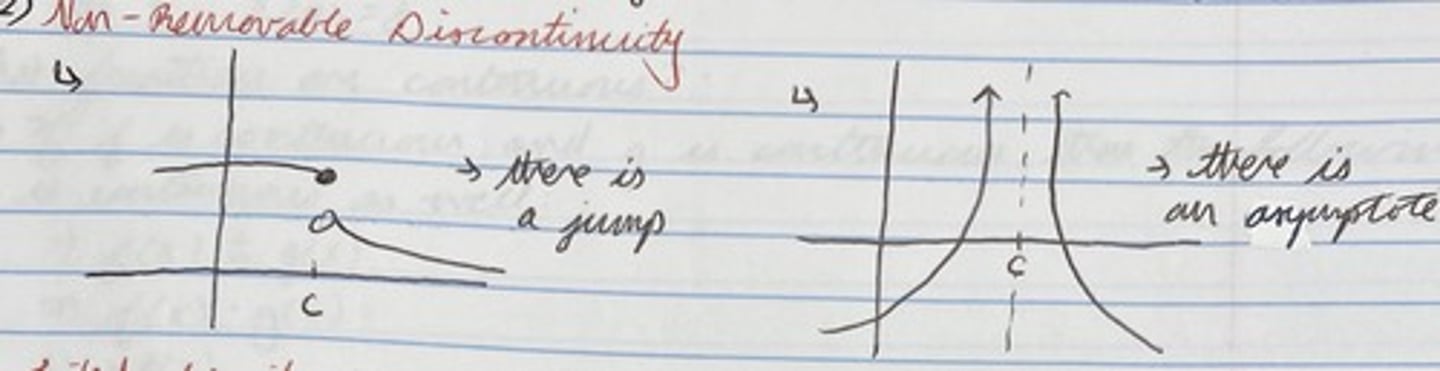
What is a non-removable discontinuity?
When there is a jump or an asymptote on the graph
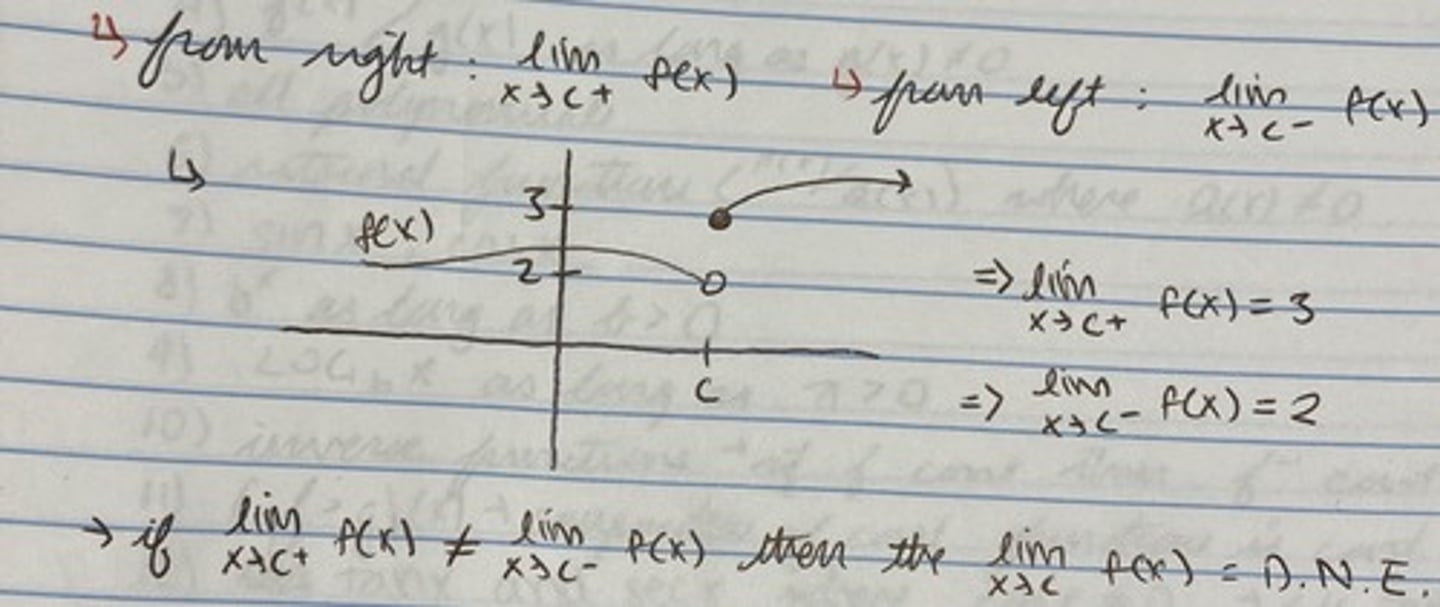
What are one-sided limits?
When the limit as x→c⁻ ≠ x→c⁺, in which case the limit if f(x) in general DNE
If given two piece-wise functions in which one function has an a, and you are told to find a so that f(x) is continuous, how do you find a?
1. Plug in x with the number that x approaches
2. set both answers equal to each other
3. solve for a
*answer: a = 2

Is f(x) ± g(x) continuous?
yes
Is f(x) ∙ g(x) continuous?
yes
Is kf(x) continuous?
yes
When is f(x) / g(x) continuous?
as long as g(x)≠0
Are all polynomials continuous?
yes
Are sinx and cosx continuous?
yes
When is bˣ continuous?
x > 0
Where are tanx and secx continuous?
Where cosx≠0
Where are cotx and cscx continuous?
where sinx≠0
How do you find the limit of a rational function that equals 0 if you plug in c?
factoring and then crossing out like top and bottom
How do you find the limit of a rational function where the numerator contains fractions?
Multiply the numerator's fractions by common factor to get the same denominator

How do you find the limit of a rational function where the numerator involves a root?
Multiply top and bottom by the numerator just with the opposite operation
OR
factor out the denominator so that each factor contains a root

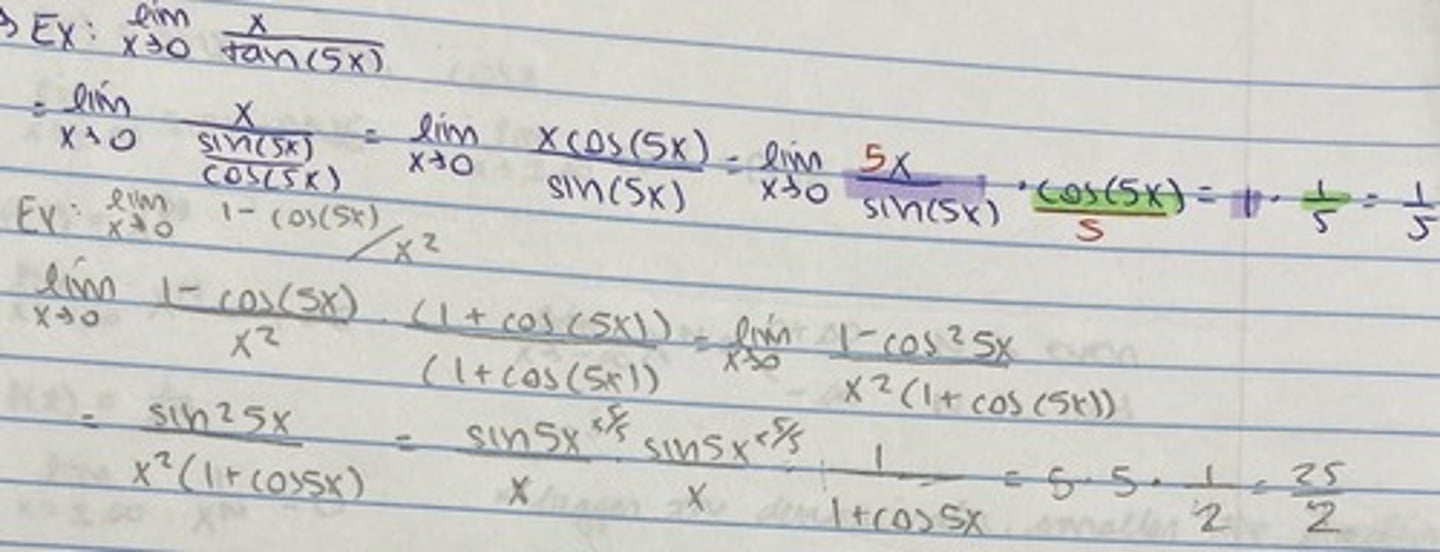
How do you solve the limit of a function that involves trig?
use trig identities to cancel out
What is the lim x→0 [sinx/x] =?
1
How do you use the Squeeze theorem?
1. Break it down to a single trig function
2. Set it -1 ≤ function ≤ 1
3. Make the function look like the original and do what you did to make the function look like the original to the -1 and 1
4. Find the limit of either ends (should be the same)
5. Therefore the function's limit is the same
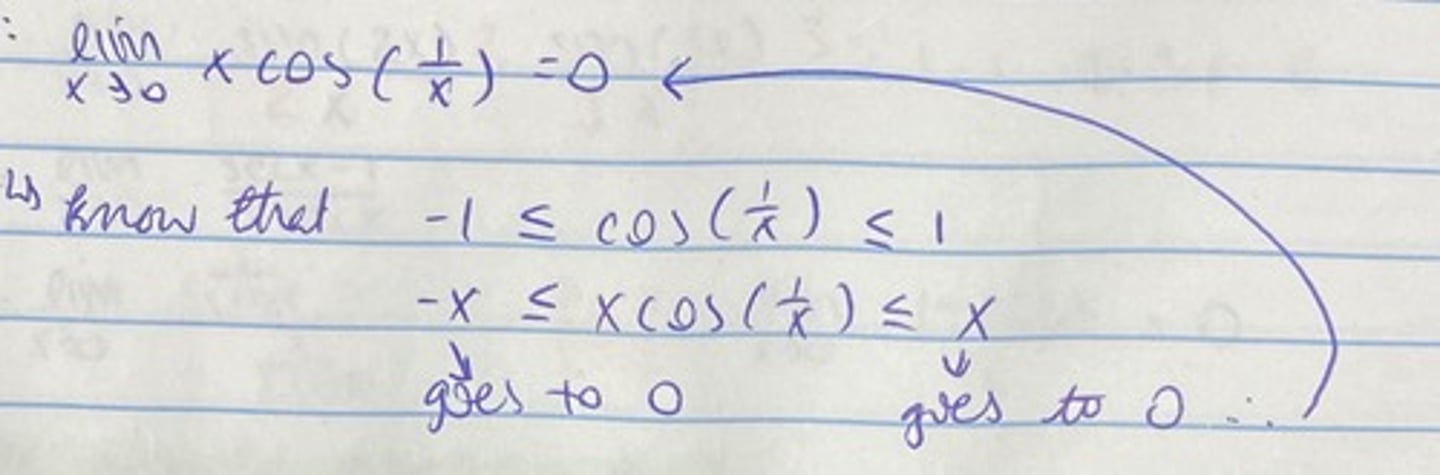
What is the Squeeze Theorem?
If g(x) ≤ f(x) ≤ h(x) AND lim x→ c g(x) = L, lim x→ c h(x) = LTHENlim x→ c f(x) = L
AKA
If g(x) is going to c and h(x) is going to c, then f(x) has no choice but to go to c w/ them while getting squeezed
What is the lim x→0 [1-cosx]/x = ?
0
How do you know that a limit involves a horizontal asymptote?
When c when x→c is ∞ or -∞
What is the lim x → ±∞ eˣ?
∞: +∞
-∞: 0
What is the lim x → ±∞ sinx?
DNE
What is the lim x → ±∞ cosx?
DNE
1. What is the lim x →+∞ xᴺ?
2. What is the lim x →-∞ xᴺ?
1. +∞
2. +∞ if N is even ; -∞ is N is odd
What is the lim x → ±∞ 1/xᴺ?
0
What is the limit of f(x) = P(x) / Q(x)
1. if the degree of P(x) < degree of Q(x)?
2. if the degree of P(x) > degree of Q(x)?
3. if the degree of P(x) = degree of Q(x)?
1. 0
2. DNE
3. leading coefficient of P(x) / leading coefficient of Q(x)
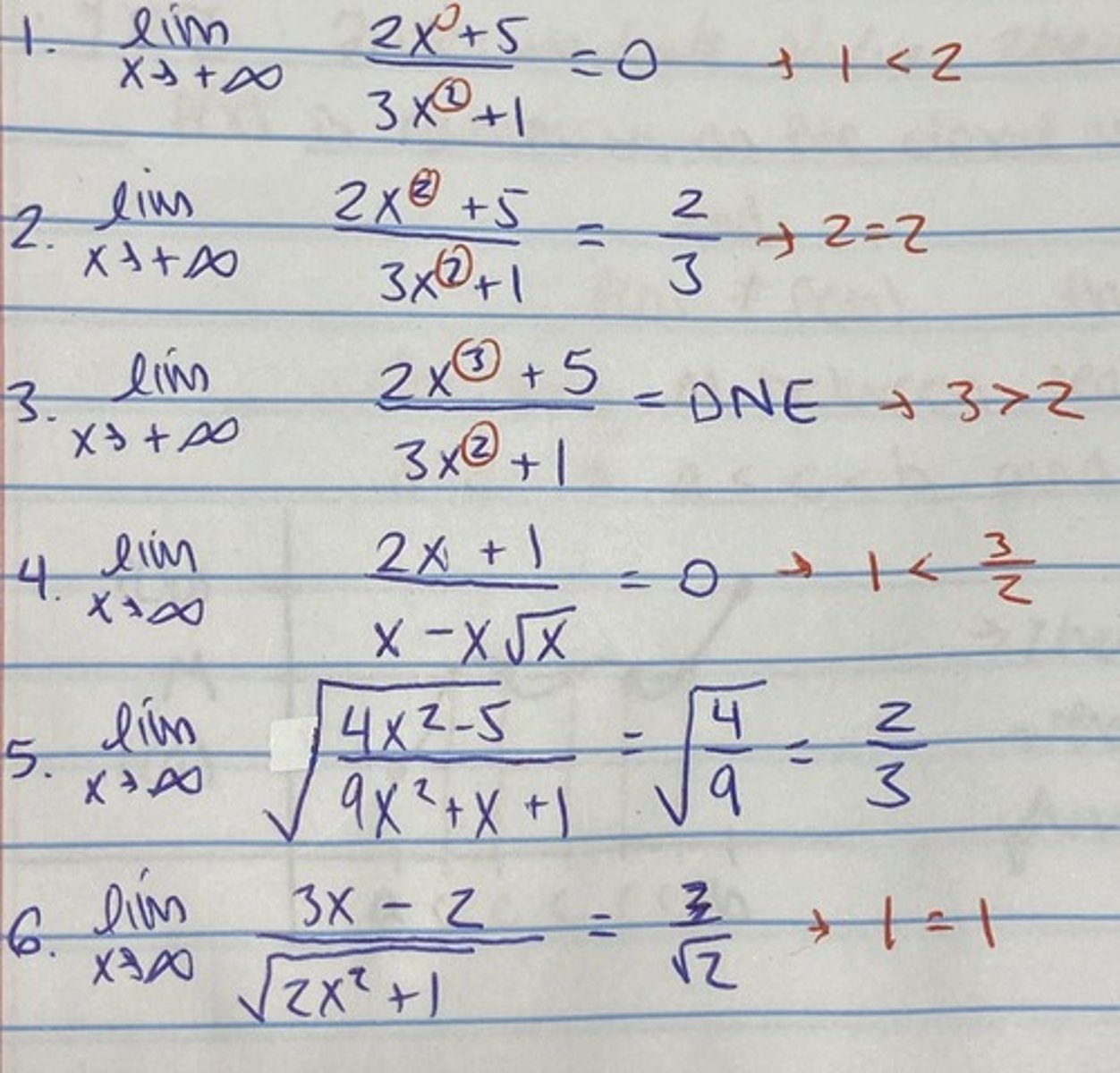
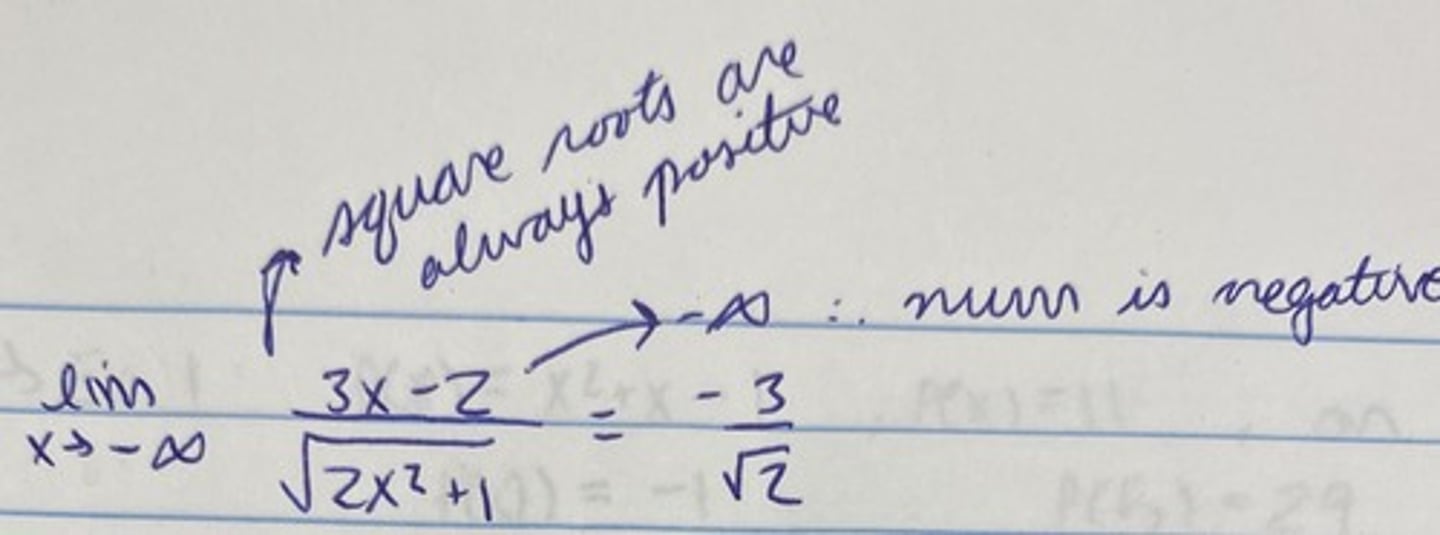
What should you be aware of when the c as x→c = -∞?
Make the answer the opposite sign of the coefficient that is not under the root
How do you find the limits of functions involving trig functions when the c as x→c = ±∞?
use the squeeze theorem
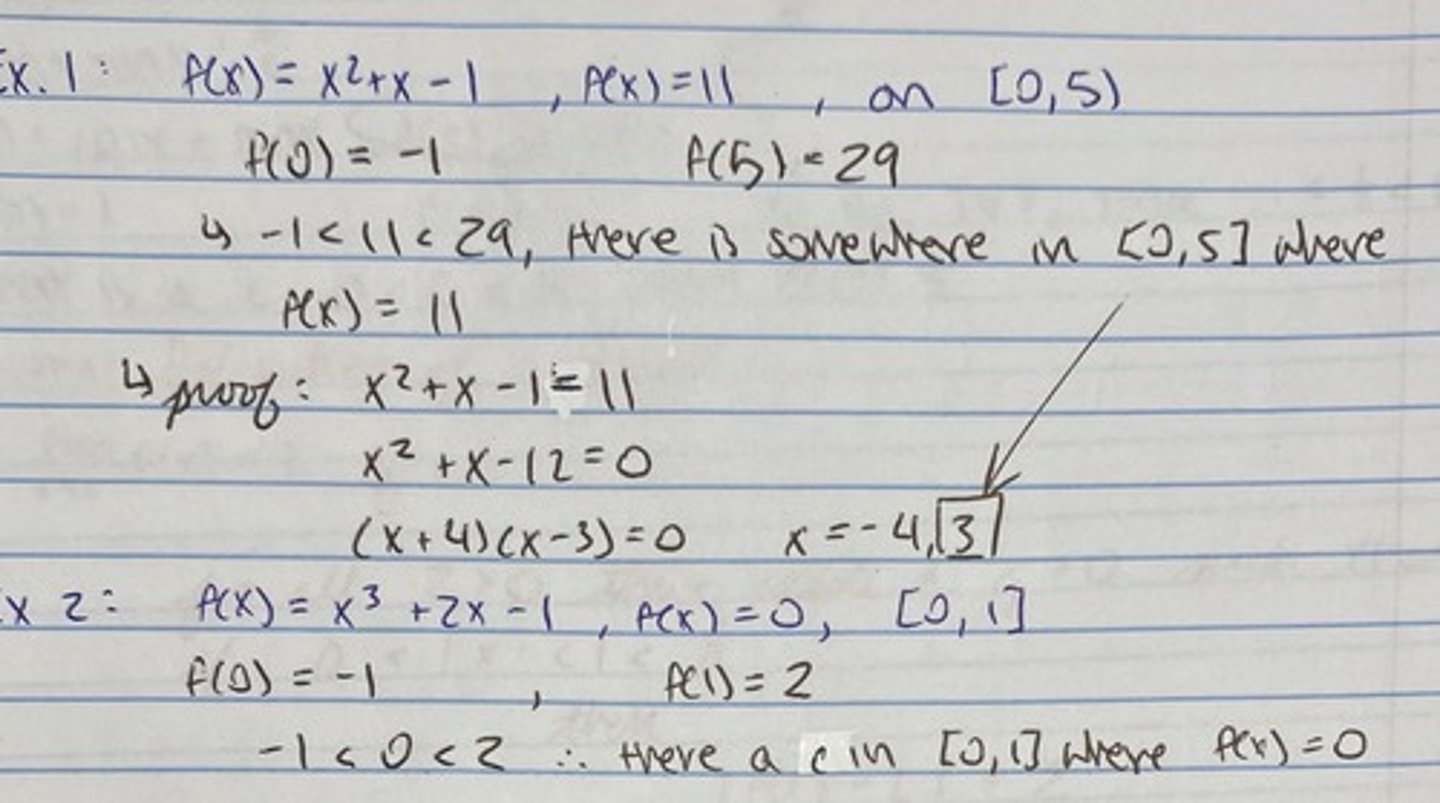
What is the Intermediate Value Theorem?
If f(x) is continuous on the closed interval [a,b]
AND
f(a) ≠ f(b) then
for any M between f(a) and f(b), there is a c where a < c < b and f(c) = M
How do you use the Intermediate Value theorem?
1. Find f(a)
2. Find f(b)
3. Make sure that M is in between f(a) and f(b)
4. Then the IVT is true
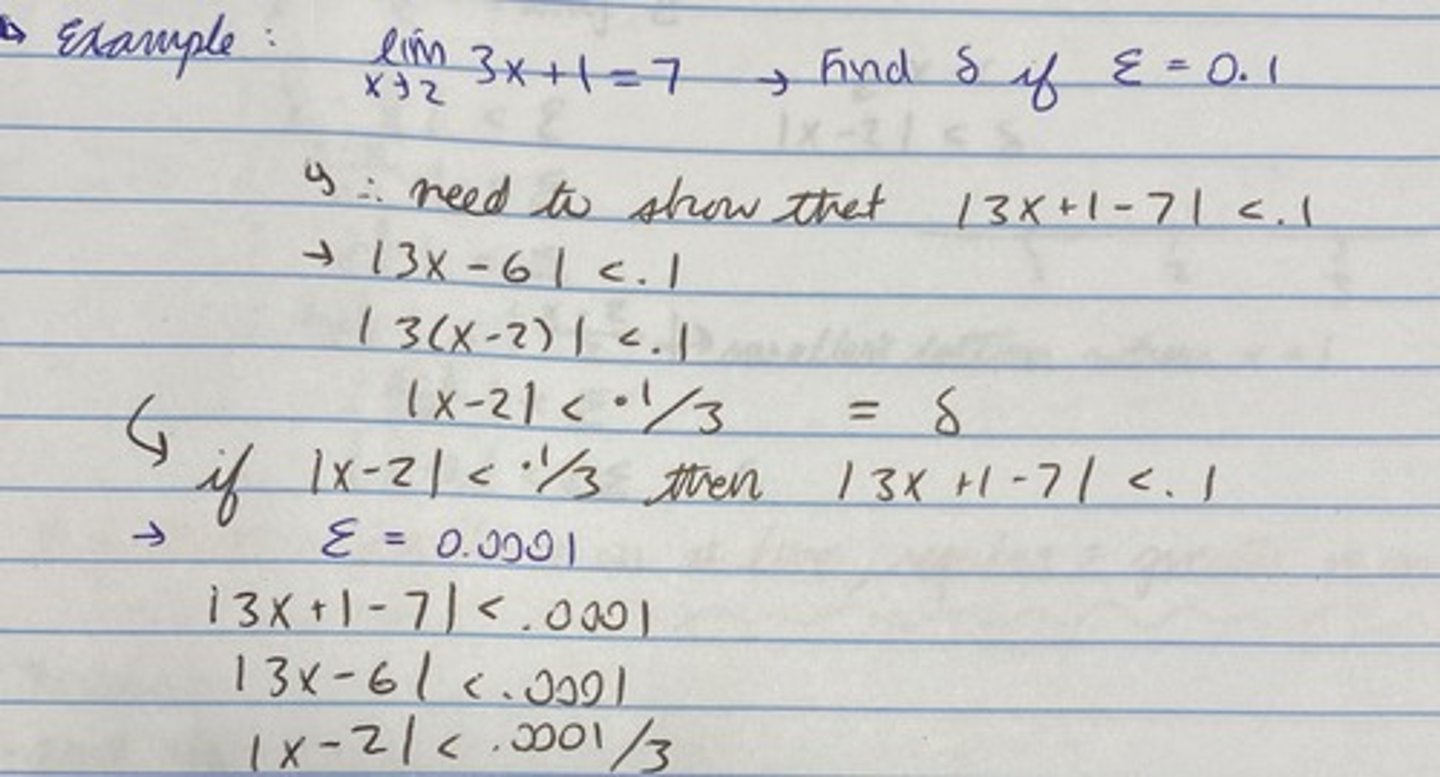
What is the formal definition of a limit?
lim x→c f(x) = L if . . .
for all ε > 0, there exists a δ > 0 such that if 0 < | x-c| < δ
then
|f(x) - L | < ε
How do you solve problems involving δ and ε?
For
lim x→c f(x) = L, ε = y
-You are solving for δ-
1. | f(x) - L | < y
2. Make | f(x) - L | into | x-c | form, applying what you don't need to y
3. Set what is done to L = δ
How do you solve δ and ε problems where you have exponents ≥2 and you need to factor things out?
Same way, except add 1 to the value of c (from x→c) and plug it into the factor that does not take the form of x - c, and then solve for the x - c form
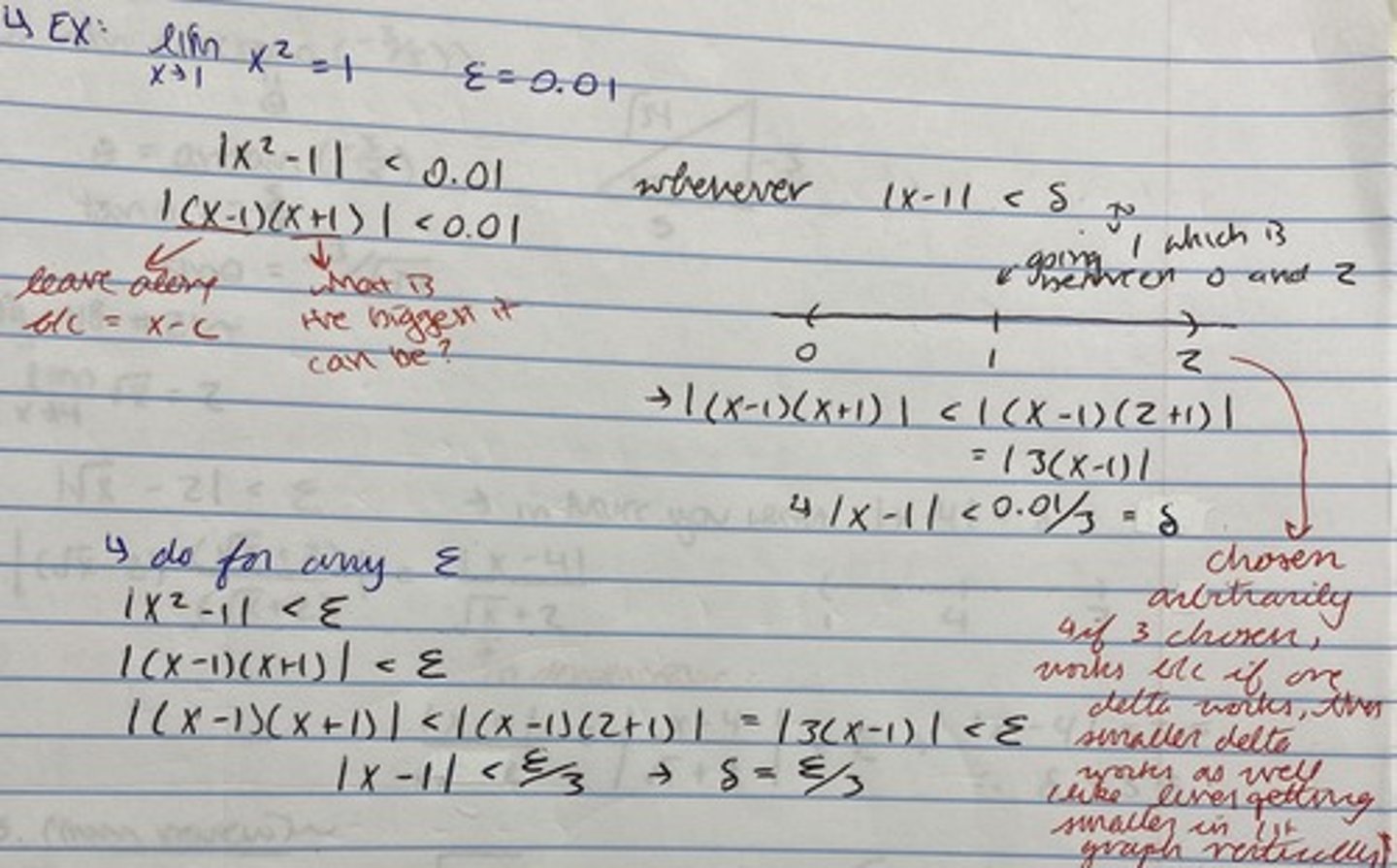
When solving δ and ε problems, when do you plug in the number higher on the number line for x vs. the number lower on the number line?
If there is a quotient then plug in smaller number on the number line; no fraction = greater # on the # line
What is the word definition of a derivative?
the slope of the tangent line
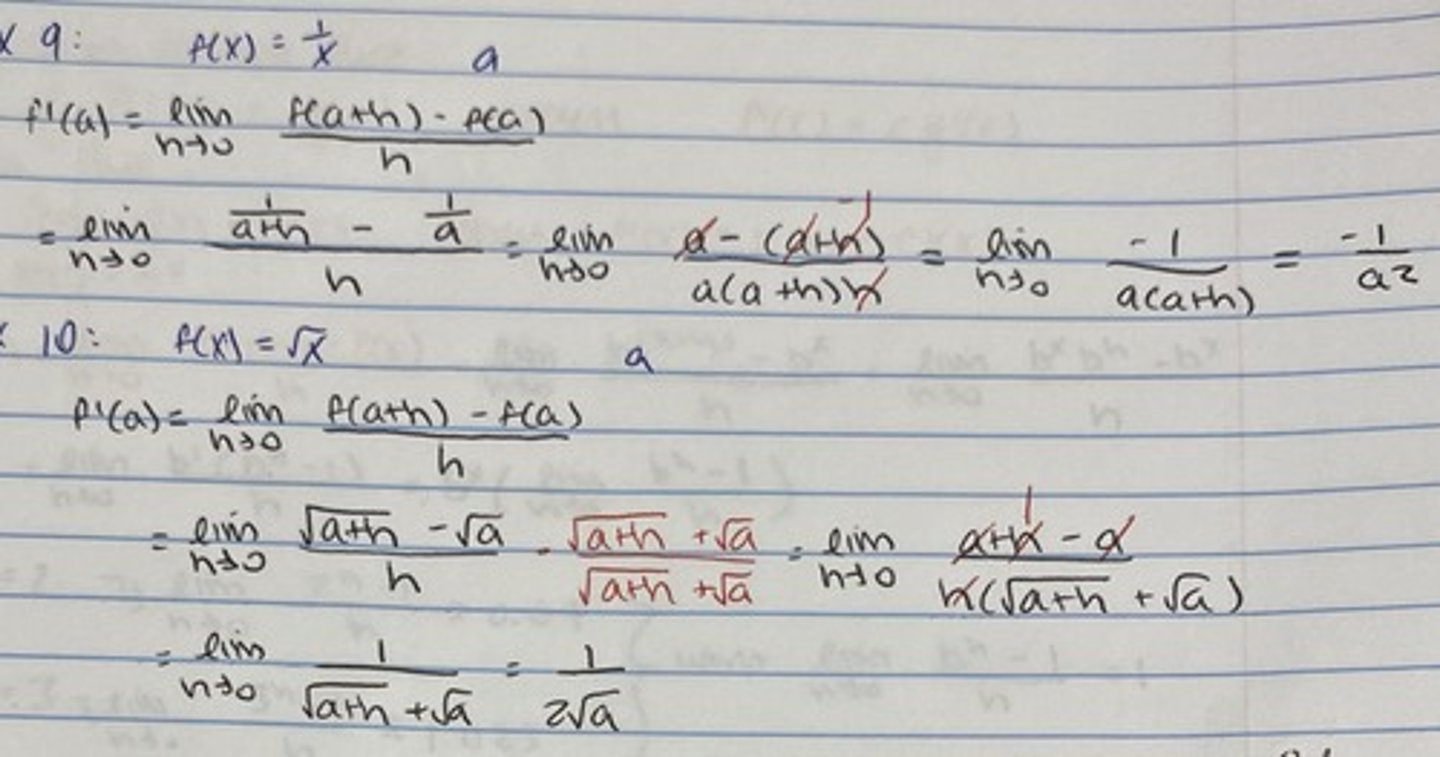
What is the definition of a derivative?
= f'(x) = slope of a tangent line = lim(h→0) [f(x+h) - f(x)] / [h] AKA f'(a) = lim(x→a) f(x)-f(a) / x-a
![<p>= f'(x) = slope of a tangent line = lim(h→0) [f(x+h) - f(x)] / [h] AKA f'(a) = lim(x→a) f(x)-f(a) / x-a</p>](https://knowt-user-attachments.s3.amazonaws.com/cc083baa-c067-4fae-9fc2-a37b8dcafc1a.jpg)
How do you solve problems with the definition of a derivative?
1. Plug in everything but keep h the same
2. Factor things out so you can somehow cancel out the h in the denominator
3. Plug in 0 for h
All _______ functions are ______ BUT NOT all ______ functions are _______.
- differentiable
- continuous
- continuous
- differentiable
What is an infinite tangent line? Example function?
When as you approach zero, the slope becomes infinity
Ex: x¹⁄³
Is a cusp differentiable?
no, limit DNE
What is the derivative of cf(x)?
cf'(x)
What is the derivative of f(x) ± g(x)?
= f'(x) ± g'(x)
What is the product rule?
P(x) = f(x)g(x)
f(x)∙g'(x) + g(x)∙f'(x)
What is the quotient rule?
q(x) = f(x) / g(x)
[g(x)∙f'(x) - f(x)∙g'(x)] / [g(x)]²
What is the reciprocal rule?
f(x) = 1 / g(x)
[-g'(x)] / [g(x)]²
What is the average rate of change?
(x₀, f(x₀)) , (x₁, f(x₁))
Δy / Δx = [f(x₁) - f(x₂)] / [x₁ - x₀]
What is the instantaneous rate of change?[x₀, f(x₀)] , [x₁, f(x₁)]
lim [Δx → 0] Δy / Δx = f'(x₀)
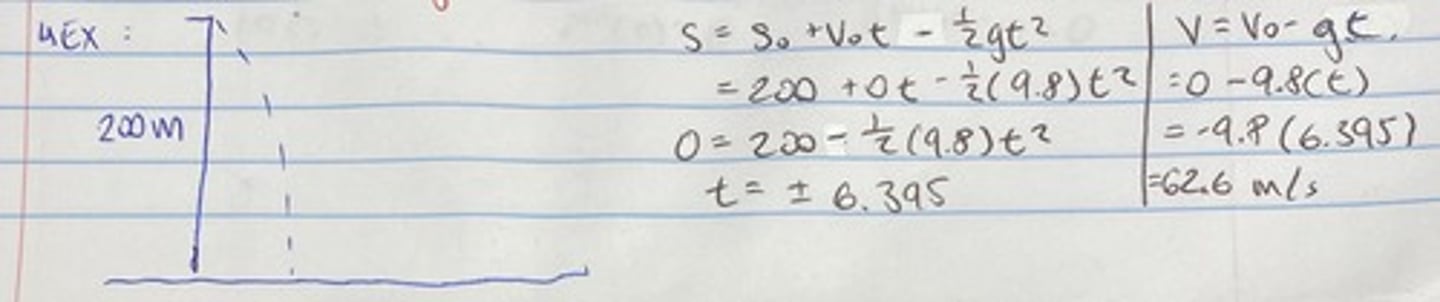
What is the equation for height?
s = s₀ + v₀t - 0.5gt²
s₀ = initial height
v₀ = initial velocity
g = acceleration of gravity
What does g = ?
9.8 m/s² OR 32 ft/s²
What is the equation for velocity?
v = ds/dt = v₀ - gt
**
What is the derivative of f(x) = sinx?
cosx
**
What is the derivative of f(x) = cosx?
-sinx
**
What is the derivative of f(x) = tanx?
sec²x
**
What is the derivative of f(x) = secx?
secxtanx
**
What is the derivative of f(x) = cotx?
-csc²x
**
What is the derivative of f(x) = cscx?
-cscxcotx
What is the chain rule?
q(x) = f(g(x))
q'(x) = f'(g(x))∙g'(x)
**
What is the derivative of f(x) = arcsinx?
[1] / [(√1-x²)]
*
What is the derivative of f(x) = arccosx?
[-1] / [(√1-x²)]
**
What is the derivative of f(x) = arctanx?
[1] / [1 + x²]