OVERALL GENPSYCH
 Call Kai
 Learn
Learn Practice Test
 Spaced Repetition
 Match
Match Flashcards
 Knowt Play
1/98

There's no tags or description
Looks like no tags are added yet.
Name | Mastery | Learn | Test | Matching | Spaced | Call with Kai | Chat |
|---|
No analytics yet
Send a link to your students to track their progress
99 Terms
Types of Neurotransmitters
1. Adrenaline
2. GABA
3. Noradrenaline
4. Acetylcholine
5. Dopamine
6. Glutamate
7. Serotonin
8. Endorphins
Psychology
old subject but a young science
Psychology
is a social science
Psyche or Brain
the seat of all knowledge and mental processes
Plato
a greek philosopher that defines psyche
Francis Bacon
work centered and experiment, experience and, common sense judgment
Franz Joseph Gall
introduced the theory of phrenology in 1808
Franz Joseph Gall
"traits and abilities reside in certain parts of the brain and measured by bumps and indentations in the skull"
Wilhelm Wundt
established the first psychology laboratory at the University of Leipzig in Germany in 1879
Wilhelm Wundt
he used scientific method to study fundamental psychological processes, such as mental reaction times in response to visual or auditory stimuli
Psychology
study of the soul
Psyche
means breath, spirit or soul
Logia
means study of
Psychology
scientific study of behavior and mental processes
Granville Stanley Hall
1st Ph.D. in Psychology in the US in 1878
Granville Stanley Hall
founded the first psychology research Laboratory in the U.S. and Johns Hopkins University in Baltimore, Maryland in 1883
Granville Stanley Hall
founded the American Psychological Association (APA)
1926
University of the Philippines Department of Psychology was established within the School of Education where Agustin Alonzo is the chairman
1930s
Department of Psychology at the University of Santo Thomas is established
1932
Sinforoso Padilla organizes the Psychological Clinic at the University of the Philippines
1933
Jesus Perpinan sets up the Far Eastern University Psychological Clinic
1938
Angel de Blas, OP, sets up the Experimental Psychology Laboratory in the University of Santo Thomas
1948
Estefania Aldaba-Lim sets up the Institute of Human Relations at the Philippine Women's University
1954
Joseph Goertz establishes the Psychology Department at the University of San Carlos
1961
Fr. Jaime Bulatao, SJ establishes the Department of Psychology and Central Guidance Bureau at the Ateneo de Manila University
1962
Philippine Psychological Corporation was founded, offering psychological tests in the country
1962
The Psychological Association of the Philippines (PAP) was founded
1963
The PAP holds its first annual convention
1975
Pambansang Samahan ng Sikolohiya was founded by Virgilio Enriquez to champion Filipino Psychology
1987
PAPJA had its first convention
1984
WMSU started offering psychology courses
1996
ADZU started offering psychology courses
Goals of Psychology
1. Describe how people behave
2. Predict what people will do under certain conditions
3. Control/influence behavior through manipulation of its causes
procedures psychology uses to study behavioral and mental phenomena
1. Observations
2. Case Studies
3. Surveys
4. Experimentations
Observations
immersive acquisition of data gathering from a primary source
Types of observation
1. Naturalistic observation
2. Analog observation
Naturalistic Observation
data is collected as they occur in nature without artificial manipulation by the observer
Analog Observation
subject is observed in an artificial setting
Case Study
in-depth examination of a certain case withing a real-world context
Surveys
list of questions to extract certain information from a group of people
Experimentations
procedure carried out to support a hypothesis
Behavior
an observable act - a combination of different types
Types of behavior
1. Overt
2. Covert
3. Voluntary
4. Involuntary
5. Conscious
6. Unconscious
Overt
behavior is explicit and open without instruments or expertise
Covert
Hidden behavior - can only know if it was let known to the world
Voluntary
intentional or willing behavior
Involuntary
done without conscious control; in response to stimuli free from conscious control
Conscious
doer is aware and alert
Unconscious
doer cannot control their actions; most of the time, they're unaware
Mental Process / Mental Function / Mental Cognition
used interchangeably to describe all things that individuals can do with their minds
School of Thoughts
1. Structuralism
2. Functionalism
3. Behaviorism Stimulus-Response
4. Gestaltism Configurationism
5.Humanistic Psychology
6. Psychoanalysis
Edward B. Titchener
identified structuralism
William Wundt
founded structuralism
Structuralism
first major school of thought in psychology
Structuralism
maintains that complex conscious experiences can be broken down into elemental structures or parts of sensations and feelings (structures and/or defines a certain behavior)
William James
introduced functionalism
Carr and James Rowland Angell
main proponents of functionalism
Functionalism
emphasized studying the purpose behaviors and mental experience (looks at the function and purpose of a certain behavior)
John B. Watson
founder and father of behaviorism
Behaviorism
Observing how a certain behavior is acquired and modified in response to environmental influences (Stimulus Response)
Gestaltism
made by Max Wertheimer, Fritz Perls, Wolfgang Kohler and Kurt Koffka (Configurationism)
Gestaltism
- looks at the human mind and behavior as a whole
- concerned with perception
- "the whole is not equal to the sum of its parts"
Humanistic Psychology
an approach to understanding human nature that emphasizes the positive and unique potential of human beings that differentiates them from others for psychological growth and self-direction
Sigmund Freud
Founder of psychoanalysis
Psychoanalysis
that attributes thoughts and actions to unconscious motives and conflicts and shapes personality and behavior
Nervous System
chief controlling and coordinating system of the human body
100 billion neurons
approximate number of neurons in the brain
Cells in the nervous system
1. Glial Cells
2. Nerve cells/neurons
Glial Cells
support, nourish, and protect neurons (structural support)
Nerve Cells
information-processing cell
Nerve cells
cannot repair or regenerate
Nerve Cells
process electrochemical energy
electrochemical energy
An energy form where minute electrical charges travel through and between neurons with the help of neurotransmitters (chemical substances)
5th to 6th week of pregnancy
what age does the nervous system develop
25 years old
end of development of nervous system
Stages of Neural Development
1. Proliferation
2. Migration
3. Differentiation
4. Synaptogenesis
5. Myelination
6. Synaptic Pruning
Proliferation
Neuron Production
Proliferation
production of neurons from stem cells
Migration
six-layered cerebral cortex is formed via the orderly migration of neurons
Differentiation
formation of distinctive features such as the axon and dendrites by neurons
Synaptogenesis
creation of connections between neurons through the formation of synapses
Synapses
tiny gaps between dendrites and axons of different neurons
Myelination
insulation of axons with a layer of myelin to speed up nerve impulse transmission
Synaptic Pruning
process of removing inefficient synapses based on individual experiences
Types of Neurons
1. afferent
2. efferent
3. interneurons
Afferent Neurons
also called the sensory neurons
Afferent Neurons
carry information to the brain
Efferent Neurons
also called the motor neurons
Efferent Neurons
carries information to different parts of the muscle and glands
Interneurons
connects the afferent and efferent neurons
Parts of a neuron
1. Nucleus
2. Dendrites
3. Axon
4. Soma
5. Myelin Sheath
6. Node of Ranvier
7. Schwann Cell
8. Axon Terminal
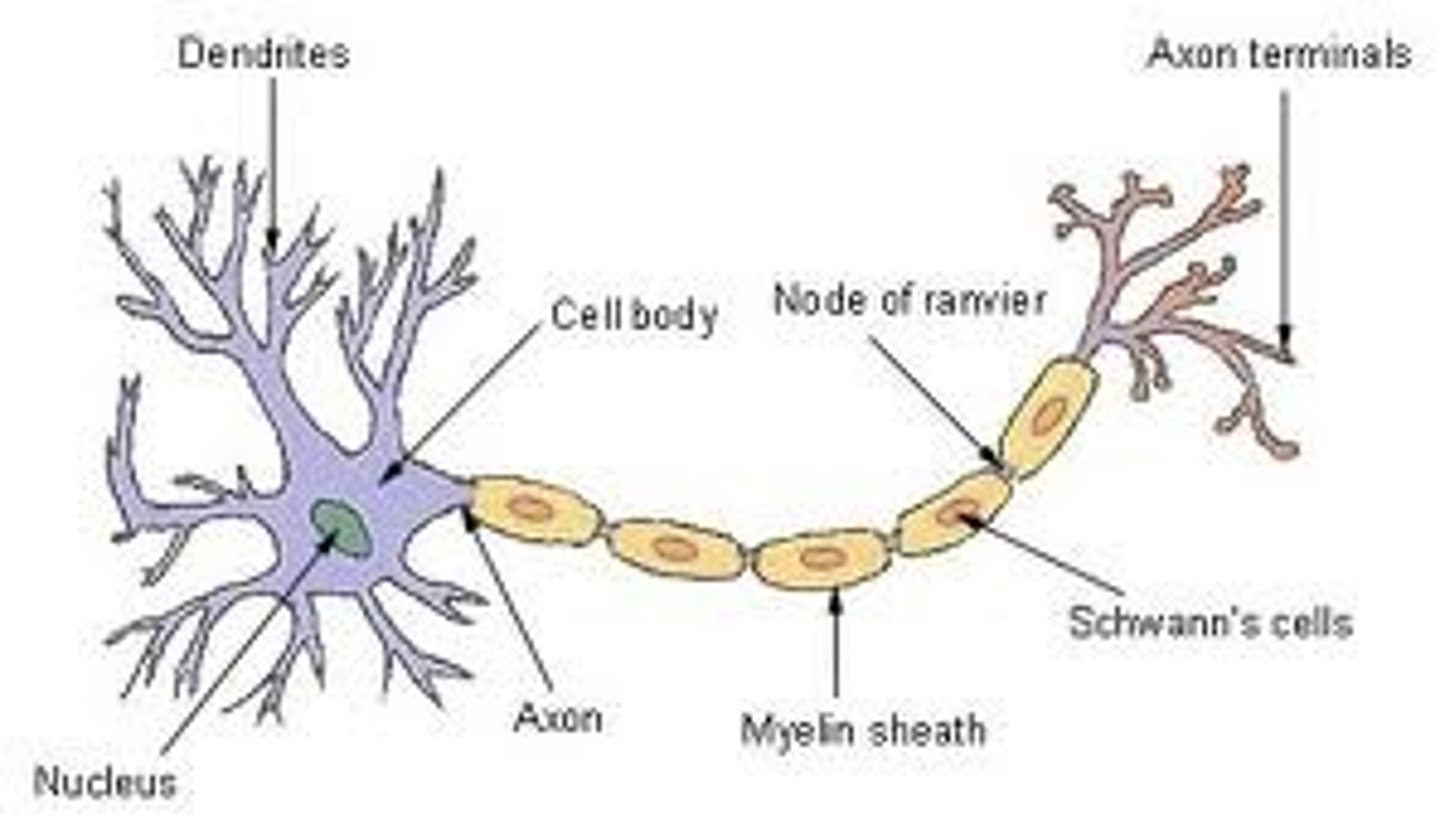
Nucleus
contains genetic information (DNA)
Dendrites
receives information from other neurons
Axon
passes messages through its branches to other neurons or to muscles or glands
Soma
where the nucleus lies
Myelin Sheath
insulating fatty layer that covers the axon to transport messages and signals faster
Node of Ranvier
gap between myelin Sheaths to raise the membrane voltage
Schwann Cell
creates the myelin sheath
Axon Terminal
Delivers information and signals (neurotransmitters) to other neurons and converted from electrical signals to chemical signals (connects to dendrites)