A-Level Biology - 3.6.2 Nervous coordination
 Call Kai
 Learn
Learn Practice Test
 Spaced Repetition
 Match
Match Flashcards
 Knowt Play
1/30

There's no tags or description
Looks like no tags are added yet.
Name | Mastery | Learn | Test | Matching | Spaced | Call with Kai | Chat |
|---|
No analytics yet
Send a link to your students to track their progress
31 Terms
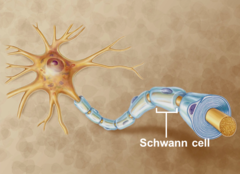
Draw the structure of a myelinated motor neurone
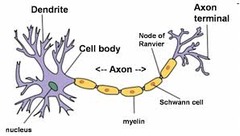
Name the parts of a myelinated motor neurone
cell body
dendrons
dendrites
axon
myelin sheath made of Schwann cells
nodes of Ranvier
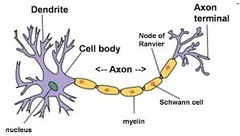
What is the role of dendrons in a myelinated motor neurone?
transmit action potential towards cell body
divide into *dendrites*
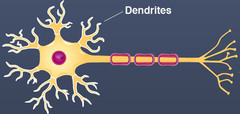
What is the role of the axon in a myelinated motor neurone?
transmits action potential away from cell body
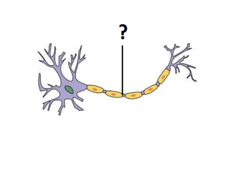
What is the structure and role of the myelin sheath in a myelinated motor neurone?
electrically insulated axon to speed up transmission of impulses
made up of *Schwann cells* wrapped around axon
Describe how a resting potential is established
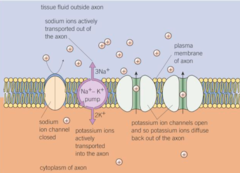
sodium-potassium pump actively transports *3* Na⁺ ions *out* of the axon for every *2* K⁺ that are actively transported *in*
Higher concentration of K⁺ inside and higher concentration of Na⁺ ions outside produces an electrochemical gradient
Membrane more permeable to K⁺ ions leaving than Na⁺ ions entering (Na⁺ channels closed, K⁺ channels open)
K⁺ diffuses out down concentration gradient, generating resting potential of -70mV
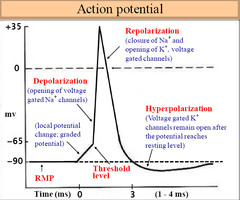
Describe how an action potential is generated
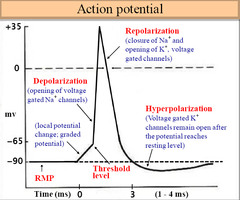
when a stimulus reaches the threshold value, *voltage-gated sodium ion channels* open
Na⁺ ions diffuse into axon down electrochemical gradient, causing more Na⁺ V-G channels to open by positive feedback
increase in Na⁺ ions inside axon produces charge of +40mV
axon is depolarised
Describe how repolarisation and hyperpolarisation happens in the axon
once action potential of +40mV is established, Na⁺ V-G close and K⁺ V-G open
K⁺ diffuse out, repolarising axon
temporary overshoot of electrical gradient (too many K⁺ diffuse out) causes inside of axon to be relatively more negative
V-G K⁺ channels close and Na⁺/K⁺ pump restores resting potential
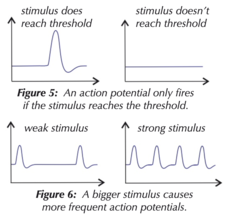
What is the all or nothing principle?
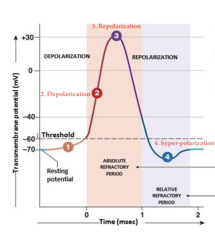
An action potential is only generated when threshold value is reached
*size of stimulus* does not affect *size of action potential*
but stronger stimuli more likely to reach threshold value
How do organisms perceive larger stimuli?
larger stimulus increases *frequency* of action potentials
does NOT cause larger action potentials
Give two roles of the refractory period
allows discrete impulses to be produced
limits the frequency of impulse transmission
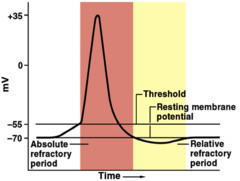
What is the refractory period?
after an action potential, another action potential can't be produced immediately
due to temporary inactivation of the Na+ channels.
Name three factors affecting speed of conductance
myelination and saltatory conduction
axon diameter
temperature
How does temperature affect speed of conductance?
Higher temperature = faster speed
Faster rate of diffusion of ions
optimum temperatures required for enzymes involved in active transport (sodium-potassium pump)
Temperature too high = membrane proteins denature.
How does axon diameter affect speed of conductance?
greater diameter = faster speed
less leakage of ions makes it easier to maintain membrane potential
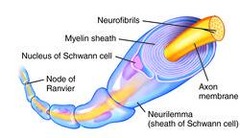
How does myelination and saltatory conduction affect speed of conductance?
Myelination increases speed of conductance
Myelination provides electrical insulation
In myelinated saltatory conduction (depolarisation at nodes of Ranvier)
In non-myelinated, depolarisation occurs along whole length of axon
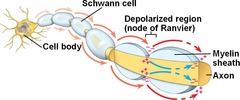
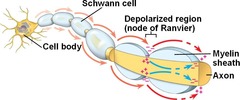
What is saltatory conduction?
Myelin sheath around axon act as an electrical insulator preventing action potentials from forming
at regular intervals, there are nodes of Ranvier (breaks in myelin sheath) where action potentials can occur
action potentials jump from node to node
action potentials pass faster along myelinated neurons
because depolarisation occurs along the whole axon in unmyelinated neurons
Draw the structure of a synapse
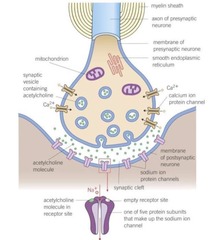
Describe the structure of a synapse
Presynaptic neuron:
-ends in synaptic knob
-has pre-synaptic membrane
has mitochondria, ER and vesicles containing neurotransmitter
synaptic cleft (gap between neurons)
Postsynaptic neuron:
-has complementary receptors to neurotransmitter
-has post-synaptic membrane
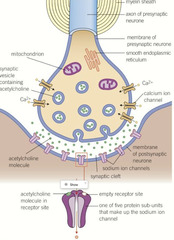
Name the neurotransmitter used in a cholinergic synapse
acetylcholine
Describe the sequence of events involved in transmission across a cholinergic synapse
1) Depolarisation of presynaptic membrane
2) Calcium channels open and calcium ions enter synaptic knob
3) Calcium ions cause synaptic vesicles to fuse with presynaptic membrane and release acetylcholine
4) Acetylcholine diffuses across synaptic cleft
5) Acetylcholine attaches to receptors on the postsynaptic membrane;
6) Sodium channels open and sodium ions enter postsynaptic neurone, leading to depolarisation and action potential
Describe how a nerve impulse causes the release of neurotransmitter at a synapse
1) Nerve impulse causes Ca²⁺ channel proteins to open
2) Ca²⁺ enter by facilitated diffusion
3) Causes synaptic vesicles to fuse with presynaptic membrane
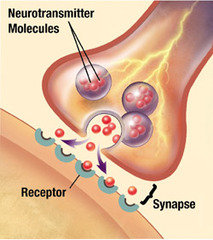
What is spatial summation at a synapse?
many different presynaptic neurones release enough neurotransmitter
to exceed threshold value of post-synaptic neurone
creates action potential
What is temporal summation at a synapse?
A single presynaptic neurone releases a high enough concentration of neurotransmitter in a short period
exceeds threshold value of post-synaptic neurone
creates action potential
Describe the unidirectionality of synapses
Neurotransmitter is only made in and released from the pre-synaptic neurone
Receptors are only present on the post-synaptic membrane
(so transmission can only happen in one direction across the synapse)
How do inhibitory synapses work?
cause hyperpolarisation in postsynaptic neurones (Cl- channels open and Cl- diffuse in, K+ channels open and K+ diffuse out)
1) Inside postsynaptic neurone is more negative - potential is below resting potential
2) More Na⁺ required to enter for depolarisation to reach threshold and produce action potential
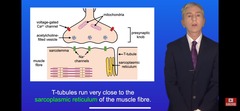
Describe how the release of acetylcholine into a neuromuscular junction causes muscle contraction
1) Acetylcholine diffuses
across synaptic cleft
2) Acetylcholine binds to receptors on sarcolemma (post-synaptic membrane)
3) Na⁺ channels open and Na⁺ enter, leading to depolarisation and action potential
4) Ca²⁺ released by endoplasmic reticulum
Describe the structure of neuromuscular junctions
Presynaptic neuron:
-ends in synaptic knob
-has pre-synaptic membrane
has mitochondria, ER and vesicles containing neurotransmitter
synaptic cleft (gap between neurone and muscle)
muscle:
-has complementary receptors to neurotransmitter
-has sarcolemma (membrane)
Compare transmission across a cholinergic synapse and a neuromuscular junction
*cholinergic synapse:*
-excitatory or inhibitory
-links neurones to neurones or other effector organs
-new action potential may be produced along another neurone
-acetylcholine binds to receptors on membrane of postsynaptic neruone
*NM junction:*
-excitatory
-links neurones to muscles
-action potential ends here
- acetylcholine bind to receptors on membrane of muscle fibre
Drugs that stimulate the nervous system are called:
agonists
Drugs that inhibit the nervous system are called:
antagonists