ENGG 201 Lecture Notes Sept. 6-19
0.0(0)
Studied by 3 people Call Kai
 Learn
Learn Practice Test
 Spaced Repetition
 Match
Match Flashcards
 Knowt Play
Card Sorting
1/61

Earn XP
Description and Tags
Last updated 10:47 PM on 10/11/22
Name | Mastery | Learn | Test | Matching | Spaced | Call with Kai | Chat |
|---|
No analytics yet
Send a link to your students to track their progress
62 Terms
1
New cards
What is dimensional analysis used for?
to ensure equations are consistent.
2
New cards
What are 4 dimensions used for dimensional analysis?
[M] - Mass
[L] - Length
[T] - Temperature
[t] - time
[L] - Length
[T] - Temperature
[t] - time
3
New cards
What are some parameters required for dimensional analysis?
• Terms in an equation need to be dimensionally consistent, i.e. must have the same dimensions
• To determine the dimensions of a term, multiply the dimensions of each parameter in the term.
• To determine the dimensions of a term, multiply the dimensions of each parameter in the term.
4
New cards
Conservation Equation
(Input + Generation) = (Output + Accumulation )
"What goes in" + "whatever is created inside" = "Must go out" or "stay inside"
-This equation applies to mass, energy and momentum
- Mass Balance equation is valid for total mass as well as for each chemical species
"What goes in" + "whatever is created inside" = "Must go out" or "stay inside"
-This equation applies to mass, energy and momentum
- Mass Balance equation is valid for total mass as well as for each chemical species
5
New cards
When is the Generation term important in Conservation Equations?
Generation term is only important when there are chemical reactions
6
New cards
When can the accumulation term be ignored in the Conservation Equation|
when a flowing system is at "Steady-State"
7
New cards
Steps to solve a MB Problem
1. Draw a diagram
a) Identify inlets and outlets
b) Write down all given information from the problem statement
c) Define symbols
2. Write out MB equation for
a) Total
b) Each component
3. Write out mathematical expression for any additional info in the
problem
a) Identify inlets and outlets
b) Write down all given information from the problem statement
c) Define symbols
2. Write out MB equation for
a) Total
b) Each component
3. Write out mathematical expression for any additional info in the
problem
8
New cards
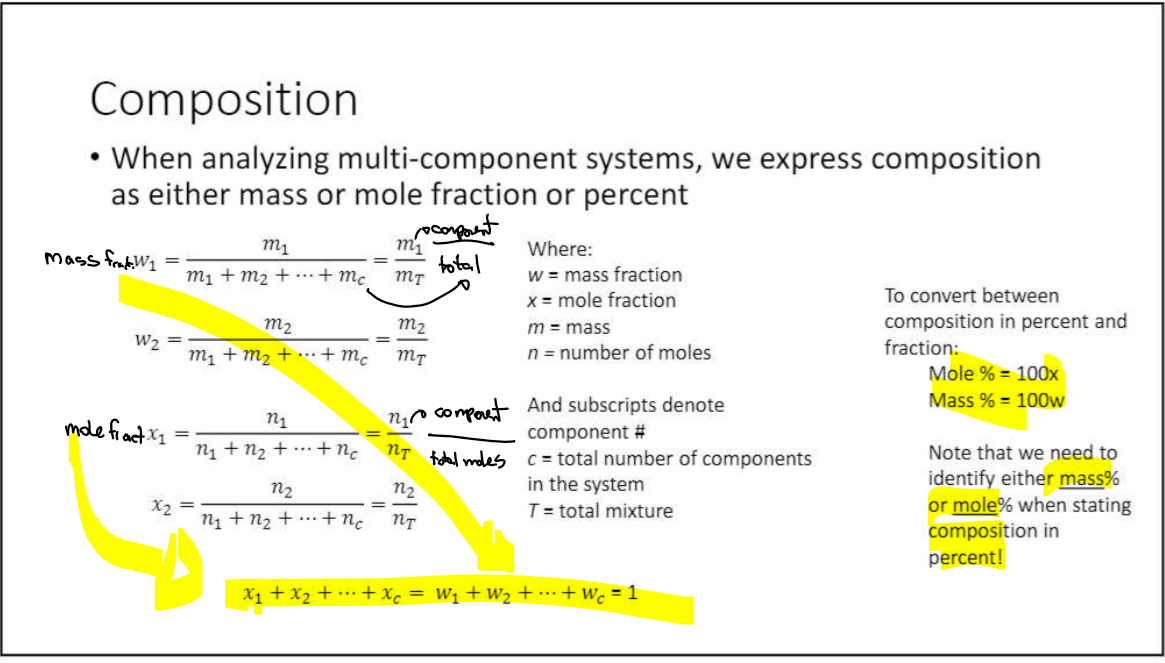
Composition as a mass% or mole% variables and expression
w = mass fraction
x = mole fraction
m = mass
n = # of moles
numerator = component
denominator = total
mass fraction = m1/mT
mole fraction = n1/nT
*Remember Wm1 + ...Wmc = 1 (or n). Wm1 =/ Xm1.
x = mole fraction
m = mass
n = # of moles
numerator = component
denominator = total
mass fraction = m1/mT
mole fraction = n1/nT
*Remember Wm1 + ...Wmc = 1 (or n). Wm1 =/ Xm1.
9
New cards
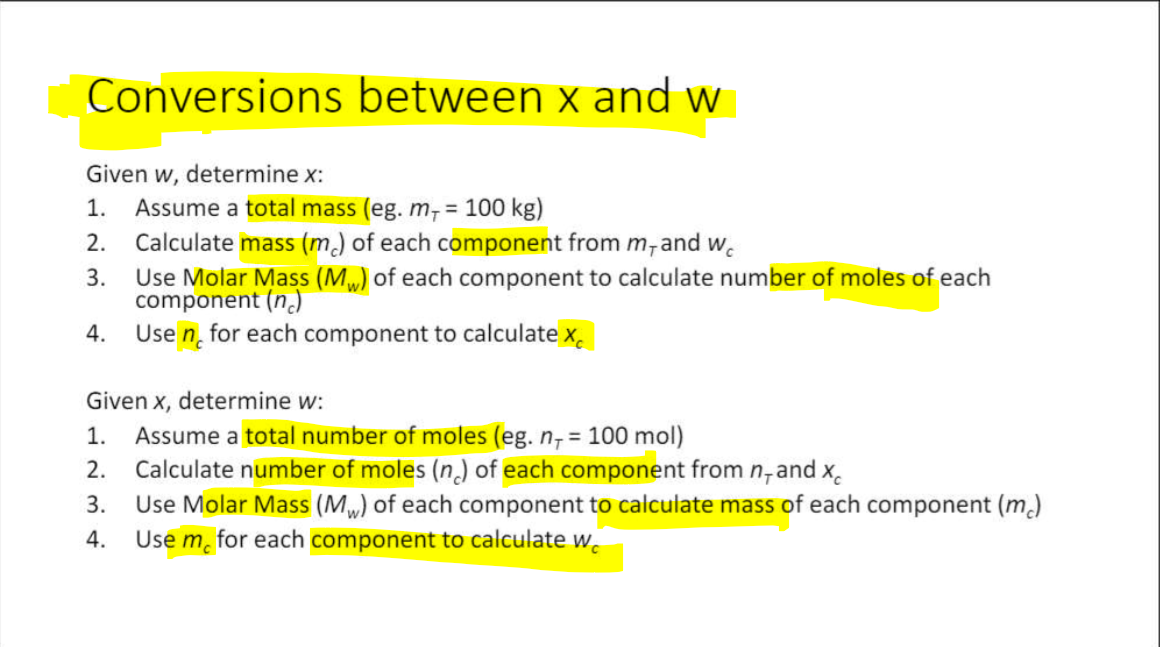
Conversions between x and w
10
New cards
Energy as a State function
- Energy is a property of the system
Examples: kinetic energy, potential, internal (from molecules moving) energy
Examples: kinetic energy, potential, internal (from molecules moving) energy
11
New cards
Energy as a path function
Energy in transit, how it moves between systems
Examples: Work, heat transfer
Examples: Work, heat transfer
12
New cards
What is the driving force for energy transfer in the form of heat?
A difference in temperature
(delta T = Q movement)
(delta T = Q movement)
13
New cards
Heat capacity:
the energy required to raise the temperature of 1kg of a substance by 1 degree Celsius
14
New cards
What is a system?
the contents in a well-defined space
15
New cards
Define property of a system:
any characteristic of a system
16
New cards
2 types of properties
extensive: size dependent (m, volume)
intensive: size independent (P, T, density, V (specific v))
intensive: size independent (P, T, density, V (specific v))
17
New cards
examples of intensive properties
Specific volume (V)
Molar volume (Vm)
Temperature (T)
Pressure (P)
Density (p = m/v)
Molar volume (Vm)
Temperature (T)
Pressure (P)
Density (p = m/v)
18
New cards
examples of extensive properties
Mass (m)
amount of matter (mol),
volume (v)
energy (E)
amount of matter (mol),
volume (v)
energy (E)
19
New cards
What is a component
When no reactions are present, every unique chemical substance in a component
- systems can be single (one chemical substance) or multicomponent (more than one)
- systems can be single (one chemical substance) or multicomponent (more than one)
20
New cards
Two main criteria for a phase.
A phase:
- is homogenous: (same composition throughout)
- has boundaries
- is homogenous: (same composition throughout)
- has boundaries
21
New cards
Can a gas and vapour phase coexist?
No. A vapour can be condensed into a liquid while a gas cannot.
22
New cards
How many liquid phases can exist for pure substances?
One
23
New cards
How many liquid phases can exist for mixtures?
More than one liquid phase for mixtures of more than one component
24
New cards
How many solid phases can exist?
For pure substances/mixtures, more than one solid phase can exist
25
New cards
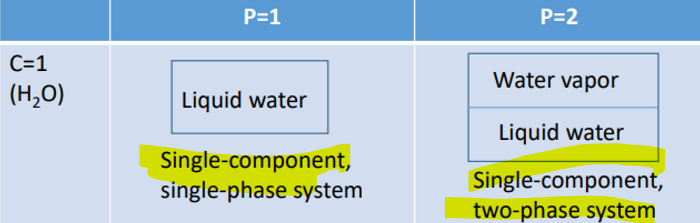
Examples of single component, one and two phase systems:
Single: Liquid water
Two: Water vapour and liquid water
Two: Water vapour and liquid water
26
New cards
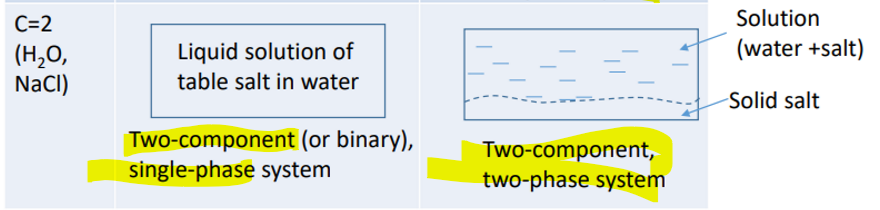
Examples of two- component, one and two phase systems:
Single: liquid solution of table salt in water
Two: water and salt solution + solid salt
Two: water and salt solution + solid salt
27
New cards
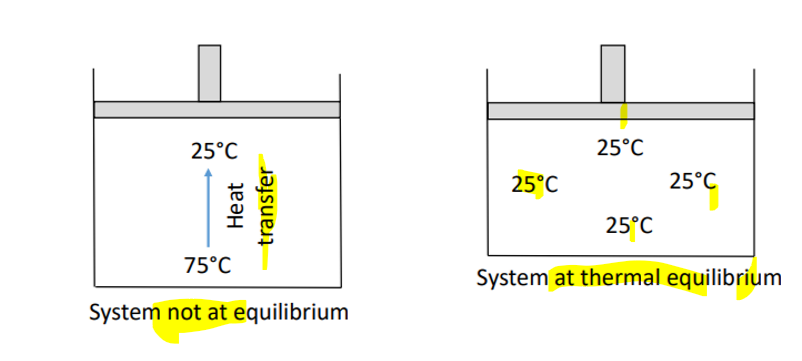
When does a system attain equilibrium?
when there is no tendency within the system to change its properties (eg. T, P)
28
New cards
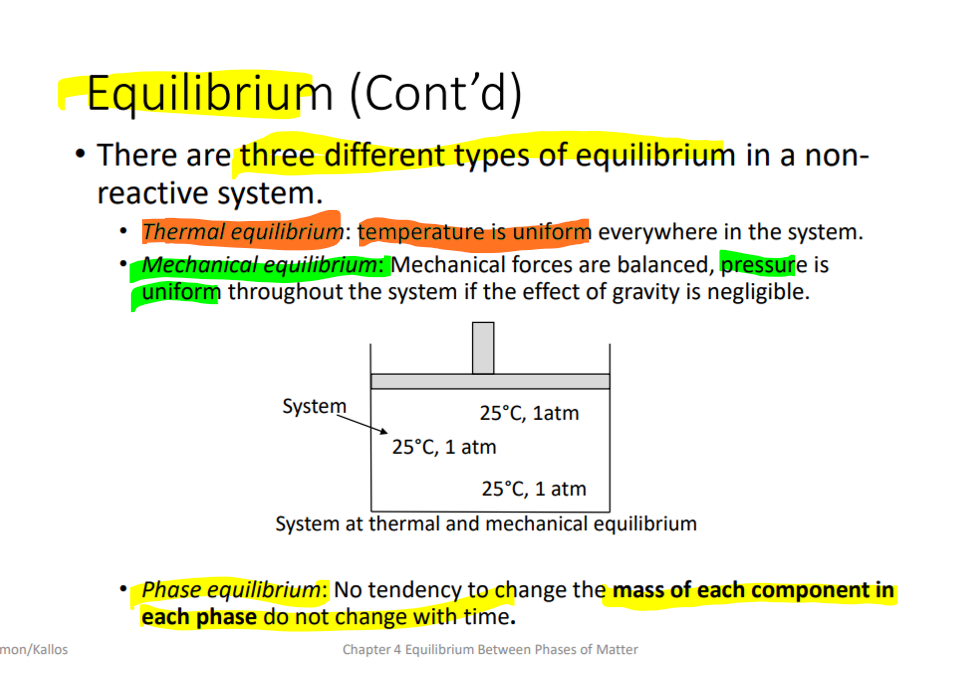
Three types of equilibrium in a system:
Thermal Eq'm: Temperature is uniform everywhere in the system
Mechanical Eq'm: Mechanical forces are balanced, pressure is uniform, gravity is negligable
Phase Eq'm: the mass of each component does not change over time
Mechanical Eq'm: Mechanical forces are balanced, pressure is uniform, gravity is negligable
Phase Eq'm: the mass of each component does not change over time
29
New cards
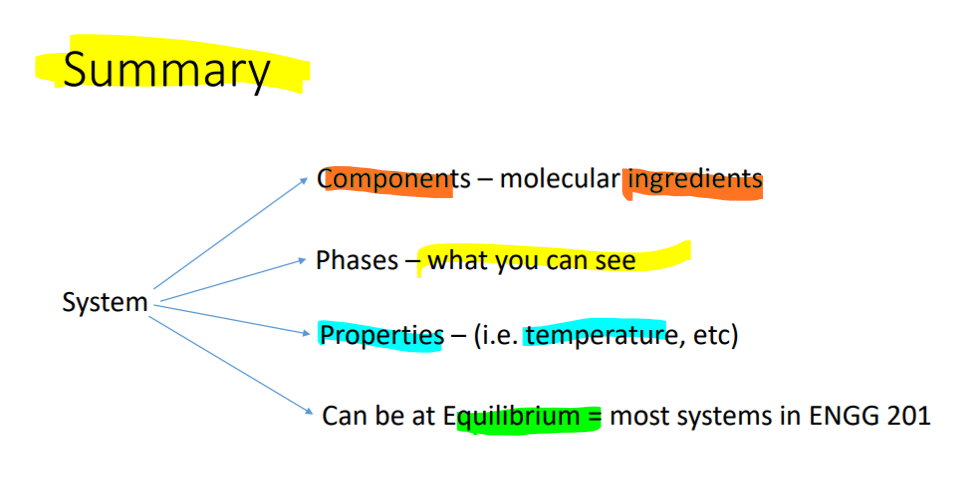
Summary of a system
30
New cards
Equation of the Phase Rule
F = C + 2 - P
C= # of independent components
P = # of phases
F = degrees of freedom
C= # of independent components
P = # of phases
F = degrees of freedom
31
New cards
2 types of systems
Non-reactive: # of components = # of unique chemical substances in a system
Reactive: # of components = number of unique chemical species required to make up all of substances in a system
Reactive: # of components = number of unique chemical species required to make up all of substances in a system
32
New cards
Example of reactive system:
reactive system with H2O, NH3, O2, N2, H2
C = 3 (H, O, N)
If non-reactive, C=5
C = 3 (H, O, N)
If non-reactive, C=5
33
New cards
What is F?
F is the number of intensive variables required to completely fix or specify the system AT EQUILIBRIUM
34
New cards
What happens when F goes to zero?
all of the other intensive variables will have fixed (can't change) values.
35
New cards
What is the Triple Point?
When there are 3 phases, so F = 0 (1 + 2 + 3 = 0), so all values of intensive properties of the phases are fixed by nature
36
New cards
Can there be more than three phases in a one-component system?
No! F would be negative, which is impossible. More than 3 phases cannot exist in equilibrium for a pure substance
37
New cards
What does Equilibrium phase depend on in a single component system?
Temperature and Pressure
38
New cards
Fixing a 1C 1P system
fix T and P, if these are fixed everything else is (like density)
39
New cards
Fixing a 1C 2P system involves:
Specify Temperature OR pressure
40
New cards
3 different combinations of phases
Vapour - Liquid
Vapour - Solid
Liquid - Solid
Vapour - Solid
Liquid - Solid
41
New cards
What happens when you fix PRESSURE in a C1 P2 Liquid-Vapour System?
The Temperature is called the BOILING POINT
When the pressure is 101.325 kPa the temp is called the NORMAL boiling point
When the pressure is 101.325 kPa the temp is called the NORMAL boiling point
42
New cards
What happens when you fix PRESSURE in a C1 P2 Solid-Liquid System?
Temperature is called the FREEZING/MELTING/FUSION POINT
43
New cards
What goes on in a Solid-Vapour C1P2 system?
- happens at a very low pressure
Solid to vapour = sublimination
vapour to solid = DEsublimation
Solid to vapour = sublimination
vapour to solid = DEsublimation
44
New cards
What do the regions/areas of a phase diagram represent?
Single phases
45
New cards
What do the lines in a phase diagram represent?
Two phases (where they coexist)
46
New cards
When three lines converge at a point in a phase diagram, what does that represent?
The Triple Point (all three phases coexist)
47
New cards
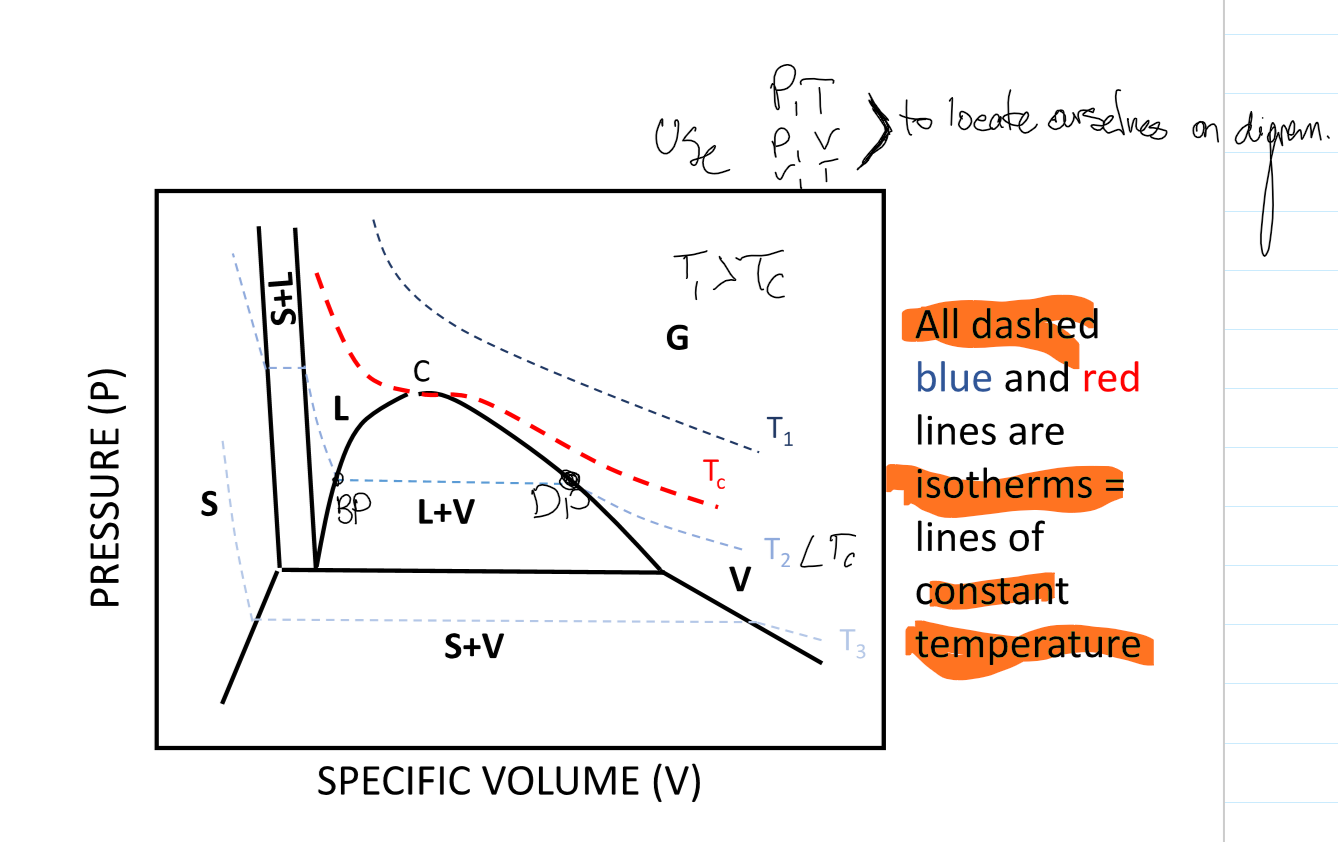
What is Tc?
Critical Temperature - the highest temperature at which the substance can exist as a liquid.
48
New cards
What happens when T > Tc
only gas phase exists. If you raise the P, the substance is still a gas
49
New cards
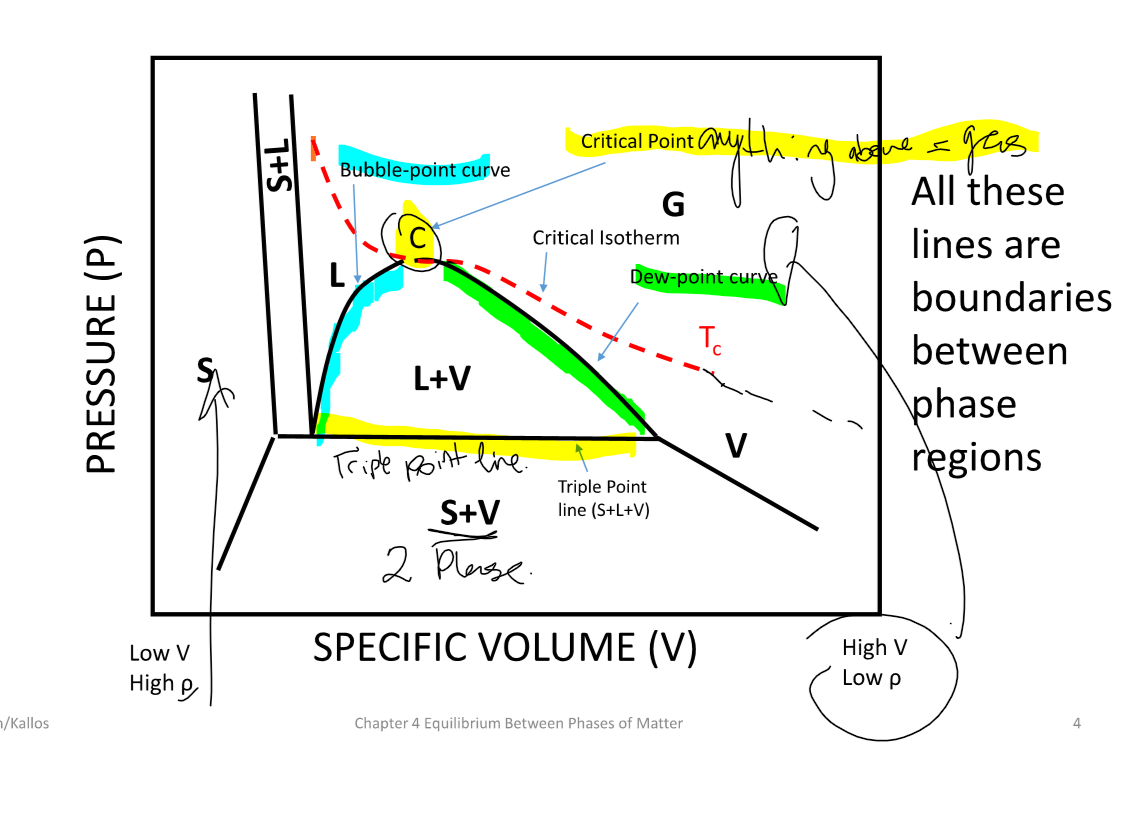
What is the Critical Point?
where the liquid and gaseous phases of a substance merge together into a single phase (gas and liquid coexist). On the Tc line
50
New cards
What is the vapour pressure of a liquid?
The pressure at which a pure liquid can coexist with its vapour at a given temperature (T is Boiling Point)
51
New cards
What is vapour pressure a function of?
Temperature
52
New cards
What is the vapour pressure of a solid?
The pressure at which a pure solid can coexist with its vapour at a given temperature (T is the sublimation point)
53
New cards
What is a process?
a change of conditions (at least one property value changes)
54
New cards
What is an isothermal process?
When T = constant
55
New cards
What is an isobaric process?
When P = constant
56
New cards
What is the dew point?
In an isothermal process, the point where there is mostly vapour and an infinitesimal amount of liquid
57
New cards
What is the bubble point?
In an isothermal process, the point where there is mostly liquid and an infinitesimal amount of vapour
58
New cards
What is specific volume?
V = v/m
V = 1/p (density)
V = m^3 / kg
V = 1/p (density)
V = m^3 / kg
59
New cards
What is an isotherm?
A constant temperature line
60
New cards
What goes on in a P-V Phase diagram?
C = 1 (because T is constant)
plot Pressure vs specific volume
plot Pressure vs specific volume
61
New cards
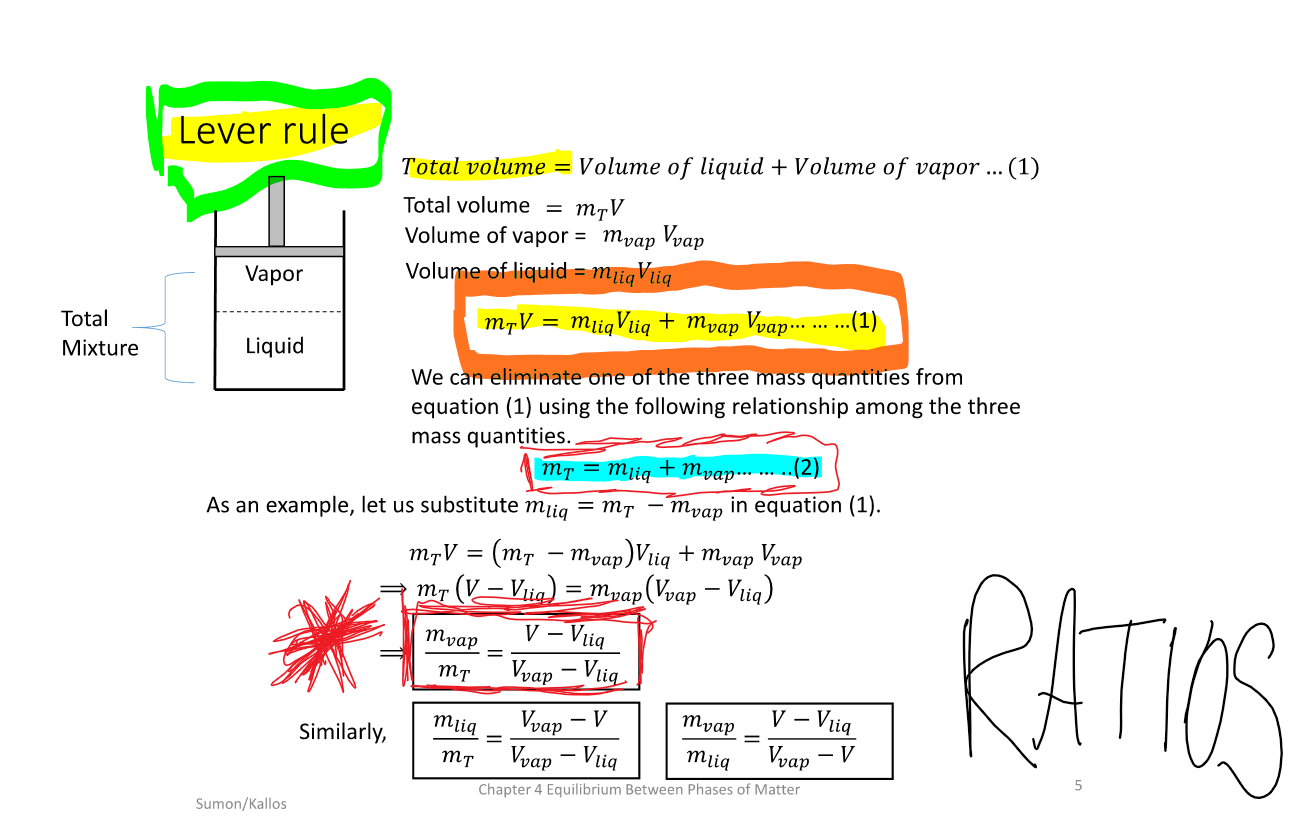
What is the Lever Rule used for?
to determine relative amounts of phases in 2-phase regions
62
New cards
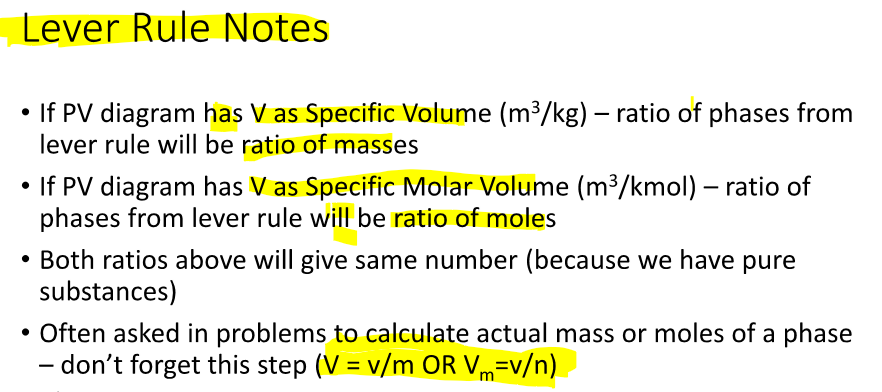
Lever Rule: 3 important things to note