Acid-Base Balance
 Call Kai
 Learn
Learn Practice Test
 Spaced Repetition
 Match
Match Flashcards
 Knowt Play
1/28

There's no tags or description
Looks like no tags are added yet.
Name | Mastery | Learn | Test | Matching | Spaced | Call with Kai | Chat |
|---|
No analytics yet
Send a link to your students to track their progress
29 Terms
Acid-Base Balance

Bicarb - Carbonic Acid Ratio
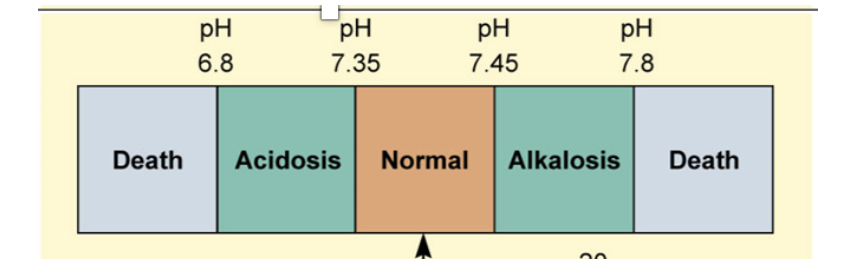
ABG Values KNOW THIS FOR THE EXAM
Normal pH: 7.35-7.45
Acidosis: pH of less than 7.35.
Alkalosis: pH of greater than 7.45
HCO3 (bicarb): Norm 22-26 mEq/L
Memory aide: 2+2+2=6
PaCO2: Norm 35-45 mmHG
PaO2: Norm 80 to 100
SaO2: Norm 95% to 99%
BE (base excess): Norm -2 to +2 mEq/L (< -2 base deficit, > 2 base excess)
Base (bicarb) Excess/Deficit
BE/BD: a calculated value. Reflects an excess or deficit in the total amount of base present to buffer body acids.
Reflects metabolic disturbances only
Always “-” in metab acidosis. Always “+” in metab alkalosis. Normal = “-2 to +2”
Compensation vs Correction
In Both: abnormal, pH is returned toward normal.
Compensation
abnormal pH is returned toward normal by the body's natural physiological response to an acid-base imbalance - if PaCO2 is high, HCO3 is retained to compensate.
Example: In Resp acidosis, kidneys compensate by retaining HCO3
Correction
abnormal pH is returned toward normal by the medical interventions and treatment provided to resolve the underlying cause of the imbalance.
Example:
In Resp. Acidosis, perform CPT, suctioning, administer bronchodilators to correct imbalance
Interpreting ABGs
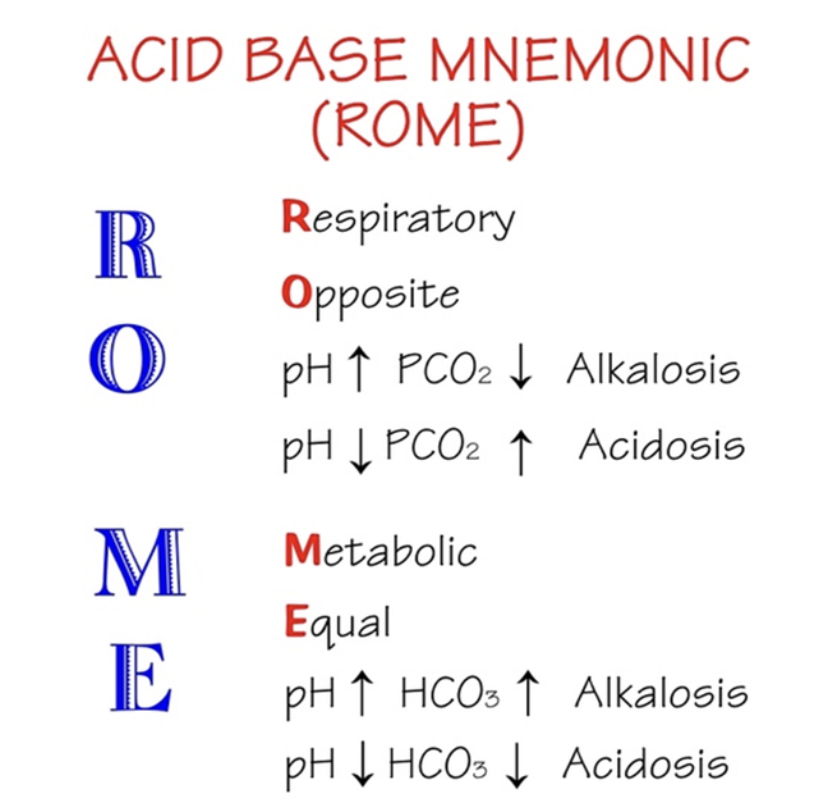
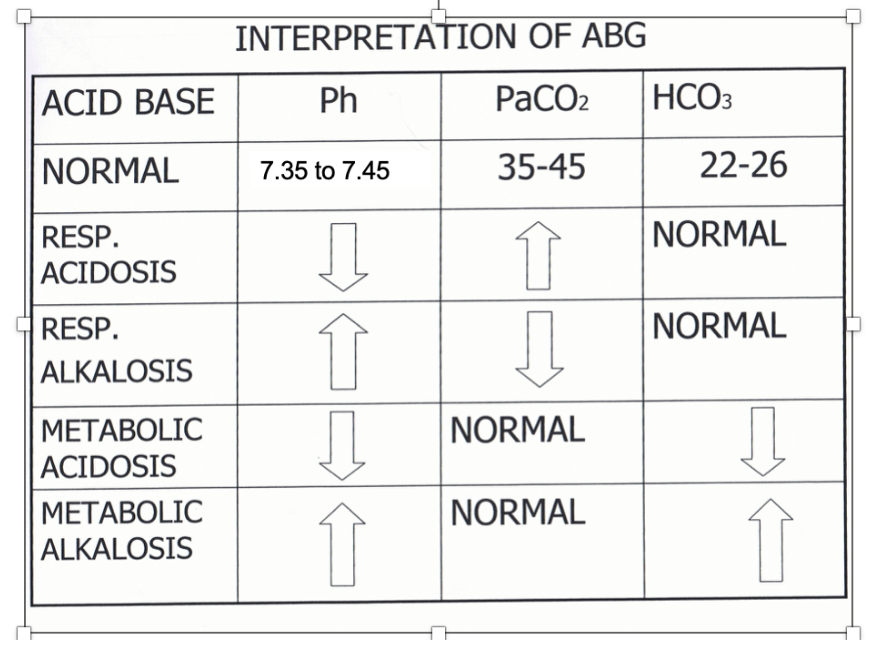
ABG Interpretation
What is the pH?
Acidosis < 7.35 - 7.45 > Alkalosis
Is it compensated or uncompensated?
Normal = compensated
Not normal = uncompensated
ABG Interpretation
What is the PaCO2?
Normal
Alkalosis < 35 - 45 >Acidosis
What is the HCO3?
Normal
Acidosis < 22 - 26 > Alkalosis
Is the pH a result of respiratory or metabolic factors?
ABG Baby
pH 7.48 Alkalosis
PaCO2 30 Alkalotic
HCO3 23 Normal
What is the baby’s last name? What is the pH?
Alkalosis
What is the baby’s first name? Compensated vs Uncompensated? Is the pH within normal range?
pH not within range, uncompensated
What is the baby’s middle name? Who is the baby daddy?
The father (the cause) is the one with the same last name. Mr. Respiratory bec he is alkalot
The Baby Daddy
Mr. Respiratory (fast acting)
Fixed by suctioning and giving O2
Mr. Metabolic (not so fast)
IV, electrode infusion
Try this
pH 7.12 (pH and PaCO2 is both going lower= metabolic)
PaCO2 20
HCO3 7
What is the baby’s last name? What is the pH?
Acidosis
What is the baby’s first name? Compensated vs Uncompensated? Is the pH within normal range?
Uncompensated
What is the baby’s middle name? Who is the baby daddy?
PaCO2 (respiratory) - alkalotic
HCO3 (metabolic) - acidotic
Which one matches the pH?
Uncompensated Metabolic Acidosis
What is the baby’s last name - the pH?
Alkalosis
What is the first name - the pH?
Compensated
What is the middle name?
PaCO2 (respiratory) - alkalotic
HCO3 (metabolic) - acidotic
Which one matches the pH?
Compensated Respiratory Alkalosis
Respiratory Acidosis - Causes (High PaCO2, Low pH)
Acid Excess, Build up of CO2
Hypoventilation
Respiratory failure
COPD
Narc or sedative OD
Airway obstruction
Pain, post-op (shallow breaths)
Respiratory Acidosis symptoms
Headache, Seizures
Hypoventilation with hypoxia
Confusion, Lethargy, Dizziness
Low BP
Warm, flushed skin
Respiratory Acidosis collaborative care
Bed in High Fowlers
Bronchodilators: ipratropium, albuterol
Narc antagonists: naloxone
Hydration
Encourage cough and deep breathing
Respiratory Alkalosis - Causes (Low PaCO2, High pH)
Acid Deficit
Hyperventilation
Salicylate OD
Fever
Anxiety, CNS disorders
Mechanical over-ventilation
Respiratory Alkalosis - Symptoms
Think vasoconstriction
Lightheadedness, dizziness
Confusion, Headache
Numbness, tingling in extremities
Tetany
Muscle cramps
Hyperactive reflexes, Seizures
Hyperventilation
Arrhythmias, Tachycardia
Respiratory Alkalosis - Interventions
Assist pt to breathe more slowly (paper bag, nonrebreather mask)
Salicylate: Activated charcoal or Alkaline diuresis with extra KCl
Metabolic Acidosis - Causes (Low HCO3, Low pH)
Bicarbonate Deficit
Diabetic Ketoacidosis
Lactic acid accumulation (shock)
Severe diarrhea (intestines get rid of base)
Kidney disease (hold in urine which is acidic)
Starvation
Cardiac Arrest
Metabolic Acidosis - Symptoms
Confusion, Lethargy, Seizures
Increased resp. rate & depth (Kussmaul resp.). Blowing off excess CO2 and acid
Nausea, Vomiting, Diarrhea
Arrhythmias, low BP, bradycardia (acidosis changes NA and K and decreases cardiac output)
Muscle weakness
Metabolic Acidosis - Interventions
Monitor I/O
Monitor LOC
IV Sodium Bicarb
Tx underlying problem
Metabolic Alkalosis - Causes (High HCO3, High pH)
Bicarbonate Excess
Prolonged vomiting or gastric suction (removing stomach acid)
Corticosteroid therapy
Severe potassium depletion
Excessive Alkali administration: Antacids
Excessive Diuretic therapy (K+ losing diur)
Metabolic Alkalosis - Symptoms
Symptoms related to decreased calcium - dizziness, tingling of fingers/toes, muscle hypertonicity (tetany)
Tremors
Decreased resp. rate & depth
Arrhythmias, Tachycardia
Lethargy, Irritability
Muscle cramps
Metabolic Alkalosis - Interventions
Monitor I/O
Monitor LOC, VS esp resp
Check electrolytes, especially calcium
IV fluid
Tx underlying problem
Elderly Concerns
Changes in pH are less well tolerated
For every year above age 60, “normal” PaO2 decreases by 1 mmHg
Decreased respiratory function
Renal response not as efficient
A patient has the following arterial blood gas (ABG) results: pH 7.48, PaO2 86 mm Hg, PaCO2 44 mm Hg, HCO3 29 mEq/L. When assessing the patient, the nurse would expect the patient to experience which of the following?
1. Warm, flushed skin.
2. Respiratory rate of 36.
3. Blood pressure of 94/52.
4. Hypertonic muscles with cramping.
A patient has the following arterial blood gas (ABG) results: pH 7.31, PaO2 86 mm Hg, PaCO2 55 mm Hg, HCO3 26 mEq/L. The nurse would anticipate which intervention for this the patient?
1. Breathing in a paper bag.
2. Administer a bronchoconstriction medication.
3. Bed in high fowlers.
4. Restrict fluids.