GEO Final
 Call Kai
 Learn
Learn Practice Test
 Spaced Repetition
 Match
Match Flashcards
 Knowt Play
1/173

There's no tags or description
Looks like no tags are added yet.
Name | Mastery | Learn | Test | Matching | Spaced | Call with Kai | Chat |
|---|
No analytics yet
Send a link to your students to track their progress
174 Terms
What is a nation?
a community of people in a particular spot
What is a state?
Political unit
Majority of places are what?
Multi-nation states
1. Which two of the following countries are considered relatively good examples of nation-states?
a. The United Kingdom b. Slovenia c. Poland d. Bosnia-Herzegovina
b. Slovenia and c. Poland
Where is the homeland of the Kurdish nation?
Ethnic homeland in Northern Iraq, eastern Turkey, and neighboring areas
The Basque homeland occupies portions of what two European countries?
Ethnic homeland in Spain and France
How many (approximately) independent states are there in the world today?
198
List the world’s five largest states (in order) by land area
Russia, Canada, USA, China, Brazil
Compact states have a shape that is considered advantageous for administration and infrastructure. List three examples of compact states mentioned in the lecture.
Uruguay, Poland, Zimbabwe
List four examples of purpose-built, planned capital cities mentioned in the lecture.
Washington D.C.; Brasilia, Brazil; Canberra, Australia; Abuja, Nigeria
The boundary between the western U.S. and western Canada, which is an example of both an artificial and antecedent boundary, follows what line of latitude?
49th parallel
Define: subsequent boundary
Established after the area is well populated
What is the term for a subsequent boundary that is intended to accommodate/coincide with existing cultural differences?
Consequent boundaries
Provide two examples of consequent boundaries that were mentioned in the lecture.
Ireland, Northern Ireland (UK). Sudan and South Sudan
What is the term for a subsequent boundary that is placed over and ignores existing cultural patterns?
Superimposed boundaries
Provide two examples of superimposed boundaries that were mentioned in the lecture.
Many African states, Iraq
Define: irredentism
People of one state claim and seek to acquire territory whose population is ethnically or historically related
Provide one example of irredentism that was mentioned in the lecture
Hungarian claims to Transylvania (in Romania) , WW1/WW2, one of Russia’s justifications for invading Ukraine
Define: nationalism
Sense of unity binding people of a state together
List two reasons why states often promote nationalism
Helps integrate different culture groups into a unified population, stabilizes and strengthens the state
Define: subnationalism
Primary allegiance is to a tribe or nation smaller than the population of the state
List three places where regionalism has been prevalent in recent history.
Catalonia, Quebec, Scotland, the Basque region
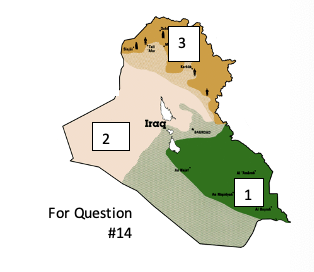
List the predominant ethno-religious group in Region 1 as shown on the map.
Shia Arabs
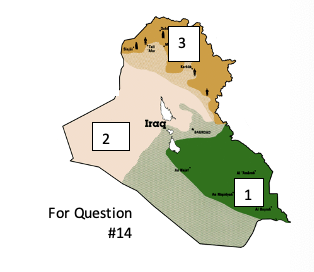
List the predominant ethno-religious group in Region 2 as shown on the map.
Sunni Arabs
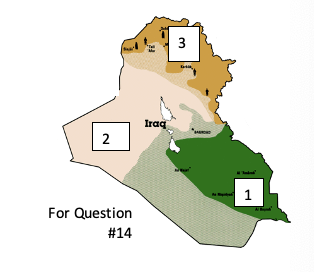
List the predominant ethno-religious group in Region 3 as shown on the map.
Kurds
Prior to the split between Sudan and South Sudan, the country was plagued by decades of civil war between the north and the south. In what part of the country (north or south) did Arab Muslims predominate?
North
Prior to the split between Sudan and South Sudan, the country was plagued by decades of civil war between the north and the south. In what part of the country (north or south) did non-Arab Christians and followers of traditional faiths predominate?
South
Prior to the split between Sudan and South Sudan, the country was plagued by decades of civil war between the north and the south. South Sudan is the most recent country to be admitted to the UN. In what year did South Sudan attain independence?
2011
Prior to the split between Sudan and South Sudan, the country was plagued by decades of civil war between the north and the south. List three factors that have exacerbated ethnic conflicts in the Darfur region of Sudan.
Drought, desertification, and overpopulation exacerbated ethnic conflicts
Define: supranationalism
Associations of states created for mutual benefit and to achieve shared objectives
Define/describe: subsistence economy
Goods and serivces are produced for self and kinship groups
With what type of government are planned (command) economies associated?
Communist governments
Provide two examples of countries with planned economies cited in the lecture/text.
North Korea and Cuba
Classify manufacturing as either a primary, secondary, or tertiary economic activity
Secondary
Classify agriculture as either a primary, secondary, or tertiary economic activity
Primary
Classify retail trade as either a primary, secondary, or tertiary economic activity
Tertiary
Classify education as either a primary, secondary, or tertiary economic activity
Tertiary
Classify construction as either a primary, secondary, or tertiary economic activity
Secondary
Classify mining as either a primary, secondary, or tertiary economic activity
Primary
In which of the three economic sectors (primary, secondary, or tertiary) are the vast majority of Americans (about 80%) employed?
Tertiary
Which countries typically have a larger proportion of their labor force engaged in agriculture, (a) LDCs or (b) MDCs?
(a) LDCs
Indicate whether the following describes (a) extensive subsistence agriculture or (b) intensive subsistence agriculture: Involves large areas of land; output per acre and population densities are low:
(a) extensive susistence agriculture
Indicate whether the following describes (a) extensive subsistence agriculture or (b) intensive subsistence agriculture: Involves small areas of land; output per acre and population densities are high
(b) intensive subsistence agriculture
Define: nomadic herding
Migratory movement of livestock for forage
In what type of environments is nomadic herding typically practiced?
Dry, cold, and/or rugged environments
List three specific regions of the world where a fair number of people engage in nomadic herding that were mentioned in the lecture.
Sahara and Sahel, the Arctic, Central Asia (Mongolia, Kyrgyzstan)
Describe: shifting cultivation
Lands cleared, burned, and cultivated for a few years; move to a new site when fertility is lost, leaving former fields fallow
With regard to temperature, precipitation, latitude, and soil quality, in what type of environment is shifting cultivation typically practiced?
Warm, moist low latitude regions with poorer soils
Is this shifting cultivation viable when population density is high?
No
What type of subsistence agriculture is most common in the fertile river valleys and deltas of eastern and southern Asia, (a) extensive or (b) intensive?
(b) intensive
What crop is most commonly grown in warm, moist areas such as the Yangtze River Valley, Mekong Valley and Delta, and the eastern Ganges Valley and Delta?
Rice
________ - ____________ varieties of wheat, rice, and corn were among the agricultural advancements associated with the Green Revolution.
High-yielding
Indicate whether the Green Revolution led to an (a) increase or (b) decrease in the use of fertilizers and pesticides
(a) increase
Indicate whether the Green Revolution led to an (a) increase or (b) decrease in grain production
(a) increase
Indicate whether the Green Revolution led to an (a) increase or (b) decrease in pollution and salinization
(a) increase
Indicate whether the consolidation and intensification of agriculture in the U.S. has led to an (a) increase or (b) decrease in the number of farms
(b) decrease
Indicate whether the consolidation and intensification of agriculture in the U.S. has led to an (a) increase or (b) decrease in average farm size
(a) increase
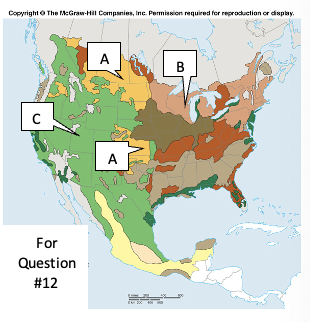
Indicate the predominant type of agriculture in Region A on the map
Wheat and small grains
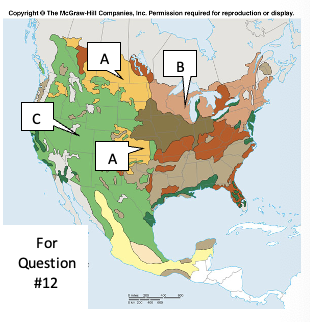
Indicate the predominant type of agriculture in Region B on the map
Dairy
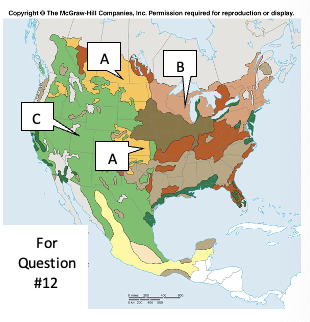
Indicate the predominant type of agriculture in Region C on the map
Range livestock
Indicate whether industrial processes that reduce the weight of the raw material (e.g., processing mineral ores) tends to have (a) a raw material orientation or (b) a market orientation
(a) raw material orientation
Indicate whether industrial processes that add weight to the finished product (e.g., soft drink bottling) tends to have (a) a raw material orientation or (b) a market orientation
(b) market orientation
Indicate whether industrial processes that reduce the bulk of the raw material (e.g., lumber milling) tends to have (a) a raw material orientation or (b) a market orientation
(a) raw material orientation
List the world’s four major manufacturing regions.
Eastern North America, Western and Central Europe, Eastern Europe, Eastern Asia
One of the country’s greatest concentrations of high-tech industry is located in North Carolina (specifically the Raleigh-Durham-Chapel Hill area). What is the nickname given to this region?
Research Triangle
Is the proportion of the world’s population living in cities (classified as urban) today (a) higher or (b) lower than it was in 1900?
(a) higher
Which countries are typically more urbanized (have a larger proportion of their population living in cities), (a) MDCs or (b) LDCs?
(a) MDCs
In early American history, many settlements were established at sites where rivers cross the Fall Line. The Fall Line represents the boundary between what two landform regions in the eastern U.S.?
Piedmont and coastal plain
List two reasons why settlements where rivers cross the Fall Line were advantageous sites.
Was a head-of-navigation location and waterwheel-powered industries
Define/describe suburb
Outside, but near the boundaries of a central city
Define/describe urbanized area
Continuously built-up, densely populated area within and surrounding a city
Define/describe metropolitan area
Major city and county or counties linked by interaction
What is the approximate population of the city of Greenville (inside the city limits)?
76,000
List the four counties that constitute the Greenville-Anderson metropolitan area.
Greenville, Anderson, Laurens, and Pickens
List the three most populous urban areas (in order) in the United States.
New York, Los Angeles, Chicago
List the five most populous urban areas (in order) in the world, according to data presented in the lecture.
Tokyo (Japan), Delhi (India), Shanghai (China), Sao Paulo (Brazil), Mexico City
Define: primate city
One city in a country with clear numeric, economic, political, social, and cultural dominance
Classify Buenos Aires, Argentina as (a) a primate city or (b) not a primate city
(a) primate city
Classify New York City as (a) a primate city or (b) not a primate city
(b) not a primate city
Classify Bangkok, Thailand as (a) a primate city or (b) not a primate city
(a) primate city
Define: Central Business District (CBD)
Commercial core of an urban area (“downtown“)
Are land values typically high or low in the CBD?
High
Define: suburbanization/urban sprawl
development and population growth along the fringes of metropolitan areas
List three factors mentioned in the lecture that contributed to an increase in suburbanization/urban sprawl in post-WWI America.
Increasing automobile ownership, construction of interstates and other highways, and new home loan terms made purchasing easier
Define: edge city
District concentrations of retail and office space on the outer fringes of a metropolitan area
List five negative impacts of urban sprawl that were mentioned in the lecture.
Farmland conversion and habitat loss, little mixed-up development, reliance on automobiles, decline of central cities, decline in benefits of agglomeration
Megalopolis is a large conurbation that extends from north of ____________ to south of ___________________.
Boston, Washington D.C
Define: gentrification
Private redevelopment of deteriorated urban property
As discussed in the lecture, what negative consequence is sometimes associated with gentrification?
Displacement of low-income residents
Consider some differences between typical European and U.S. urban areas. Do European urban areas typically exhibit (a) more or (b) less urban sprawl than American urban areas?
(b) less urban sprawl
Consider some differences between typical European and U.S. urban areas. Are residents of European urban areas (a) more or (b) less likely to live in multi-unit housing than residents of American urban areas?
(a) more likely
Consider some differences between typical European and U.S. urban areas. Do European urban areas typically have (a) more or (b) less mixed-use development than American urban areas?
(a) more
Describe: shantytown/squatter settlement
Unplanned, makeshift housing developments
According to recent estimates, what is the approximate population of the world?
8.2-8.3 billion
List some of the primary factors that contributed to the dramatic increase in population growth in modern history.
Advances in medicine and healthcare, agriculture and nutrition, and sanitation
How (in general) is a more-developed country (MDC) different from a less-developed country (LDC)?
They have high economic productivity, standard of living, levels of technology
Is most of the world’s population growth occurring in MDCs or LDCs?
LDCs
Define: birth rate
Number of live births per 1,000 people per year
Define: total fertility rate (TFR)
Average number of births per woman
What is the approximate TFR in the United States?
1.8