cultural practices in socioecological context
 Call Kai
 Learn
Learn Practice Test
 Spaced Repetition
 Match
Match Flashcards
 Knowt Play
1/18

There's no tags or description
Looks like no tags are added yet.
Name | Mastery | Learn | Test | Matching | Spaced | Call with Kai | Chat |
|---|
No analytics yet
Send a link to your students to track their progress
19 Terms
describe Frisen (1972, display rules for emotions)
expression of emotion among US and Japanese
watch short film of bodily mutilation; 2 conditions - alone vs. together; facial expressions videoed and coded
results: alone - both nationalities showed disgust; together - Japanese didn’t show disgust
negative emotional display risks harmony
describe Matsumoto (1990, displaying emotions)
predicted differences in display rules for positive and negative emotions
collectivism predicts showing more positive (vs. negative) emotions to ingroups (vs. outgroup)
across US, Japan, Russia, South Korea, individualism-collectivism measure accounted for 30% of cross-cultural differences in display rules
describe Matsumoto, Consolacion et al. (2002, reading emotions)
US participants judged high intensity expression as indicating less intense experience than expression
Japanese judged low intensity expressions as indicating more intense experience than expression
individualism-collectivism measure accounted for individual but not cultural differences
what is a tight culture?
has many strong norms and a low tolerance of deviant behaviour
what is a loose culture?
has weak social norms and a high tolerance of deviant behaviour
what causes cultural tightness and looseness?
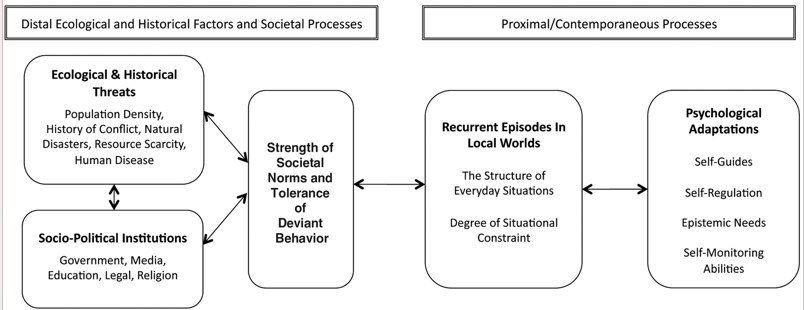
ecological and human-made threats increase the need for strong norms and punishment of deviant behaviour in the service of social coordination for survival
what are the factors that influence cultural tightness and looseness according to Gelfand et al. (2011)?
ecological and historical threats
Population density and growth, lower food and water supplies, lower air quality, more natural disasters, more territorial threats from neighbours, more diseases and infant mortality
societal institutions and practices
Autocratic rule, closed media, fewer political rights and civil liberties, more police per capita, stricter punishments, lower crime, more religion, less collective action
psychological adaptations
Cautiousness, dutifulness, self-regulation (impulse control),
need for structure, self-monitoring
how do family structures differ around the world?
nuclear family - prevalent in North America and Northern Europe; prevalent in hunter-gatherer societies
extended families - majority of the rest of the world, especially agrarian societies
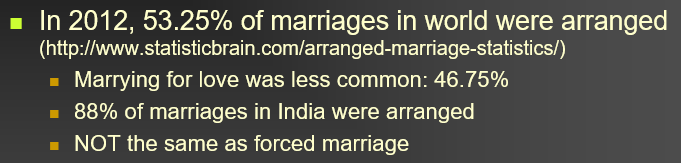
why might someone choose to have an arranged marriage?
preserve social harmony
create political and economic links between families
social and economic protection
rational rather than emotional choice
describe Levine et al. (1995)
surveyed students in in India, Pakistan, Thailand, Mexico, Brazil, Japan, Hong Kong, the Philippines, Australia, UK, USA
asked “if a man/woman had all the other qualities you desired, would you marry this person if you were not in love with him (her)?”
majority answered ‘non’
predicted effects of individualism-collectivism (r = .56) - individualistic cultures less likely to get married without love
stronger correlation with affluence (r = .75) - richer countries less likely to get married without love
desirable characteristics of a mate according to Buss et al. (1990)
studied mate preferences in 37 cultures
relatively similar profile across cultures (greatest cultural variation in value of chastity)
most desirable characteristics:
Mutual attraction—love
Dependable character
Emotional stability and maturity
Pleasing disposition
Education and intelligence
desirable characteristics of a mate according to Shackelford et al. (2005)
factor analysed Buss et al. at individual level
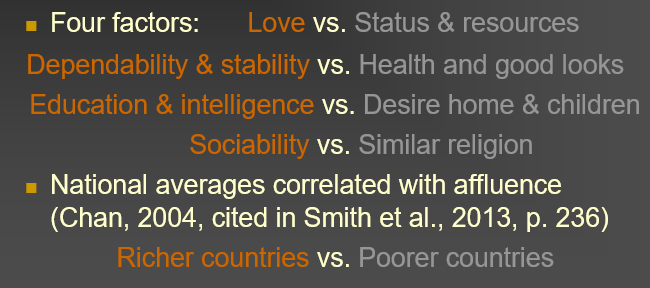
four factors identified:
love vs status and resources
dependability and stability vs health and good looks
education and intelligence vs desire home and children
sociability vs similar region
national averages correlated with affluence
love in collectivist vs individualist cultures
companionate love in collectivist cultures
romantic love in individualist cultures
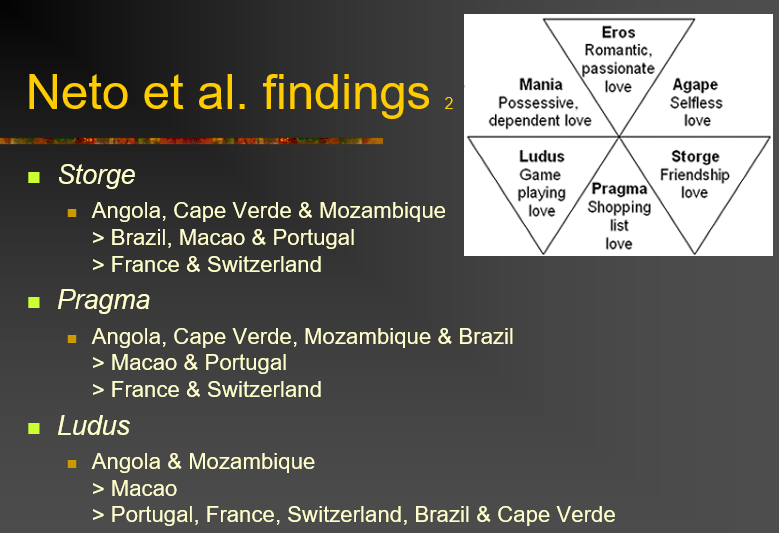
describe Neto et al. (2000)
studied endorsement of six ‘love styles’ among students in 8 countries
based on Lee’s (1973) theory of ‘colours of love’
minimal differences in eros, mania, and agape
stronger differences in ludus, pragma, storge
what is relational mobility?
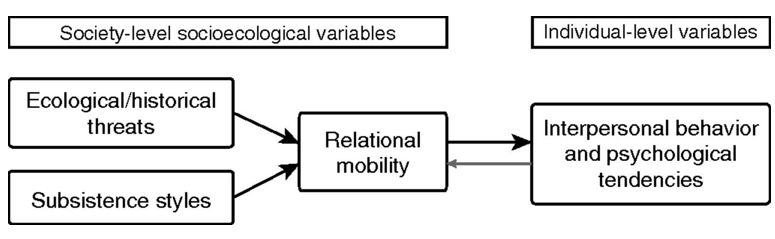
a socioecological variable that represents how much freedom and opportunity a society affords individuals to choose and dispose of interpersonal relationships based on personal preference
describe Thomson & Yuki et al. (2018) - relational mobility
asked questions about how much people felt statements about the immediate society where they lived were accurate (e.g. ‘there are many chances to get to know other people’)
relational mobility predicted by:
subsistence styles - lower RM in rice-farming cultures; higher RM in herding cultures
ecological and historical threats - RM lower in harsh climates, higher pathogen prevalence, population density, historically poorer nations
relational mobility predicts:
greater investment in relationships - higher RM predicts trust in strangers, higher self-esteem, self-disclosure, intimacy with close friend/partner, willingness to help a close friend in crisis (i.e., offer social support)
what does the ‘eco-cultural framework’ aim to do?
to map context of cultural differences using culture-level rather than aggregated indicators
ecological context - temperature, rainfall, resources etc.
socio-political context
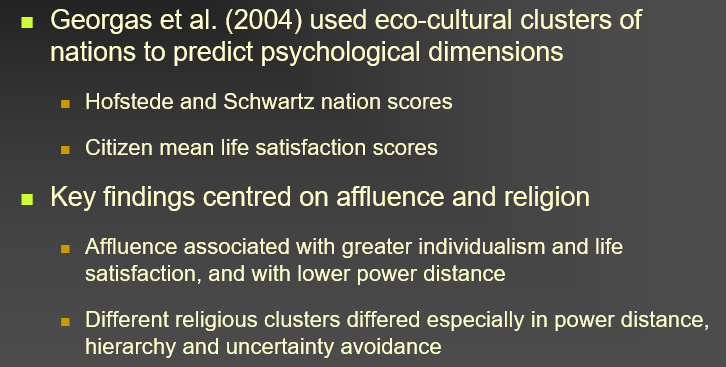
beyond affluence and religion
Means of subsistence
Farmers and fishers vs. herders in Eastern Turkey
(Uskul, Kitayama, & Nisbett, 2008, PNAS)Southern (rice) vs. Northern (wheat) China
(Talhelm et al., 2014, Science)
Ecological threats
Pathogen prevalence
(Fincher, Thornhill, Murray, & Schaller, 2008, PRS B)Climato-economic interactions
(Van de Vliert, 2009; Van de Vliert, Huang, & Parker, 2004)
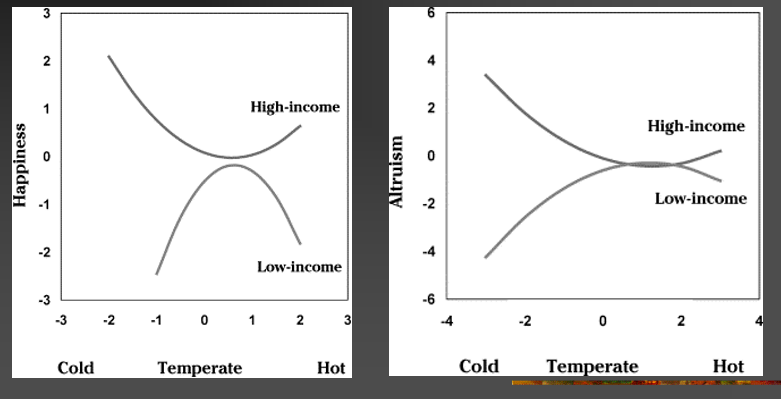
climato-economic interactions
income makes a greater difference in harsher climates
in temperate climates, income makes little difference to happiness or altruism