Lecture 8: Pathological Human Gait
 Call Kai
 Learn
Learn Practice Test
 Spaced Repetition
 Match
Match Flashcards
 Knowt Play
1/29

There's no tags or description
Looks like no tags are added yet.
Name | Mastery | Learn | Test | Matching | Spaced | Call with Kai | Chat |
|---|
No analytics yet
Send a link to your students to track their progress
30 Terms
Primary Deviations
The actual physical pathologies that result in impaired ambulation:
Motor deficits
Sensory deficits
Deformity
Pain
Motor Deficits
Inability to properly control motor function
Depressed motor function
Neuromuscular weakness, destruction or loss of innervation
ex. upper & lower motor neuron lesions, Guillain-Barré, CP, MS, etc.
Excessive motor function
clonus, spasticity
ex. upper motor neuron lesions, CP, CVA, etc
Sensory deficits
Inability to receive proper neuromuscular signals
Depressed limb awareness - ex. CVA, head injury, etc.
Depressed proprioception - ex. upper motor neuron lesions, etc.
Depressed tactile sensation - ex. CVA, head injury, MS, etc.
Deformity
Physical alteration from normal form
Contractures - Muscular, ligamentous, or capsular
Bone deformity - Change in bone shape, bony restriction to ROM ex. arthritis, Blount’s, Paget’s, etc.
Ligamentous laxity - joint instability, ex. trauma, CP, etc
Pain
Physical discomfort that alters gait
Joint pain - ex. arthritis, trauma, etc.
Bone pain - ex. Legg-Calve-Perthes, Paget’s, osteomyelitis, etc.
Soft tissue pain - ex. burns, scars, sprains, etc.
Compensatory Deviation Defined
The method of accommodating for a primary deviation so that the effects of the primary deviation on gait are diminished
ex. - Muscular weakness of the dorsiflexors is a primary deviation (motor deficit). To prevent falling because of an inability to achieve toe clearance during swing phase, a compensatory deviation would be steppage gait
Common Compensatory Deviations
Effectively long/short limb
Steppage gait
Lateral trunk bending
Hip hiking
Circumduction
Wide/narrow base of support
Excessive medial foot contact
Anterior/Posterior trunk bending
Lordosis
Hyperextended knee
Excessive knee flexion
Inadequate dorsiflexion control
Insufficient push-off
Vaulting
Causes of effectively long limb
weak swing knee flexors
weak swing hip flexors
dorsiflexion weakness
knee extension contracture
spastic knee extensors
plantarflexion contracture
coxa valga
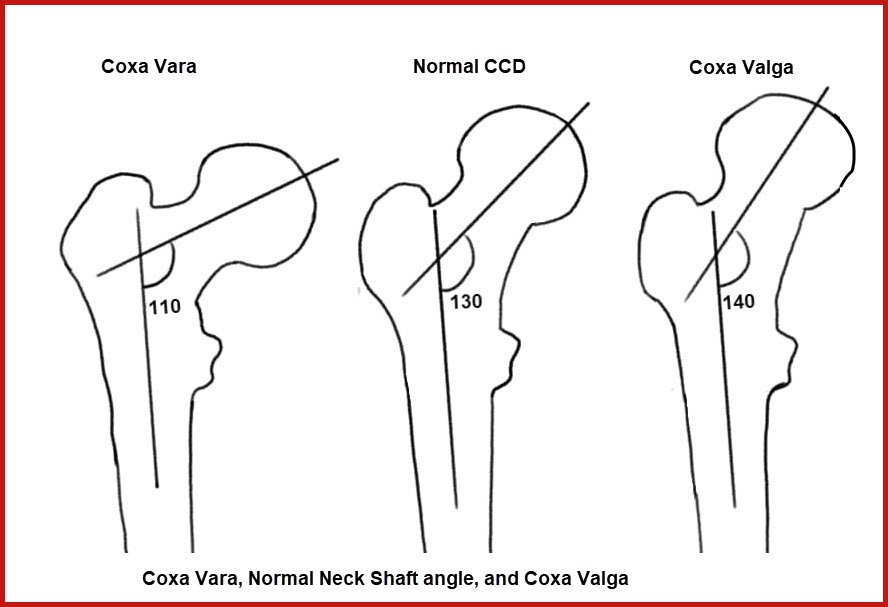
Causes of effectively short limb
bony shortening
knee flexion contracture
coxa vara
genu varum
genu valgum
genu recurvatum
Steppage gait
excessive hip and knee flexion during swing phase aid in the ability to clear the toe.
During terminal swing the knee is forcefully extended and at initial contact the forefoot contacts first.
Loading response follows rapidly which results in a “slapping of the foot”
Primary deviations that cause compensatory Steppage gait
Weak dorsiflexors
Lateral Trunk Bending
Occurs during single limb support of stance phase with the subject leaning toward the stance limb to clear a relatively longer swing limb.
Primary deviations that cause compensatory Lateral Trunk Bending
weak stance hip abductors
stance hip dislocation (deformity)
stance coxa vara (short stance leg)
others: stance hip pain (less motion & less force), short stance limb, long swing limb, instability (wide base), high medial orthotic wall
Hip hiking
Occurs during swing phase with the swing limb elevating at the hip to clear the foot.
Primary deviations that cause compensatory Hip Hiking
Long swing limb (not usually enough to shorten the swing limb from ankle lengthening)
Short stance limb
Circumduction
Occurs during swing phase where the swing limb arcs laterally using swing hip abduction to clear the foot
Primary deviations that cause compensatory circumduction
Long swing limb
Wide base of support
Can occur during swing and stance phase but is most visible during stance. May also have lateral trunk bending associated with wide base of support.
Primary deviations that cause compensatory wide base of support
Hip abduction contracture, instability due to fear, proprioception deficit, generalized hip weakness, genu valgum, leg length discrepancy (long leg is held laterally to shorten it), perineal orthosis pain.
Narrow Base of Support
Can occur during swing and stance phase but is more visible during stance
Primary deviations that cause compensatory narrow base of support
Spastic hip adduction
Genu varum
Hip orthosis adducted
Excessive Medial Foot Contact