Anatomy/Physiology Deck
 Call Kai
 Learn
Learn Practice Test
 Spaced Repetition
 Match
Match Flashcards
 Knowt Play
1/229

There's no tags or description
Looks like no tags are added yet.
Name | Mastery | Learn | Test | Matching | Spaced | Call with Kai | Chat |
|---|
No analytics yet
Send a link to your students to track their progress
230 Terms
What are the 3 standard sectioning planes?
Coronal (Frontal), Sagittal (Longitudinal), Transverse (Axial)
For each standard sectioning plane, what are the two sides?
Coronal (Anterior - Posterior), Sagittal (Left - Right), Transverse (Superior - Inferior)
What does the sagittal plane differ between?
Foot and hand. Foot is divided after thumb. Hand is divided through middle finger.
What are oblique sectioning planes?
Unequal sections at an angle other than 90 degrees from any axis
What sectioning plane is standard radiographic view?
Coronal (PA, posterior to anterior view)
What sectioning plane is standard MRI and CT scans view?
Transverse
What is anatomical position?
Standing upright. Facing forward, chin level. Holding the palms forward. Feet flat on the floor.
Which movements are along the coronal plane?
Abduction/adduction, inversion/eversion, radial deviation / ulnar deviation
Which movements are multidirectional?
Circumduction
Which movements are axial?
Lateral rotation / medial rotation, supination/pronation
Which movements are along sagittal plane?
Protraction/retraction, flexion/extension, dorsiflexion/plantarflexion, hyperextension/extension/flexion
Cranial
Pertaining to, or located toward, the head
Caudal
Pertaining to, or located toward, the tail
Anterior
Pertaining to, or located toward, the front; synonym: ventral
Posterior
Pertaining to, or located toward, the back; synonym: dorsal
Superior
Upper or above
Inferior
Lower or below
Axial
Pertaining to the axis of a structure
Transverse
Situated at right angles to the long axis of a structure
Longitudinal
Parallel to the long axis of a structure
Horizontal
Parallel to the plane of the horizon
Vertical
Perpendicular to the plane of the horizon
Medial
Toward the median plane
Lateral
Away from the median plane
Median
Situated at the medial plane or midline
Peripheral
Situated away from the center
Superficial
Situated near the surface
Deep
Situated beneath the surface
External
Outer or lateral
Internal
Inner or medial
Apical
Pertaining to the top or apex
Basal
Pertaining to the bottom or base
Sagittal
Situated parallel to the sagittal suture
Coronal
Situated parallel to the coronal suture
Proximal
Close to, or toward, the trunk or point of origin
Distal
Away from the trunk or point of origin
Radial
Pertaining to the radius or lateral side of the forearm
Ulnar
Pertaining to the ulna or medial side of the forearm
Tibial
Pertaining to the tibia or medial side of the leg
Pertaining to the fibula or lateral side of the leg
Fibula or peroneal
Pertaining to the palm of the hand
Palmar (volar)
Plantar
Pertaining to the sole of the foot
Dorsal
Pertaining to the back of the hand or top of the foot
Pertaining to the thumb
Pollicis
Pertaining to the great toe
Hallicus
Coronal / Frontal
Dividing the body into anterior and posterior pieces
Sagittal / longitudinal
Dividing the body into left and right pieces
Median Plane
Dividing the body through the midline into left and right
Oblique
A planar division at an angle
Transverse / axial
Diving the body into superior and inferior pieces
Median plane of hand
Dividing the hand into left and right through 3rd digit
Median plane of foot
Dividing the foot into left and right through 2nd digit
Flexion
Decreases angle at a joint
Extension
Increases angle at a joint
Protraction
Moving forward
Retraction
Moving backward
Elevation
Move in a superior direction
Depression
Move in an inferior direction
Adduction
Move toward midline
Abduction
Move away from midline
Circumduction
Distal aspect makes a circle
Pronation
Palm rotates posteriorly
Supination
Palm rotates anteriorly
Lateral/External Rotation
Rotation away from midline along long axis
Medial/Internal rotation
Rotation toward midline along long axis
Thumb moves toward other digits
Thumb moves away from other digits
Opposition/Reposition
Eversion
Sole tilts away from midline
Inversion
Sole tilts toward midline
Dorsiflexion
Flex foot superiorly (extension)
Plantarflexion
Flex foot inferiorly (flexion)
What is radial deviation / ulnar deviation?
IMAGE

What are thoracic landmarks?
Ribs and intercostal spaces
What are the abdominal quadrants?
Right upper quadrant; left upper quadrant; right lower quadrant; left lower quadrant
What are the 9 abdominal regions?
Right hypochondriac region; epigastric region; left hypochondriac region; right lumbar region; umbilical region; left lumbar region; right iliac (inguinal) region; hypogastric (pubic) region; left iliac (inguinal) regional
What are the 4 cavities?
Cranial cavity; thoracic cavity; abdominal cavity; pelvic cavity
What is the cranial cavity?
Brain and spinal cord
What is in the thoracic cavity?
Mediastinum; pericardial cavity; surrounds heart. Pleural cavities; surrounds lungs.
What is in the abdominal cavity?
Gastrointestinal tract
What is in the pelvic cavity?
Pelvic organs
What is the axial vs appendicular skeleton?
Axial is the skull, sternum, ribs, vertebral column, and sacrum + coccyx. Appendicular is everything else.
Clavicle

Scapula

Humerus

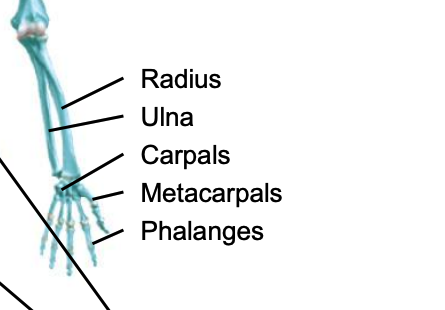
Radius, Ulna, Carpals, Metacarpals, Phalanges
Os Coxa

Femur

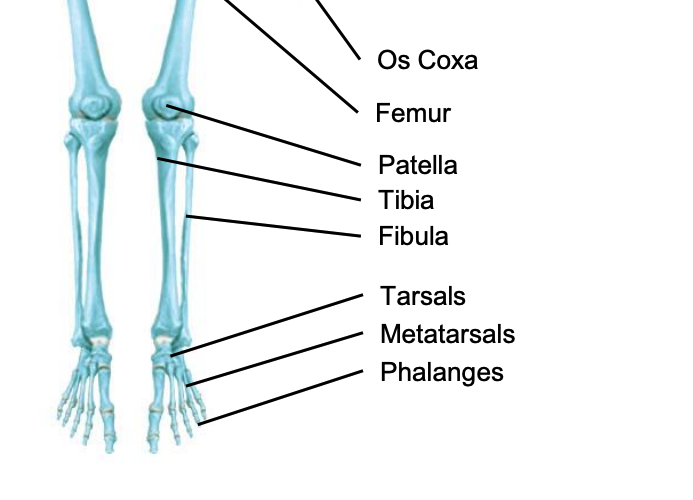
Patella, Tibia, Fibula, Tarsals, Metatarsals, Phalanges
What is homeostasis?
Maintenance of relatively stable internal conditions despite continuous change in internal and external environments
How do we maintain homeostasis short-term and long-term?
Autonomic NS via neurons (short-term). Endocrine via hormones (long-term).
What are four parts of feedback systems that maintain homeostasis?
Set point. Receptors. Control center. Effector
What are negative feedback systems?
Reverse a change to stop the stimulus
What are positive feedback systems?
Reinforces a change to perpetuate a stimulus. Includes a terminating mechanism outside of system.