Exam 2 Geology
 Note
Note Call Kai
 Learn
Learn Practice Test
 Spaced Repetition
 Match
Match Flashcards
 Knowt Play
1/23

There's no tags or description
Looks like no tags are added yet.
Name | Mastery | Learn | Test | Matching | Spaced | Call with Kai | Chat |
|---|
No analytics yet
Send a link to your students to track their progress
24 Terms
Streamflow
Stream runoff is crucial for humans as it provides
-Drinking Water
-Transportation
-Waste Disposal
-Recreation
-Commerce
-Irrigation
-Energy
Streamflow
Streams are powerful agents of change
-Flowing water erodes, transports, and deposits sediments
-Sculpts Landscapes
-Transfers mass from continents to oceans basins
Earth is the only planet in solar system with flowing water
Recharging Streams
Direct Precipitation or snowmelt
Surface runoff
Flow through soil
Infiltration
Groundwater Recharge
Forming Streams
Streamflow begins as moving sheetwash ( think water flowing over a parking lot)
Sheetwash erosion creates tiny rill channels.
Rills coalesce, deepen, and downcut into channels

Headward Erosion
Lengthens channels upslope. The stream valley grows towards the headwaters

What happens over time?
Over time, smaller tributaries join larger trunks stream
The array of connected channels comprise a drainage network
The specific patterns reflect the underlying geology

Dendritic
Branching, “treelike”
-Rocks of uniform strenght
-Rocks are relatively flat

Radial
Like spokes of a wheel
-conical hill or mountain
-common for volcanoes

Rectangular
right angle flow
-Rocks fracture/faulted in two main directions

Trillis
Named for gardening structure
-folded, alternating layers of hard and soft rock
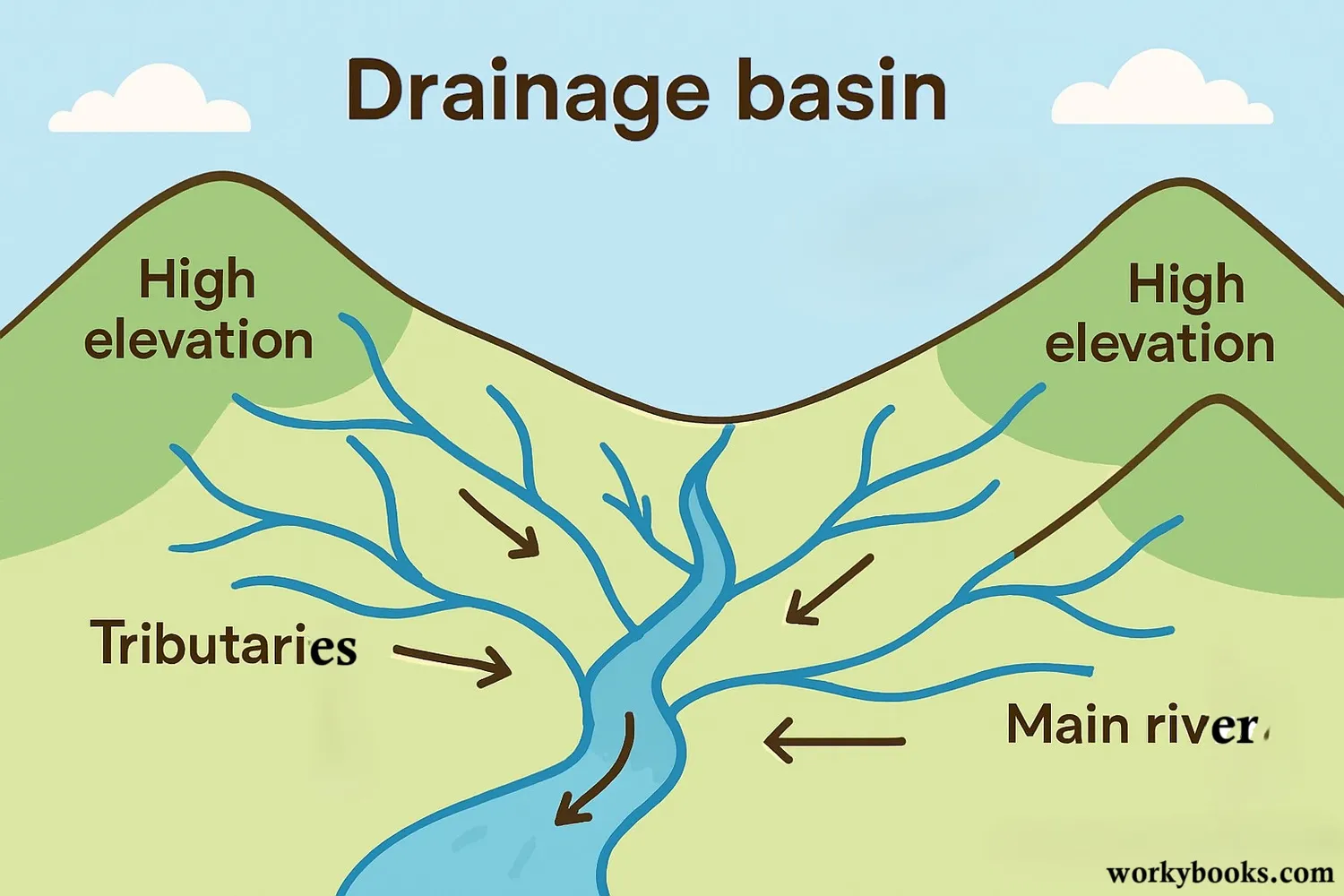
Drainage Basins
(watersheds, catchments) generally, a watershed is the area of land drained by a stream or network of stream
-all of the water at same place
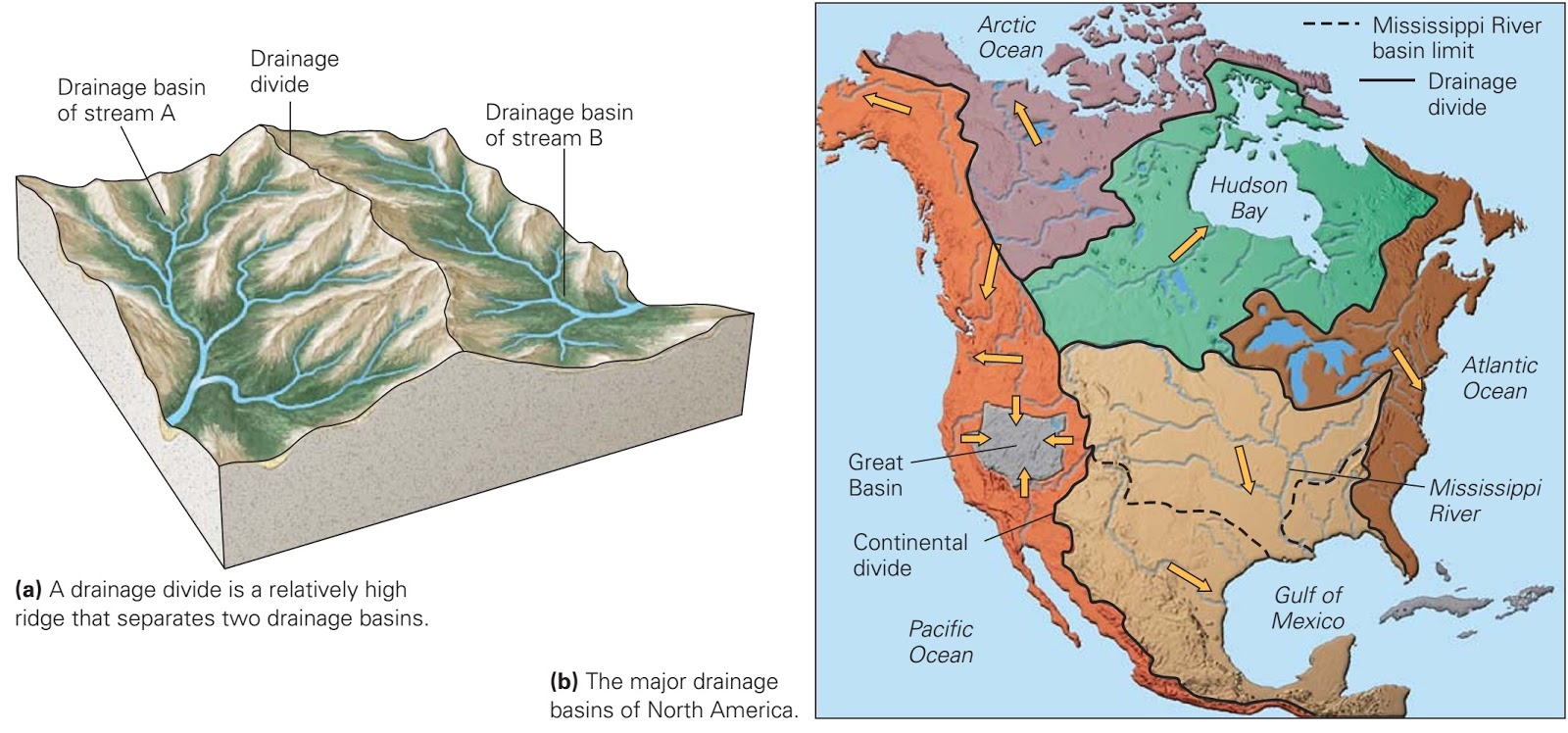
Drainage Divides
Watersheds can be defined for smallest of tributaries or at the continental scale
continental divides separate flow to different oceans

Watershed size & Stream
Stream size is function of stream order (number of tributaries)
1st order = 0 tributaries
2nd order = 1 tributary
3rd order = 2 tributaries
Nth order = N–1 tributaries
High order = lots of tributaries = draining large area

Perennial
Flows all year
at or above water table

Ephemeral
flows only during and after rainfall
above water table

“How big is that stream?” Velocity and Discharge
Velocity: distance divided by time
Discharge: volume divided by time
Depth: Hydraulic pressure from overlying water column
Discharge equations
Q= volume/time
Q=area * velocity
ft x ft x ft= volume
time in seconds: ft3/sec
Q=area * velocity
Area = ft * ft=ft2
Velocity= ft/sec
ft2* ft/sec= ft3/sec
If area decreases (channel gets smaller) what would happen to velocity?
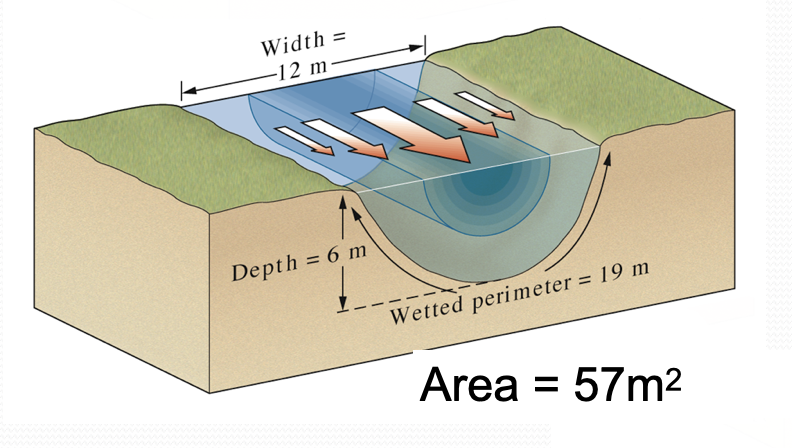
wetted perimeter= 19m, depth= 6, width= 12m
Fastest flow is in center of channel (when straight- rare in nature)

Wetted perimeter= 32m, Depth= 2m, Width= 30 m
Larger wetted perimeter
same area
slower flow
Uniformitarianism
the idea that the present is the key to the past, allowing scientists to infer that the martian feature is likely also a delta
Turbulence
shearing against banks, rocks, floor causes water to deflect
Fluvial (Stream) processes
Erosion
Transportation
Deposition
Alluvium
sediment deposited by streams