Astronomy unit SNC1W1
 Call Kai
 Learn
Learn Practice Test
 Spaced Repetition
 Match
Match Flashcards
 Knowt Play
1/118

There's no tags or description
Looks like no tags are added yet.
Name | Mastery | Learn | Test | Matching | Spaced | Call with Kai | Chat |
|---|
No analytics yet
Send a link to your students to track their progress
119 Terms
How long can a star's life cycle last?
Billions of years.
How long has our sun been around
5 billion years and it is not year the end of it’s life cycle.
What is a nebula?
A massive cloud of interstellar gases and dust, primarily consisting of hydrogen and helium.
How are stars formed from nebulas?
Parts of nebulas collapse in on themselves due to gravity, forming dense regions that become protostars.
What is a protostar?
A dense region within a nebula that forms as gravity pulls in gas and dust.
What initiates nuclear fusion in a protostar?
For millions of years, the core of a protostar continues to
contract due to the pull of gravity. The core temperature
rises until it meets a critical temperature of 15 million °C
What is the significance of nuclear fusion in stars?
It produces an enormous amount of energy that counteracts gravitational forces.
How does a star's mass affect its life cycle?
More massive stars have faster fusion rates, resulting in shorter life cycles.
What does the Hertzsprung-Russell (H-R) diagram illustrate?
It plots absolute magnitude against star surface temperature, showing the relationship between a star's mass, brightness, color, and life span.
What is the main sequence in the H-R diagram?
A diagonal band where 90 percent of stars, including the Sun, are found, indicating they fuse hydrogen to produce helium.
What happens to small or medium-sized stars (10 solar masses or less) at the end of their life cycle?
They become red giants, then collapse into white dwarfs, and eventually cool into black dwarfs.
What causes a red giant
a star of 10 solar masses or less will become larger and redder as it runs out of fuel.
What causes a white dwarf
nuclear fusion stops within the red giant, and the star’s core collapses.
The outer layers of the star drift away, and only the hot core remains. Creating a small, dim hot star.
what causes a black dwarf
nuclear fusion stops within the red giant, and the star’s core collapses.
The outer layers of the star drift away, and only the hot core remains. Creating dark and cold matter.
What occurs when a large star (greater than 10 solar masses) runs out of fuel?
It produces heavier elements, collapses, and explodes in a supernova.
What is a neutron star?
The core left behind after a supernova from a star with an initial mass between 10 to 30 solar masses.
What is a black hole?
The core left behind after a star with an initial mass greater than 30 solar masses collapses, having gravity so strong that not even light can escape.
What happens to the outer layers of a red giant?
They drift away, leaving only the hot core behind.
What is the final stage of a white dwarf?
It cools and becomes a black dwarf.
What are the two possible outcomes for a star after a supernova?
It can become a neutron star or a black hole, depending on its initial mass.
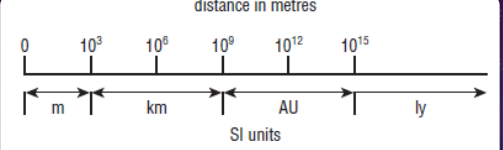
What unit is used to measure distances beyond the Solar System?
Light years (l.y.) are used to measure distances beyond the Solar System.
What is a light year?
A light year is the distance that light travels in a vacuum in one year.
What is the speed of light in kilometers per second?
Light travels at 300,000 km/s.
How many kilometers are in one light year?
One light year is 10 trillion kilometers (9.46 x 10^12 km).
How far is the star Vega from Earth in light years?
The star Vega is 25 light years from Earth.
What does observing distant stars and galaxies allow us to do?
Observing distant stars and galaxies allows us to look back in time, as the light we see left those stars years ago.
How do astronomers use parallax to estimate distances to stars?
Astronomers observe a star, wait six months, and then observe it again from the opposite end of Earth's orbit to form a triangle for distance calculation.
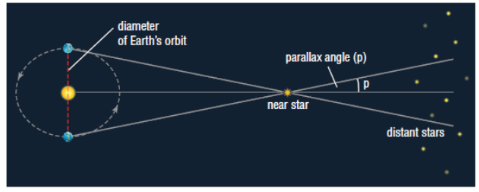
What is the maximum distance to which parallax can be used effectively?
as far away as 100 light years. Larger distances must use satelitles
Appropriate Units
What factors differentiate stars in the night sky?
brightness, colour, temperature, composition, and mass.
What is luminosity in relation to stars?
Luminosity is the total amount of energy produced by a star each second.
What is the sun’s luminosity?
1
How does the luminosity of Sirius compare to that of the Sun?
Sirius has a luminosity of 22, meaning it emits 22 times more energy each second than the Sun.
Why does the Sun appear brighter than Sirius despite its lower luminosity?
The Sun appears brighter because it is much closer to Earth (0.000016 light years) compared to Sirius (9 light years away).
What is the relationship between brightness and distance from an observer?
Brightness depends on both luminosity and the distance from the observer; closer objects appear brighter.
What does apparent magnitude measure?
the brightness of celestial objects, with brighter objects having lower values.
How does the apparent magnitude scale work?
brighter celestial objects have lower apparent magnitude
values, and dimmer stars have higher values.
Who created the apparent magnitude scale and when?
Greek astronomer Hipparchus created the apparent magnitude scale about 2100 years ago.
He classified brightest stars in the sky as magnitude 1 and the faintest as magnitude 6
What is the apparent magnitude of the Sun?
The Sun's apparent magnitude is -26.8.
What is absolute magnitude?
Absolute magnitude is the apparent magnitude a celestial object would have if it were 33 light years (10 parsecs) from Earth.
What is the Sun's absolute magnitude?
4.83.
What is the absolute magnitude of Polaris?
-3.63.
How does absolute magnitude help compare stars?
Absolute magnitude allows for a better comparison of luminosity between stars as if they were the same distance away.
What color indicates a relatively hot star?
A relatively hot star appears bluish.
What color indicates a relatively cool star?
A relatively cool star appears reddish.
What is the surface temperature of our Sun?
The Sun has a surface temperature of 6000 °C.
How does the color of Betelgeuse compare to Rigel?
Betelgeuse appears reddish-white, while Rigel appears bluish-white, indicating their temperature difference.
What is the significance of the apparent color of a star?
The apparent color of a star indicates its surface temperature.
What happens to light from a source as it moves farther away?
Light spreads out over a larger area and becomes more diffuse, making the source appear dimmer.
What is astronomy?
The scientific study of celestial objects.
What are stars?
Massive collections of hot gases
radiate large amounts of energy
luminous
Luminous
Produce and emit their own light
What defines a planet?
A large celestial object that travels around a star.
the eight planets that travel around the Sun
Mercury, Venus, Earth, Mars, Jupiter, Saturn, Uranus, Neptune.
What are terrestrial planets?
The four planets closest to the Sun with hard, rocky surfaces.
Mercury, Venus, Earth, and Mars
What are Jovian planets?
The four larger planets composed mainly of gases and liquids.
Known as gas and ice gaints
Jupiter, Saturn, Uranus, Neptune
Earths order from the sun
The third planet from the sun
Earths order in size in the solar system
The fourth largest
What are galaxies?
Huge collections of stars, gas, dust, and planets within the universe
How many galaxies are in the universe?
billions
How many stars in the milky way Galaxy?
more than 200 billion
What galaxy is the Solar System part of?
The Milky Way galaxy.
What is the core of the Sun?
The center of the sun where high temperatures and pressures cause nuclear fusion.
What is nuclear fusion?
The process where particles collide at high speeds causing them to fuse. This releases enormous amounts of energy.
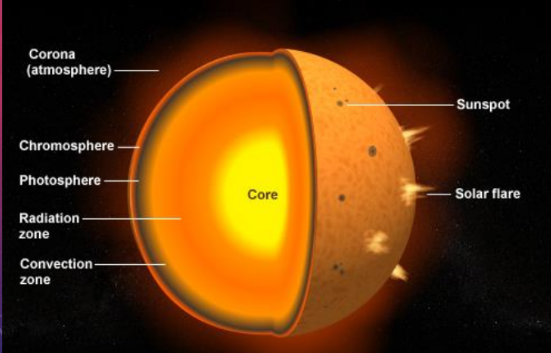
What are the three prominent features of the Sun's surface?
Sunspots, solar flares, and solar prominences.
Solar wind
created by solar storms
a stream of charged particles flowing out from the sun
Solar storm
Caused by gases of the sun swirling around
what causes the aurora borealis?
solar winds travel toward earth, when they come into contact with Earth’s magnetic field, they produce colourful displays of light
What are the other names for the aurora borealis ?
Aurora borealis & northern lights- northern hemisphere
Aurora australis & southern lights- southern hemisphere
harms of solar radiation
Solar radiation causes communication disruptions and can be hazardous to
human health.
What are three main reasons people have used patterns of stars in the night sky?
1) Planting and harvesting crops based on seasonal changes.
2) Navigation for those living in areas surrounded by water.
3) Religious and cultural significance.
What is a constellation?
They are regions of the sky, stars within a constellation can appear as patterns.
How many constellations are recognized by the International Astronomical Union (IAU)?
88
How did different cultures interpret the constellation Orion?
The ancient Greeks depicted Orion as a hunter, while North American First Nations saw it as a canoe.
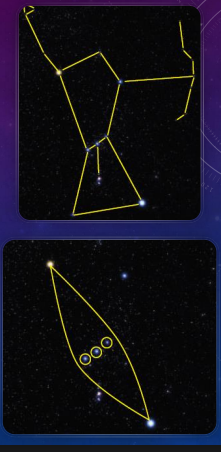
Constellations changing patterns
Constellations move slowly over thousands of years. This movement can only be observed with high power telescopes.
What is the celestial sphere?
An imaginary sphere surrounding Earth onto which celestial objects are projected, historically believed to be a solid sphere.
What is celestial navigation?
A method used to determine location using the stars, facilitated by the celestial sphere.
What divides the celestial sphere into northern and southern hemispheres?
The celestial equator, an imaginary extension of Earth's equator projected into space.
What are the North and South Celestial Poles?
Imaginary points where Earth's axis of rotation extends out onto the celestial sphere, with the North Celestial Pole near Polaris.
How did ancient Egyptians use the sky to develop their calendar?
They observed that the annual flooding of the Nile River occurred every 365 days when the Sun was in the constellation Leo.
What is the ecliptic?
The annual path that the Sun, Moon, planets, and some constellations appear to follow across the sky.
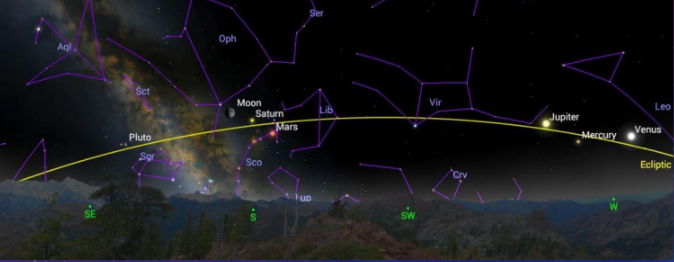
What is retrograde motion?
The apparent reversal of direction in the path of certain planets that are farther from the Sun than Earth.
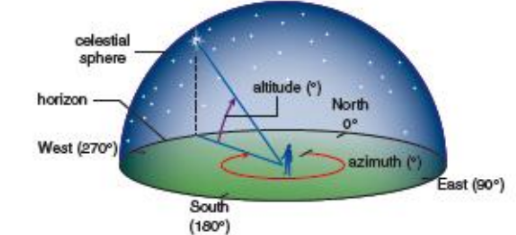
What is azimuth in celestial navigation?
The distance in degrees from north along the horizon to a celestial object.
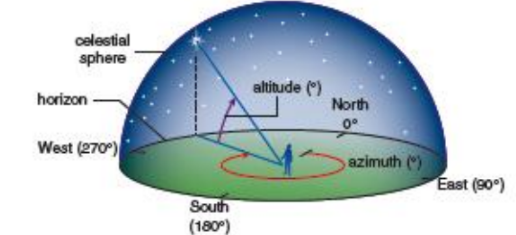
What is altitude in celestial navigation?
The angular height of the object measured in degrees from the horizon.
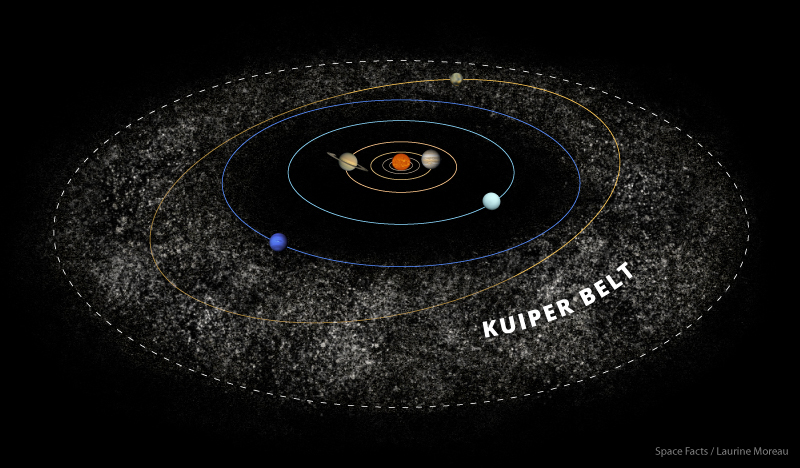
Kuiper Belt
It contains Pluto and other dwarf planets
Cold, dark
Most unexplored
believed to hold clues about how planets where formed
What is the astronomical unit (AU)?
Used to measure distances within the Solar System.
equivalent to 150 000 000 km, the average distance between the Sun and Earth.
How far is Neptune from Earth in astronomical units?
29 A.U.
the distance of the nearest star, Proxima Centauri, from Earth
300,000 AU
What is the classification of Pluto and why?
Pluto has been reclassified as a dwarf planet based on its physical properties and motion.
two other dwarf planets besides Pluto
Ceres (part of the Asteroid belt) and Eris (part of the Kuiper belt)
Astronomers suspect there are hundreds more
What are the three types of smaller celestial objects in the Solar System?
Asteroids, meteoroids, and comets.
Asteriods
orbit the sun between orbits of mars and jupiter (asteroid belt)
Small celestial objects made of rock and metal
Meteoroids
chunks of rock and metal
smaller than asteroids
sometimes pulled in by earths gravity, then they burn up in the atmosphere or occasionally impact earths surfaces
Comets
large chunks of ice dust and rock
orbit the sun
100m - 40km
few hundred thousand year orbit
How long does it take Earth to complete one revolution around the Sun?
365.25 days
What direction does the earth revolve around the sun?
Counterclockwise
What causes the apparent motion of the Sun across the sky?
The rotation of Earth on its axis.