chp. 14: photosynthesis
 Call Kai
 Learn
Learn Practice Test
 Spaced Repetition
 Match
Match Flashcards
 Knowt Play
1/94

There's no tags or description
Looks like no tags are added yet.
Name | Mastery | Learn | Test | Matching | Spaced | Call with Kai | Chat |
|---|
No analytics yet
Send a link to your students to track their progress
95 Terms
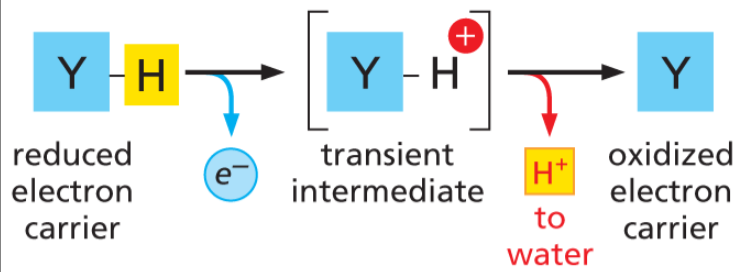
reduction
gaining of electrons (ANABOLIC)
can occur through the addition of an H or the removal of an Oxygen
energetically UNFAVORABLE = requires energy
always coupled w/ oxidation!
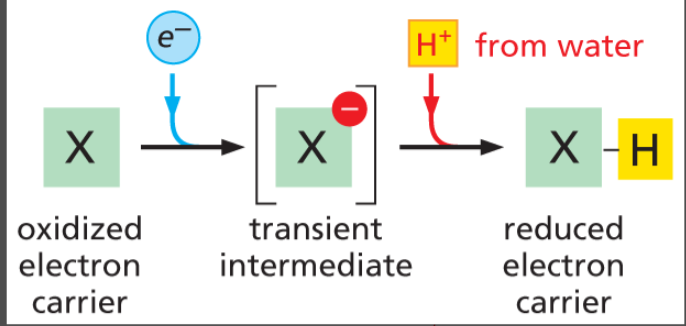
oxidation
removal of an electron (CATABOLIC)
occurs through the addition of an oxygen, or removal of an H
energetically FAVORABLE! = releases energy
always coupled w/ reduction!
catabolism
BREAK down molecules = RELEASE ENERGY
increases disorder/spontaneous (-G)
energy can be released as heat too
OXIDATION! (cell respiration)
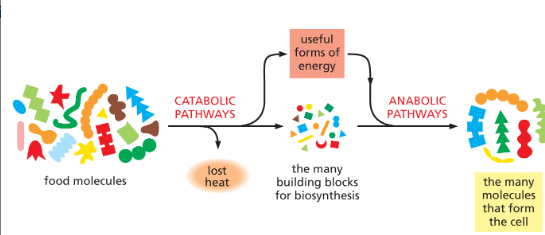
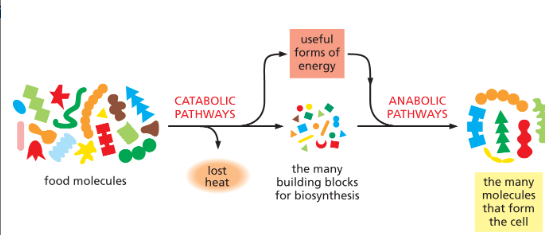
anabolism
BUILD larger molecules = REQUIRE input of energy
cause more order so they decrease the disorder/entropy of a system (+G)
REDUCTION! (photosynthesis)
is photosynthesis anabolic or catabolic?
anabolic: it builds complex molecules (glucose) from simpler ones (CO₂ and H₂O) using energy from sunlight
NADPH is produced during photosynthesis and used as a __________ during glucose metabolism
reducing agent
mainly used in anabolic rxns (photosynthesis)
When is NADPH stable?
NADPH donates its high energy H- which oxidizes NADPH to NADP+
This reaction releases energy because NADP⁺ is more stable/favorable after losing those electrons.
NADPH → NADP⁺ + electrons
is a favorable (energy-releasing) oxidation reaction.
oxidation-reduction rxns
chemical reactions where electrons are transferred between molecules.
Oxidation = a molecule loses electrons
Reduction = a molecule gains electrons
They always happen together: when one molecule loses electrons, another gains them.
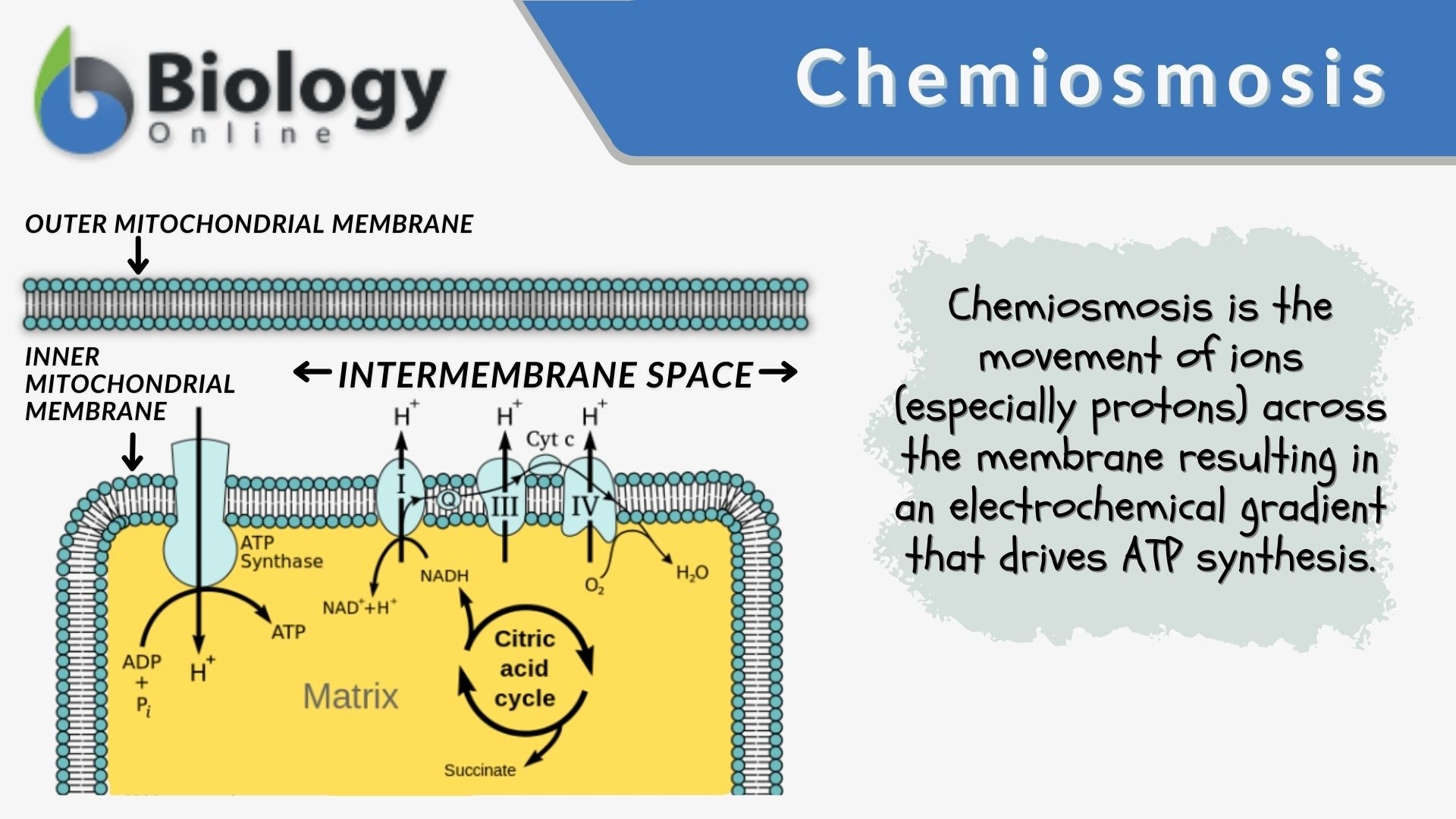
chemiosmosis
The process by which protons (H⁺ ions) move across a membrane down their electrochemical gradient, and the energy from this movement is used to produce ATP.
redox potential
A measure of how easily a substance gains or loses electrons.
The lower the redox potential, the lower the molecules’ affinity for electrons—and the more likely they are to act as electron donors
oxygen has very high affinity for electrons → high redox potential
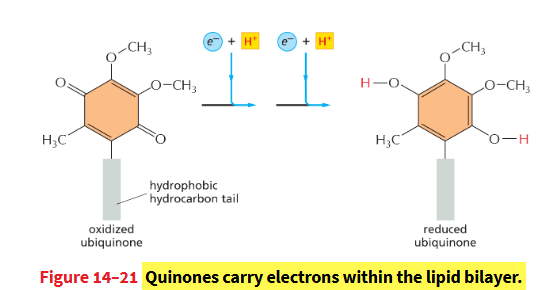
quinones
Small, lipid-soluble, mobile electron carrier molecule that functions in the respiratory and photosynthetic electron-transport chains.
in photosynthesis plastoquinone is present
Proton Motive Force vs Chemiosmosis
Proton Motive Force (PMF): The energy stored in a proton gradient across a membrane. (like pressure)
Chemiosmosis: The actual flow of protons down that gradient to make ATP.
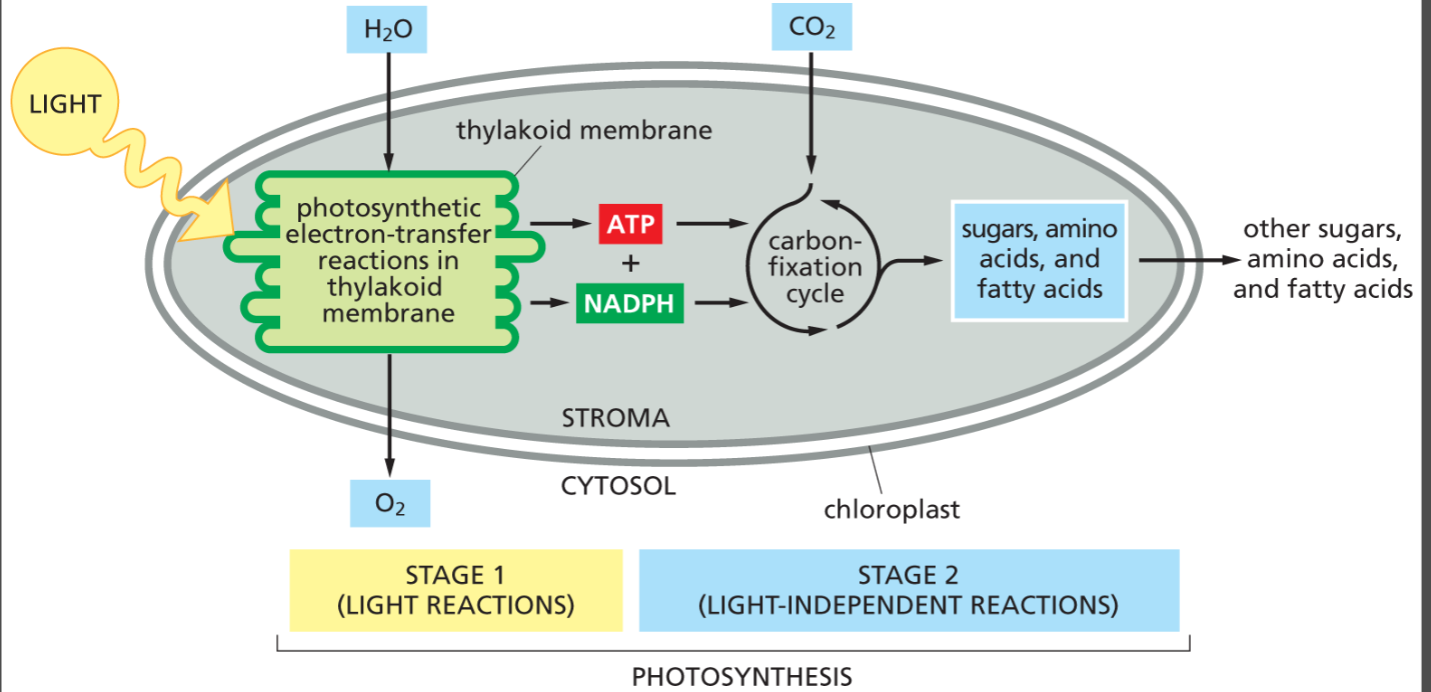
photosynthesis
light energy + CO2 + H2O ⟶ sugars + O2 + heat energy
process in which plants, algae, and bacteria use the energy of sunlight to synthesize organic molec. from CO2 and H2O.
occurs in 2 stages and generates and consumes ATP + NADH
where does photosynthesis occur?
in the leaves/green area of plant
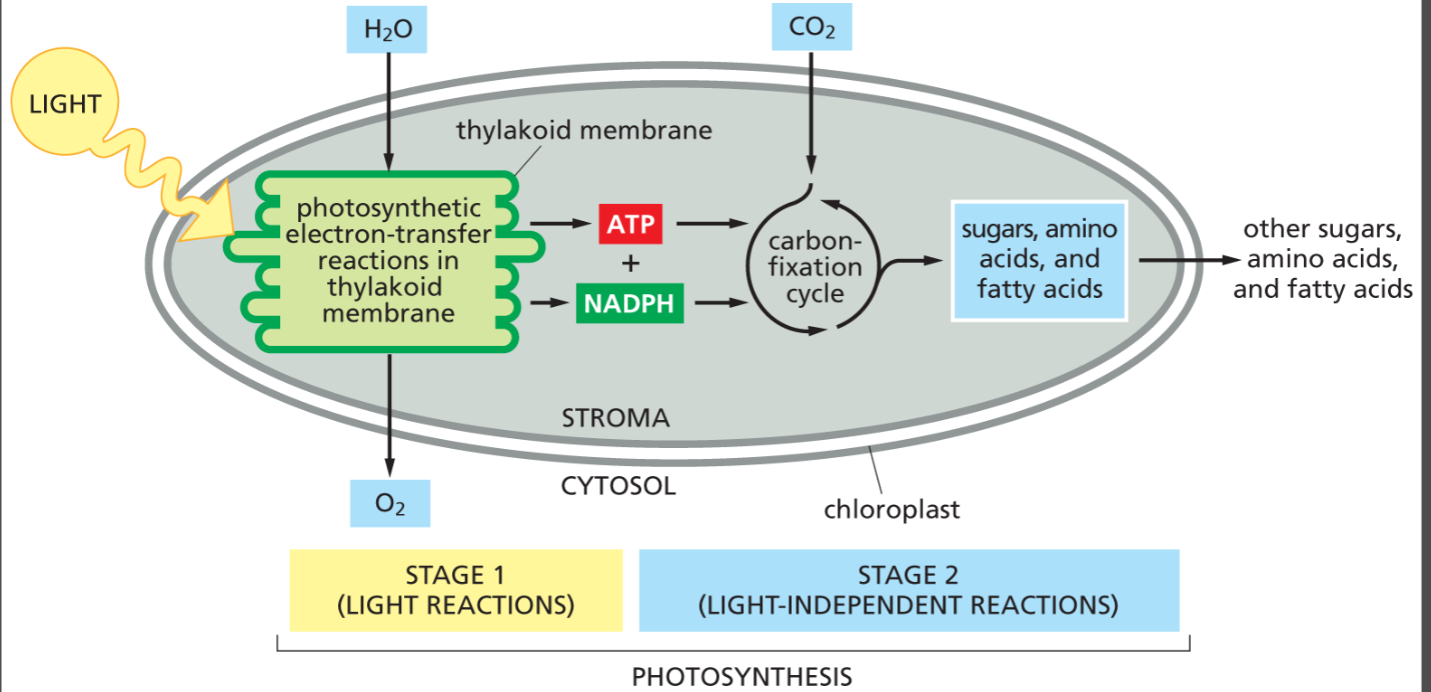
Light-dependent rxns occur in the thylakoid membrane of chloroplast
Light-ind. rxns occur in the chloroplast stroma and continues in the cytosol
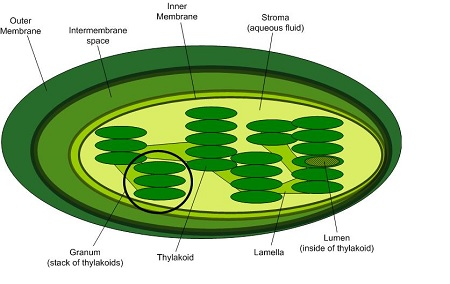
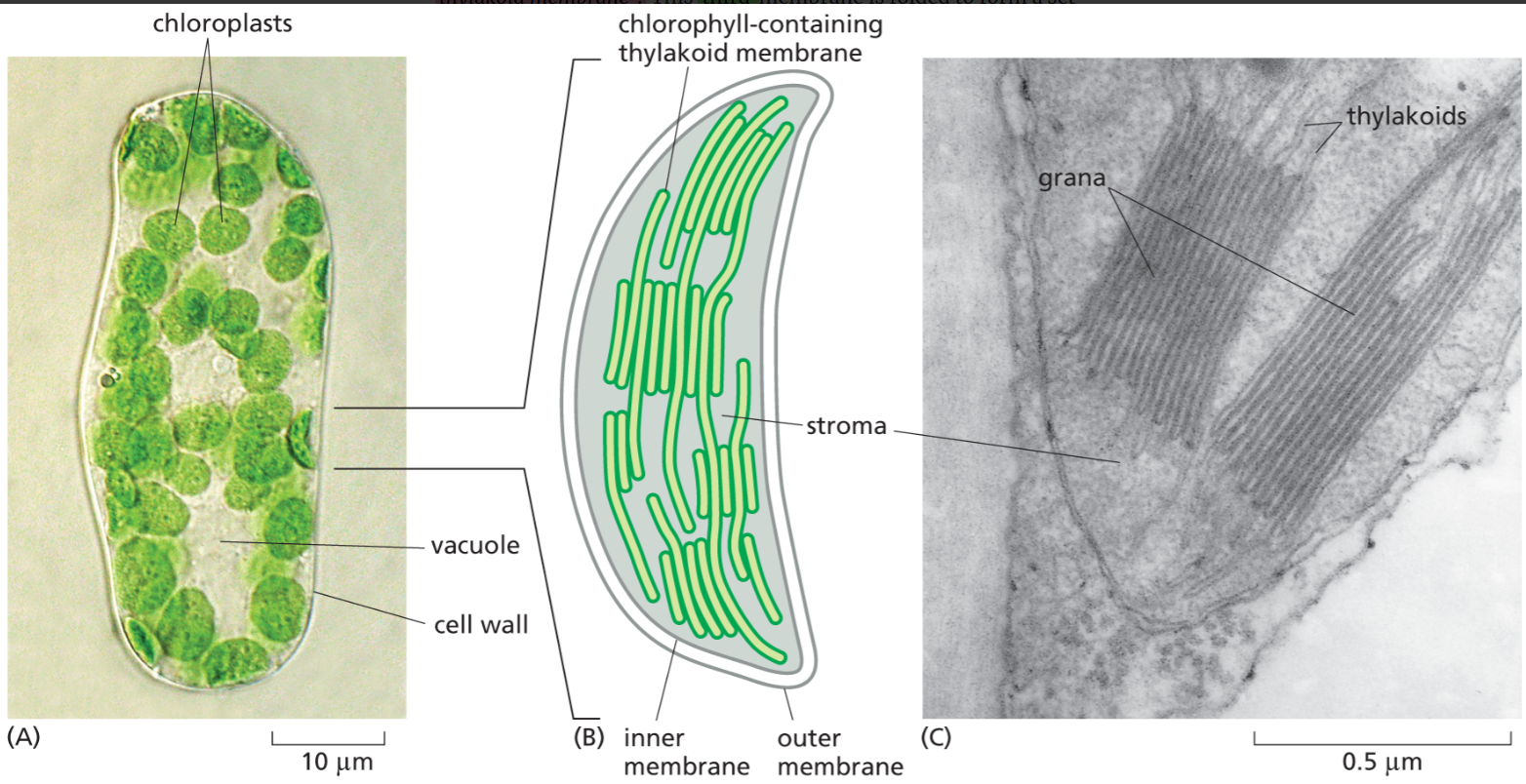
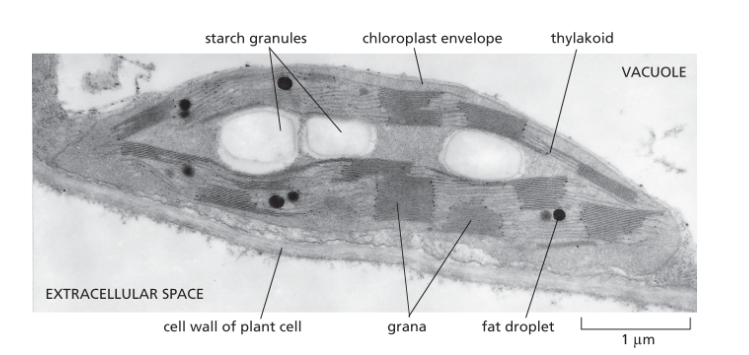
chloroplasts
specialized organelle in algae and plants that contains chlorophyll and is site of photosynthesis. capture light energy and use it to produce ATP + NADPH
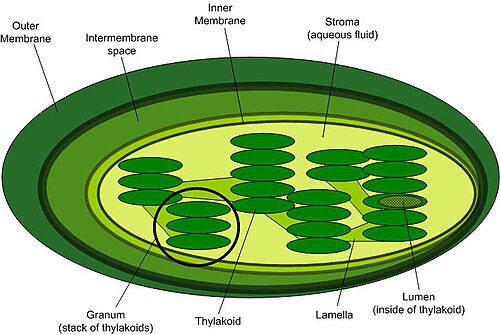
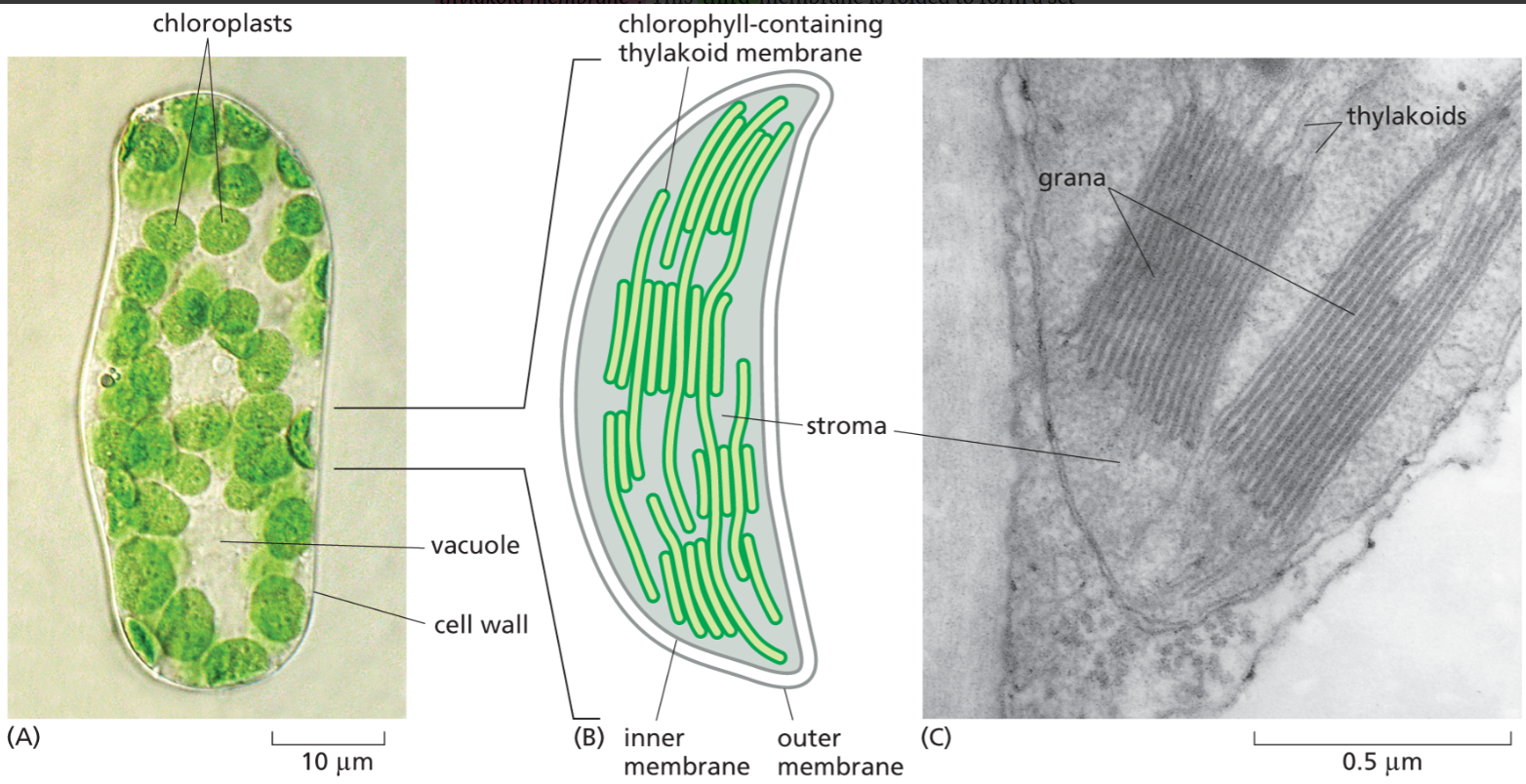
has 3 layers of membrane (outer, inner, and thylakoid membrane)
contains: stroma, thylakoids, grana (stack of thylakoids), ribosomes, chlorophyll
stroma
the large anterior space in a chloroplast’s inner membrane that contains enzymes needed to incorporate CO2 into sugars during carbon-fixation stage of photosynthesis
like the cytosol
thylakoid membrane
since a chloroplasts innner membrane cant have ETC, this thylakoid membrane contains:
light-capturing systems
electron transport chain
ATP synthase
it is the 3rd membrane of a chloroplast which is folded to form thylakoids.
thylakoids
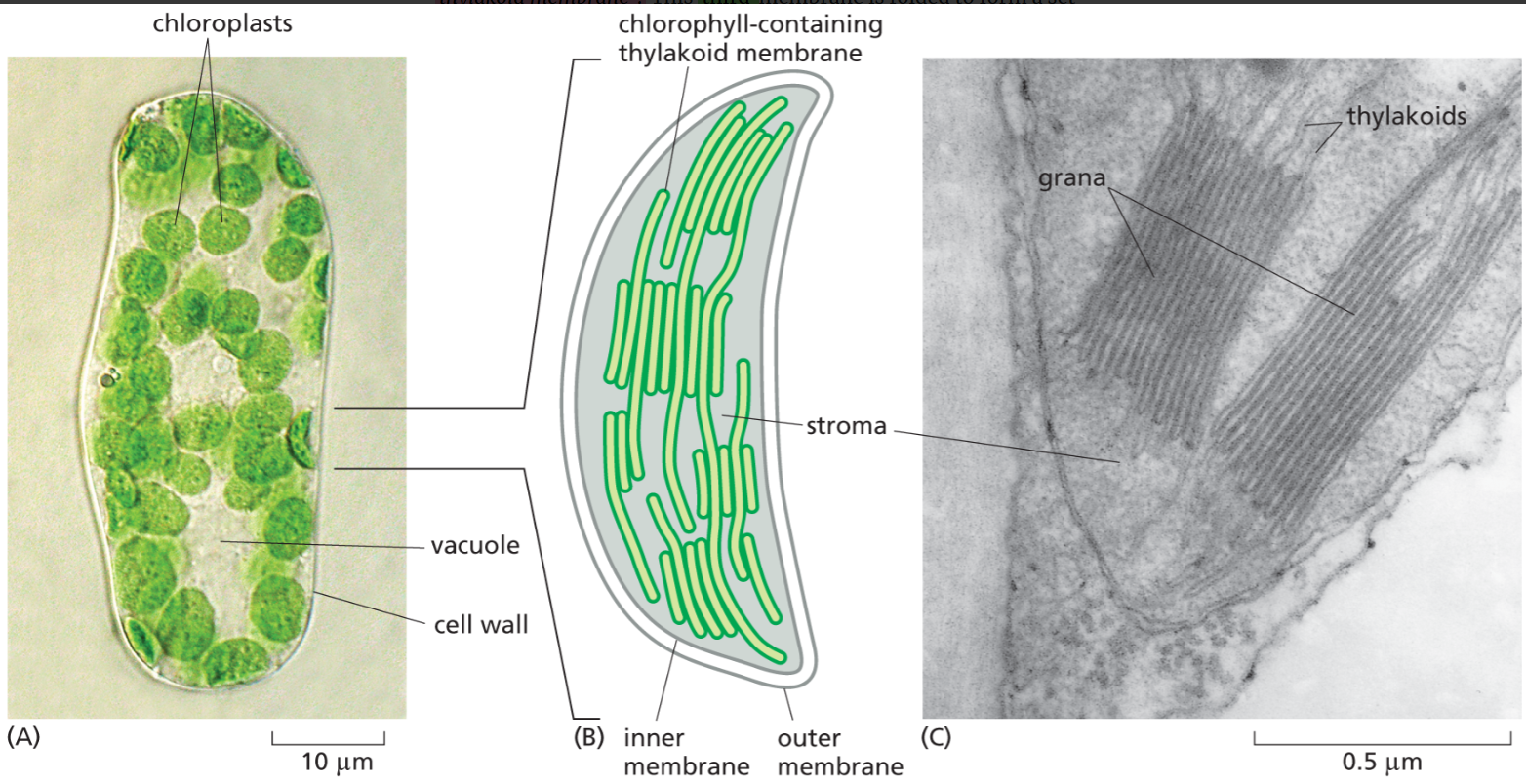
the flattened, disc sacs whose membranes contain the proteins and pigments that convert light energy into chemical energy in photosynthesis
contain chlorophyll which absorbs light!
grana
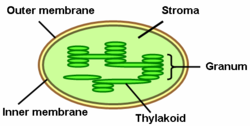
stacks of thylakoids in the chloroplasts
made up of thylakoids
chlorophyll
light-absorbing green pigment that absorbs energy from sunlight
located in the thylakoid membrane (embedded in PSI and PSII)
how do photosynthetic prokaryotes carry out photosynthesis?
since they dont have organelles, they use multiple layers of the plasma membrane to turn themselves into chloroplasts and carry out photosynthesis.
what are the 2 stages of photosynthesis?
1) light- dependent = series of photosynthetic electron-transfer rxns makes proton gradient producing ATP and NADPH.
electrons r extracted from H2O and oxygen is released
2) light-independent = carbon dioxide is assimilated (fixed) to produce sugars and a variety of other organic molecules. the ATP and NADPH are used to drive this
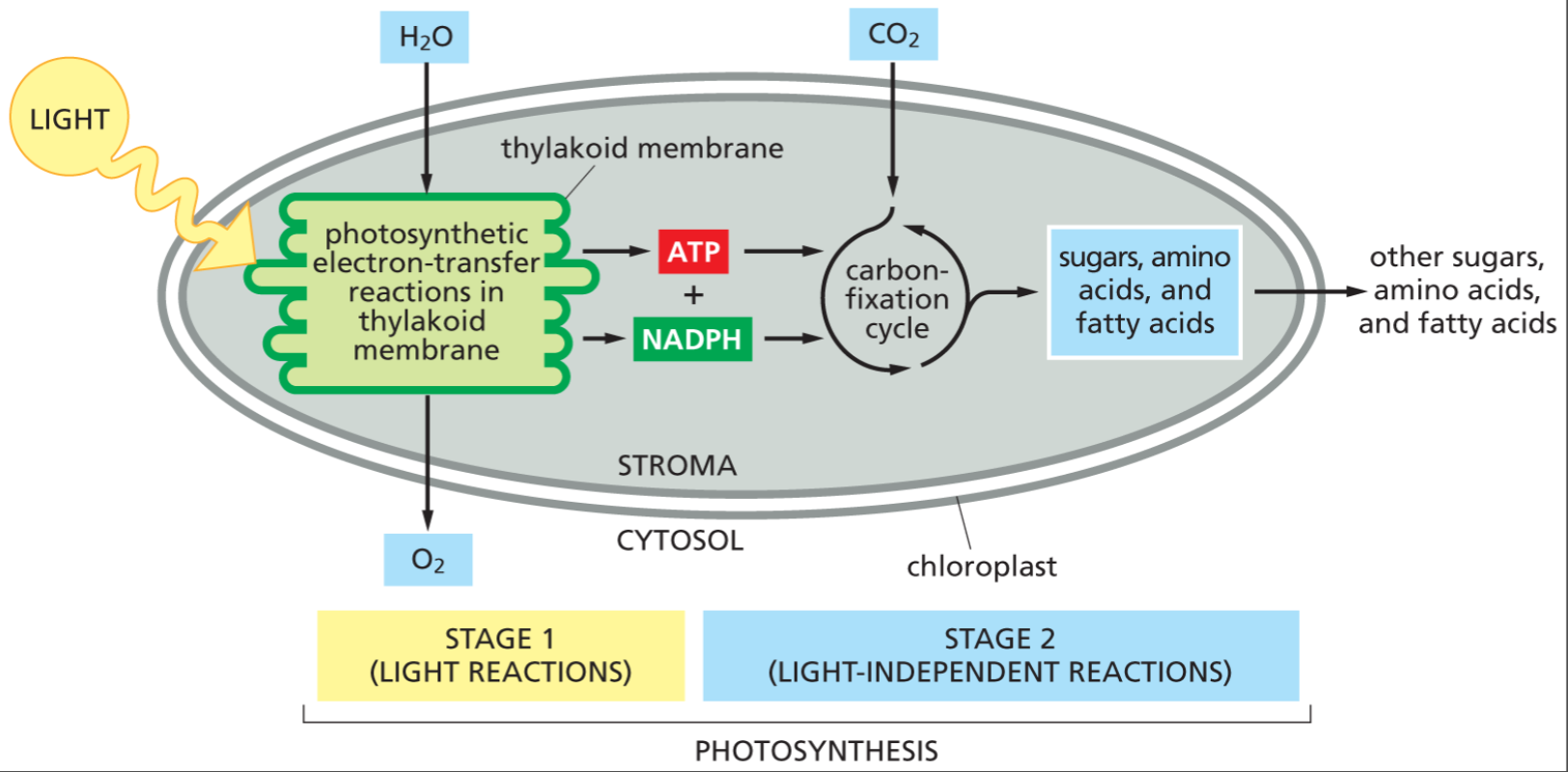
Where does Stage 1 (light reactions) occur?
Thylakoid membrane
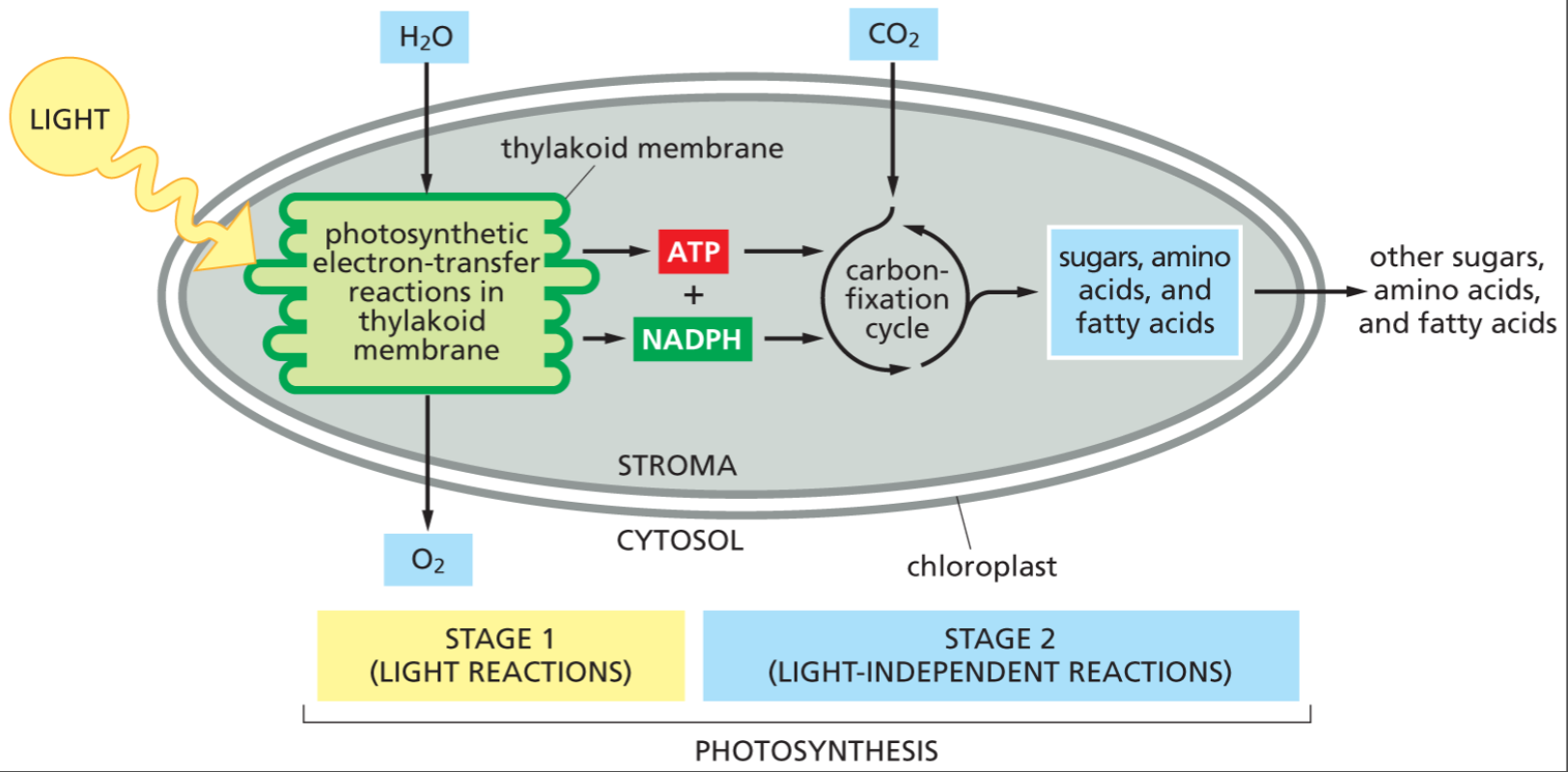
Where does Stage 2 (carbon fixation/Calvin cycle) occur?
Stroma (and continues in cytosol)
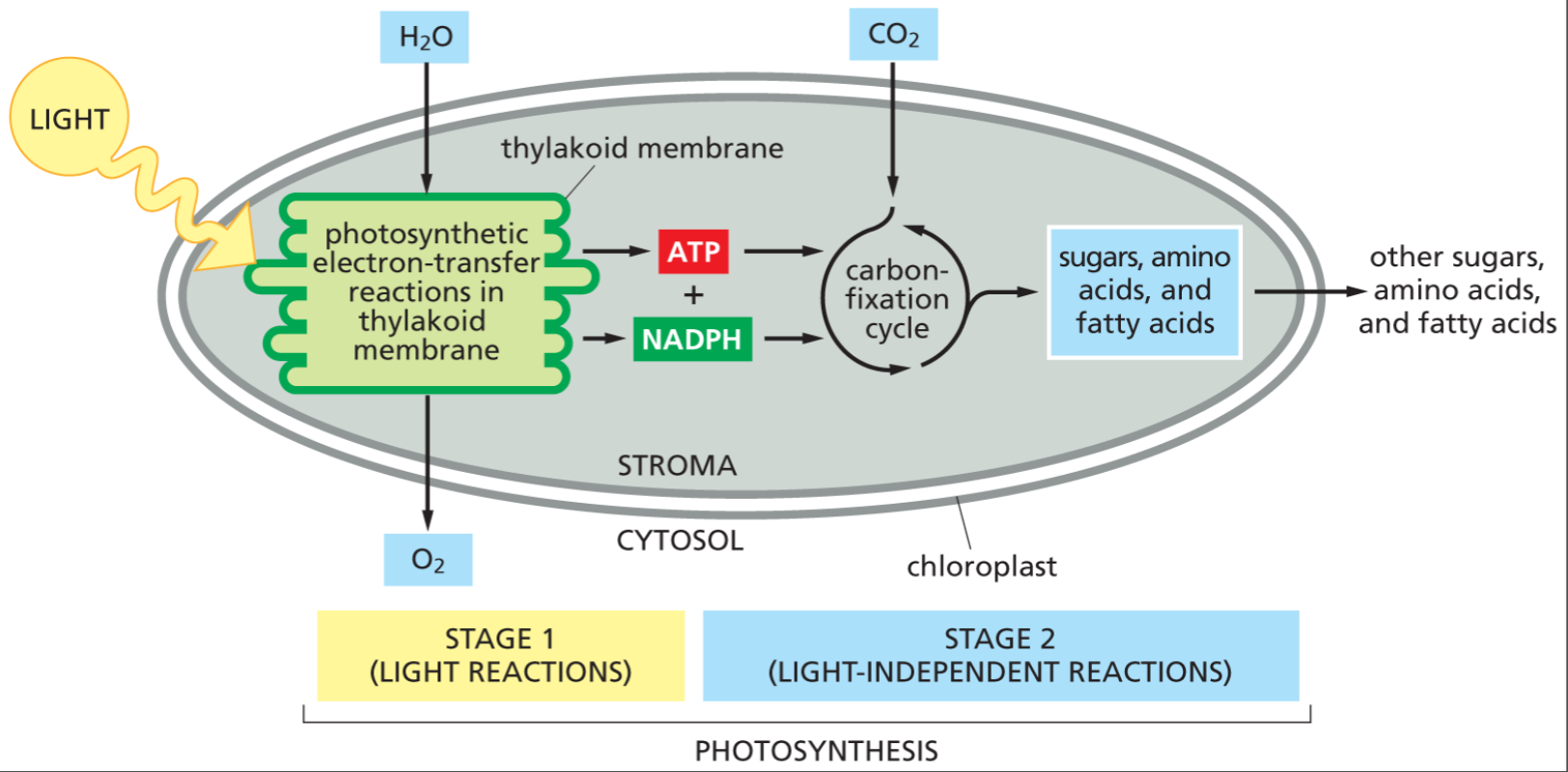
How is NADPH different from NADH?
NADPH is used for biosynthesis (photosynthesis); NADH is used in energy production (mitochondria)
where do the high energy electrons come from in photosynthesis?
Light excites electrons in chlorophyll → those become the high-energy electrons used in photosynthesis.
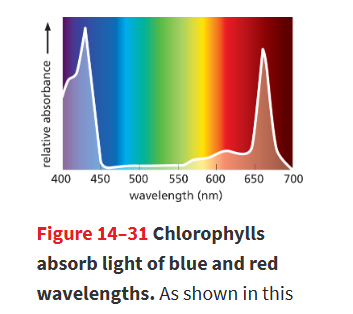
what light does chlorophyll absorb?
blue/purple and red
they absorb green light poorly so its reflected back to our eyes
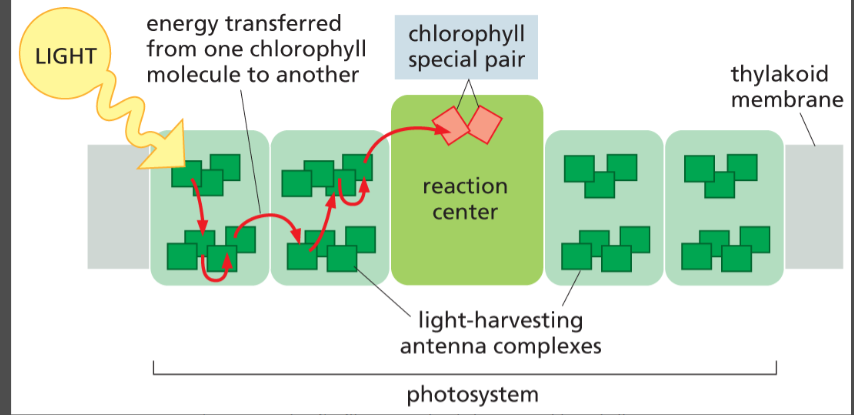
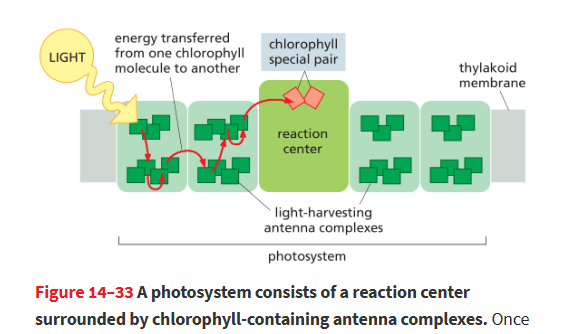
photosystems
Large multiprotein complex containing chlorophyll that captures light energy and converts it into chemical-bond energy
- consists of a set of antenna complexes and a reaction center.
in stage 1 of photosynthesis
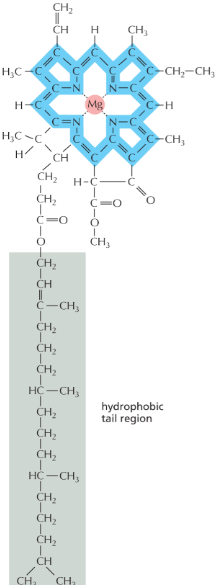
chlorophylls structure
has a poryphrin ring with magnesium in the center to allow it to absorb energy from light
the hydrophobic tail region holds chlorophyll in thylakoid membrane
antenna complex
In chloroplasts and photosynthetic bacteria, the part of the membrane-bound photosystem that captures energy from sunlight
contains an array of proteins that bind hundreds of chlorophyll molecules and other photosensitive pigments
Both the antenna complex and the reaction center are parts of a photosystem.
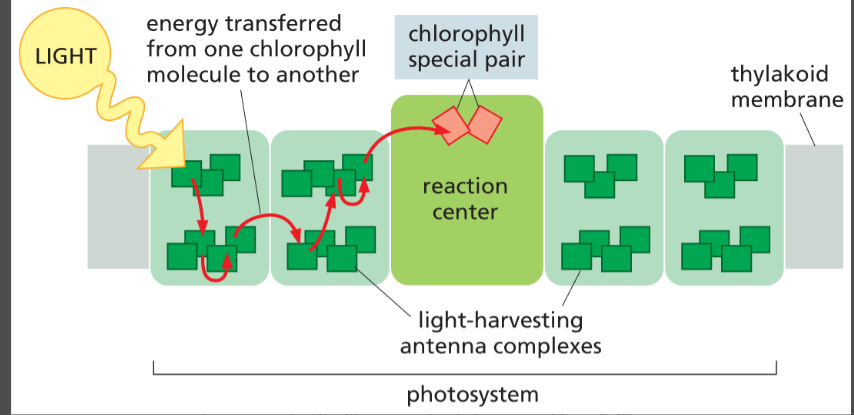
reaction center
In photosynthetic/thylakoid membranes, a protein complex that contains a special pair of chlorophyll molecules
it performs the photochemical reactions that convert the energy of photons (light) into high-energy electrons for transport down the photosynthetic electron-transport chain so it turns into chemical energy
the special pair is found here, not the antennae complex
Both the antenna complex and the reaction center are parts of a photosystem.
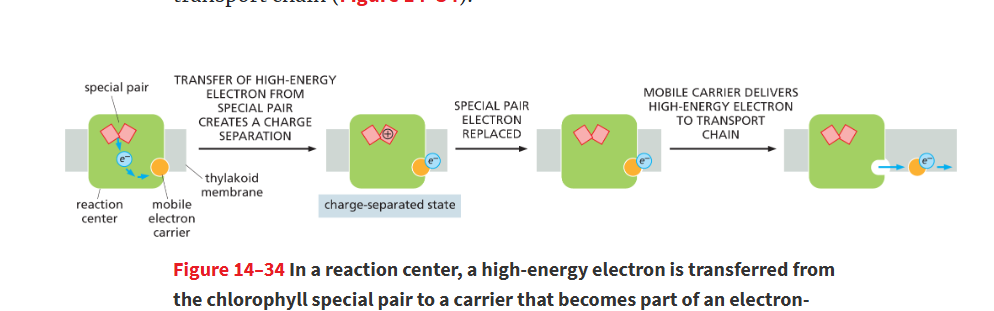
special pair
a chloropyll dimer which holds its electrons at a lower energy than antennae chlorophylls, so energy transferred to it gets trapped in there
h-energypositioned next to electron carriers in rxn center that accept the high electrons
electron transfer creates charge separated state which converts light energy → chemical energy
charge separation
happens when a high-energy electron is passed from chlorophyll to an electron carrier. The chlorophyll special pair becomes positively charged, and electron carrier becomes negative
electron must be replaced
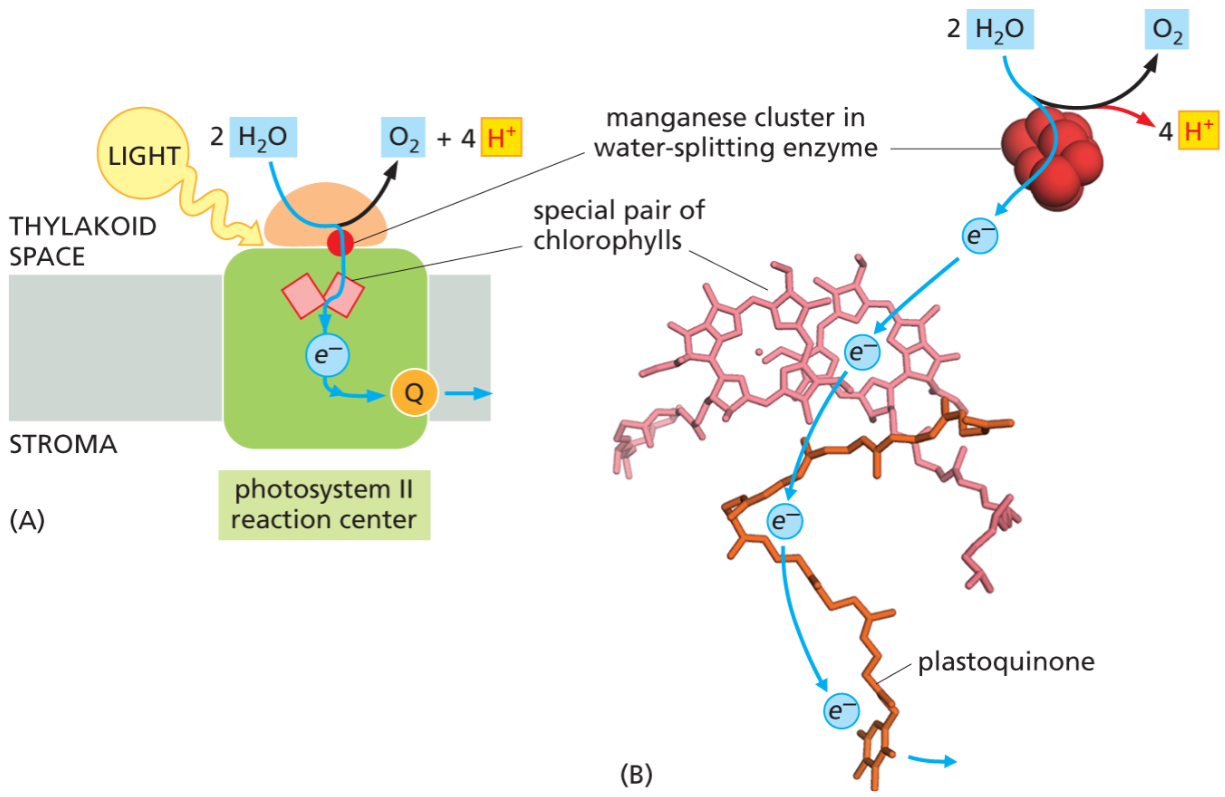
what is the strongest known oxidizing agent?
Photosystem II due to its water splitting ability!
produces oxygen byproduct
Which photosystem is mainly responsible for ATP production?
Photosystem II
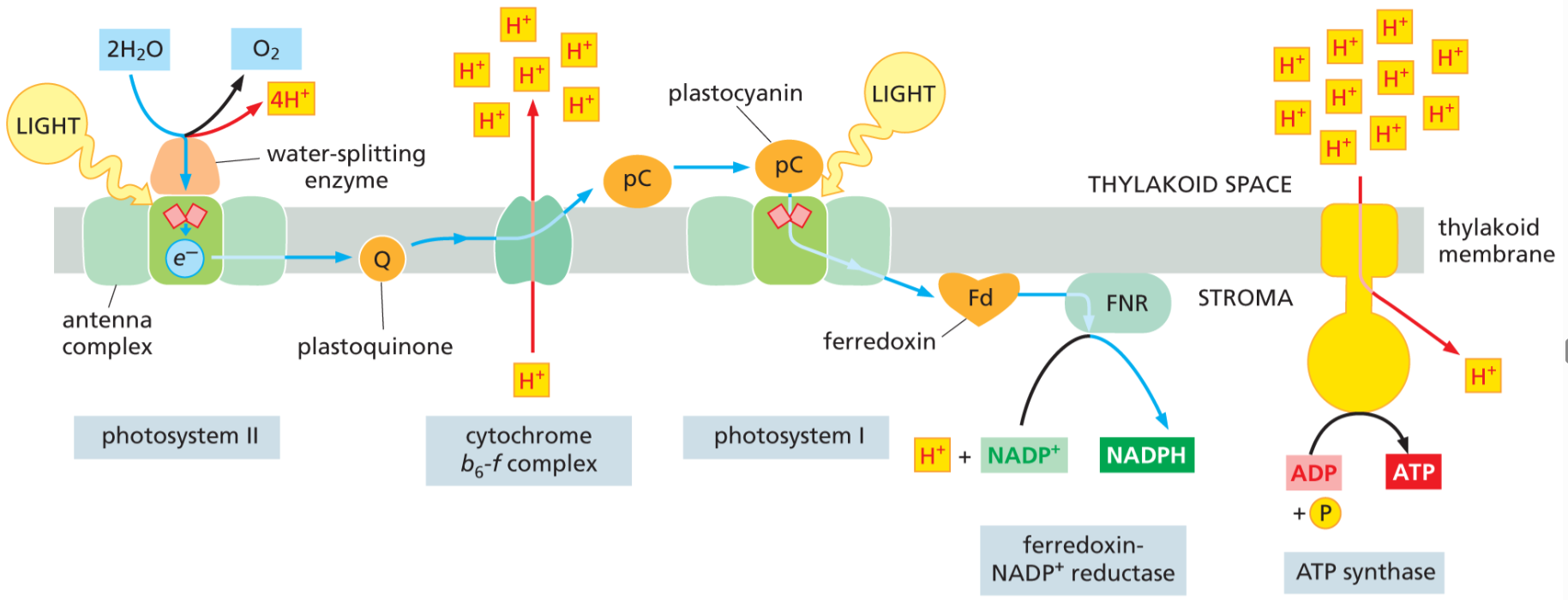
Which photosystem is mainly responsible for NADPH production?
Photosystem I
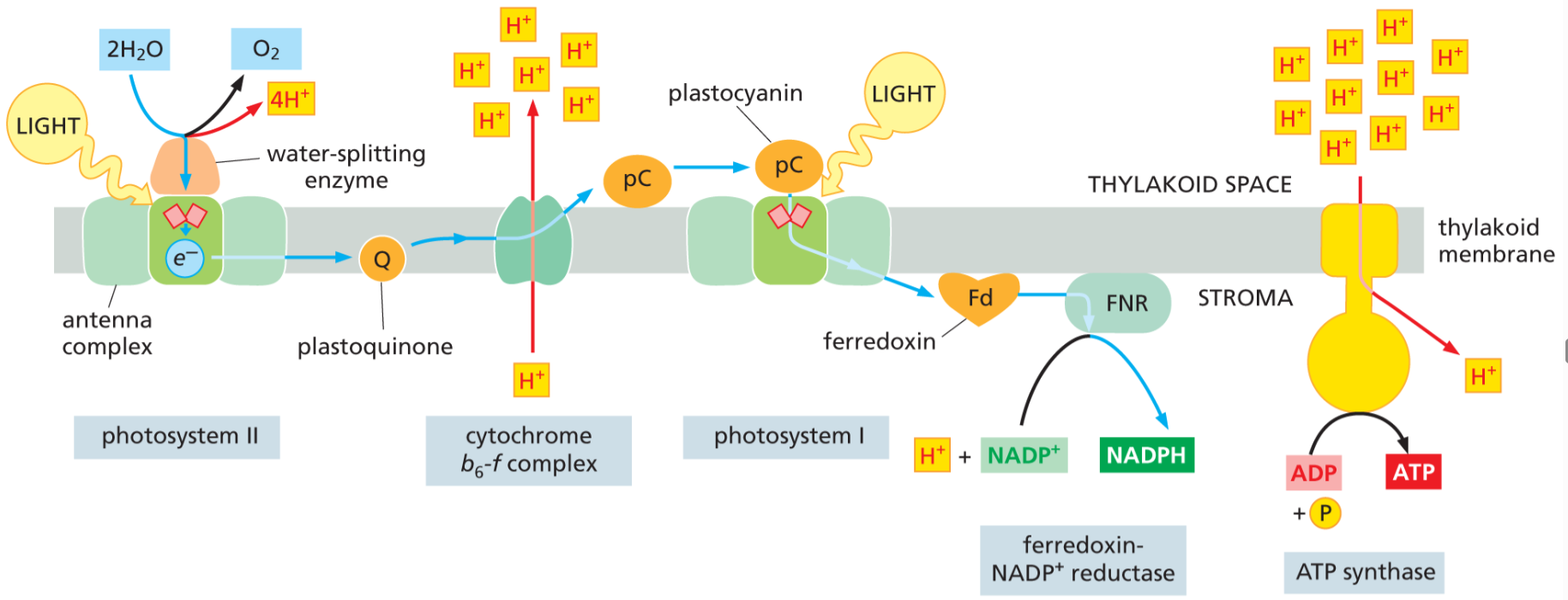
What is the main role of Photosystem II vs Photosystem I?
PSII → ATP production (via proton gradient)
Splits water, provides electrons
PSI → NADPH productionRe-energizes electrons to make NADPH
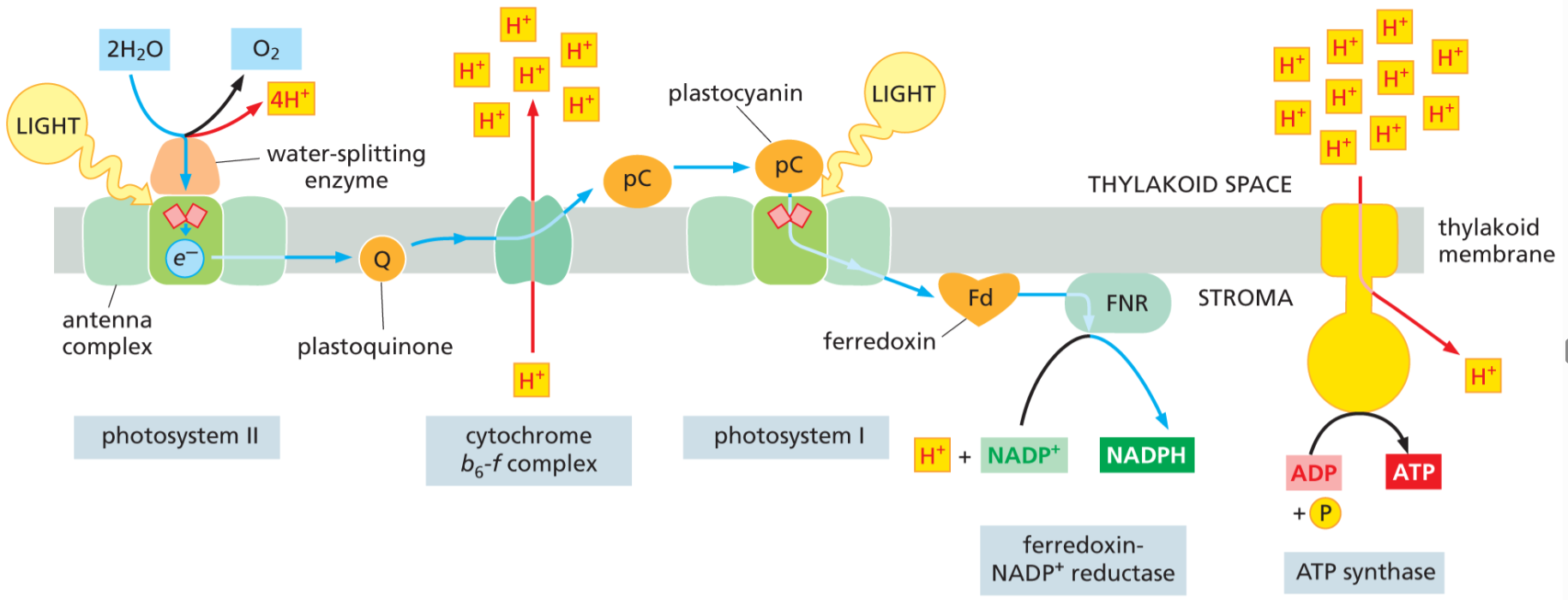
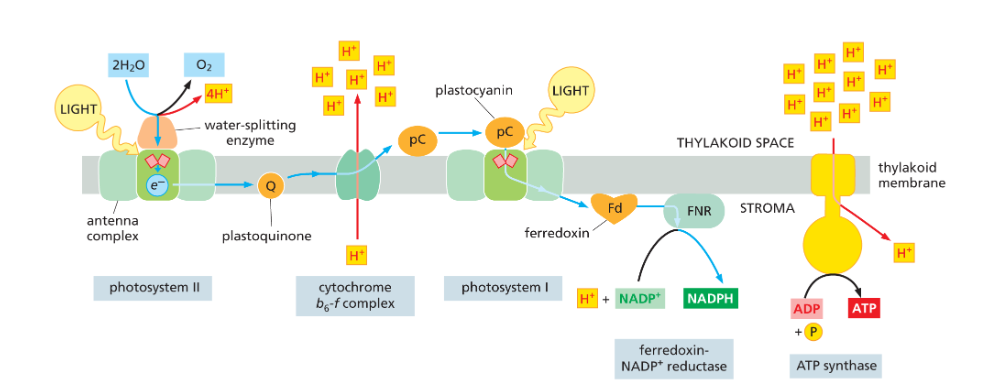
plastoquinone
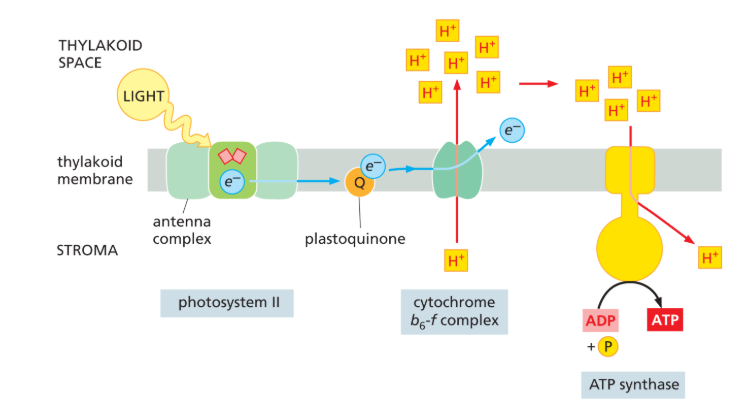
a mobile electron carrier in thylakoid membrane that accepts electrons from PSII rxn center and then passes them to cytochrome b6-f complex (proton pump).
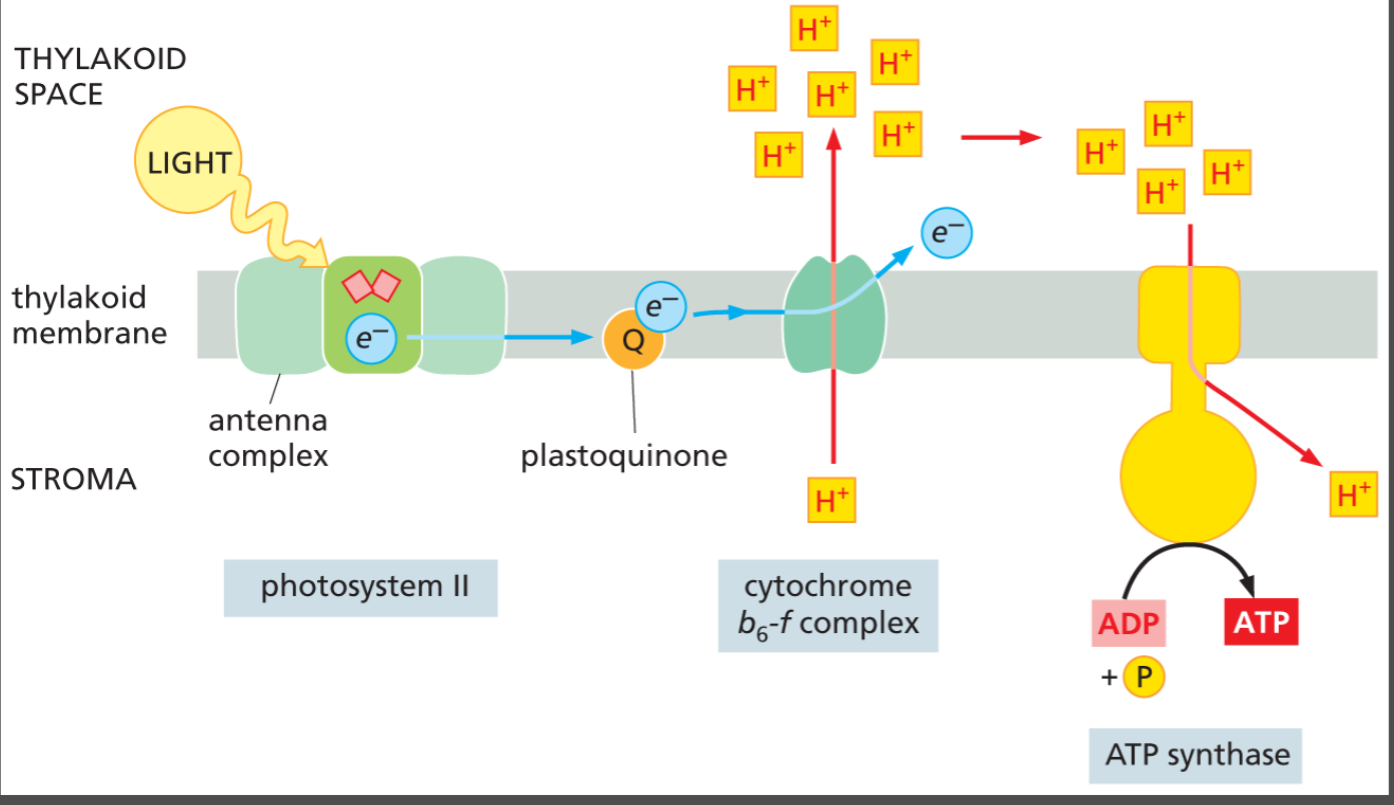
What happens when Photosystem II absorbs light?
Its reaction center transfers high-energy electrons to plastoquinone
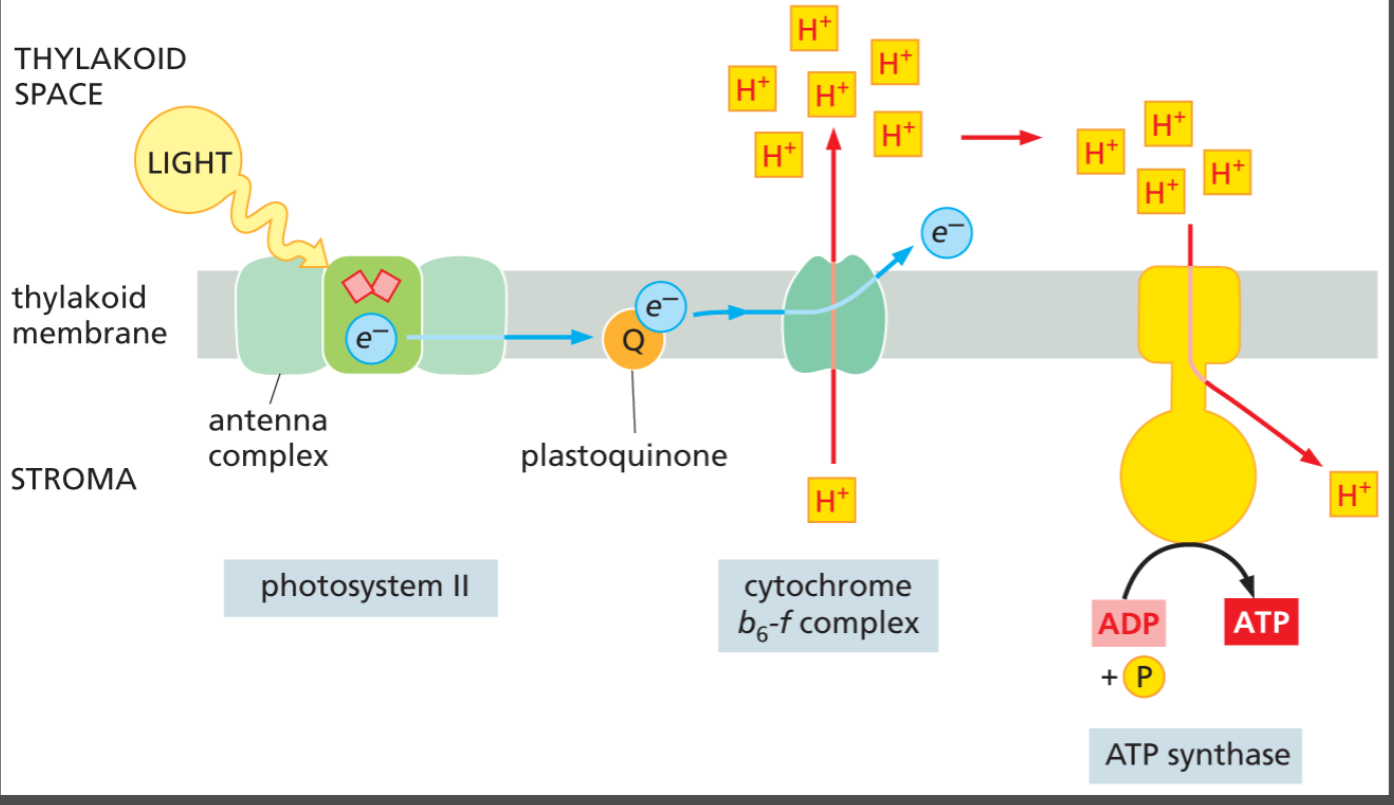
cytochrome b6-f complex (proton pump)
accepts electrons from plastoquinone and uses electron energy to pump H⁺ and create a proton gradient.
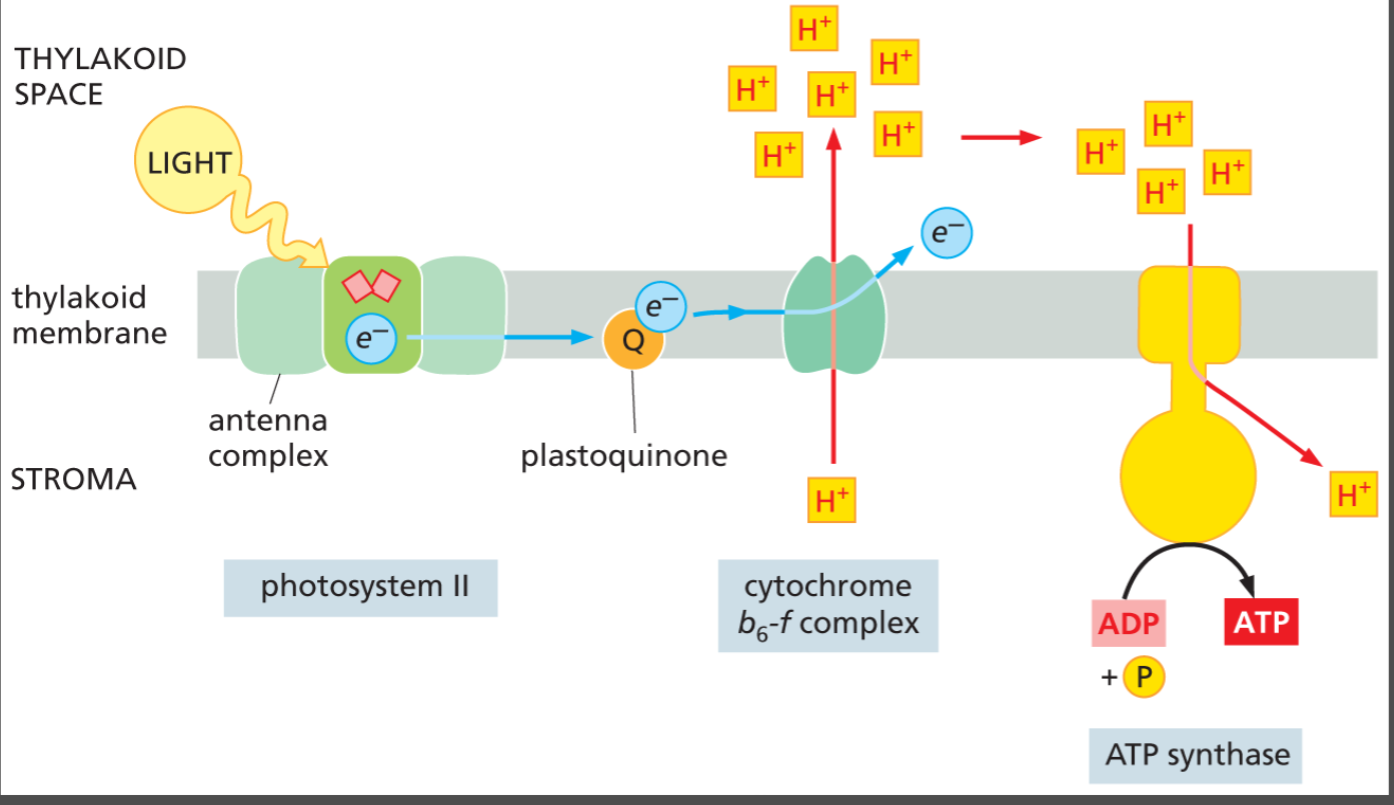
this proton gradient will drive ATP synthase
PUMPS PROTONS FROM STROMA INTO THYLAKOID SPACE!
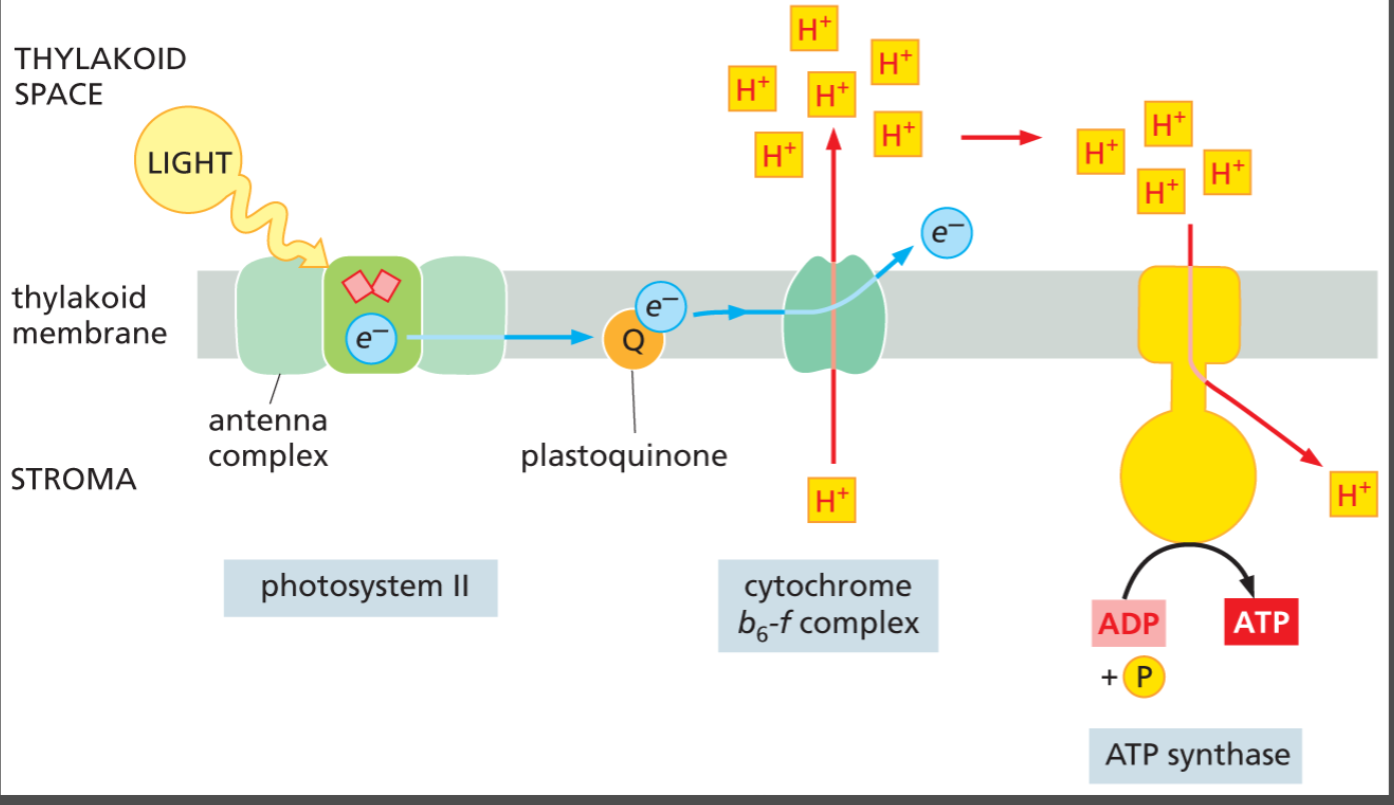
What is the result of the proton gradient in the light dependent rxns?
the proton gradient created by cytochrome b6-f complex drives ATP synthesis via ATP Synthase
What happens when Photosystem I absorbs a second strike of light?
Its reaction center transfers electrons to ferredoxin
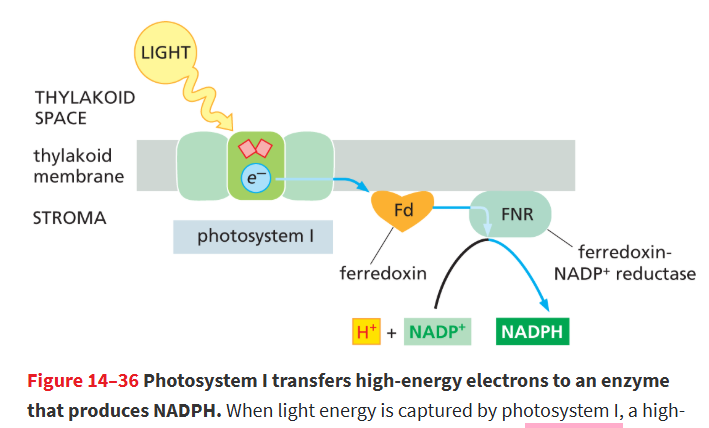
it will ultimatelty transfer electrons through an ETC that will produce NADPH
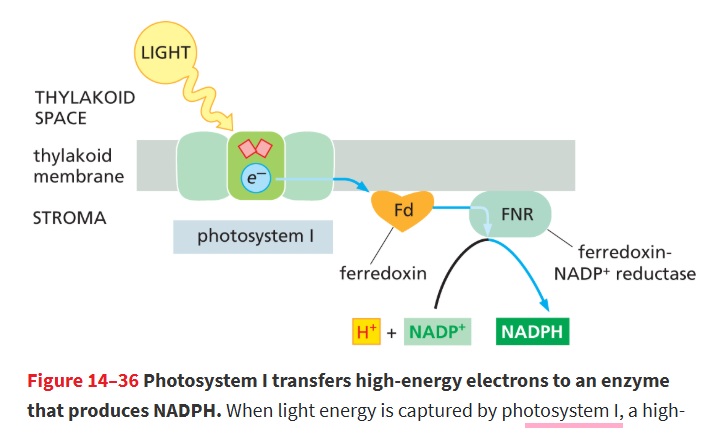
ferredoxin
a mobile electron carrier that accepts high energy electrons from PSI rxn center and brings them to an enzyme that uses electrons to reduce NADP+ → NADPH
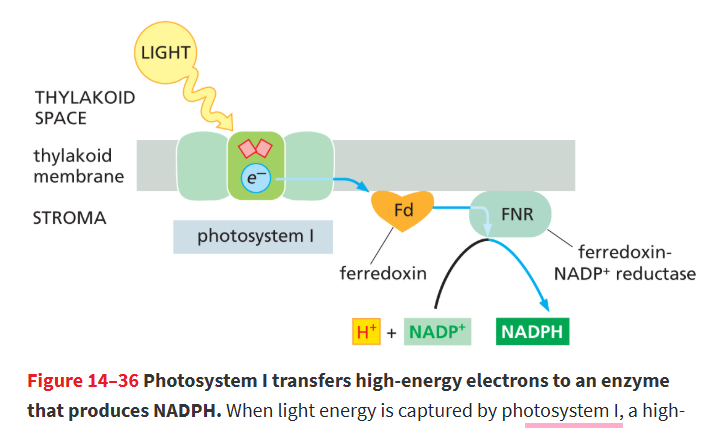
ferredoxin-NADP+ Reductase
the enzyme that accepts electrons from ferredoxin to reduce NADP+ → NADPH in PSI
What is the final electron acceptor in photosynthesis?
NADP⁺ → becomes NADPH
What is the overall purpose of the light reactions?
Convert light energy into ATP and NADPH for carbon fixation in stage 2 of photosynthesis
ultimately wants to produce sugars
the cytochrome b6-f complex proton pump will pump protons from where to where?
from the stroma into the thylakoid space
so after atp synthase, protons will be released into stroma
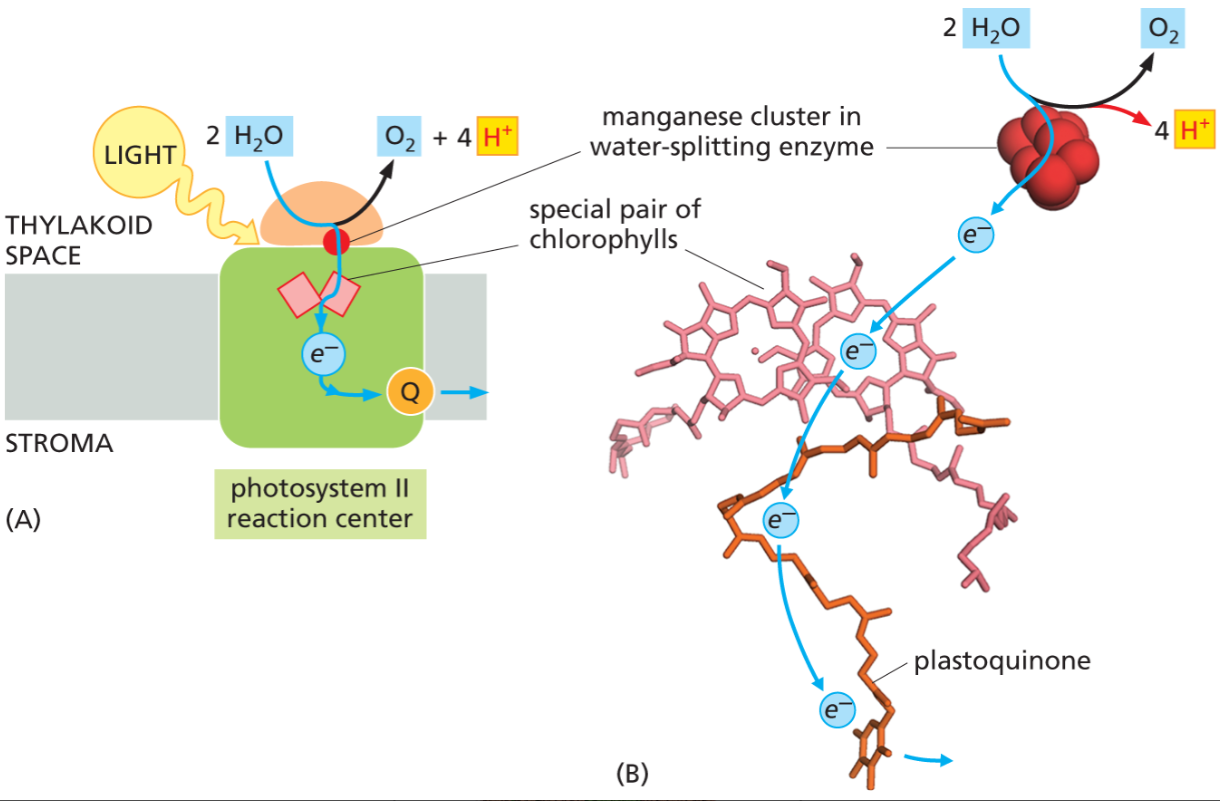
What enzyme splits water in Photosystem II?
A manganese-containing water-splitting complex
it removes electrons from 2 water molecules one at a time until 4 electrons have been removed
these electrons then replace the electrons lost by 4 excited chlorophyll molecules
oxygen is released as a bypoduct!
Where do the replacement electrons for Photosystem II come from?
Water (H₂O)
a manganese containing enzyme will remove the electrons from 2 water molecules one at a time until it reaches 4 electrons to replace the ones lost by 4 excited chlorophyll special pairs
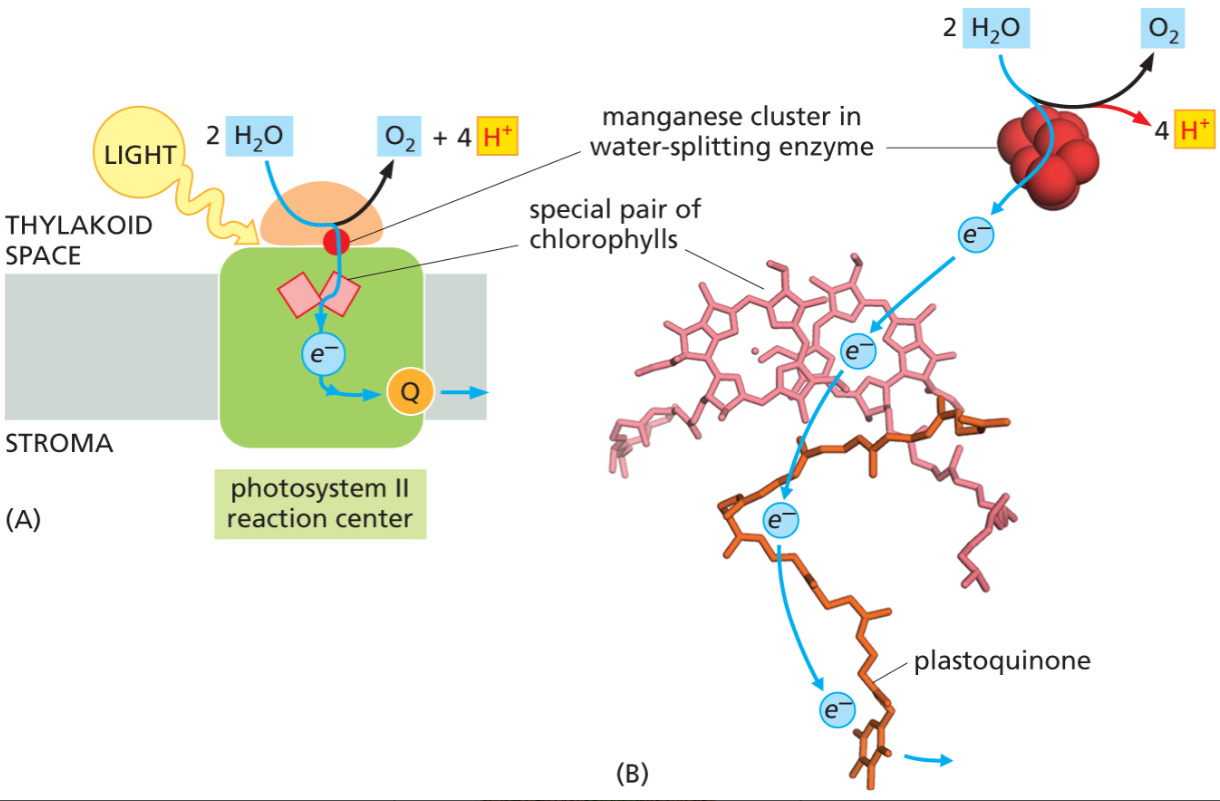
How many electrons must be removed to release O₂?
4 electrons
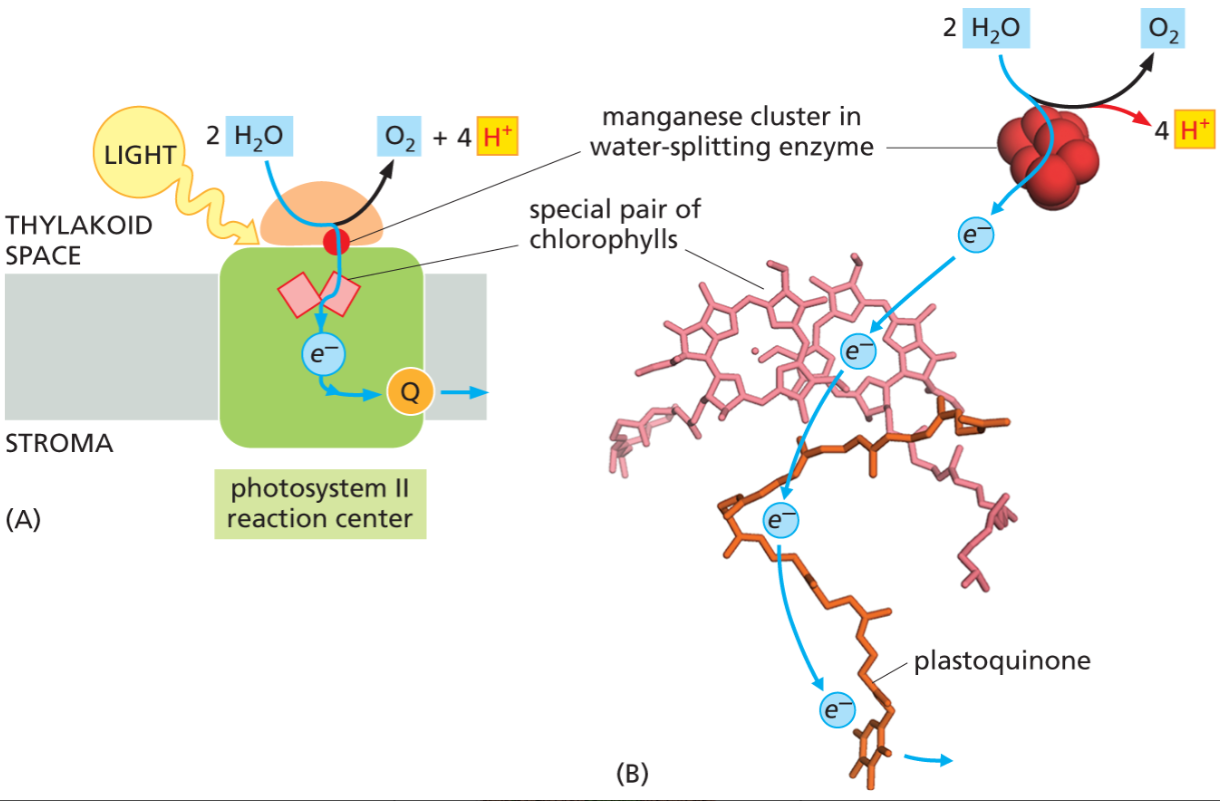
How many water molecules are needed to produce one O₂?
2 water molecules
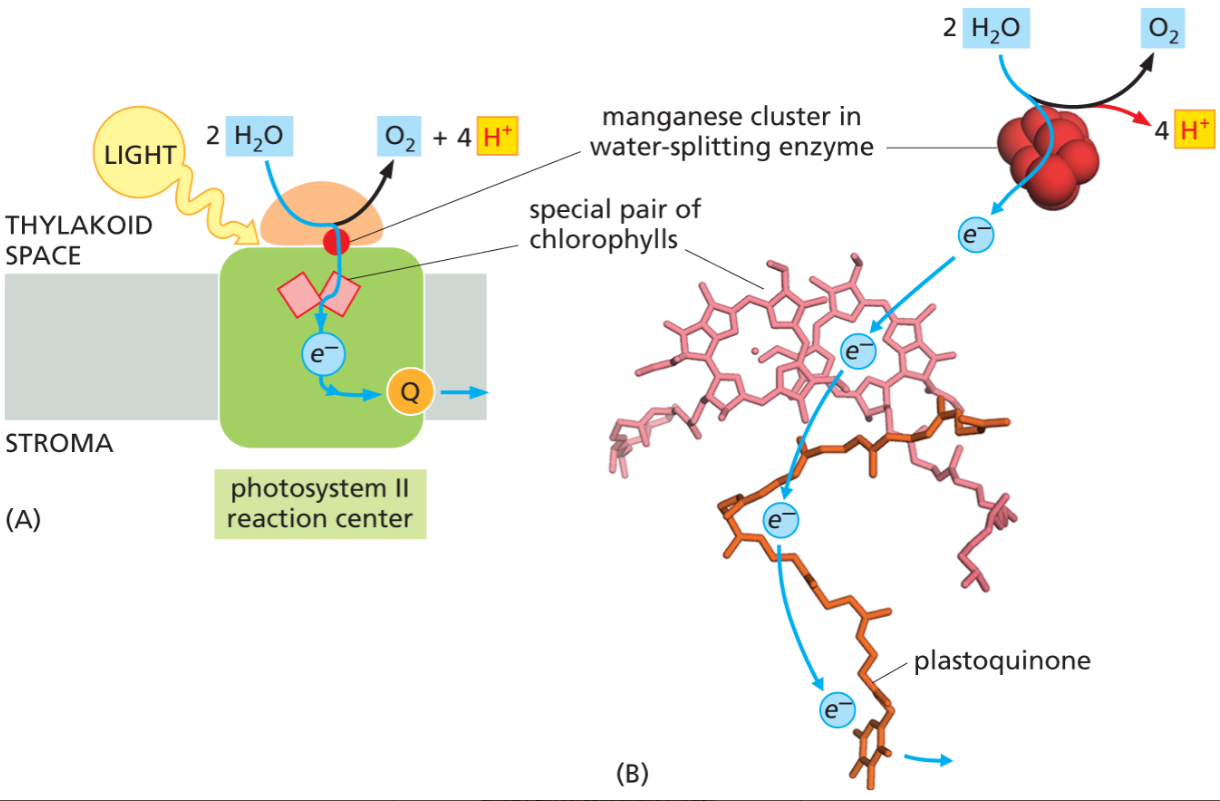
Why does the water-splitting complex wait for 4 electrons to replenish PSII chlorophyll rxn center?
To prevent formation of harmful reactive intermediates
What is the source of all atmospheric oxygen?
Water splitting in Photosystem II
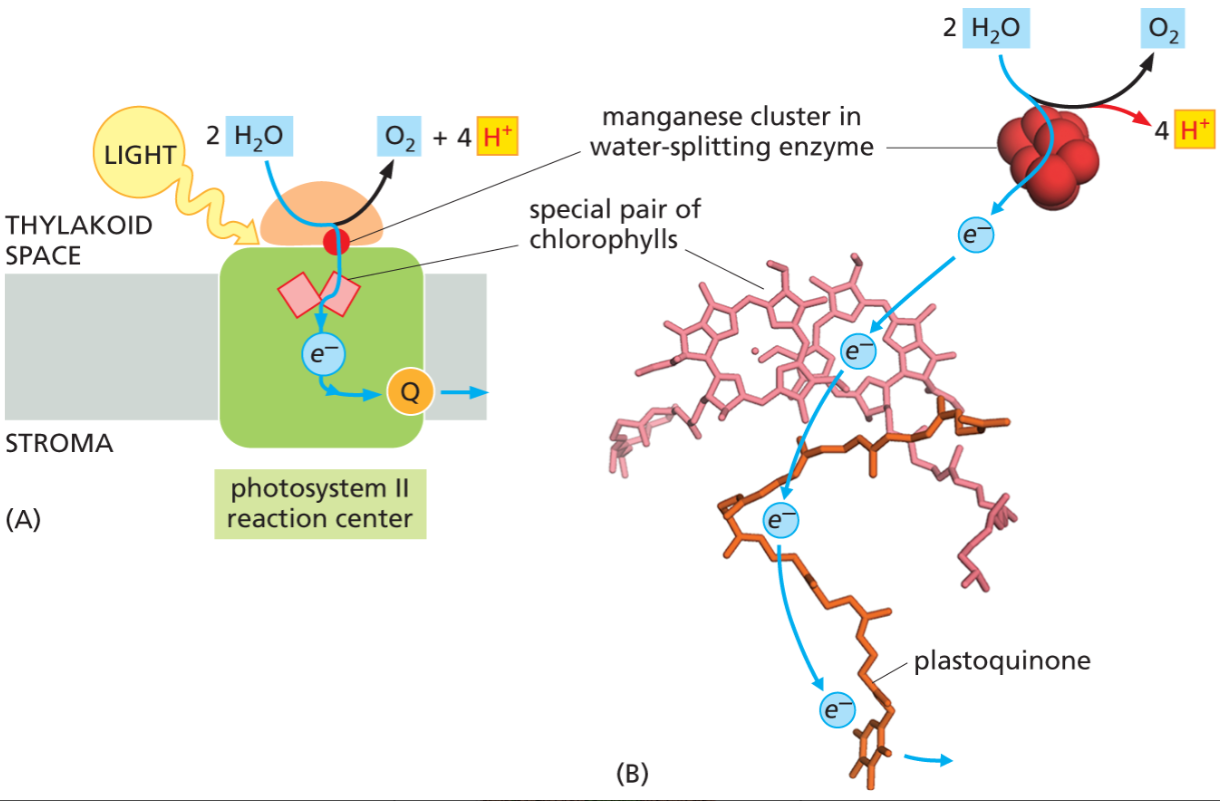
Where does Photosystem I get its electrons?
From Photosystem II
they’re transferred through ETC
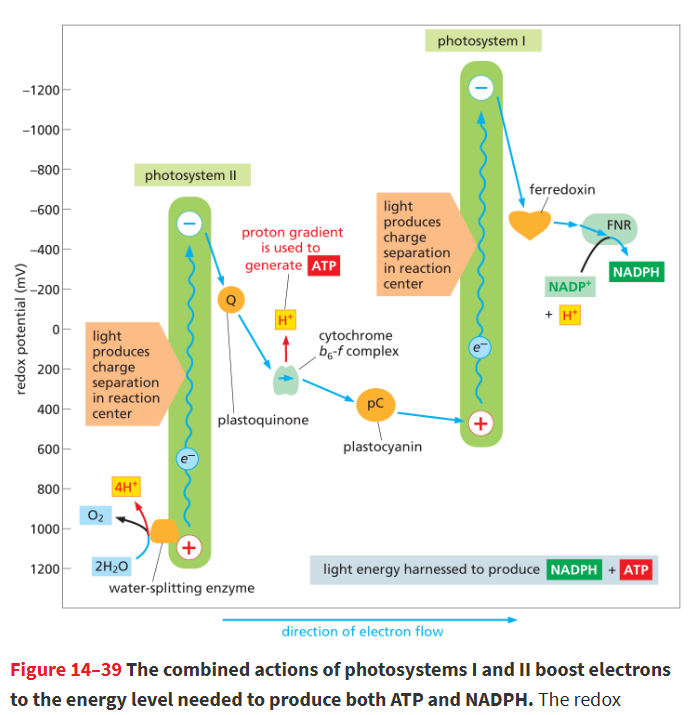
the two photosystems work in series, such that the chlorophyll special pair in photosystem I serves as the final electron acceptor for the electron-transport chain that carries electrons from photosystem II.
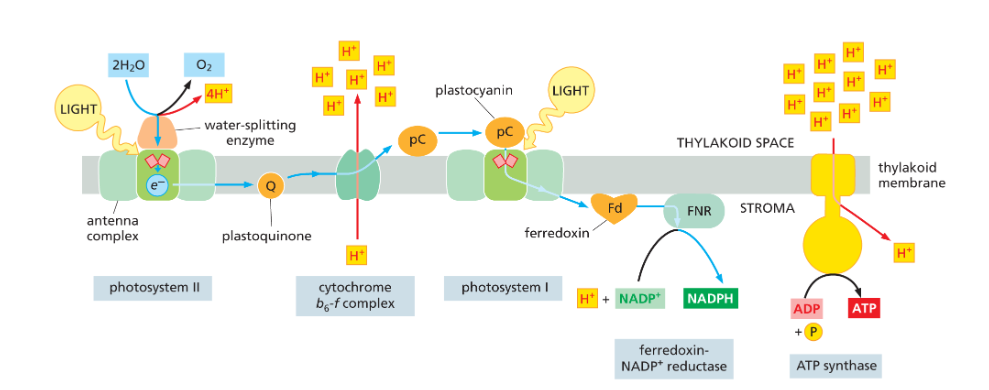
plastocyanin
a mobile electron carrier that carries electrons from PSII → PSI
After e- removed from water by PSII are passed through proton pump, plastocyanin picks them up and carries them to PSI to replace the electrons lost by its excited chlorophyll special pair.
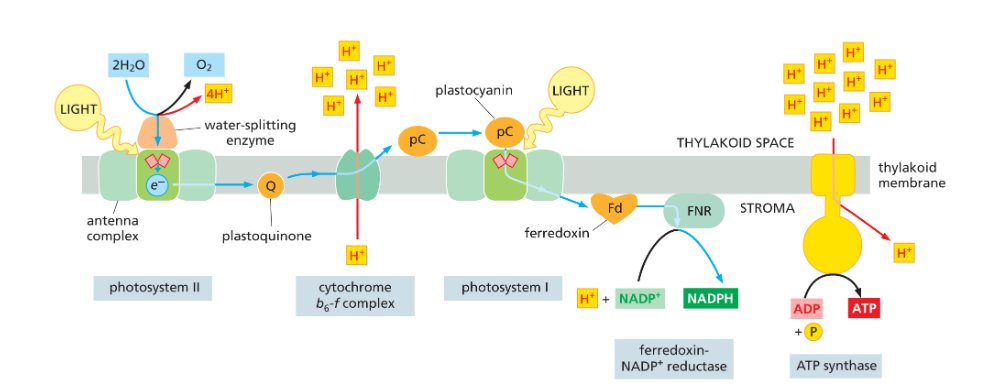
What happens to electrons when they reach Photosystem I?
They are re-excited by light to a higher energy level
What is the overall electron flow in photosynthesis?
Water → Photosystem II → ETC → Photosystem I → NADPH
linear flow of electrons
what is the final electron acceptor for PSII?
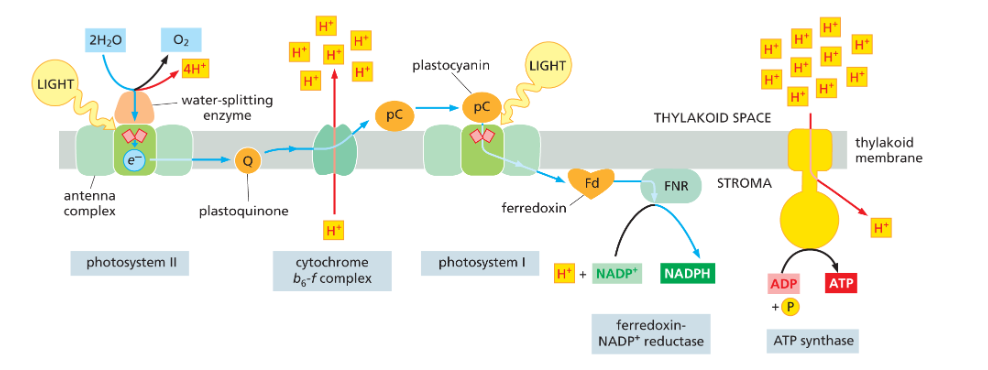
the chlorophyll special pair in PSI
linear flow of electrons from H2O to NADPH
there’s 2 photosystems and 2 ETC
mobile electron carriers connect the photosystems (plastocyanin)
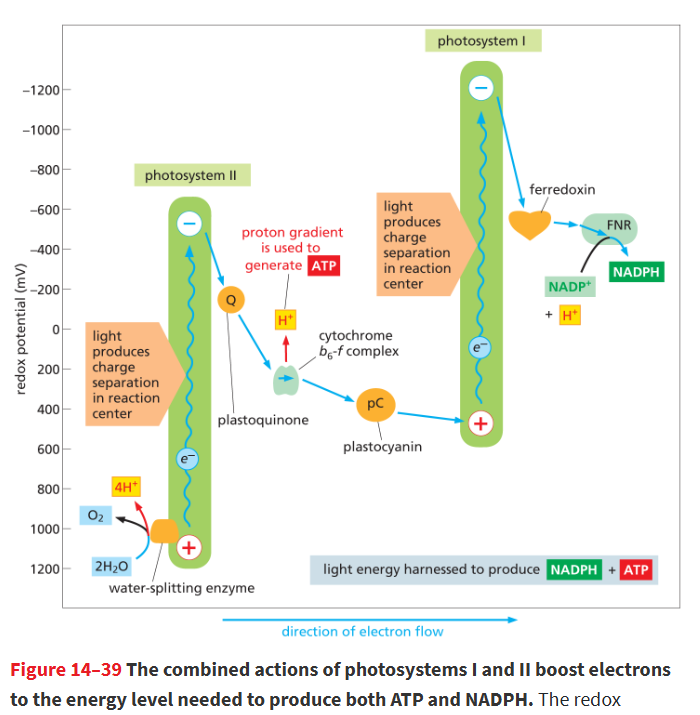
Why are two photosystems needed?
To provide enough energy to move electrons from water to NADPH
electron movement through ETCs provides energy to produce ATP and NADPH
carbon fixation (Calvin Cycle/ light independent rxn)
The process of converting CO₂ → organic molecules (sugars)
ATP and NADPH from light-dependent rxn will be used as energy to drive this
occurs in the chloroplast stroma!
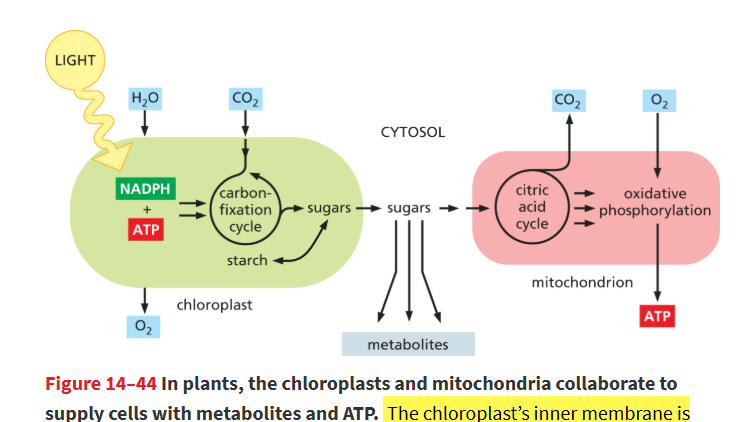
Why can’t ATP and NADPH leave the chloroplast?
The chloroplast inner membrane is impermeable to them
SO, to expoirt energy out of cell, a a 3-carbon sugar (G3P) that can be transported out must be produced
How do chloroplasts export energy to the rest of the cell since ATP?NADPH cant leave chloroplast?
By producing a 3-carbon sugar (G3P) that can be transported out to cytosol by carrier proteins
glyceraldehyde 3-phosphate
Rubisco
the key enzyme in carbon fixation and most abundant enzyme on earth.
it fixes CO2 by attaching it to ribulose 1,5-bisphosphate (RuBP)
works v slowly which is why it’s so abundant
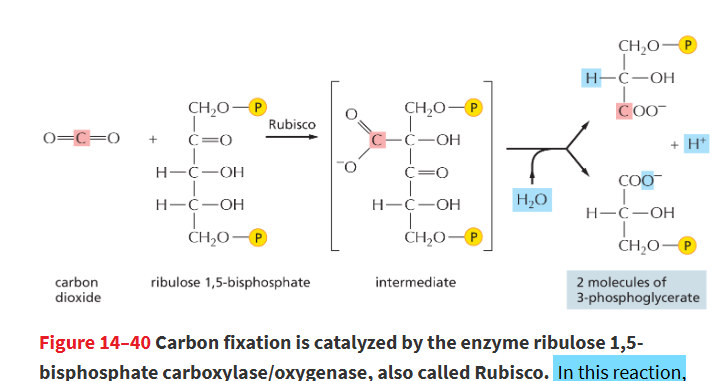
what is Rubisco’s actual name
ribulose 1,5-bisphosphate carboxylase/oxygenase
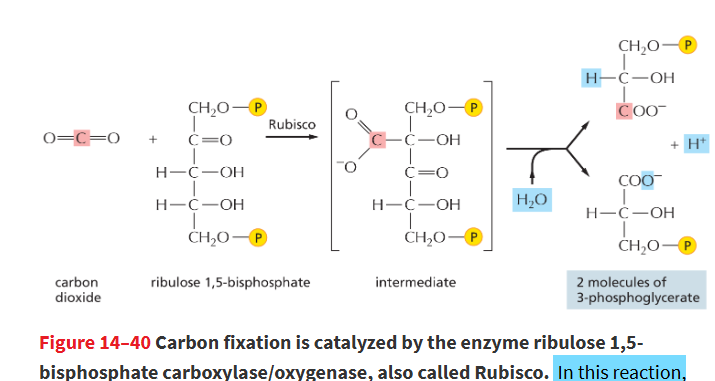
What is the product when CO₂ combines with RuBP (ribulose 1,5-bisphosphate)?
a covalent bond forms btwn CO2 and RuBP after Rubisco joins them together.
Then, the intermediate reacts w H2O (hydrolysis) to produce 2 molecules of 3-phosphoglycerate
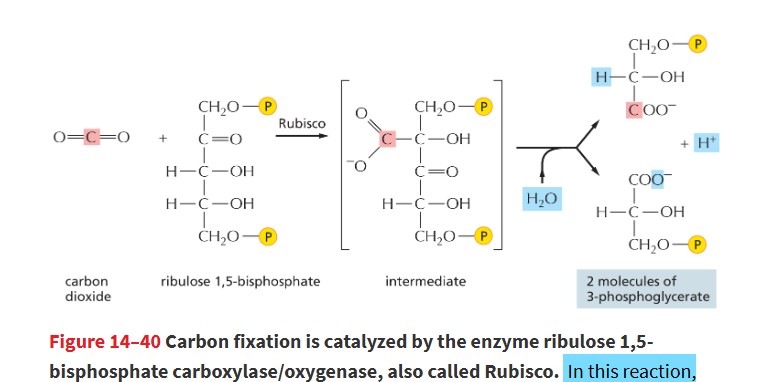
3-phosphoglycerate
2 molecules of this r created after hydrolysis of the intermediate btwn CO2 and Ribulose 1,5-bisphosphate (6C total)
pyrenoids
membraneless organelles in algae that concentrate Rubisco and CO₂
they increase efficiency of carbon fixation by boosting conc’n of CO2 that reaches Rubiscos active site!
How do pyrenoids help algae remove CO₂ from the environment?
Pyrenoids concentrate CO₂ near Rubisco by converting bicarbonate (HCO₃⁻) into CO₂, allowing faster carbon fixation into sugars and effectively removing CO₂ from the environment.
algae removes lots of CO2 from env
carbonic anhydrase
an enzyme that catalyzes the conversion of bicarbonate (HCO3-) back into CO2 in algae
what happens when Co2 dissolves in water?
it turns into bicarbonate (HCO3-) which the algae must convert back into CO2 for carbon fixation
carbonic anhydrase is the enzyme that converts HCO3- → CO2
Why is carbon fixation energetically favorable even though making carbohydrates from CO₂ is unfavorable?
Because Rubisco uses energy-rich RuBP to drive CO₂ fixation, and RuBP is continuously regenerated using ATP and NADPH from the light reactions.
What are the three main stages of the Calvin cycle?
1) Carbon fixation
2) Sugar formation (reduction)
3) Regeneration of RuBP
fixes CO2 to produce glyceraldehyde 3-phosphate (G3P)
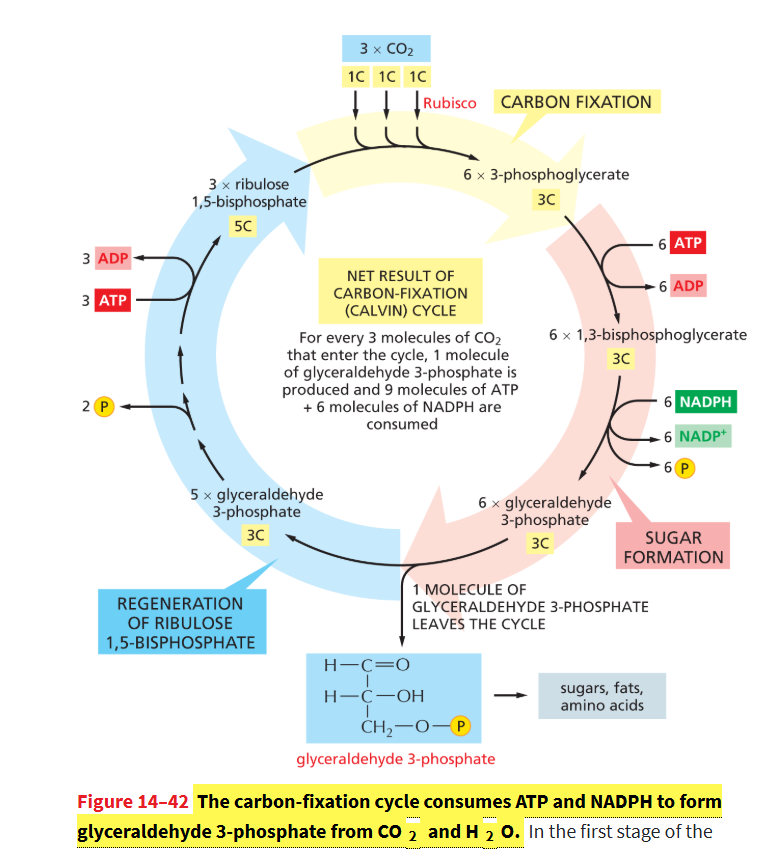
How many CO₂ molecules are needed to make one G3P?
3 CO₂
also uses H20!
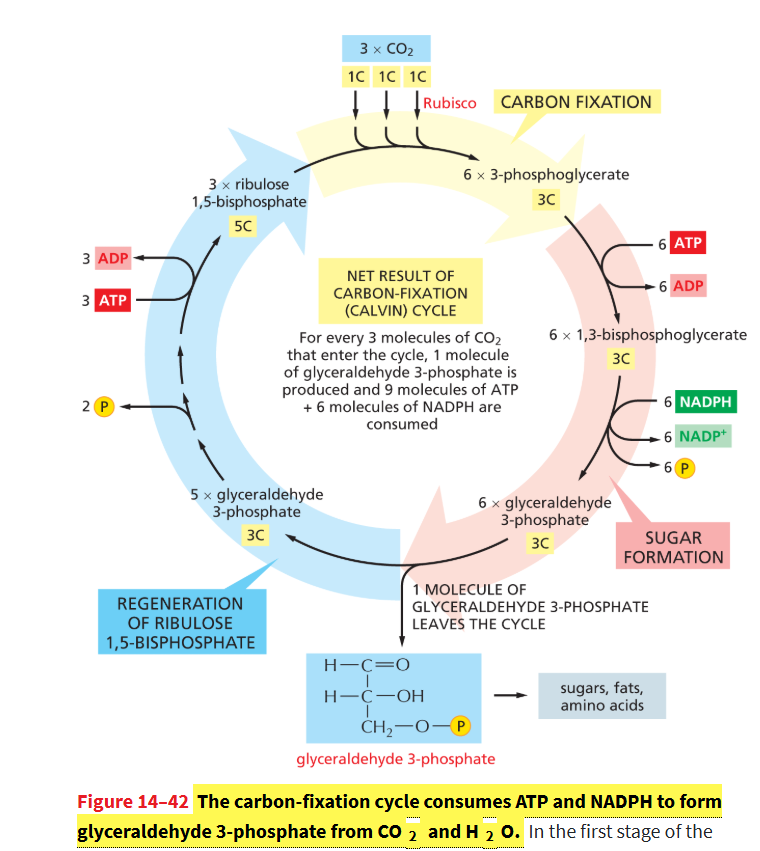
for every 3 CO2 in the calvin cycle what’s produced
1 molecule of glyceraldehyde 3-phosphate (G3P)
3 molecules of ribulose 1,5-bisphosphate is regenerated
9 ATP and 6 NADPH r used up
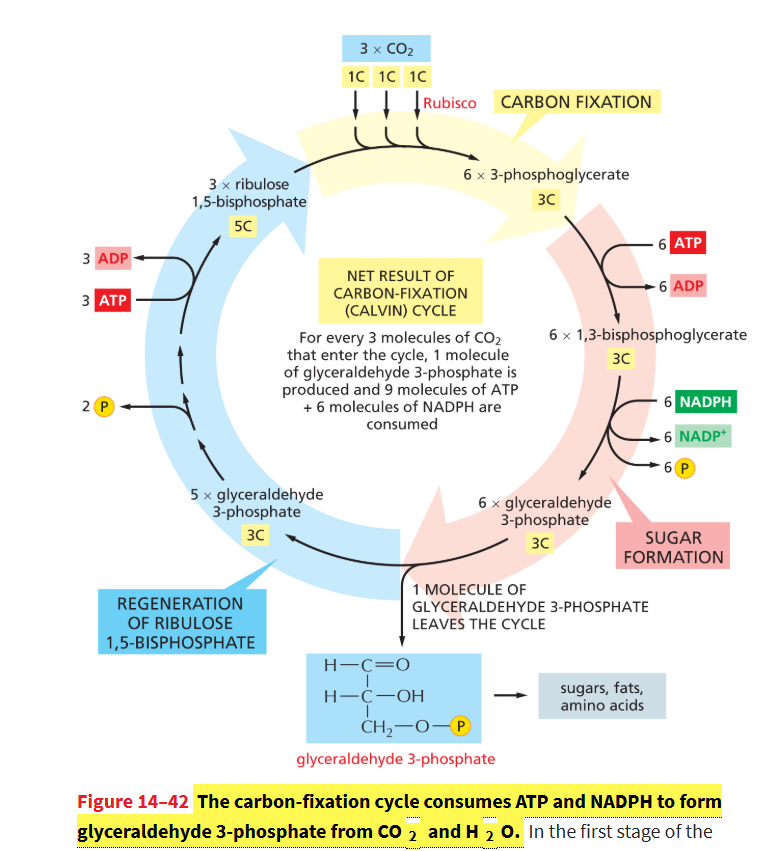
what is used up in calvin cycle?
9 ATP
6 NADPH
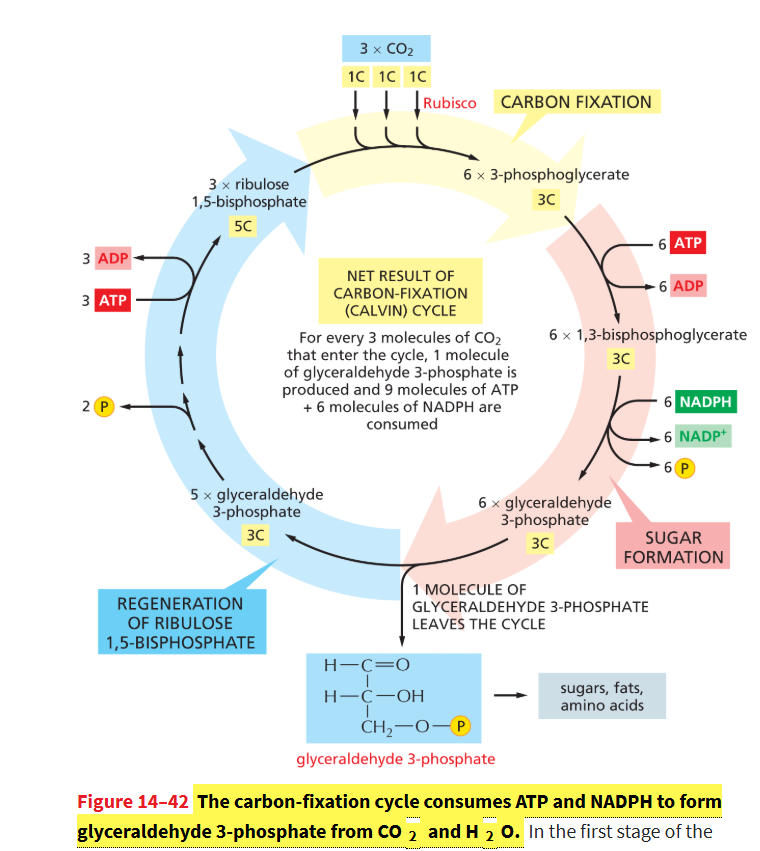
glyceraldehyde 3-phosphate
the main product of the calvin cycle! exported to provide energy and combine w other sugars
2 of these make one molecule of glucose
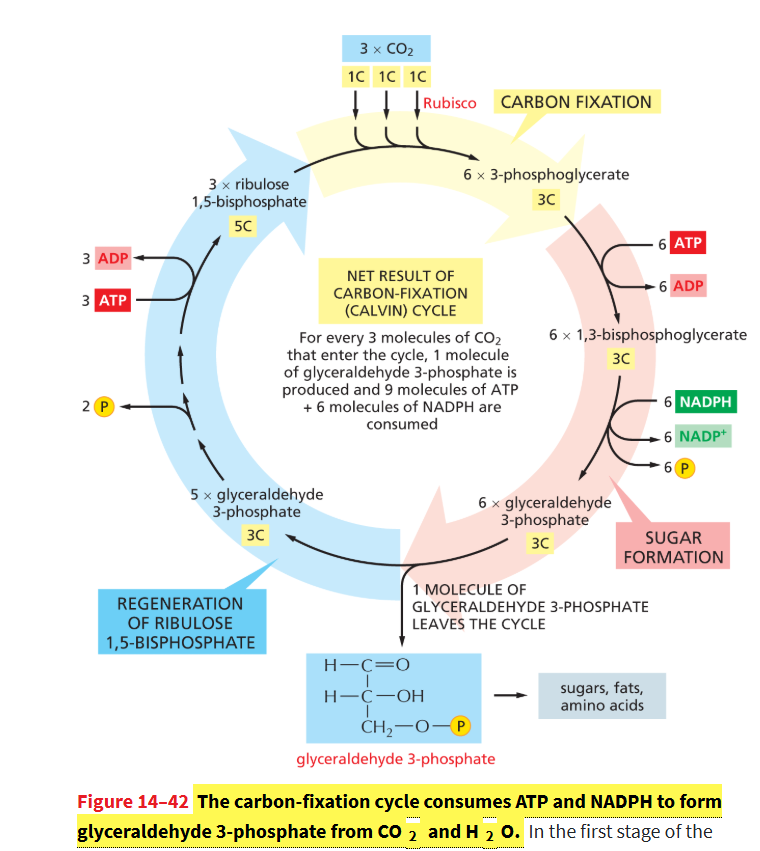
starch
a large polymer of glucose that serves as a carbohydrate reserve in plants (similar to glycogen)
accumulates in chloroplast stroma
g3P is converted into glucose and stored as starch when cell has energy
What other energy storage molecule besides starch can be made from G3P?
can be converted into fat which serves as an energt reserve
in the stroma
What happens to stored starch and fats when energy is needed?
Broken down into sugars and fatty acids
some of the exported sugar will enter glycolysis → become pyruvate
some of the fatty acids will enter plant mitochondria and go into CAC to produce ATP
sucrose
G3P can be converted into sucrose which is the major form that plants transport sugar btwn cells.
cellulose
glucose will be used to produce cellulose which makes up cell wall for structure
How did the first cells generate ATP before oxygen was present?
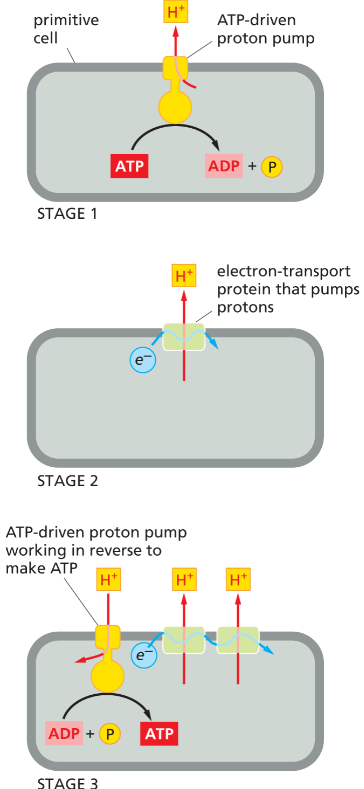
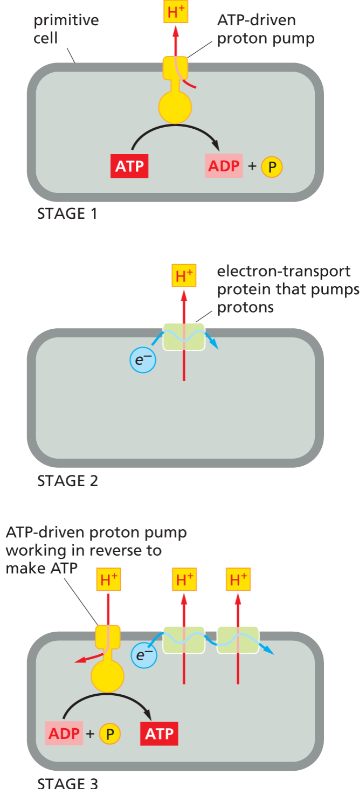
They used anaerobic fermentation of organic molecules and pumped H⁺ out of the cell to prevent acidification.
What evolutionary steps led to modern ATP synthase?
Stage 1: H⁺ pumped using ATP hydrolysis.
Stage 2: H⁺ pumped using electron transport.
Stage 3: Links both where ATP synthase uses protons pumped by ETC to synthesize ATP
How did photosynthesis first evolve in bacteria?
Early bacteria (like green sulfur bacteria) used a single photosystem to transfer electrons from H₂S to NADPH.
then they likely used H2O instead of H2S as the electron source for photosynthesis
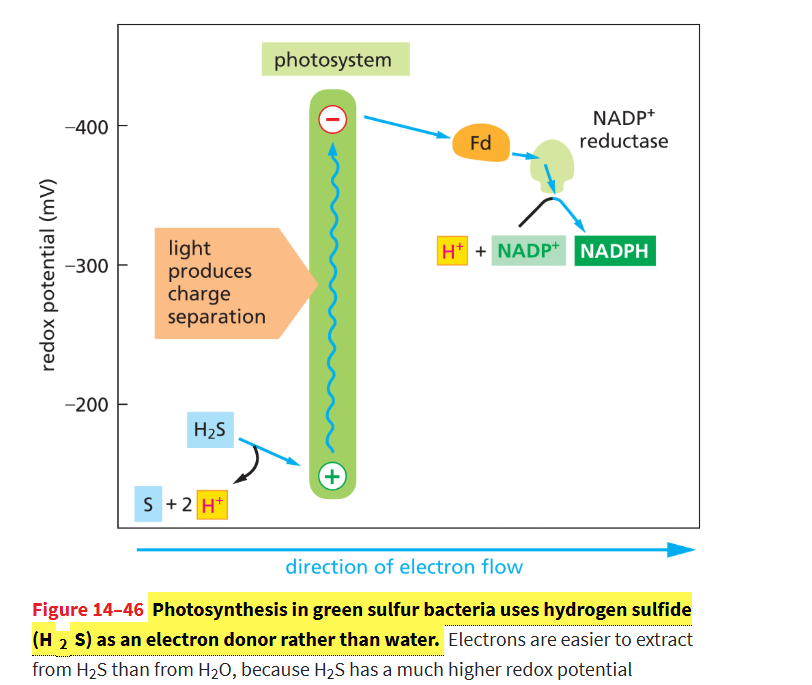
Why was evolving water-splitting photosystems significant?
It allowed electrons to be taken from H₂O instead of H₂S, producing O₂ and enabling stronger reducing power for NADPH and carbon fixation.
How did photosynthesis affect Earth’s atmosphere and other organisms?
O₂ accumulated → aerobic metabolism evolved → mitochondria appeared in eukaryotes → plants acquired chloroplasts → complex life could evolve.
What is chemiosmotic coupling?
Using a proton gradient, created by electron transport, to drive ATP synthesis—a fundamental energy mechanism in nearly all life.
What does Methanococcus tell us about early life?
It uses H₂ and CO₂ to generate ATP via chemiosmotic proton gradients, showing the storage of energy in a proton gradient derived from ETC is an extremely ancient process.
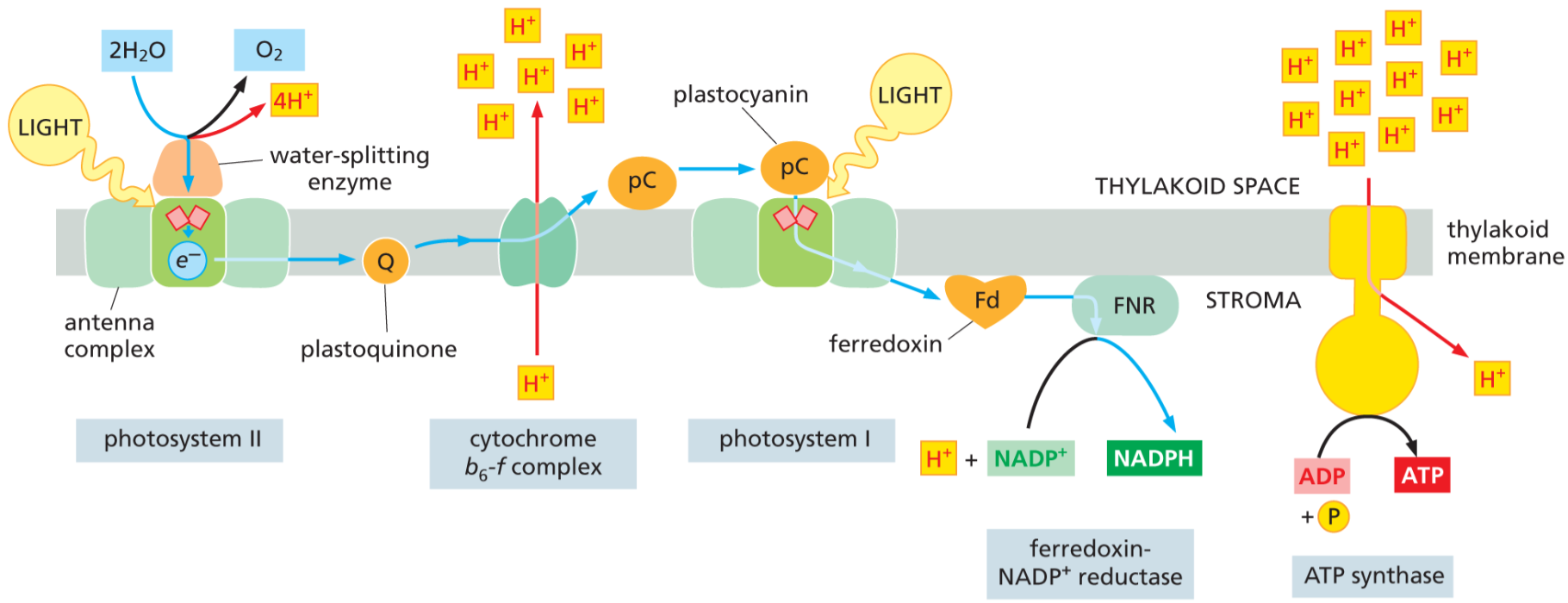
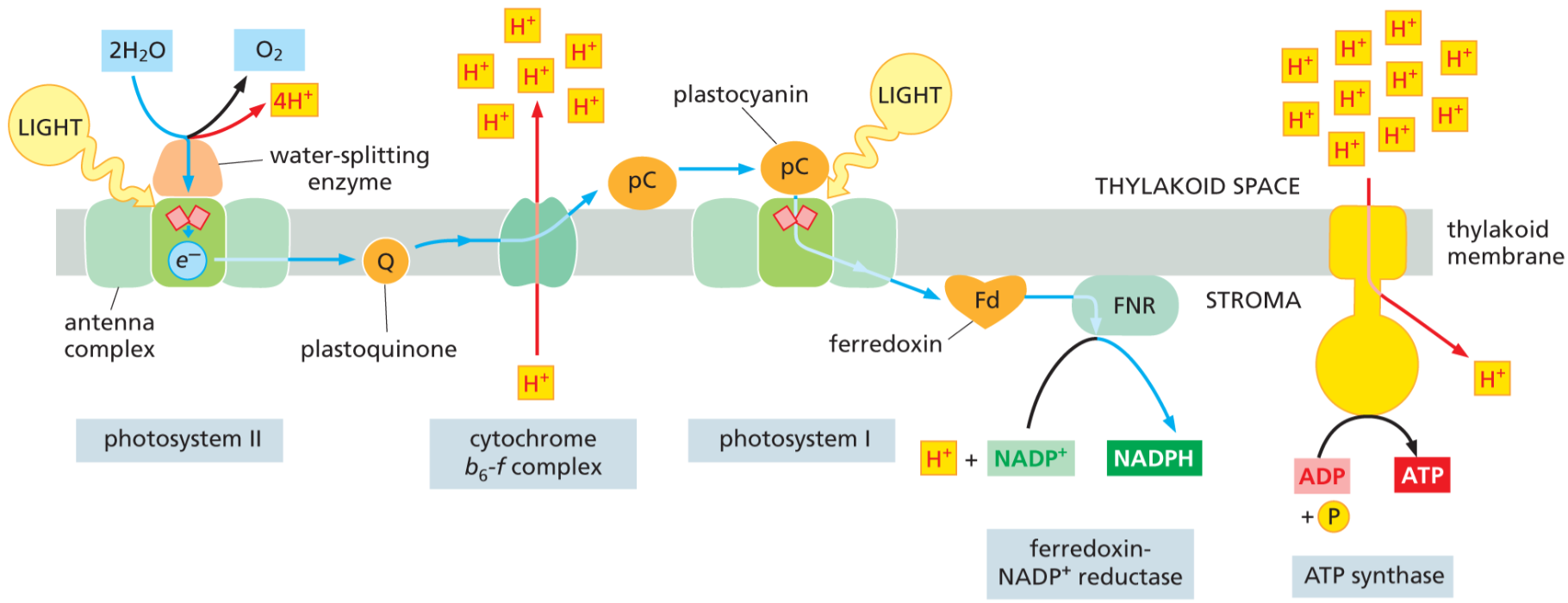
What path do electrons follow in the light reactions of photosynthesis?
Water (H₂O) → Photosystem II → plastoquinone → cytochrome b6-f complex → plastocyanin → Photosystem I → ferredoxin → NADP⁺ → NADPH
PSII gets electrons from water (splitting produces O₂)
PSI re-energizes electrons using light
Final electron acceptor is NADP⁺ → NADPH
Similarities and differences between oxidative phosphorylation and photophosphorylation
Both use an electron transport chain
Both create a proton (H⁺) gradient
Both use ATP synthase to make ATP (chemiosmosis)
Differences:
Feature | Oxidative Phosphorylation (Mitochondria) | Photophosphorylation (Chloroplast) |
|---|---|---|
Energy source | Chemical energy from food | Light energy |
Electron source | NADH/FADH₂ | Water (H₂O) |
Final electron acceptor | O₂ → H₂O | NADP⁺ → NADPH |
Main product | ATP | ATP + NADPH |
What is the role of ATP and NADPH in the Calvin cycle?
ATP: provides energy
NADPH: provides high-energy electrons (reducing power)
Together they power CO₂ reduction into sugars
How do plants fix CO₂ into sugars?
CO₂ is attached to RuBP (ribulose 1,5-bisphosphate)
Enzyme Rubisco catalyzes the reaction
Produces 3-Phosphoglycerate → converted into G3P (glyceraldehyde 3-phosphate) using ATP and NADPH
G3P is used to build sugars like glucose
What do plants do with the sugar they produce?
Plants use sugars for:
Energy (cellular respiration → ATP)
Storage → starch (in chloroplasts)
Structure → cellulose (cell walls)
Transport → sucrose (moves through plant)
Biosynthesis → fats, amino acids, etc.