Cost accounting
 Call Kai
 Learn
Learn Practice Test
 Spaced Repetition
 Match
Match Flashcards
 Knowt Play
1/134

There's no tags or description
Looks like no tags are added yet.
Name | Mastery | Learn | Test | Matching | Spaced | Call with Kai | Chat |
|---|
No analytics yet
Send a link to your students to track their progress
135 Terms
What is cost accounting?
supports the management of a company by providing information necessary for managing the entire company or individual departments
What are the four main accounting objectives?
control (steer)
planning
monitoring
documentation
What are the three systems in corporate accounting?
financial accounting (balance-sheet, cash-flow)
capital budgeting
management accounting (incl. cost accounting)
What are the differences between management and financial accounting?
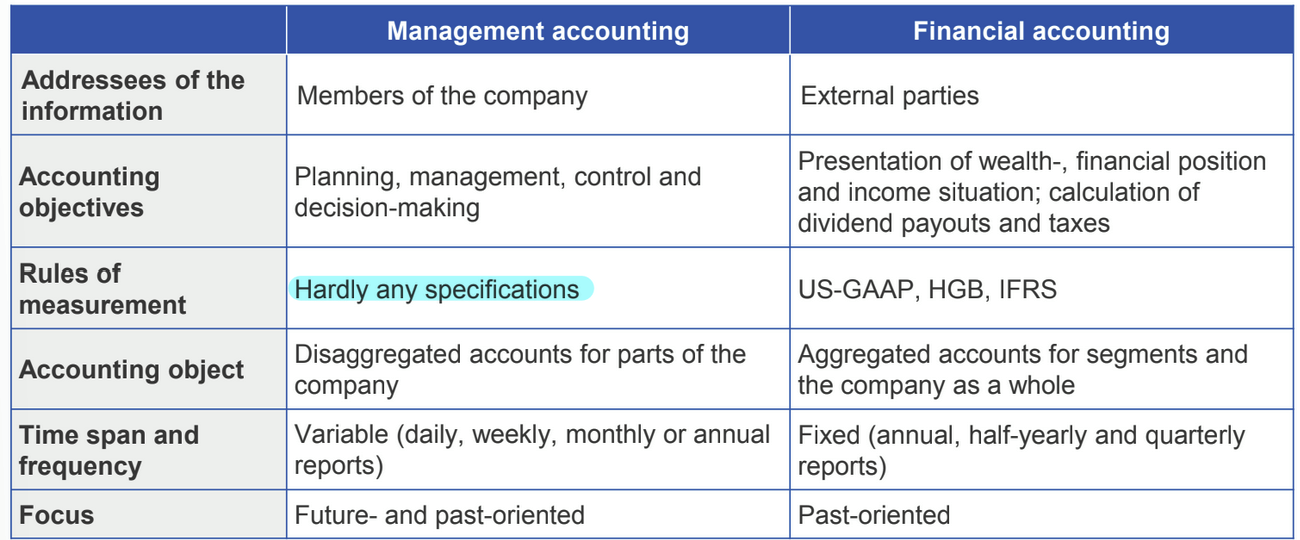
What is the difference between cost accounting and capital budgeting?
cost accounting
up to one year
operational decisions
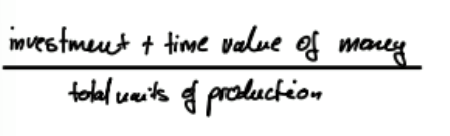
time value of money neglected
capital budgeting
long-term effects of decisions
time value of money important - interests
What are costs?
valuated consumption of resources
What are revenues?
valuated production of goods
What are the three key elements related to costs and revenues?
objective orientation (cost: only if expense aligns with intent)
valuation (no explicit price tag)
consumption of resources/production of goods
exchange of money for products/using them to make something else
What are artificial indirect costs?
costs that could be traced, but would be hard to, thus treated as indirect (e.x. electricity)
What is economies of scale?
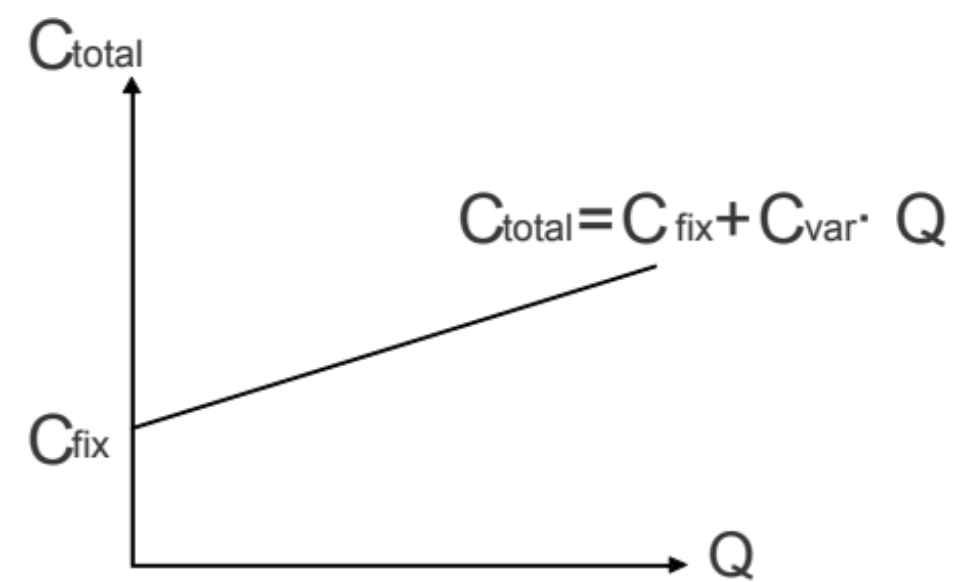
with increasing quantity, average costs decrease as fixed costs are distributed over more products
How are fixed costs calculated?
What are inventoriable costs?
costs assigned to a particular product unit
What are period costs?
costs that cannot be capitalized (cannot be considered in balance sheet; e.x. research)
What are opportunity costs?
Contributions to a company’s profit that is foregone by choosing a decision
alternative over the next-best alternative
What are sunk costs?
Costs that were caused in the past and can no longer be changed by current decisions
What are levelized product costs?
how expensive a product is over its entire life cycle (e.x. electricity - wind vs. solar)
average prices should be higher than levelized costs
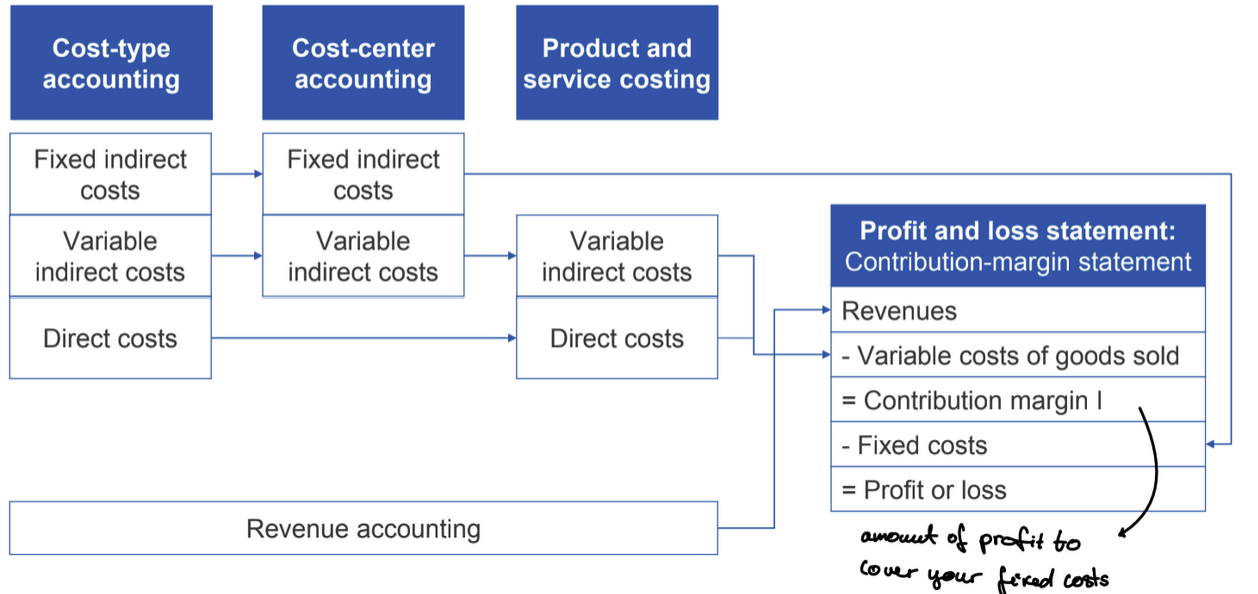
What does cost-type accounting show?
which costs have been incurred
e.x. labor, material, depreciation
What does cost-center accounting show?
where have costs been incurred
e.x. cost centers
What does product and service costing show?
for which products have the costs been incurred
How are costs calculated in absorption costing?
Product units are valued at full costs
How are costs calculated in variable costing?
product units are valued at variable cost
do not include e.x. R&D, just what directly went into producing the product → shows what you have to sell the product at at minimum
How are costs funnelled into the P&L statement in absorption costing?
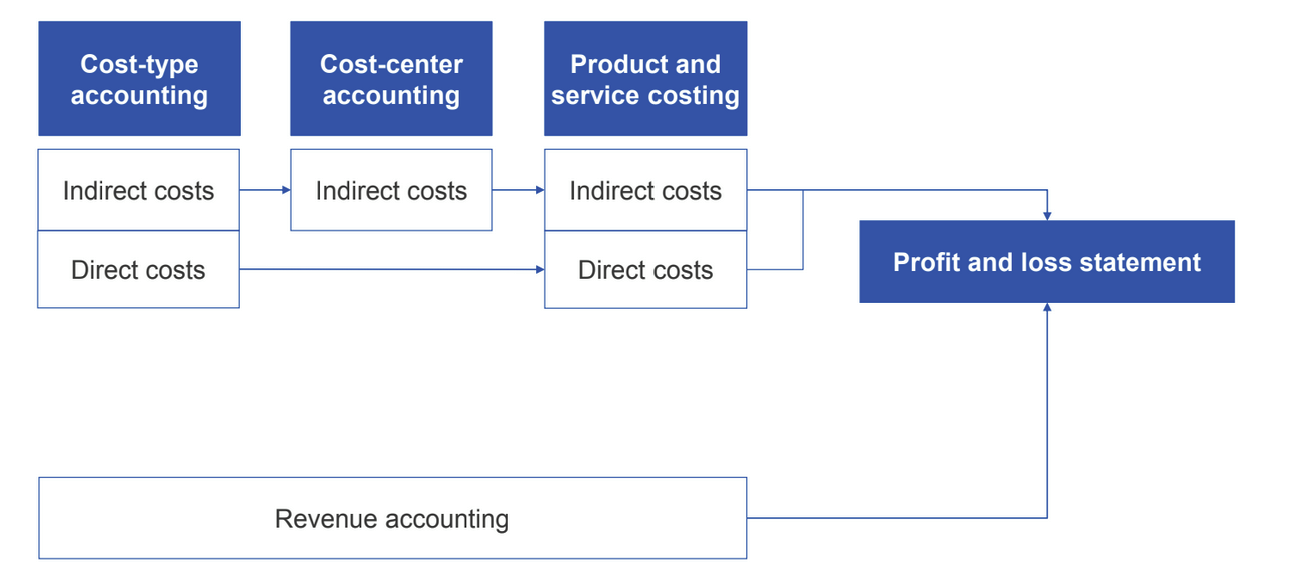
How are costs funnelled into the P&L statement in variable costing?
How can cost types be classified?
nature of the input goods: material costs, personnel (labor) costs, machine costs (depreciation, interest), costs for external services
attributability of costs: direct, indirect
dependence on output variation: variable, fixed
position in value chain: R&D costs, procurement costs, manufacturing costs, selling and shipping costs, administrative costs
origin of the input goods: primary, secondary
What are the 3 most important cost types?
material, personnel, machine
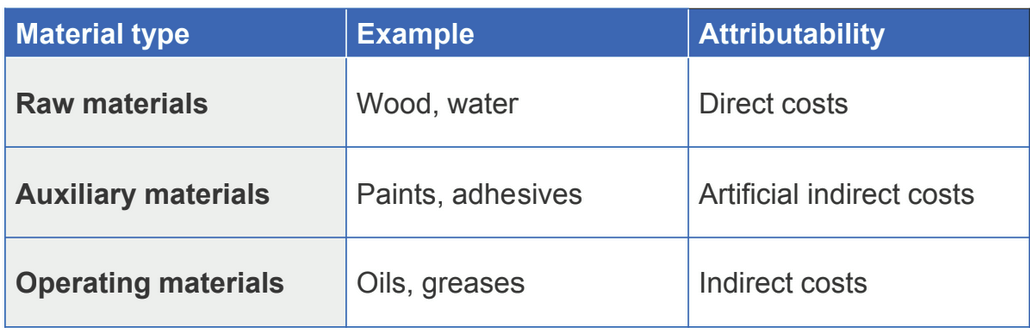
What are the 3 material types based on which manufacturing costs are categorized? How are they attributed?
How are material costs calculated?
= quantity ∙ price
What are the 3 methods to record material consumption?
inventory method
carry-on method
retroactive accounting method
What are the 4 methods for valuing material consumption?
FIFO
LIFO
ex-post average prices
uses the average purchase price for all the consumed material at the end of an accounting period
moving average prices
uses the average price after each material consumption based on the total inventory at that time
How is consumption calculated under the inventory method?
= beginning inventory + acquisitions – ending inventory
What are the benefits and disadvantages of the inventory method?
very accurate but complex
requires stock taking
reasons for consumption cannot be identified (e.x. regular consumption, theft, shrinkage)
cannot identify for which cost center or cost object the materials were consumed
How is consumption calculated under the carry-on method?
Directly recorded (consumption slip) → when they occur
What are the benefits and disadvantages of the carry-on method?
differences from other methods: measurement errors, stealing
can directly trace what the material consumption was used for
stock taking still necessary → account for unplanned usage
How is consumption calculated under the retroactive accounting method?
Calculated based on the bills of materials for each product
What are the benefits and disadvantages of the retroactive accounting method?
unplanned consumption cannot be recorded → stocktaking still necessary
bills of material must be kept up-to-date
How are auxiliary wages allocated?
wages of employees like warehouse or transportation workers
not directly involved in production
treated as indirect cost
allocated to the cost objects through cost centers and overhead rates
What are the 5 types of personnel costs?
salaries
time wages
piece-rate wages
premium wages
fringe benefits
e.x. corporate car, social security contributions
convert to standardized values & allocate them to wages as percentage
What are the 5 types of machine costs?
depreciation
interest costs
leasing/rental payments
acquisition-related costs (e.x. transportation, training)
maintenance costs
What are the 4 depreciation methods?
time dependent
straight-line depreciation
declining balance depreciation
arithmetic-degressive depreciation
output dependent
units of production depreciation
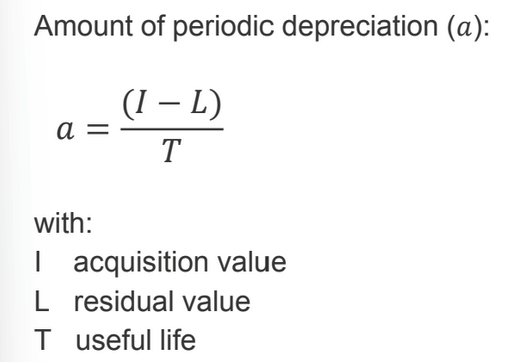
How is straight-line depreciation calculated?
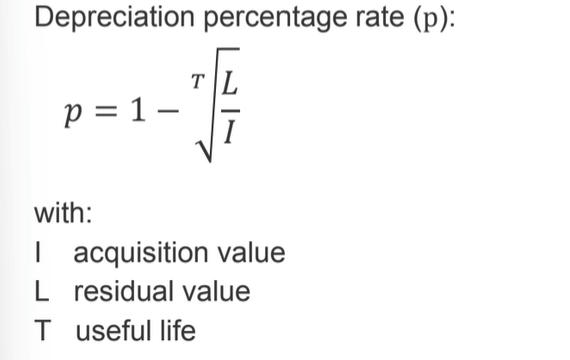
How is declining balance depreciation calculated?
depreciation amounts decrease gradually over time
How is arithmetic-degressive depreciation calculated?
depreciation amounts decrease each year by a constant value
useful for companies to decrease earnings heavily in the beginning → lower taxes
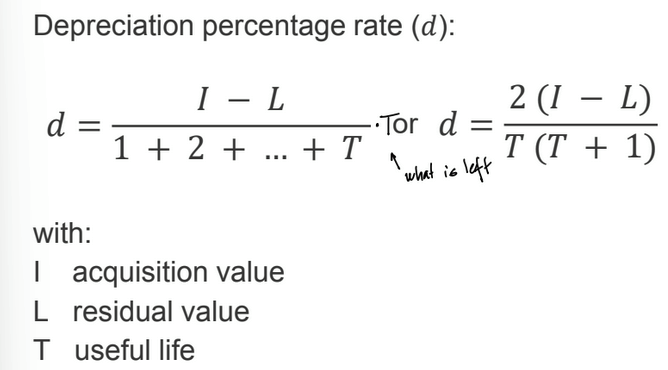
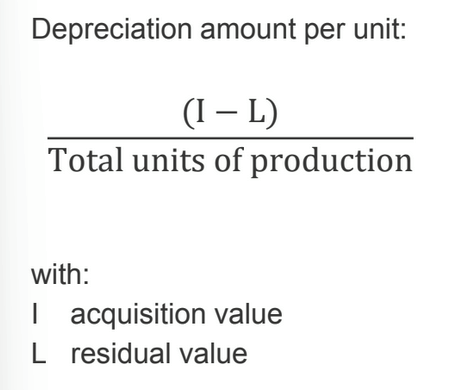
How is units of production depreciation calculated?
based on the utilization of the asset
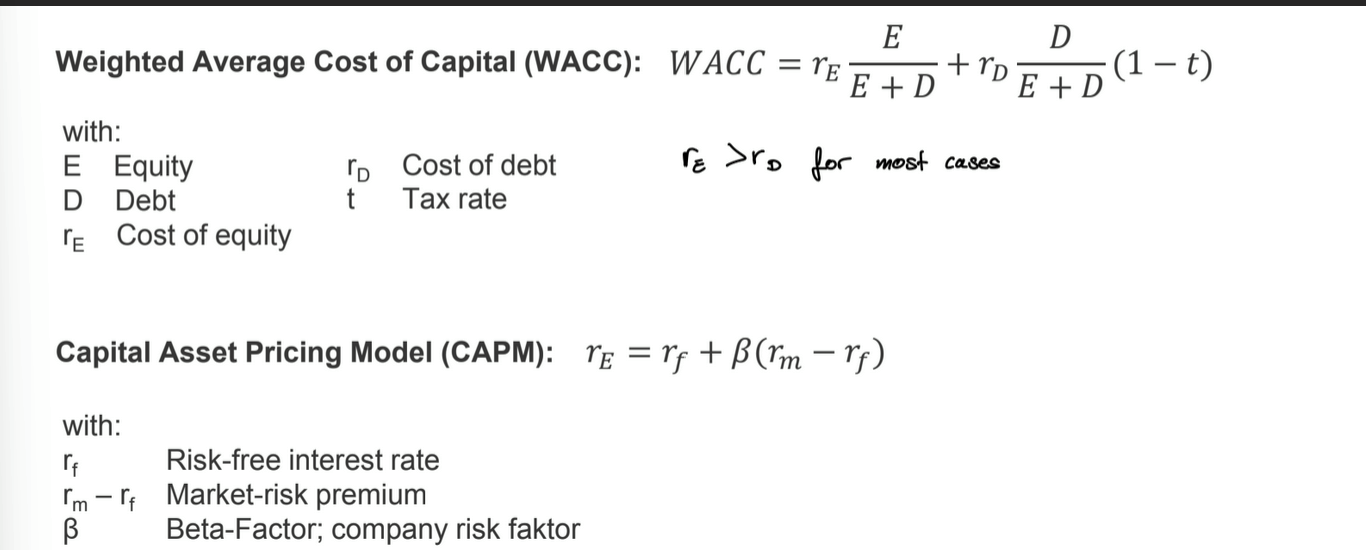
How are interest costs calculated, and what are the four steps of determining interest costs
capital required for operations ∙ interest rate
Determine the assets necessary for operations
check the operational necessity for each position on the active side
important: machinery, inventory, cash & cash equivalents
Value the assets necessary for operations
decision: valuation based on replacement cost/acquisition & production cost
estimate average values of assets over the accounting year (previous & current year’s balance sheets)
Determine the capital required for operations
deduct non-interest-bearing-liabilities from the operating assets
valuation based on average values
e.x. provisions, accounts payable, revenues received in advance
Determine the interest rate
WACC or CAPM model
What are the 4 basic requirements for cost centers?
homogeneity of cost drivers (dependence on same variable)
matching of cost centers & the assignment of responsibilities
completeness & clarity
cost-benefit criterion (benefit > cost; usually above 100 employees)
What are 2 criteria that need to be considered about defining cost centers?
depending on the business function of departments (ideal: 8-10)
depending on how costs are allocated
indirect: far from products (e.x. energy, building, maintenance)
direct: close to products (e.x. material, manufacturing, administration, sales & distribution)
Germany: many small cost centers - detailed management → bring down costs
US: bigger cost centers - cost departments → less detailed departments
According to the Federation of German Industries, what are the main tasks allocated to the 6 main cost centers?
material-handling cost centers: procurement of raw, auxiliary & operating materials
manufacturing cost centers: carry out activities directly on the company’s products
R&D centers: R&D, design & construction of prototypes
administrative cost centers: corporate management, HR management, finance, accounting
sales cost centers: finished goods storage, sales, order processing, shipping
general cost centers: services required by most other cost centers; property, energy, social services
What are the three steps of cost-center accounting?
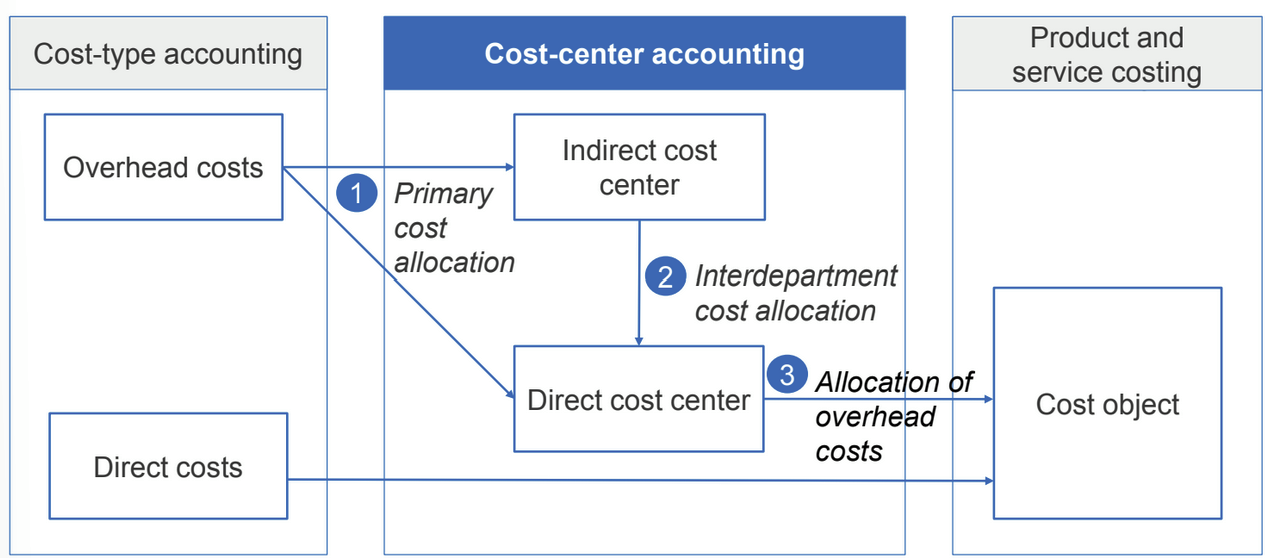
What are the two types of primary costs?
cost center direct costs: costs that can be directly traced to one cost center (e.g. the salary of the head of the material warehouse)
cost center indirect costs: costs for which it is not possible to trace them directly to a unique cost center (e.g. salary of the employee responsible for material storage and production preparation)
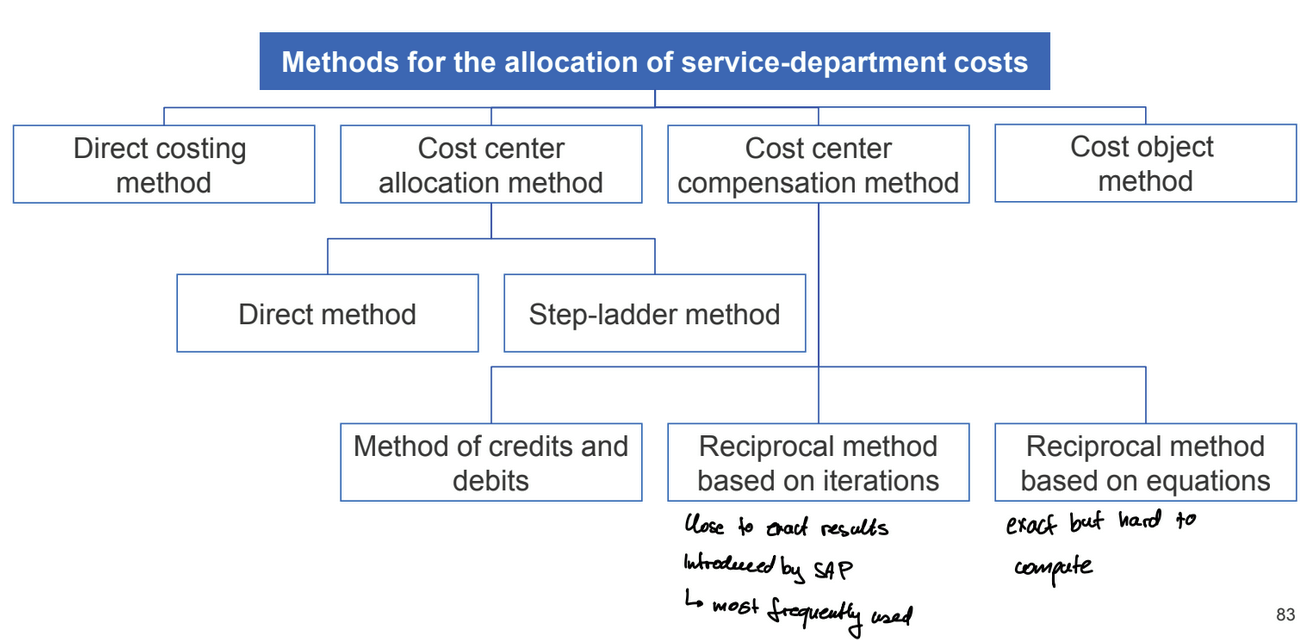
What are the possible methods for the allocation of service-department costs?
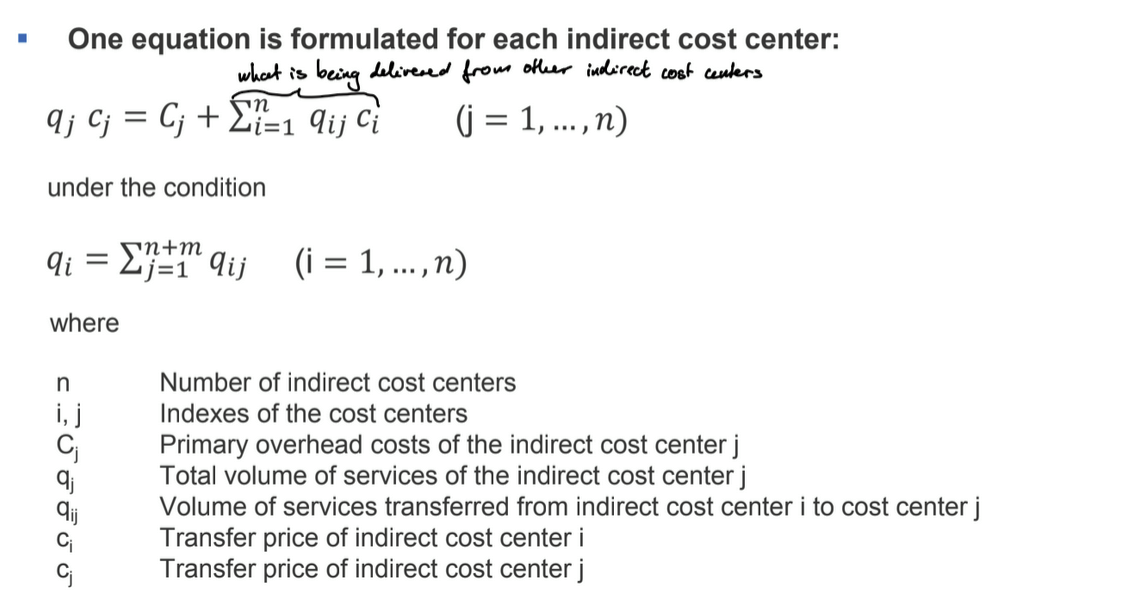
How are costs allocated using the reciprocal method based on equations?
determine transfer prices by solving a system of equations
exact method
need to record all internal exchanges of services
transfer prices (or total costs) must be recalculated periodically
e.x. total x c1 = primary overhead + energy x c1 + property x c2 + maintenance x c3
How are costs allocated using the reciprocal method based on iterations?
repeated allocation of the costs for internal services in several steps
approximation, accuracy increases with number of iteration
all internal exchanges of services need to be recorded
determination of transfer process for allocation of service exchanges not necessary
termination of the procedure as soon as the costs on each indirect cost center fall below 2 cents
transfer price = Sum of all cost incurred by an indirect cost center at all iteration levels divided by the output to other cost centers
primary overhead + what is carried over from other cost centers/total - what is used for own cost center
How are costs allocated using the method of credits and debits?
assume that transfer prices for internal services already exist
approximation, accuracy depending on the transfer prices used
all internal exchange of services need to be recorded
transfer prices are predefined → can only determine transfer prices accurately at the end of the year (as it involves primary costs)
How are costs allocated using the step-ladder method?
unlike the reciprocal method, it is only in one direction → reduce iterations
considers services between indirect cost centers, but only in one direction
internal exchange of services recorded in one direction only
transfer prices must be recalculated periodically; the amount of transfer prices varies according to the sequence of the settled indirect cost centers
(primary overhead + what comes from previous cost center)/(total-used for own)
How are costs allocated using the direct method?
no consideration of exchanges of services between indirect cost centers
exact if no exchanges between indirect cost centers exist, otherwise approximate
internal exchanges only recorded at direct cost centers
transfer prices must be recalculated periodically; relation of primary costs and activity output to direct cost centers
primary overhead/(total-what is used across all indirect cost centers)
What are the purposes of product and service costing?
planning: production program, procurement decisions, sales/list prices
control: cost control, performance review
documentation: inventory valuation
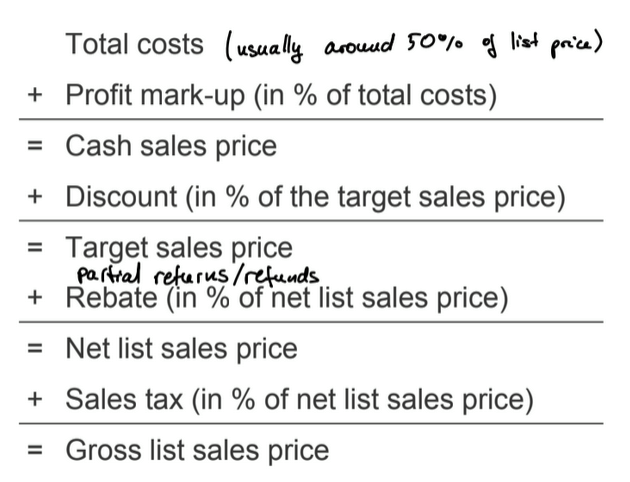
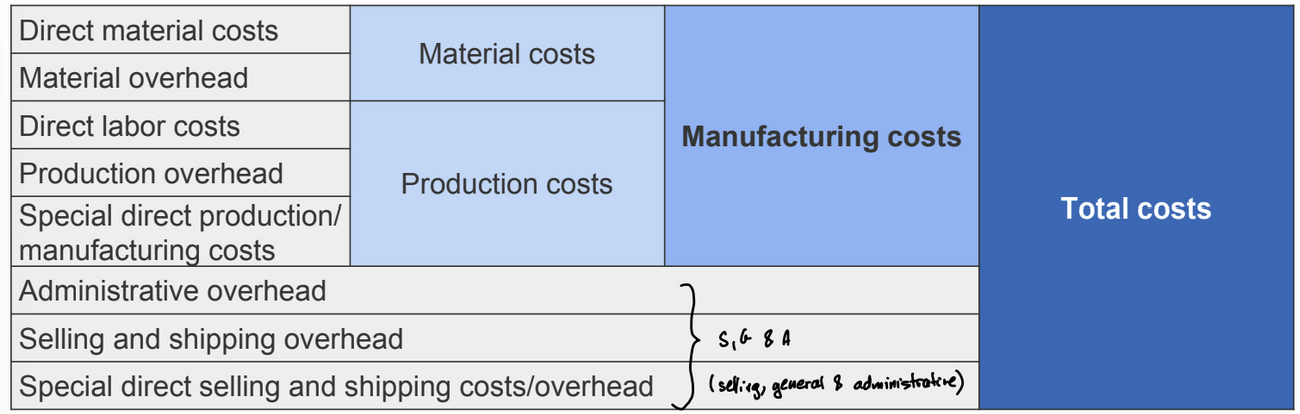
How are manufacturing costs calculated?
= material costs + production costs
How is total cost calculated?
= manufacturing costs + research and development costs + administrative costs + selling and shipping costs
What are the 4 characteristics based on which cost objects are classified?
production stage: final or intermediate products
purpose: products to be sold or products to be used by the company
production-related connection: non-connected products or joint & byproducts (e.x. hydrogen production)
type of goods: tangible or intangible goods
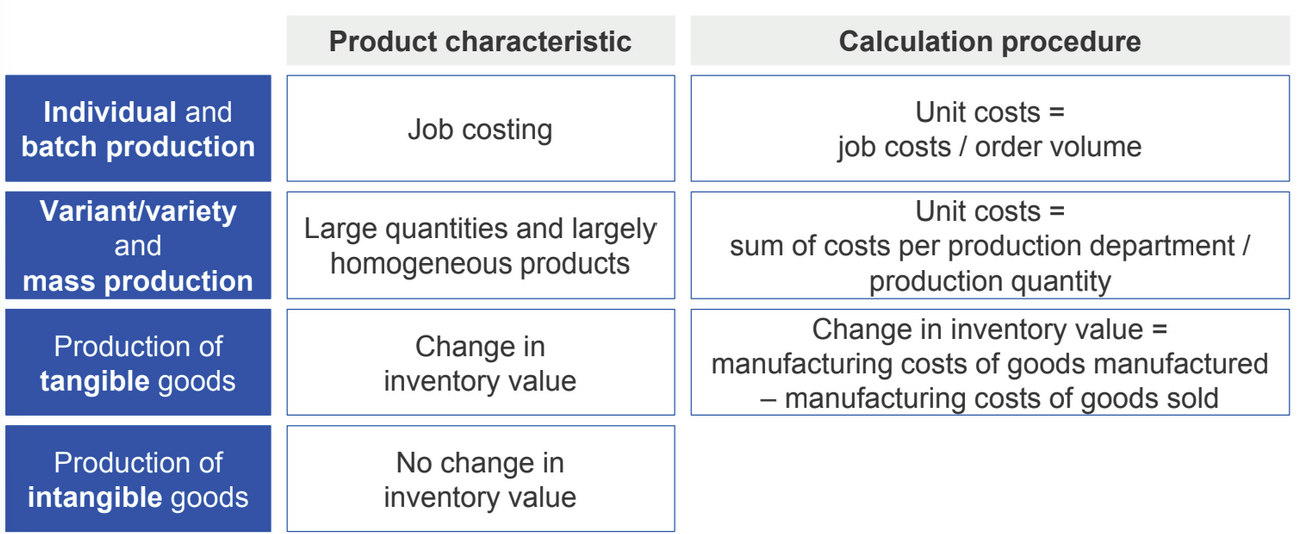
What are the 4 types of production methods and what costing methods are used for that?
job costings & machine hour costing
individual production (e.x. custom clothing, large scale plant)
batch production (e.x. business cards, wine, cars)
process costing & equivalence number method
variant/variety production (e.x. magazines, chemicals, beer)
mass production (e.x. electricity, cement, pencil)
How are different program types and costing methods related?
How is job costing broken-down in industrial companies?
Why is machine-hour costing particularly difficult to allocate?
increasing automation of processes → total labor costs & production times are not suitable for cost allocation
alternative allocation bases
machine times
lead times
processing times
most precise approach for costing
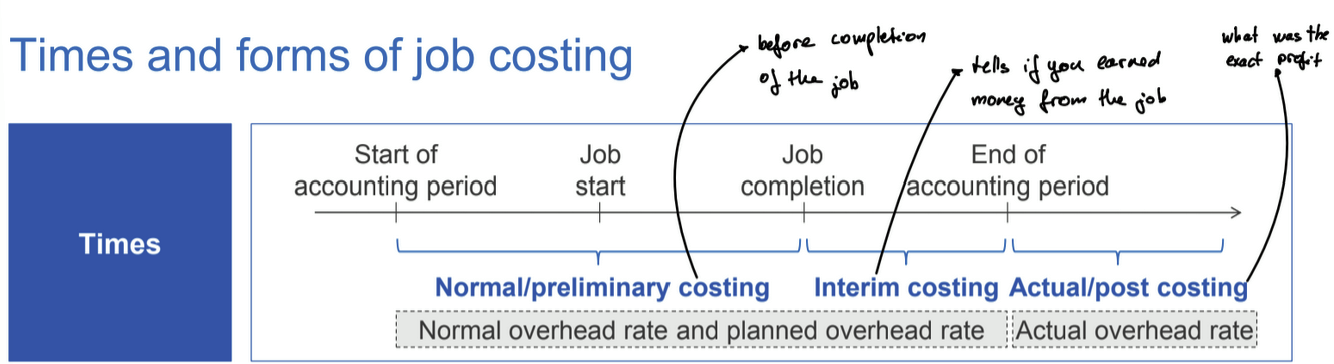
What is the timeline for job costing?
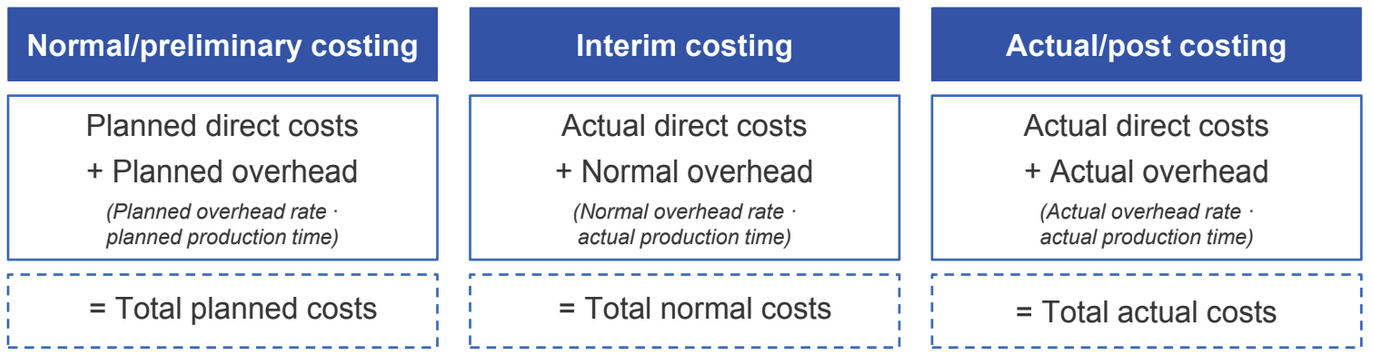
normal/preliminary costing
until job completion
production program, negotiation or price policy planning
normal & planned overhead rate
interim costing
promptly after job completion
cost & profit control
actual/post costing
after the end of the accounting period
inventory valuation, costs, and profit control
actual overhead rate
How is normal overhead rate calculated?

What are the three types of costing methods?
they do not affect the general structure of job costing
When is single-stage process costing used?
single-product production (e.x. electricity, forestry, water)

When is multi-stage process costing used?
manufacturing process meets different quality standards
stock changes to varying degrees
products’ degrees of completion differ
What are the two special features that can happen at the end of an accounting period?
different levels of completion of intermediate products possible
cost of unfinished products flows into next period
material and production costs may change over time
What are the requirements for the products produced to use the equivalence number method?
related products
produced on similar equipment
using similar raw materials
mainly in batch production
e.x. breweries - types of beer, screws

What are the three methods based on which costs of joint products and byproducts can be calculated?
main-product method
breakdown into main and byproducts
profits of byproducts deduced form total cost before decoupling point → cost neutralization
process cost - (market value-direct cost of byproducts) = process cost of main product
distribution method based on production volumes
allocation of costs before decoupling point according to produced quantities or weight
determination of profit for all products
distribution method based on market values
allocation of costs before decoupling point according to market values
How are proportional, convex and concave costs related to each other?
proportional costs: increase in the same proportion as the level of activity
convex costs: increase in higher proportion compared to the increase in activity (e.x. overtime, training for LLM, plane tickets)
concave costs: increase in lower proportion compared to the increase in activity
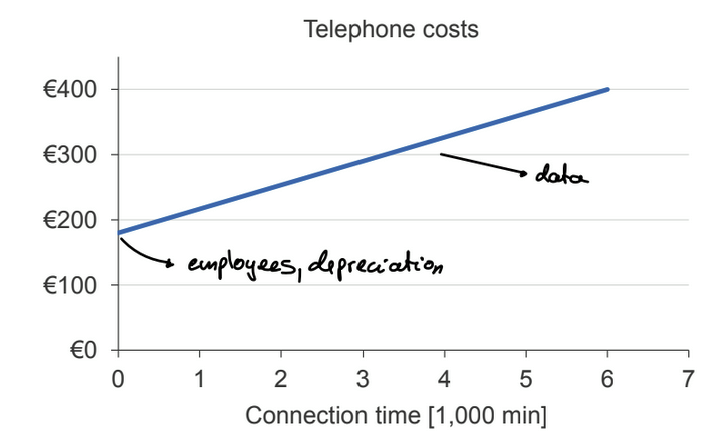
What are semi-proportional costs?
consist of a fixed and a proportional component
e.x. buy a machine, then pay for the electricity; phone plan
What are examples of costs with limits?
legal fees, electricity with cutoff, bonuses of managers
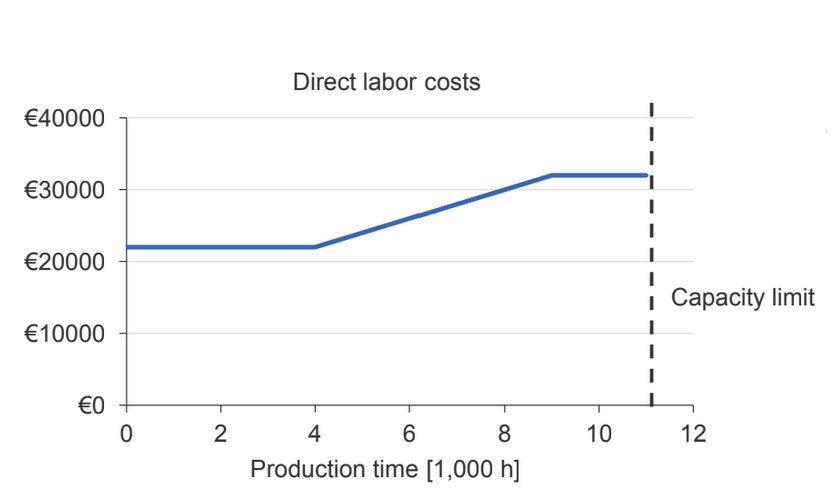
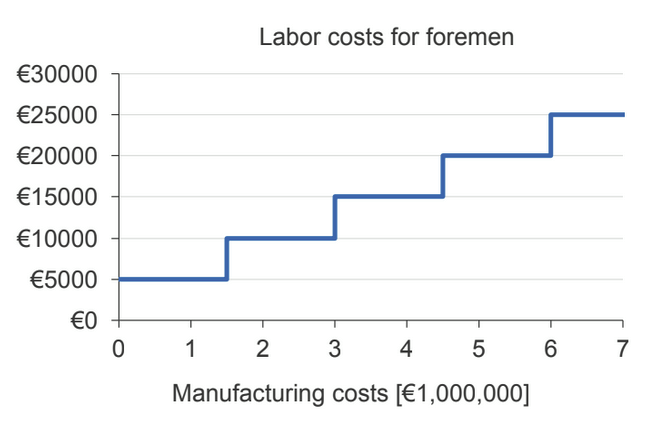
What are step fixed costs?
they increase by leaps and pounds
e.x. needing another machine; some process with capacity limits
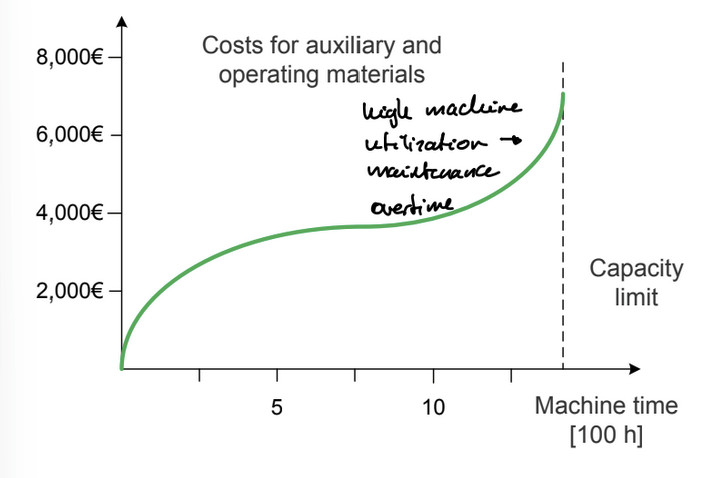
What are S-shaped costs?
characterized by a mixture of fixed and proportional costs
e.x. auxiliary & operating materials, covid vaccine production (license, scarce materials), life of a machine
What are sticky costs?
costs that respond asymmetrically to changes in activity
costs decrease to a lesser extent when activity levels decline than they increase when the activity level rises
e.x. selling, general & administrative expenses; cost of goods sold
adjusting capacity down is more challenging then adjusting it up
high committed resources (e.x. airlines, pharma, healthcare)
resistance to downsizing
more likely in financially healthy companies (that cannot bother to make adjustments)
to avoid high adjustment costs (e.x. nurses)
adjustment of prices over costs (e.x. lower selling prices to simulate demand)
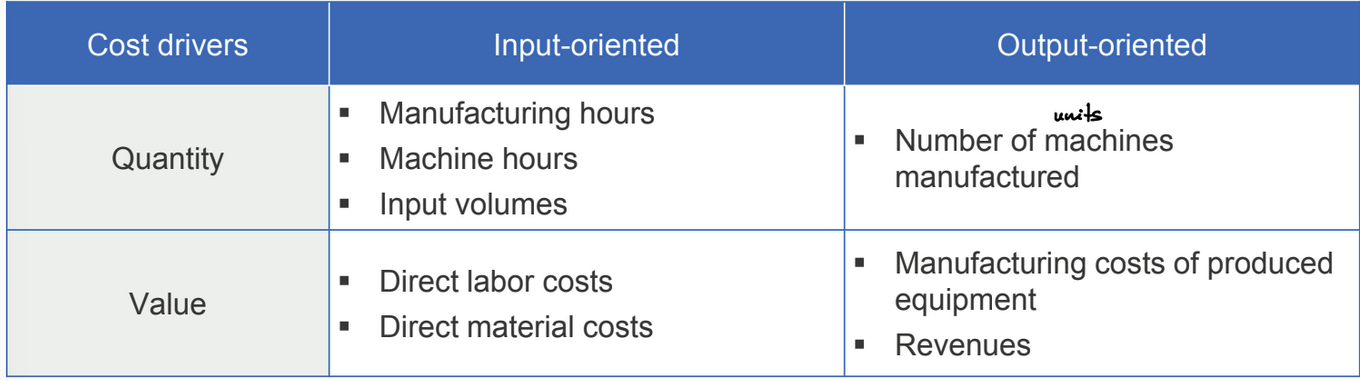
What are cost drivers?
constitute the independent (explanatory) variables of the cost function (e.x. level of activity)
How does the time horizon affect how costs are allocated?
Short-term fixed costs can be variable in the medium to long term and vary with one or more cost drivers
What are learning curves?
average working time decreases with the number of products manufactured (repetition)
concave cost function of wage/salary costs (e.x. direct labor costs per unit decrease with output quantity)
assume manual activities
What are experience curves?
unit costs decrease with the increase in output
concave manufacturing costs function (e.x. consumption of auxiliary and operating materials decreases with the number of repetitions, or the scrap is reduced)
also applies to automated activities
What are the three methods to simplify cost functions?
aggregation (calculate equivalent units for externalities into one variable)
linearization (minimize errors in relevant range; for complex cost curves)
homogenization
What is the purpose of analytical methods & what are the 6 resources for it?
analyze cause-and-effect relationships between outputs and inputs in terms of quantity and time
resources
bills of material
work schedules & functional analysis
time-and-motion studies
empirical values
technical documentation
legal regulations & contractual documents
What are statistical methods, and which are the 3 most common?
use the costs of past periods (historical data) to estimate cost functions & to forecast the costs of a future period
methods
account analysis method
high-low method
univariate/multivariate regression
How are costs estimated using the account analysis method?
costs of each category are classified as fixed, proportional, or mixed
provides a subjective cost function
uses shares of proportional costs (%) / old cost driver + fixed costs
How are costs estimated using the high-low method?
considers only the highest & lowest past observations
provides an objective, estimate cost function
outliers can lead to distorted values
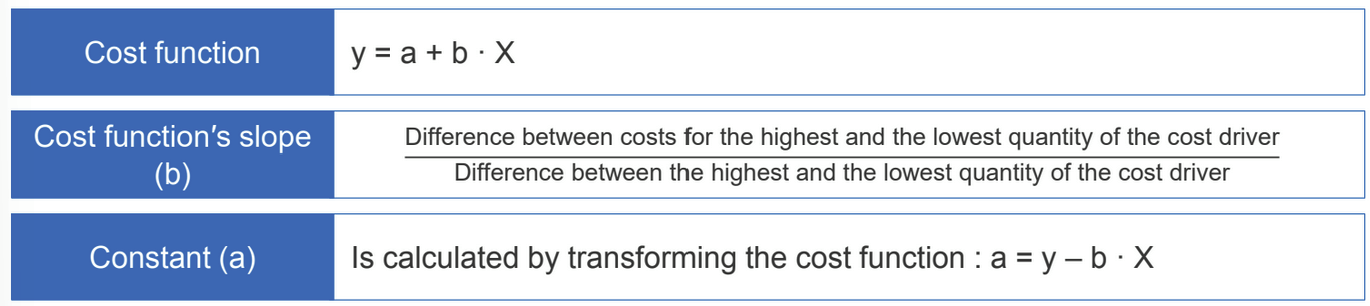
How are costs estimated using linear regression?
uses all available observations to estimate the cost function
provides an objective estimate of the cost function
more precise, but requires more observations with the least deviations (e.x. least-squares method)
linear regression: one dependent & one independent variable (e.x. repair cost & repair hours)
multiple regression: one dependent & several independent variables (e.x. repair costs, repair hours & repair orders)
What is the differentiated approach for overhead cost forecasting, and what are the most common categories?
cost functions are determined & documented separately for each overhead cost category
overhead cost categories
overhead costs of operations
auxiliary material, operating material, and tool costs
maintenance costs
imputed depreciation
imputed interest
taxes & insurance
What is the purpose of cost-center summary sheets?
used to document overhead cost forecasts
assumes that there is only one cost driver for each cost center
What are the 2 ways to calculate the extension of cost-center summary sheets?
differentiated reporting of fixed & variable costs
break down planned budget for fixed & variable costs
step-by-step plans
shows possible costs saved by increasing output volume
beneficial for uncertain environments
What are the tasks of the profit & loss calculation?
linkage of costs & revenues
comparison of costs & revenues to reveal a company’s profit
only possible for private companies that create revenues
determination of the profit per unit
contribution that a product/service makes to a company’s profit
determination of unit costs and prices on a per-unit basis necessary
determination of the net profit for a period
comparison of costs & revenues of an accounting period → net profit (also for individual products)
internal income statements more often produced → decision-making
What is the basic problem of preparing an income statement, and what are the 2 methods to calculate the net profit of a period?
the quantities produced is different from the quantities sold
produced → manufacturing costs
sold → selling & shipping costs
methods to calculate the net profit of a period
nature of expense method: quantity produced as cost basis
cost-of-sales method: quantity sold as cost basis
How is the net profit calculated with the nature of expense method?
compare total costs (production) with total revenues (sell) of a period
any changes in inventory must be taken into account
mostly used by SMEs in Germany
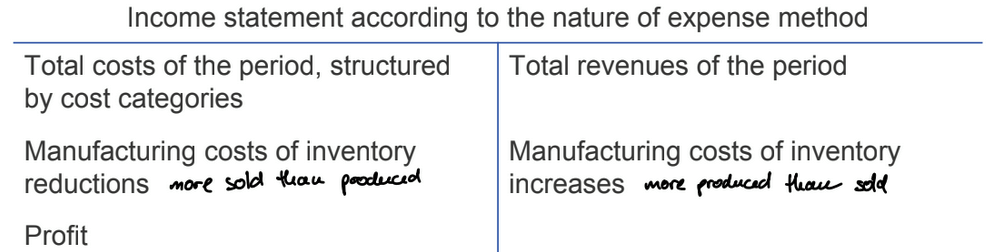
What are the advantages & disadvantages of the nature of expense method?
advantages
simple calculation structure
easy integration into double-entry bookkeeping
overview of cost type structures
inventory changes can be immediately recognized
classification of cost categories usually already done in financial accounting → necessary information already available
disadvantages
inventory recording needed → time-consuming
unit cost calculation required for manufacturing costs
no indications for profit on product or functional area level
no differentiation of cost structures between functional departments
How is the net profit calculated with the cost-of-sales method?
comparison of costs & revenue on a product level, not category level
application of product costing → unit costs
total costs include manufacturing costs, and administrative, selling and shipping costs
more prevalent internationally, especially large companies
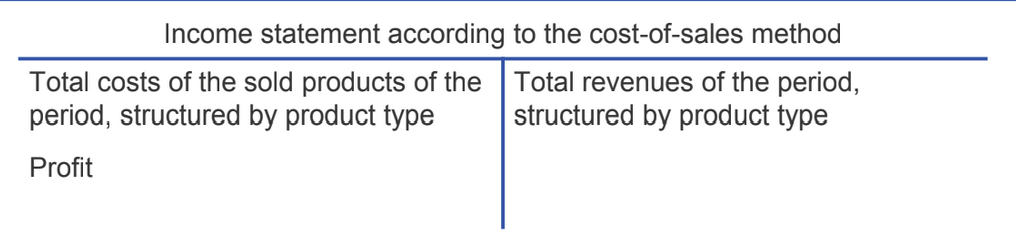
What are the advantages & disadvantages of the cost-of-sales method?
advantages
no stocktaking necessary
very fast profit determination
profit analysis on product level possible
disadvantages
difficult to integrate into double-entry bookkeeping
calculation of total cost necessary
What are the different entries of an income statement?
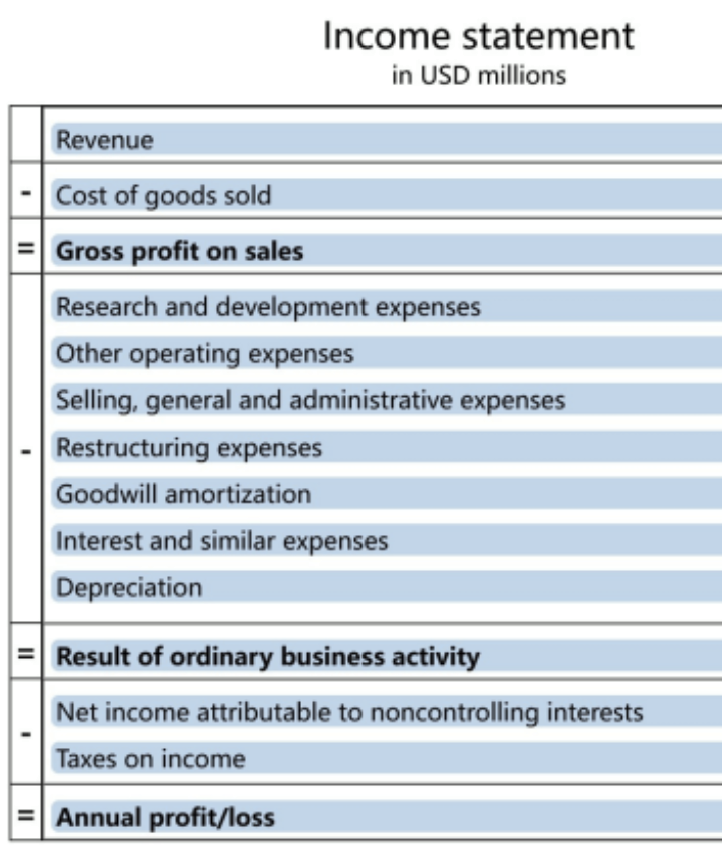
What is the difference between absorption and variable costing for the income statement?
absorption costing: valuation of product units at full cost
variable costing: valuation of product units at variable cost, fixed costs shown separately
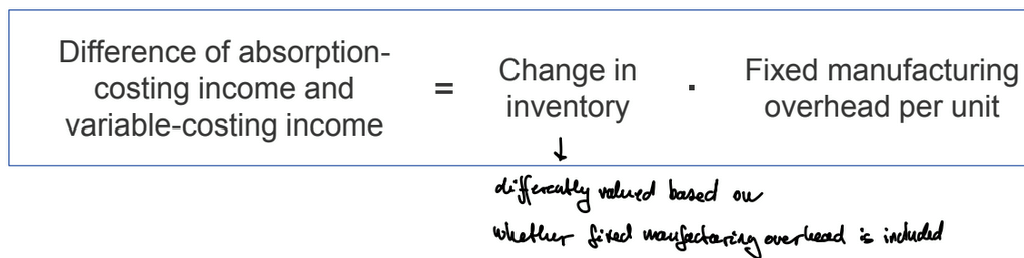
How does the operating income over multiple periods differ between absorption and variable costing
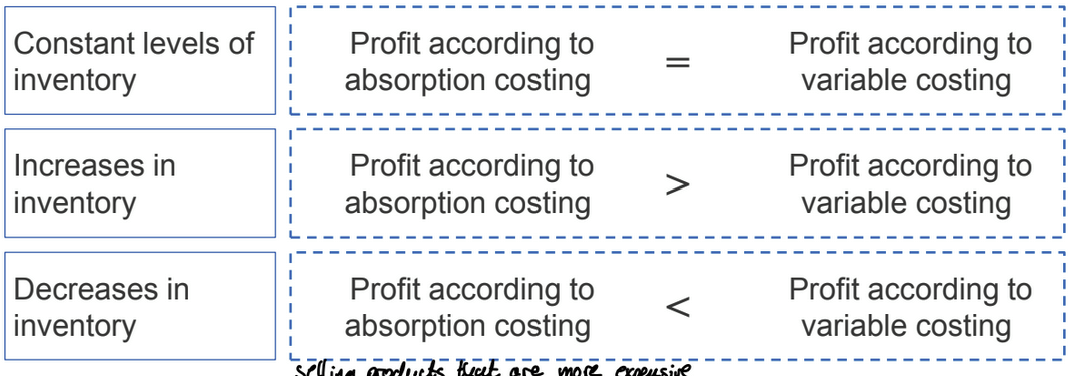
What are possible incentives for building up inventory under absorption costing?
higher production → higher profits without increase in sales
unit-related fix production overhead increases profit for each unit produced & stored
enables managers in making decisions not in the interest of the company
deferral of maintenance & repair → more capacity for production → increase profits short-term
increase of production of products that have a higher proportion of fixed production overhead