Personality Vocab
 Call Kai
 Learn
Learn Practice Test
 Spaced Repetition
 Match
Match Flashcards
 Knowt Play
1/29

There's no tags or description
Looks like no tags are added yet.
Name | Mastery | Learn | Test | Matching | Spaced | Call with Kai | Chat |
|---|
No analytics yet
Send a link to your students to track their progress
30 Terms
personality
An individual’s characteristic pattern of thinking, feeling, and acting.
Persons pattern/tendency fail test-think: I’m dumb- feel sad/discouraged-may avoid studying
free association
in psycho-analysis, a method of exploring the
unconscious in which the person
relaxes and says whatever comes
to mind, no matter how trivial or
embarrassing.
A therapist asks a patient to say whatever comes to mind when they hear the word “school.” The patient might say:
“School → teacher → fear → test → failing → my parents → pressure.”The therapist may use these responses to explore the person’s underlying thoughts and feelings.
unconscious
According to Freud, it is a reservoir of mostly
unacceptable thoughts, wishes,
feelings, and memories. According
to contemporary psychologists,
information processing of which
we are unaware. This may still influence our behavior.
A person may feel nervous around dogs without knowing why. Later, they may remember having a frightening experience with a dog as a young child. The memory may have been outside their conscious awareness but still affected their behavior.
id
Primial urges we’re born with. The Id unconsciously strives to satisfy basic sexual and aggressive drives, operating on the pleasure principle, demanding immediate gratification.
newborn infant crying out for satis-faction, caring nothing for the outside world’s conditions and demands. Or think of people with a present rather than future time perspective—those who abuse tobacco, alcohol, and other drugs, and would sooner party now than sacrifice today’s pleasure for future success and happiness
You are hungry during class and want to eat a snack immediately, even though you are not supposed to eat in class. Or get up take someones drink without caring abt them or anything jsut to satisfy your thirst.
ego
Devil. The ego functions as the “executive” and mediates the demands of the id and superego. the ego is the part of personality that helps us deal with reality. It develops as a person learns that they cannot always get what they want immediately.
You really want to buy an expensive pair of shoes, but you don't have enough money.
Id: “Buy the shoes! I want them!”
Superego: “You shouldn't waste your money.”
Ego: “I'll save money for a few weeks and buy them later if I still want them.”
So, you can think of the ego as the realistic decision-maker. It doesn't necessarily eliminate your desires; instead, it finds realistic ways to satisfy them.
superego
Age 4-5 or 2/3 Angel superego provides standards for judgment (the conscience) and for future aspirations.person’s morals, values, rules, and sense of right and wrong. It tells us how we “ought” to behave and can create feelings of guilt when we do something we believe is wrong, or pride when we behave well.
Imagine you are at a store and notice that the cashier accidentally gives you $10 extra in change.
Id: “Keep the money! I can use it.”
Superego: “This money isn't mine. I should give it back.”
Ego: “I'll return the $10 because keeping it could cause problems and isn't right.”
The superego is the voice of your conscience that tells you what you believe is right or wrong.
psychosexual stages
the childhood stages of development (oral, anal, phallic, latency, genital) during which, according to Freud, the id’s pleasure-seeking energies focus on distinct erogenous zones.(Freud believed that as children grow, their pleasure and curiosity are focused on different parts of the body at different ages.) personality develops through a series of stages during childhood. In each stage, pleasure is focused on a different part of the body. Freud believed that if a child experiences too much or too little satisfaction during a stage, they may become “fixated” at that stage.

Oedipus complex-phallic stage
A boy’s sexual desire for his mother and feelings of jealousy and hatred for the rival father. A girl’s desire for her father is called the Electra complex. identifies with the father and adopts some of the father’s behaviors and values. This helps resolve the conflict and contributes to the development of the superego.
identification
Children cope with threatening feelings by repressing them and by identifying with the rival parent. Through this process of identification, their superego gains strength that incorporates their parents’ values.A young boy sees his father as a role model. He starts dressing like his father, copying the way he talks, and following his father's rules.
In Freud’s theory, this identification with the father helps the boy resolve the Oedipus complex and contributes to the development of his superego. Parent's rules → child copies parent → child internalizes the rules → superego develops
fixation
Fixation is Freud’s idea that a person can become “stuck” at a particular psychosexual stage because of strong conflict, overindulgence, or deprivation during that stage. As a result, some of the person’s pleasure-seeking behaviors may continue into adulthood.
Example: Oral fixation
Smoke cigarettes
Overeat
Bite their nails
Seek excessive comfort or dependence on others
defense mechanisms
The ego’s protective methods of reducing anxiety by unconsciously distorting reality.
Repression banishes anxiety-arousing thoughts, feelings, and memories from consciousness.
Regression leads an individual faced with anxiety to retreat to a more infantile psychosexual stage.Person of advanced age-result of frustration of needs/wants not met→early development/childlike behavior. Conflict in ego when ID is not met. ID behavior of not getting what they want.
Reaction Formation causes the ego to unconsciously switch unacceptable impulses into their opposites. People may express feelings of purity when they may be suffering anxiety from unconscious feelings about sex. The person unconsciously turns an unacceptable feeling or impulse into its opposite. Someone feels sexually attracted to another person but is uncomfortable with those feelings. They may act extremely judgmental or disapproving of sexual behavior.
Projection leads people to disguise their own threatening impulses by attributing them to others.A person puts their own unacceptable thoughts or feelings onto someone else, rather than recognizing that they have them. A student is jealous of their friend's success but doesn't want to admit it. They say, “My friend is jealous of me.”The jealousy actually belongs to the student, but they attribute it to their friend. Easy way to remember:
Projection = “I feel it, but I think YOU feel it.”
Rationalization offers self-justifying explanations in place of the real, more threatening, unconscious reasons for one’s actions.A person creates a reasonable-sounding explanation for their behavior instead of acknowledging the real reason, which may be uncomfortable. Example:
Someone doesn't get invited to a party and says, “I didn't want to go anyway. Parties are boring.” The actual reason may be that they feel hurt or rejected, but they give themselves an explanation that makes the situation easier to accept.
Displacement shifts sexual or aggressive impulses toward a more acceptable or less threatening object or person, redirecting anger toward a safer outlet.A person redirects their feelings, usually anger, from the person who caused them to a safer target. Your boss makes you angry at work, but you don't feel comfortable confronting your boss. When you get home, you snap at your family over something small. The anger toward your boss is displaced onto your family.
repression
Repression is a defense mechanism in Freud’s theory where the ego unconsciously pushes painful, threatening, or unacceptable thoughts, feelings, or memories out of conscious awareness.
banishes anxiety-arousing thoughts, feelings, and memories from consciousness.
Sometimes a person experiences something that creates too much anxiety or emotional discomfort. Instead of consciously dealing with it, the mind keeps it outside of awareness. The person may not realize that the thought, feeling, or memory exists, even though Freud believed it could still influence their behavior.
A child experiences a very frightening event. As they grow older, they cannot consciously remember the event. However, they may still feel unusually anxious in situations that remind them of it without understanding why.
collective unconscious
Carl Jung. which contained a common reservoir of images derived from our species’ past. This is why many cultures share certain myths and images such as the mother being a symbol of nurturance. Patterns of living, behaviors, thinking, exists across time and space, and passed down human history.
The mother — associated with nurturing and protection
The hero — someone who faces challenges and overcomes them
The shadow — the darker or unwanted parts of ourselves
projective test
Evaluating personality from an unconscious mind’s perspective would require a psychological instrument (projective tests) that would reveal the hidden unconscious mind. Projective tests are personality tests that use ambiguous or unclear stimuli to encourage people to project their unconscious thoughts, feelings, and conflicts onto the stimulus.
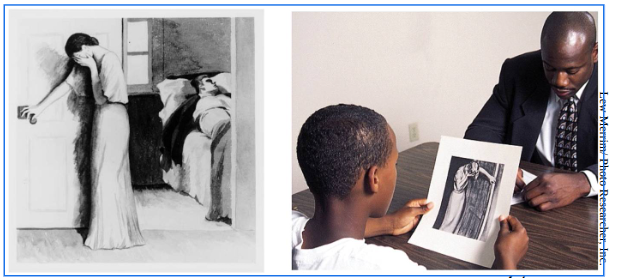
Developed by Henry Murray, the TAT is a projective test in which people express their inner feelings and interests through the stories they make up about ambiguous scenes.
Thematic Apperception Test
Thematic” because psychologists look for recurring themes in the person's stories, and “Apperception” refers to how a person interprets what they see based on their own experiences and perspective. Developed by Henry Murray, the TAT is a projective test in which people express their inner feelings and interests through the stories they make up about ambiguous scenes. projective personality test in which a person is shown ambiguous pictures and asked to create a story about each picture. The idea is that people may project their own thoughts, feelings, concerns, and experiences into the stories they create.
A person is shown a picture of a young person sitting alone with their head down.
The psychologist might ask: “What is happening in this picture? What happened before? What will happen next?”
The person might say: “The student failed an important test and is worried about disappointing their parents. They decide to work harder and eventually succeed.”
The psychologist can look at themes in the person's stories, such as relationships, fears, goals, conflicts, or feelings about themselves.
Rorschach inkblot test
The most widely used projective test uses a set of 10 inkblots and was designed by Hermann Rorschach. It seeks to identify people’s inner feelings by analyzing their interpretations of the blots. What you see.

false consensus effect
the tendency to overestimate the extent to which others share our beliefs and our behaviors.the tendency to overestimate the extent to which others share our beliefs and behaviors. People who cheat on their taxes or break speed limits tend to think many others do likewise. People who are happy, kind, and trust- worthy tend to see others as the same
terror-management theory
a theory of death-related anxiety; explores people’s emotional and behavioral responses to reminders of their impending death. people develop psychological strategies to manage that fear. People may cope with the awareness of death by strengthening their sense of meaning, self-worth, and connection to their culture or beliefs.
Example
Imagine someone is reminded that life is temporary after hearing about someone their age who died.
They might cope by:
Spending more time with family and friends
Becoming more committed to their religious or cultural beliefs
Focusing on their goals and achievements
Thinking about the positive impact they will leave behind
The person is using things that give their life meaning and a sense of lasting significance to manage anxiety about death.
self-actualization
according to Maslow, one of the ultimate psychological needs that arises after basic physical and psychological needs are met and self-esteem is achieved; the motivation to fulfill one’s potential. Maslow proposed that we as individuals are motivated by a hierarchy of needs. Beginning with physiological needs, we try to reach the state of self-actualization—fulfilling our potential.

unconditional positive regard
Carl Rogers also believed in an individual's self-actualization tendencies. He said that Unconditional Positive Regard is an attitude of acceptance of others despite their failings.Unconditional positive regard means accepting and valuing a person as a human being without judging or rejecting them because of their mistakes, flaws, or difficult feelings. It does not mean approving of everything the person does. You can disagree with someone's behavior while still caring about and respecting them.
You tell your close friend:
“I made a really bad mistake, and I'm ashamed of it.”
Your friend responds:
“I don't think what you did was right, but I still care about you and I'm not going to judge you as a person.”
self-concept
All of our thoughts and feelings about ourselves, in an answer to the question, “Who am I?” Self-concept is the way a person thinks and feels about who they are. It includes your beliefs, qualities, abilities, personality, appearance, roles, and values.
“I am a hardworking student. I’m good at science, I’m friendly, and I sometimes get nervous when speaking in front of a class.”
These beliefs about their abilities, personality, and characteristics make up their self-concept.
trait
a characteristic pattern of behavior or a disposition to feel and act, as assessed by self-report inventories and peer reports.A trait is a person’s usual tendency to behave, feel, or react in a certain way. We figure out what their traits are by asking them questions about themselves and asking other people who know them.
If someone is naturally curious, they may:
Ask lots of questions.
Enjoy learning new things.
Explore unfamiliar topics.
Want to understand how things work.
That person's curiosity can be considered a personality trait because it is a characteristic pattern that appears repeatedly.
empirically derived test
An empirically derived test is a test that is created using real-world data and evidence to determine which questions or answers are actually useful for measuring something.
Give questions to lots of people.
Look at their answers and real-life characteristics/behaviors.
See which questions actually help identify those characteristics.
Use those questions to make the test.
social-cognitive perspective
Views behavior as influenced by the interaction between people’s traits (including their thinking) and their social context. It emphasizes that people learn by observing others, thinking about the consequences of their actions, and interpreting their experiences
A student sees their friend study hard and get a good grade. The student thinks, “If I study like them, I can do well too,” and starts studying more.
reciprocal determinism
Reciprocal determinism is the concept that behavior, personal factors (such as thoughts and emotions), and the environment all influence one another.the interacting influences of behavior, internal cognition, an environment.
Example: A student feels confident in math (personal factor), so they participate more in class (behavior). The teacher encourages them (environment), which makes the student even more confident and willing to participate.
self
in contemporary psychology, assumed to be the center of personality, the organizer of our thoughts, feelings, and actions. In psychology, the self refers to the way we understand, think about, and evaluate ourselves. It includes our thoughts, feelings, beliefs, traits, goals, and ideas about who we are and who we want to become.
The self is important because it helps organize our thoughts, feelings, and actions.
A college student might think:
“I am hardworking and good at science. I want to become a doctor, and I can see myself being a successful doctor in the future.”
This involves the self because the student has beliefs about who they are and a vision of who they want to become.
Desired possible self: “I want to become a successful doctor.”
Feared possible self: “I don't want to become someone who fails out of school.”
spotlight effect
overestimating others’ noticing and evaluating our appearance, performance, and blunders (as if we presume a spotlight shines on us).
Imagine you walk into class wearing a shirt with a small stain on it.
You might think:
“Everyone is going to notice my shirt. They're all looking at me.”
But most students are focused on themselves, their friends, or the class, and may not even notice the stain.
Whydoes this happen?
We naturally pay a lot of attention to ourselves, so we assume other people are paying similar attention to us. But other people are usually focused on themselves too.
self-esteem
one’s feelings of high or low self-worth. Self-esteem is how positively or negatively you evaluate and value yourself. It reflects how much you feel that you are good, capable, worthy, or valuable. “How do I feel about who I am?”
A student gets a low grade on a test.
High self-esteem: They might think, “I did poorly on this test, but I'm still capable. I can study more and improve.”
Low self-esteem: They might think, “I'm stupid. I'm not good at anything.”
Notice that self-esteem is about how you evaluate yourself, while self-concept is your broader understanding of who you are.
self-efficacy
Self-efficacy is your belief that you are capable of successfully performing a specific task or reaching a specific goal.one’s sense of competence and effectiveness.
Two students have a difficult math test tomorrow.
Student A: “This test is hard, but I know I can study and figure it out.” → High self-efficacy
Student B: “I'm terrible at math. There's no way I can do this.” → Low self-efficacy
Because Student A has higher self-efficacy, they may be more likely to study, keep trying when the work gets difficult, and persist after making mistakes.
self-serving bias
a readiness to perceive oneself favorably. Self-serving bias is the tendency to view and explain ourselves in ways that protect or enhance our self-image. We tend to take more personal credit for positive outcomes while attributing negative outcomes to external factors.
Example
You get a 95% on a test:
“I got a good grade because I studied hard and I'm good at this subject.”
You get a 60% on the next test:
“The teacher made the test way too difficult.”
In the first situation, you give yourself credit. In the second, you blame something outside yourself.
Why?
The self-serving bias can help maintain self-esteem by allowing us to see ourselves in a more favorable way.
Easy definition to memorize
Self-serving bias = the tendency to take credit for our successes and blame external factors for our failures.