BIOL 121: Chapter 7 - Darwinian Evolution (Exam 3)
 Studied by 0 people
 Call Kai
 Learn
Learn Practice Test
 Spaced Repetition
 Match
Match Flashcards
 Knowt Play
1/97

There's no tags or description
Looks like no tags are added yet.
Name | Mastery | Learn | Test | Matching | Spaced |
|---|
No study sessions yet.
98 Terms
Natural Selection & Evolution
-Explains how life changes.
-Says nothing about purpose or anything beyond the physical.
Charles Darwin
-A British Naturalist.
-On November 24, in 1859, published "On the Origin of Species by Means of Natural Selection".
On the Origin of Species by Means of Natural Selection
-Darwin introduced the concepts of evolution and natural selection:
+Those individuals with variations that make them best suited to their environment will, on average, be more likely to survive and reproduce.
Early History of Life and Species
-In early history, most thought a young Earth held unrelated and unchanging species.
-The discovery and study of fossils (1700s) first suggested that the Earth was very old, and that species could change over time.
-By the 1800s new views about species and the history of Earth had emerged.
Jean-Baptiste Lamarck
-A French Biologist.
-One of the first to suggest that species change over time (Evolution).
Charles Lyell
-A Scottish Geologist.
-Suggested that an old Earth had gradually changed through slow, accumulating processes.
+EX) Grand Canyon is 5-6 million years old.
Background on Charles Darwin
-Spent his time observing nature when he was young.
-He did not enjoy formal schooling, so he traveled.
+His travels allowed him to compare species from different regions.
-Began an in-depth study of change over time (evolution).
+Darwin spent decades reading, analyzing his specimens, and discussing ideas with colleagues.
=Voyage 1831-1836, Published 1859.
-He was the first to propose a mechanism to explain how species could evolve: natural selection.
The Voyage of the Beagle (1831-1836)
-A crucial expedition that shaped Charles Darwin's ideas on natural selection and evolution.
Alfred Russel Wallace
-A British Biologist.
-Around the same time as Darwin, independently came up with the theory of evolution by natural selection.
In The Origin of Species Darwin made Two Important Points:
1) First, modern species have descended from common ancestors (evolution).
2) Second, natural selection is the mechanism of evolution.
-Darwin arrived at the idea of evolution by natural selection through several important observations and conclusions.
Observation: Overproduction
-More individuals are born than can be supported by the environment.
**Darwin first observed that populations produce more individuals than can survive.
Observation: Limited Resources
-The amount of resources (such as food, water, shelter, sunlight) stays relatively constant.
Competition
-More offspring are born than can be supported by limited resources; not all individuals survive and reproduce.
**Darwin concluded that competition was a factor for all living things.
Variation
-Darwin also observed that no two individuals are alike.
Natural Selection
-Those individuals with variations that make them best suited to their environment will, on average, be more likely to survive and reproduce.
**Darwin concluded that favorable variations will be naturally selected.
**Darwin concluded that natural selection can lead to evolution.
Heritability
-The traits of an organism are likely to be passed to the next generation.
Evolution
-Traits are passed from one generation to the next + certain members are more likely to survive and reproduce --> a population will change over time --> becoming better suited to its current environment.
Important Points about Evolution
-Individuals don't evolve.
+Natural selection acts on individuals, but only populations evolve.
-Natural selection works with heritable traits.
+Only genetically coded traits are subject to natural selection.
-Evolution does not have a goal.
+Evolution occurs in response to local environmental conditions, not future ones.
Adaptation
-The accumulation of favorable traits in a population over time.
+Evolution is seen in this.
Artificial Selection
-Humans have been substituting our desires for natural selection for millennia, enforcing unequal reproductive success.
Natural Selection in Action
-Rabbits introduced to Australia in in 1788.
-Few natural predators became invasive --> 10 billion by 1920s.
1) Invasive rabbits introduced to Australia were an issue!
2) Myxoma virus (effects rabbits) was introduced into Australia in 1950 in an attempt to control the rabbit population.
3) Population dropped from 600 million to 100 million.
4) The rabbits remaining alive were those least affected by the disease.
5) Resistance has been increasing slowly since the 1970s:
+Now killing about 50% of infected rabbits.
+In an attempt to increase that rate, a second virus was introduced in 1996.
+Imported Korean strain of RHDV1 (K5) released in 2017.
Fossils and their Importance
-Fossils form when organisms die, fall into accumulating sediment, and are compressed into rock.
-The fossil record provides important evidence for evolution.
+Fossils can be dated.
+Fossil's geological position.
=Older fossils are buried further down.
+Radiometric dating.
=Ratio of C-14 to C-12.
Fossils and Carbon
-Living organisms incorporate carbon from the environment into their bodies.
+Including carbon-12 and carbon-14 in known ratios.
+Upon death the carbon-12 (standard atomic mass) doesn't go away, but carbon-14 isotopes decay.
Half-Life
-How long it takes for half of the atoms of an isotope to decay.
+Half-life of carbon-14 is 5,700 years.
=Therefore, the ratio of C-12 to C-14 in fossils can be measured and their age calculated.
Fossil Record
-Chronological collection of life's remains in sedimentary rock layers.
+Reveals an ordered appearance of life on Earth, from prokaryotes to today's life forms.
Transitional Forms
-Fossils that connect ancestral species with their descendants through a series of tiny steps.
+Provide evidence of change within lineages.
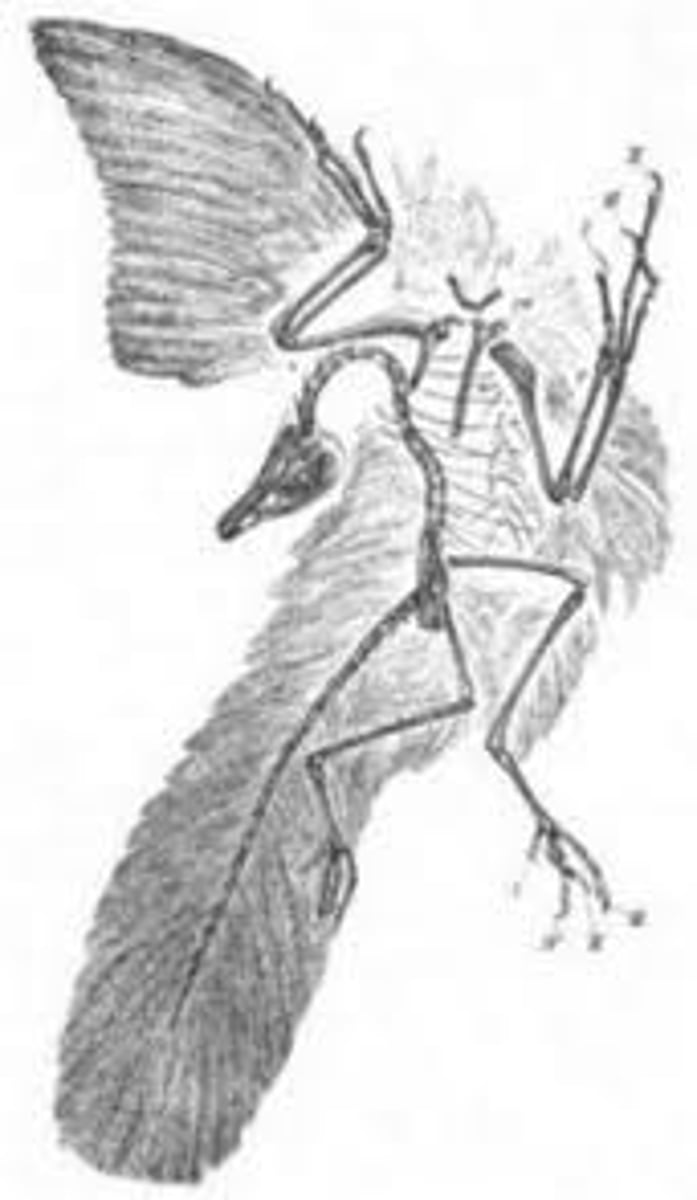
Archaeopteryx
-An intermediate fossil that shows both reptile and bird characteristics.
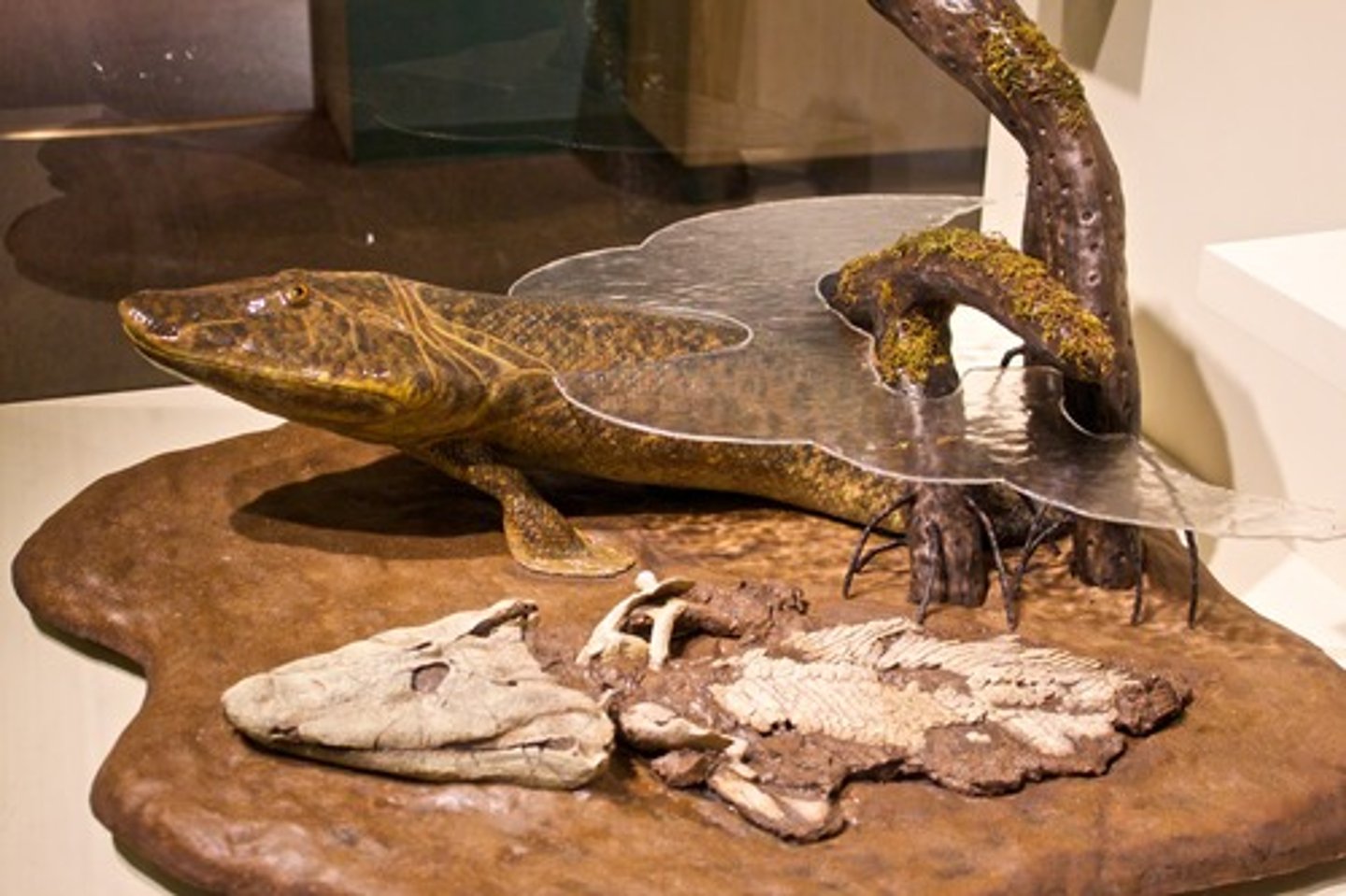
Tiktaalik
-"Missing link" thought to be a transitional form between fish and tetrapods.
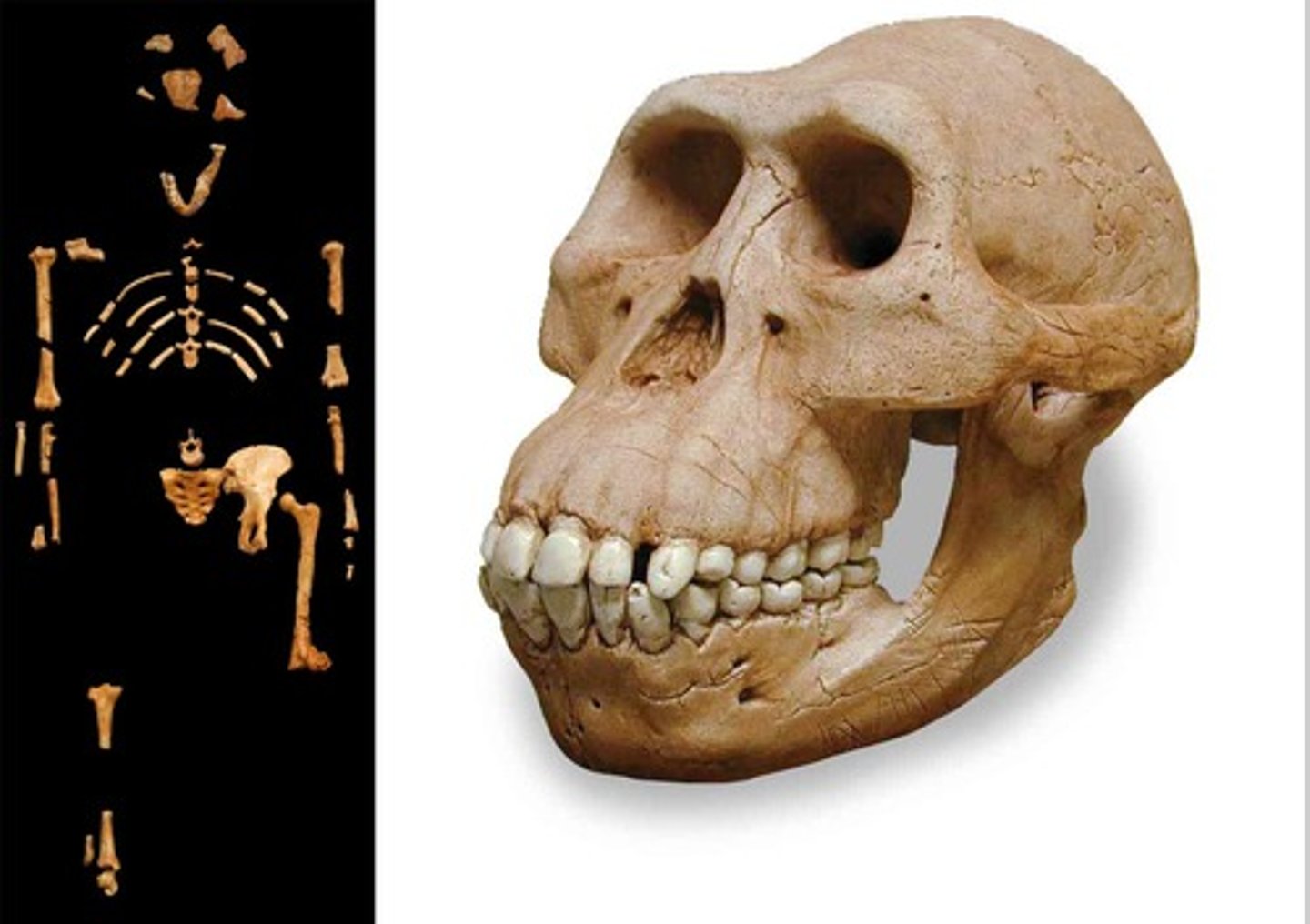
'Lucy'
-A hominin (a member of the human lineage after splitting from the common ancestor with chimpanzees) that lived about 3.2 million years ago in what is now Ethiopia.
Biogeography
-The study of the geographic distribution of species.
+Both current and historical distributions.
+The geographic distribution of species provides much evidence of evolution.
=Geographic isolation of Australia accounts for the dominance of marsupial mammals.
=Outcompeted by placental mammals on other continents
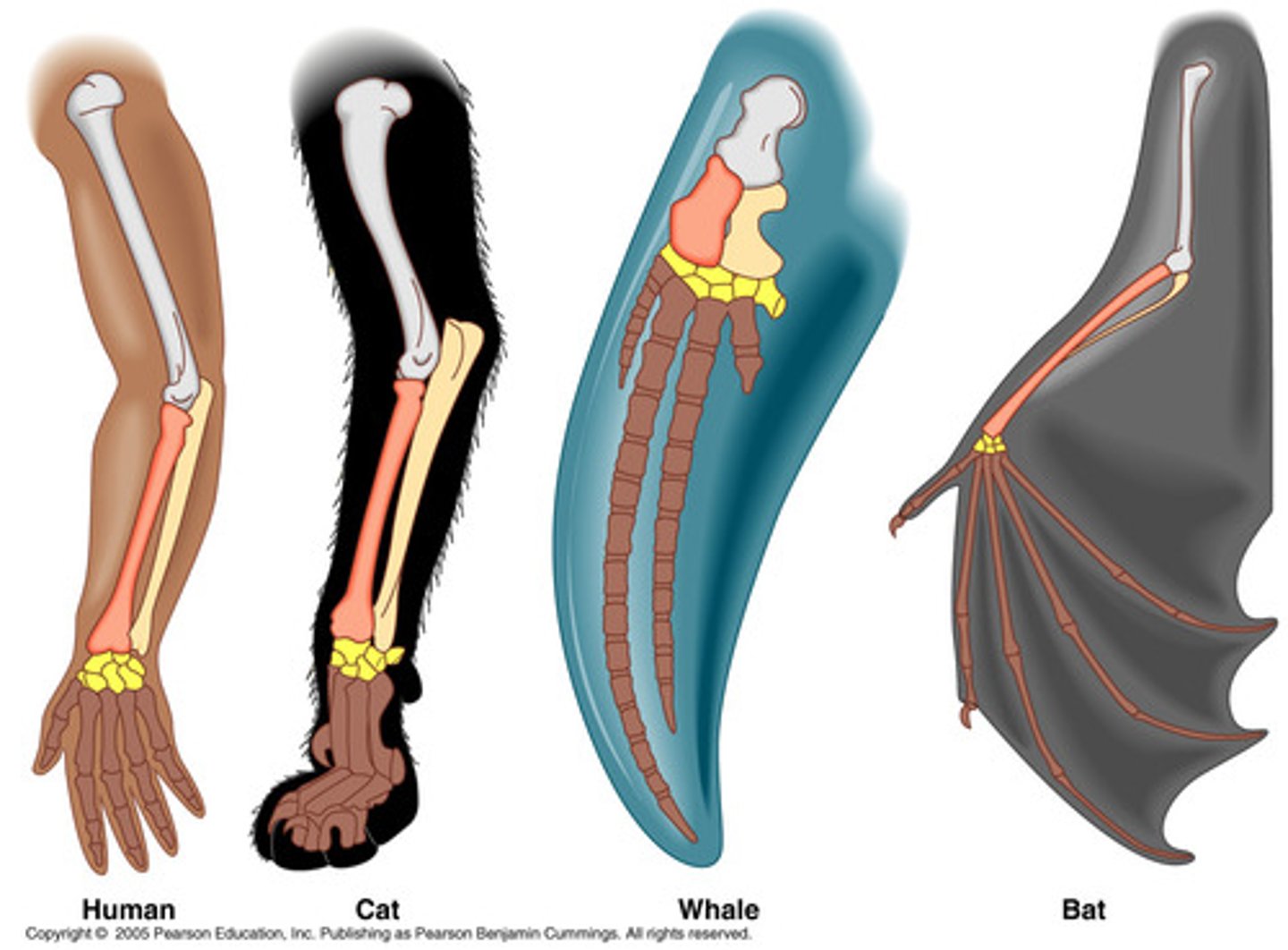
Comparative Anatomy
-Comparisons of the body structures of modern organisms.
-Provides much evidence of evolution.
+Examination of animal forelimbs shows they are all constructed from similar bones and share an evolutionary history.
=Followed by an anatomical and functional divergence.
Bioinformatics
-Application of mathematics and computer science to store, retrieve, and analyze biological data.
-Employs computational tools to process genetic data.
-Closely related species will have similar DNA and protein sequences.
+Such as in primates.
+All life uses DNA for genetic code.
=DNA and bioinformatics provide much evidence of evolution.
What are the Units of Evolution?
-Population.
-Defined only in terms of changes in a population over time.
What are the Units of Natural Selection?
-Individuals.
-Acts on individuals.
Population
-A group of individuals of the same species living in the same place at the same time.
+The members of a population may carry different gene versions.
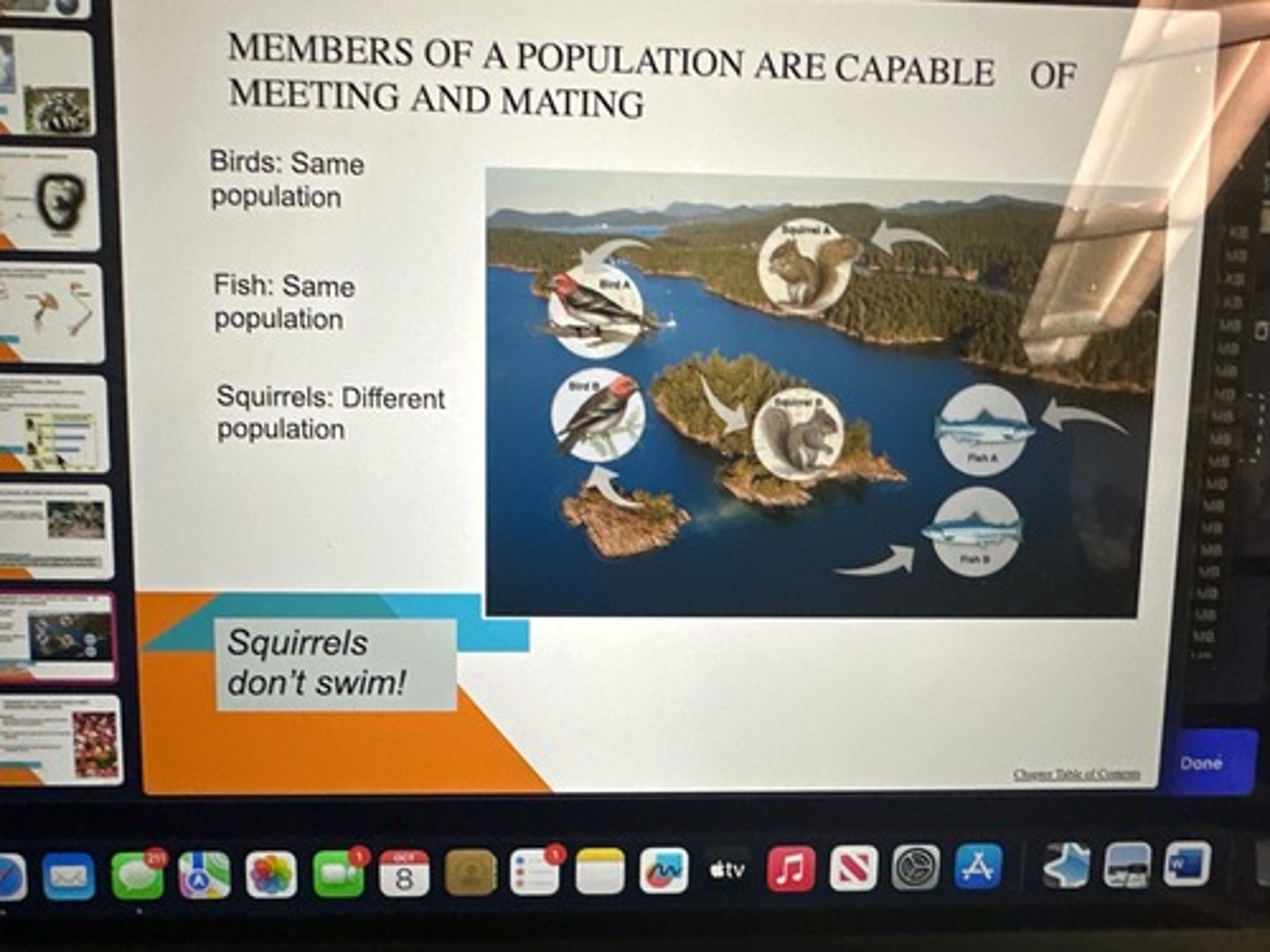
Members of a population are capable of meeting and mating:
-Birds: Same Population because they can meet and mate.
-Fish: Same Population because they can meet and mate.
-Squirrels: Different Population because they cannot meet and mate! They are separated by water and cannot swim.
Gene Pool
-Consists of all versions of all the genes carried by all the individuals in a population.
Mutation
-A change in a gene or chromosome.
-Genetic variation in a gene pool can arise through mutation.
Sexual Reproduction
-Ensures that genes are randomly mixed.
Natural Selection and the Gene Pool
-Traits that enhance survival, and reproduction will be represented with increasing frequency in the gene pool.
Microevolution
-A generation-to-generation change in the gene pool.
-Evolution occurring on its smallest scale.
+Taken over many generations, microevolution can result in the gradual adaptation of species to the local environment.
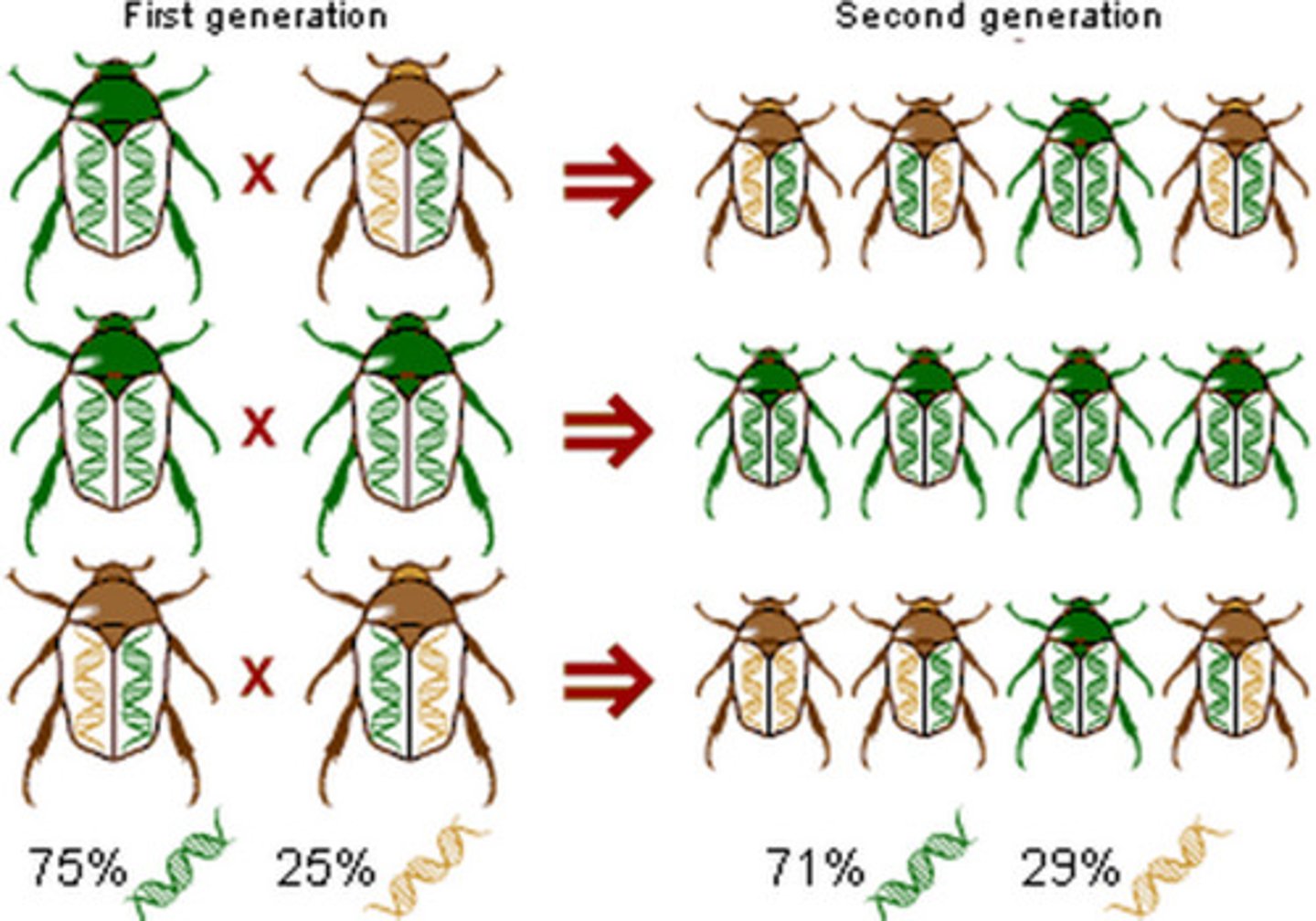
Changes to the Genetic Makeup of a population can arise via Two mechanisms:
1) Mutations: Random changes to DNA which can create new genes.
2) Sexual Recombination: During the formation of sperm and eggs, chromosomes can exchange pieces of DNA, shuffling genes.
Darwinian Fitness
-The contribution that an individual makes to the gene pool of the next generation in comparison to the contributions from other individuals.
-The fittest individual is not always the strongest.
-There are many sorts of adaptations that can improve fitness.
What can lead to changes in a gene pool over successive generations?
-Natural selection is the primary mechanism that can lead to a change in a gene pool, also known as evolution.
Mechanisms of Evolution
-Mechanisms that can also contribute to evolution in gene pools:
1) Natural Selection
2) Genetic drift
3) Bottleneck and founder effect
4) Gene flow
5) Sexual selection
-In evolving populations, some combination of all the mechanisms operates.
Genetic Drift
-A change in a gene pool due to chance.
+For example, genes may be lost if a few individuals die or migrate at random.
+This is important in small, or isolated, populations.
=Can lead to changes in a gene pool over successive generations.
Bottleneck
-If a population is drastically reduced in numbers.
+By chance, some genes will be lost from the gene pool.
=Can change gene pools.
Founder Effect
-If a few individuals migrate to a new isolated habitat.
+By chance, some genes will be lost from the gene pool.
=Can change gene pools.
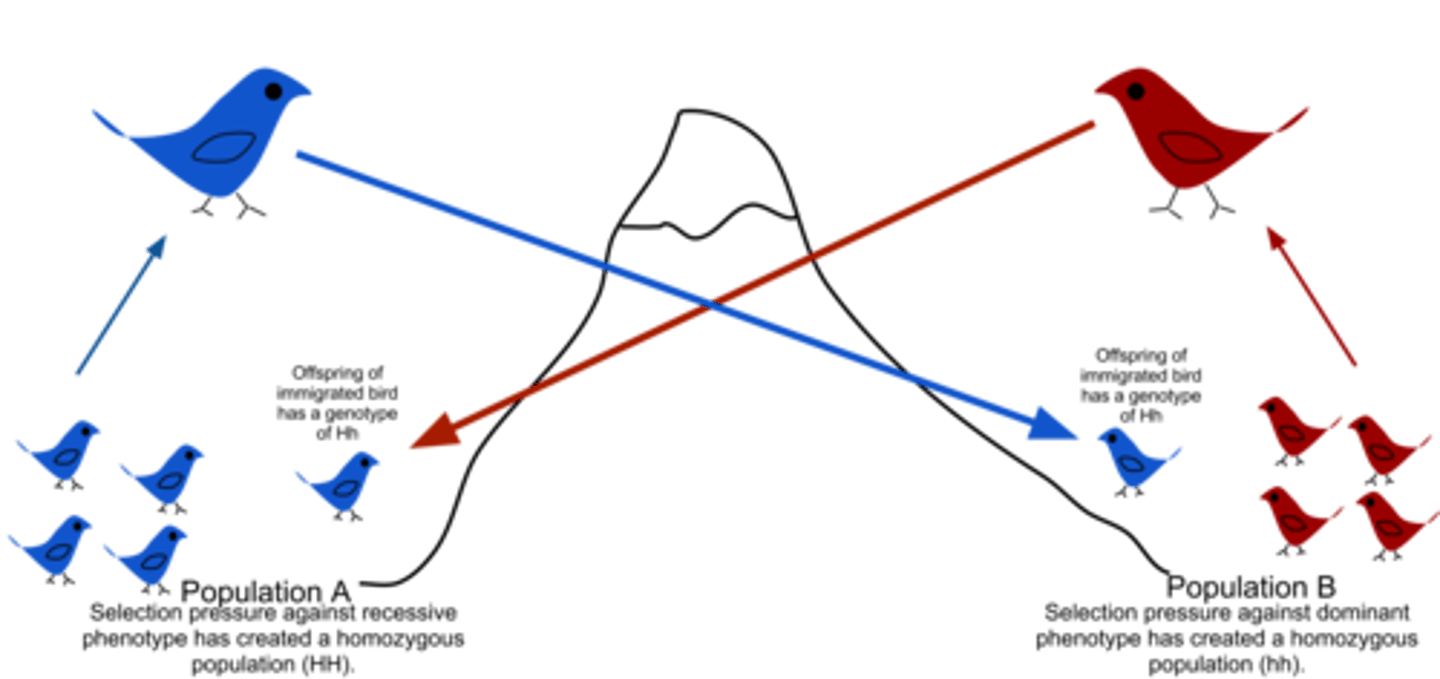
Gene Flow
-The genetic exchange among populations due to dispersal (emigration and immigration).
+Most populations are not isolated.
=Tends to reduce differences among gene pools.
Sexual Selection
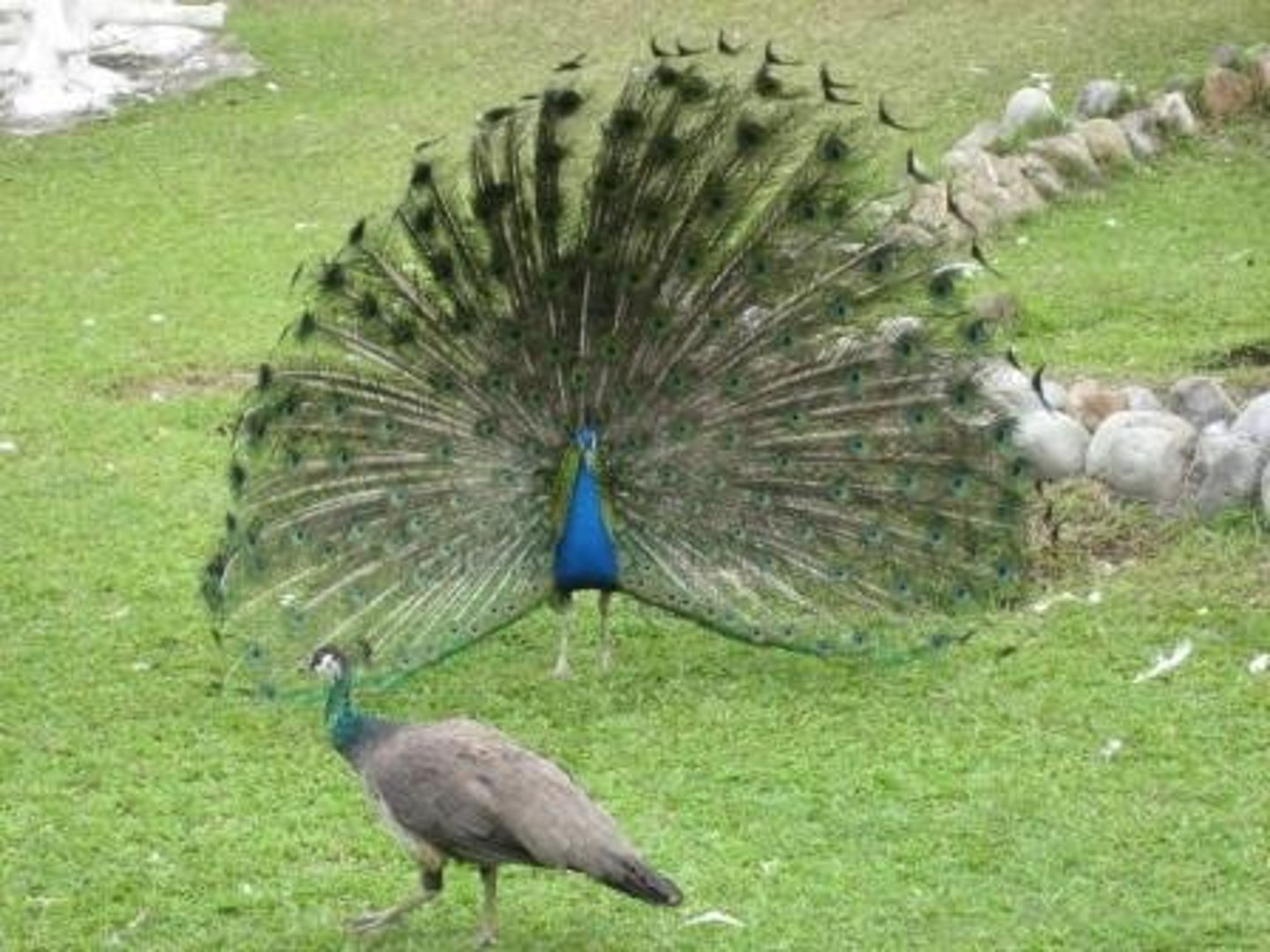
-A form of natural selection that depends on an individual's ability to obtain a mate.
+Females may choose males for their traits.
+Males may compete for access to mates.
=Can lead to changes in a gene pool over successive generations.
Macroevolution
-Genetic change on a large scale.
+Encompasses the major changes in the history of life.
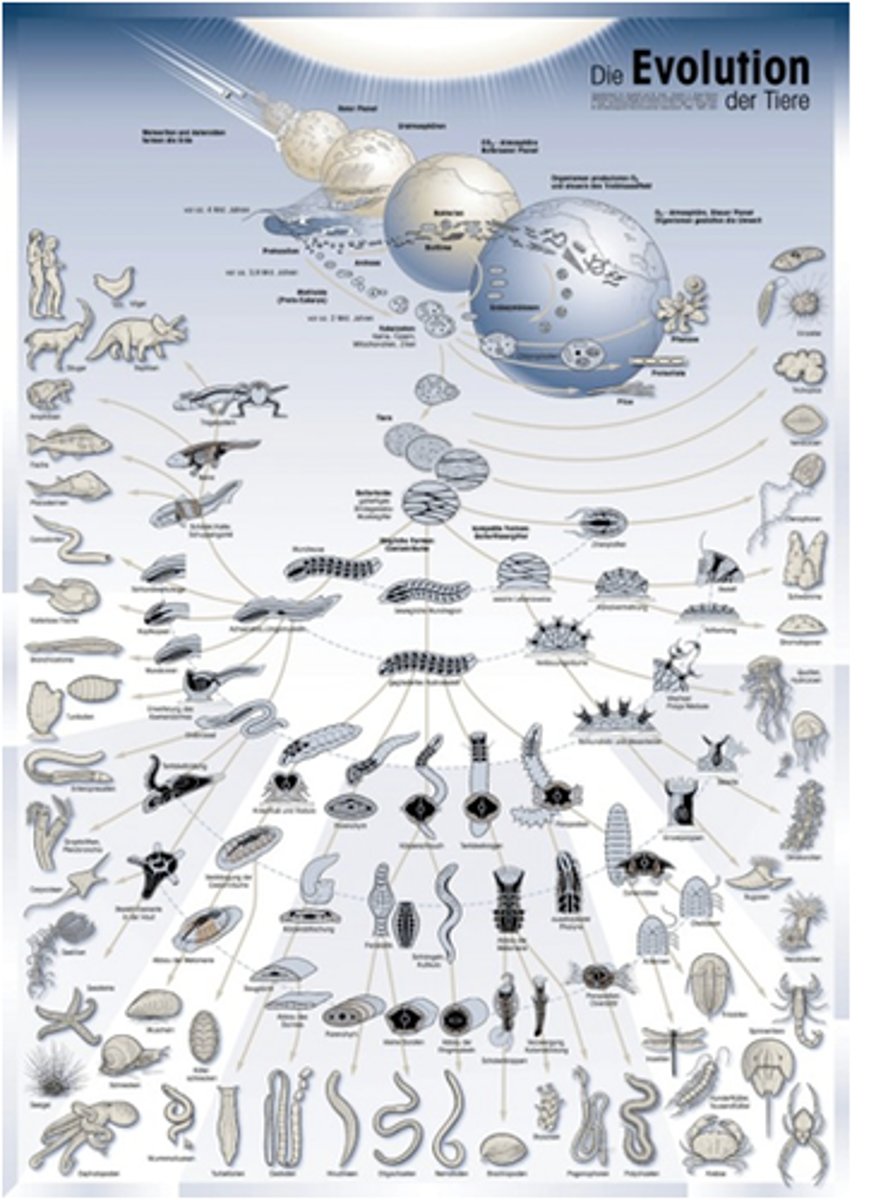
Speciation
-The evolutionary formation of new species.
+Earth's incredible diversity represents a long history of evolution, as ancestral species gave rise to one or more new species.
Speciation may occur through Two Different Mechanisms:
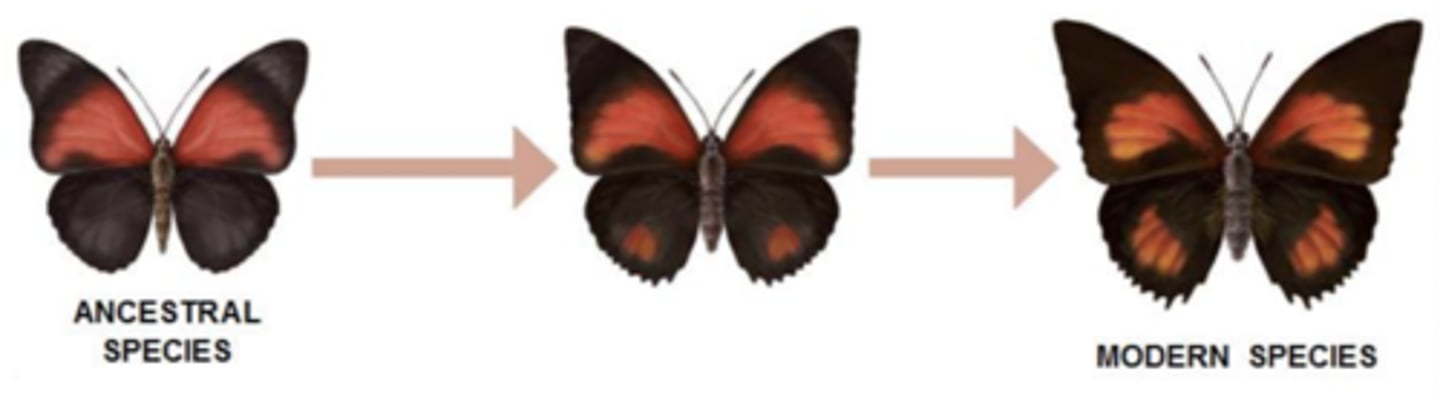
1) Nonbranching Evolution.
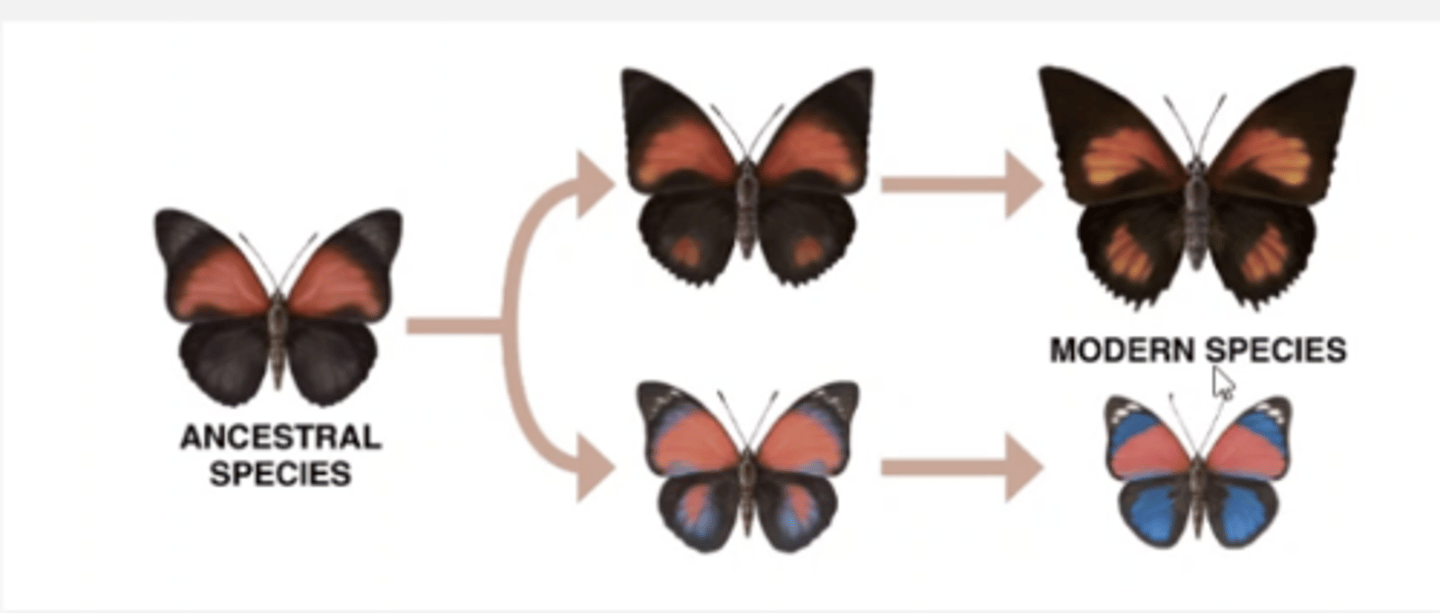
2) Branching Evolution.
Nonbranching Evolution
-An ancestral population changes gradually.
Branching Evolution
-An ancestral population splits into two or more populations.
Novel Features
-In response to natural selection, species may develop new features or functions that improve their survivability.
+Novel features may spur large-scale evolution.
=Throughout the history of life on Earth, novel features have evolved.
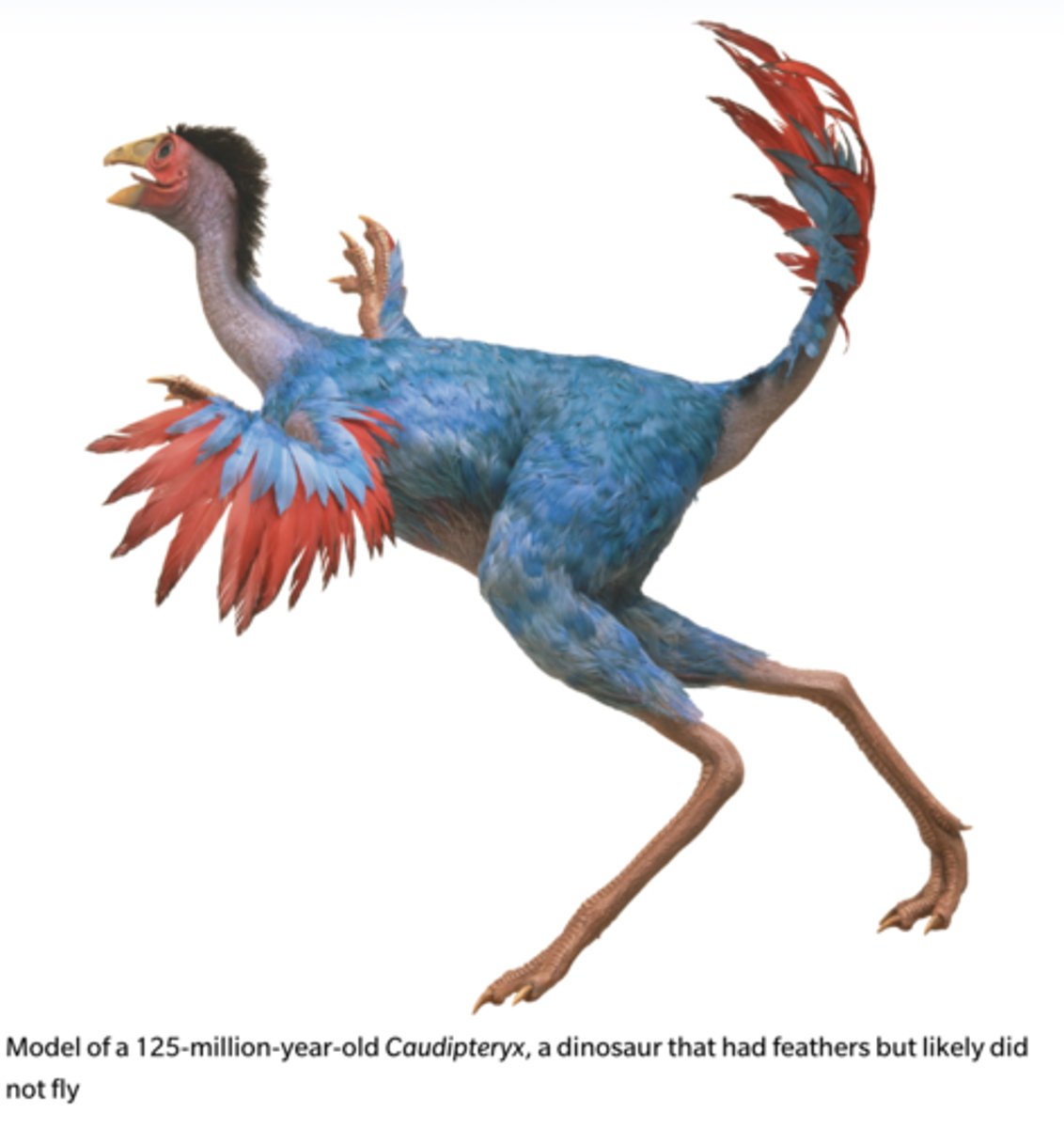
-EX) The evolution of feathers and flight in birds is an example of how structures that serve one role can gradually change to serve another.
+Feathers: sensory, insulation, communication, flight.
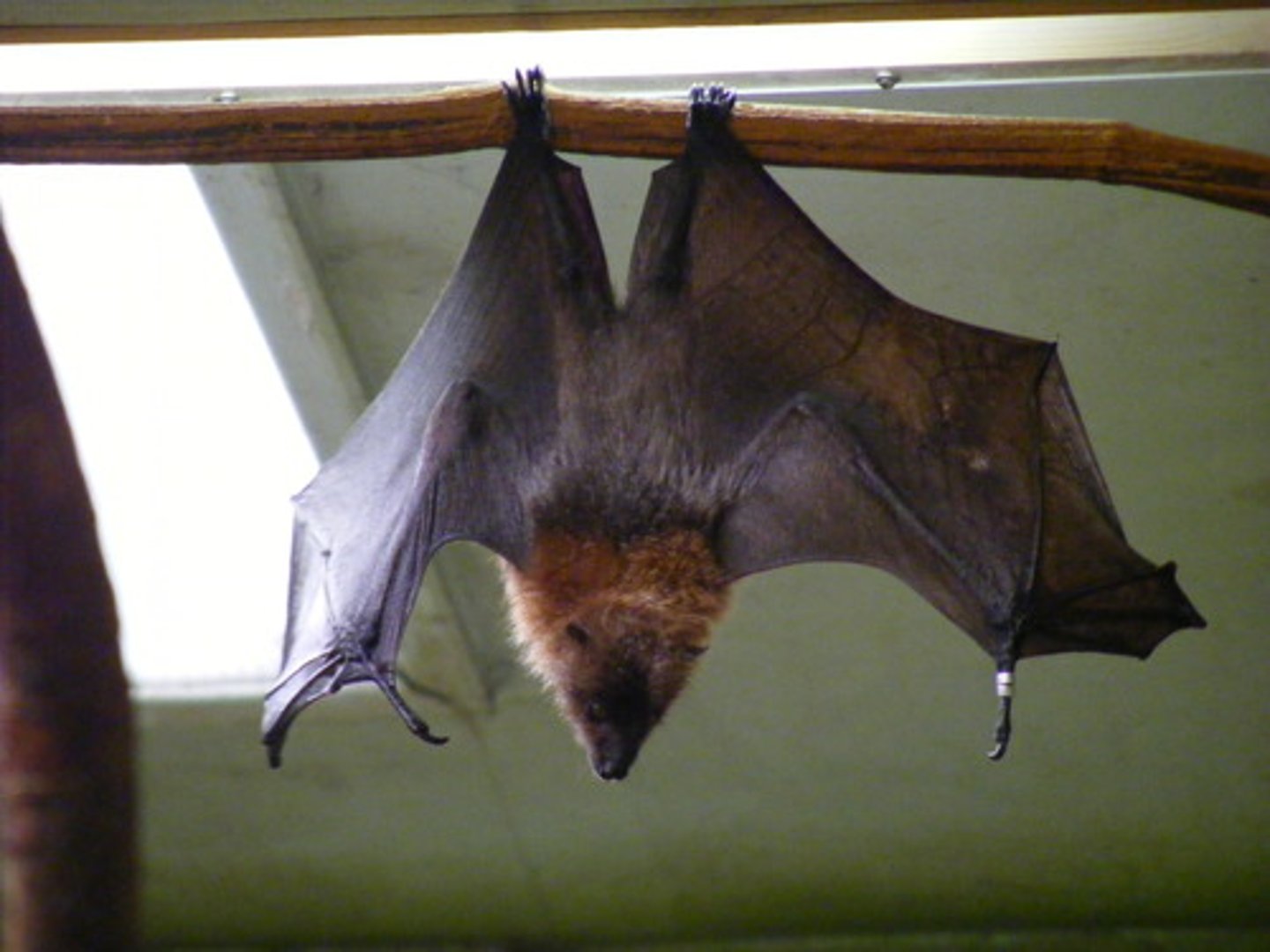
Novel Feature Example: Bats
-Novel Feature: Flight in bats, the world's only flying mammal
+Filling of the nighttime aerial niche (unused resources).
=Filled by birds during the day.
+Explosion of diversity (rapid diversification).
Mass Extinctions
-There have been FIVE mass extinctions in the history of life.
-Following the mass extinction of the dinosaurs 65 mya, mammals diversified.
+Filling open niches.
**Rapid species diversification follows mass extinctions.
Geologists and Geological Record
-Geologists recognize FOUR broad eras in the history of Earth, each marked by the appearance of distinctive life:
1) Precambrian
2) Paleozoic
3) Mesozoic
4) Cenozoic
-Each era represents a distinct period in the history of life.
Eras in History: Precambrian Era
-4.6 billion years ago to 541 million years ago.
-Highlights from the Precambrian:
+4.6 bya: Earth forms
+3.5 bya: Oldest known prokaryote (primitive-celled) fossils.
+2.1 bya: Oldest known eukaryote (modern-celled) fossils.
Eras in History: Paleozoic Era
-541 million years ago to 251 million years ago.
-Highlights from the Paleozoic:
+541 mya: Explosion in animal diversity within the oceans.
+420 mya: Plant life begins on land.
+370 mya: Animals migrate to land.
+251 mya: Mass extinction event.
Eras in History: Mesozoic Era
-251 million years ago to 65 million years ago.
-Highlights from the Mesozoic:
+230 mya: First dinosaurs.
+100 mya: Flowering plants begin to dominate the land.
Eras in History: Cenozoic era
-65 million years ago to today.
-Highlights from the Cenozoic:
+65 mya: Extinction of dinosaurs (meteorite hit) and diversification of mammals.
+200,000 years ago: Appearance of anatomically modern humans.
Earth's Geology and the History of Life
-Earth's geology has had a profound impact on the history of life.
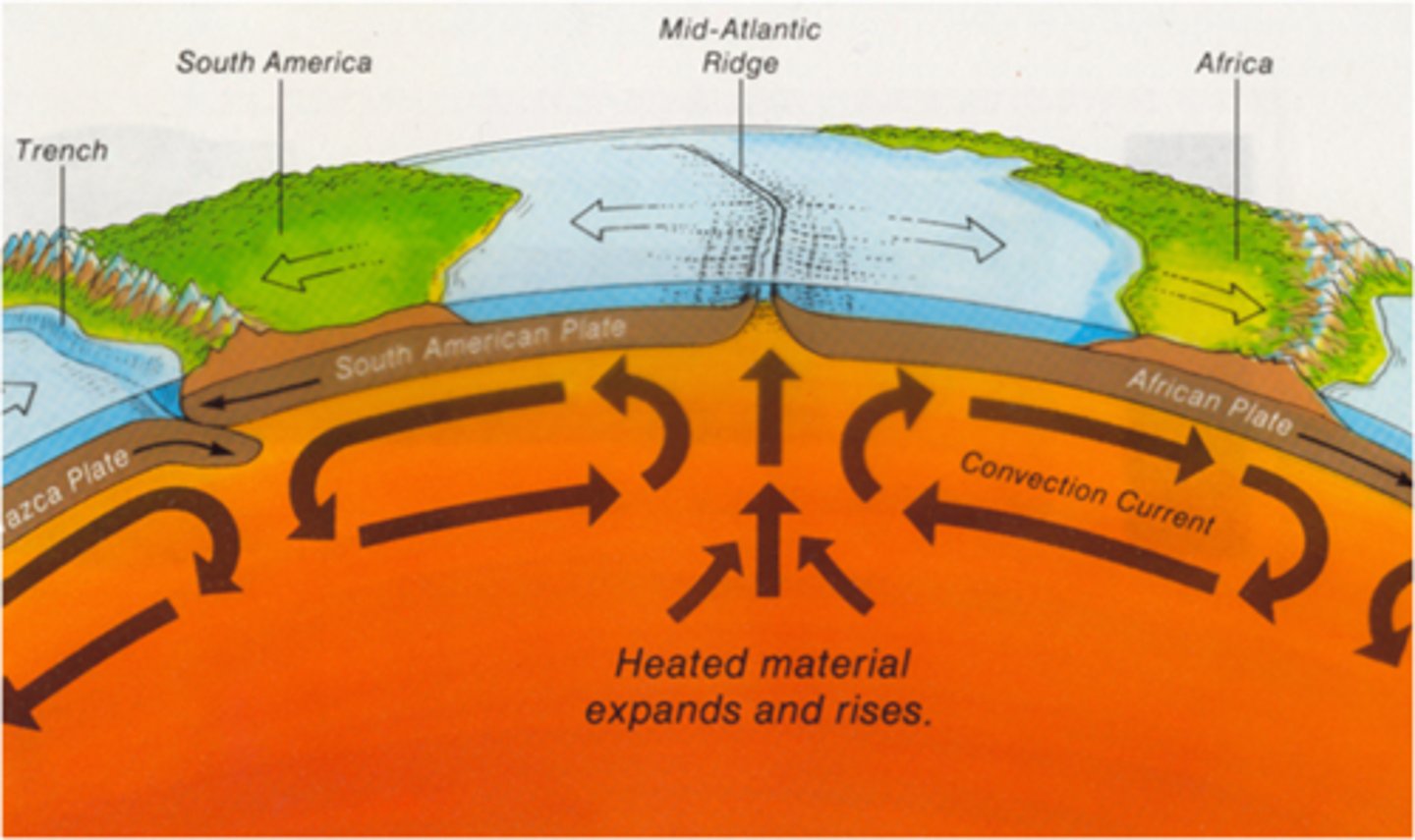
-The Earth's crust is composed of large tectonic plates floating atop a very hot layer of rock called the mantle.
-Plate movement continuously rearranges the geography of the continents.
+200 million Years ago, all continents were combined into the single land mass Pangea.
+100 Million years ago, diverging plates began to open up the Atlantic ocean and separate the continents.
Tectonic Plates
-Large movable plates under the Earth's surface.
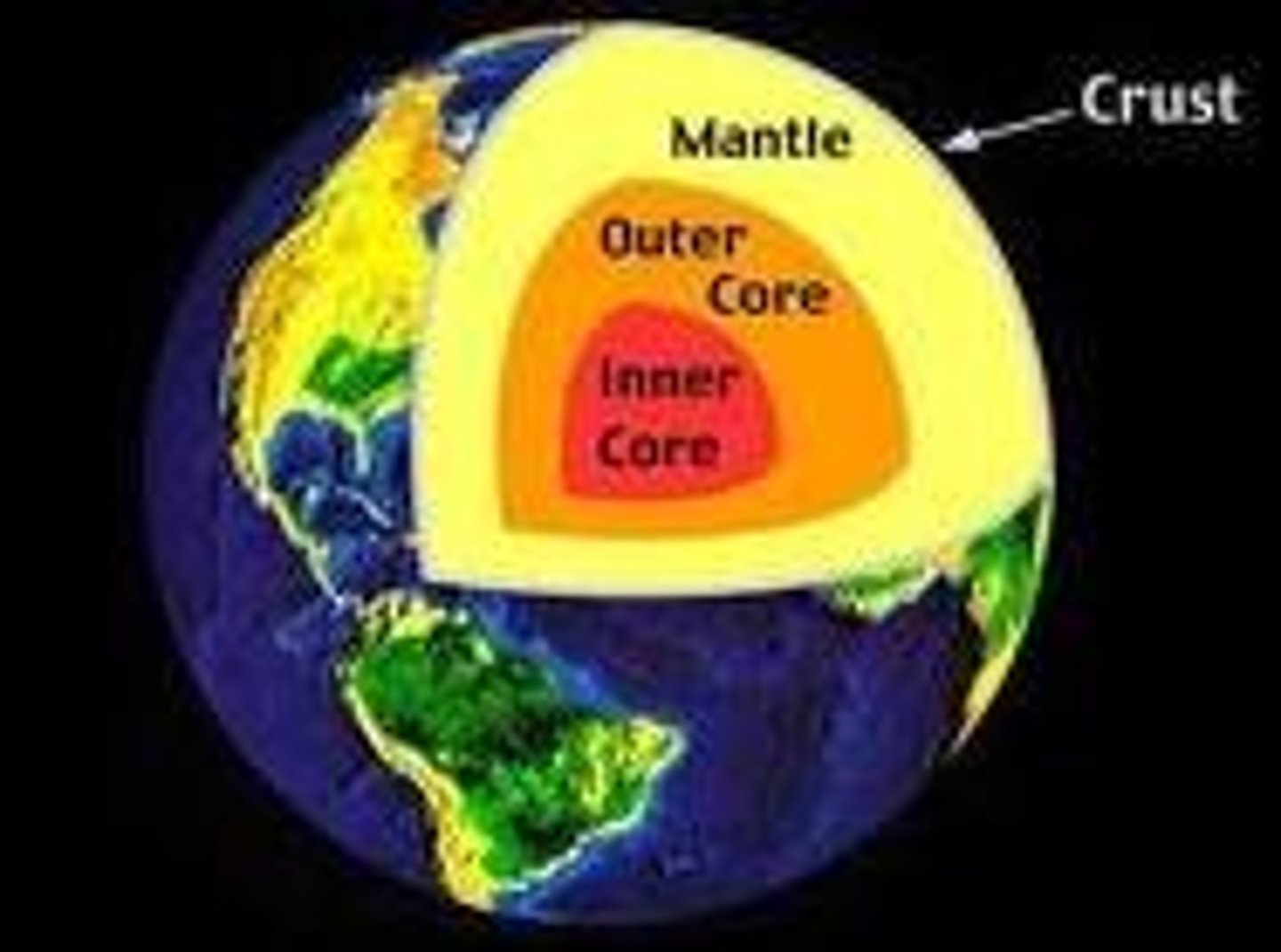
Mantle
-The layer of hot, solid material between Earth's crust and core.
Earth's Geology and the History of Life (Again)
-The Earth is a dynamic planet.
-Geological upheavals can be catastrophic in the short term and can alter the evolution of life on Earth in the long term.
+Earthquakes, mountain building, volcanoes.
**Changes in the Earth's geology over time have intertwined with the history of life on Earth.
The Earth: Toba
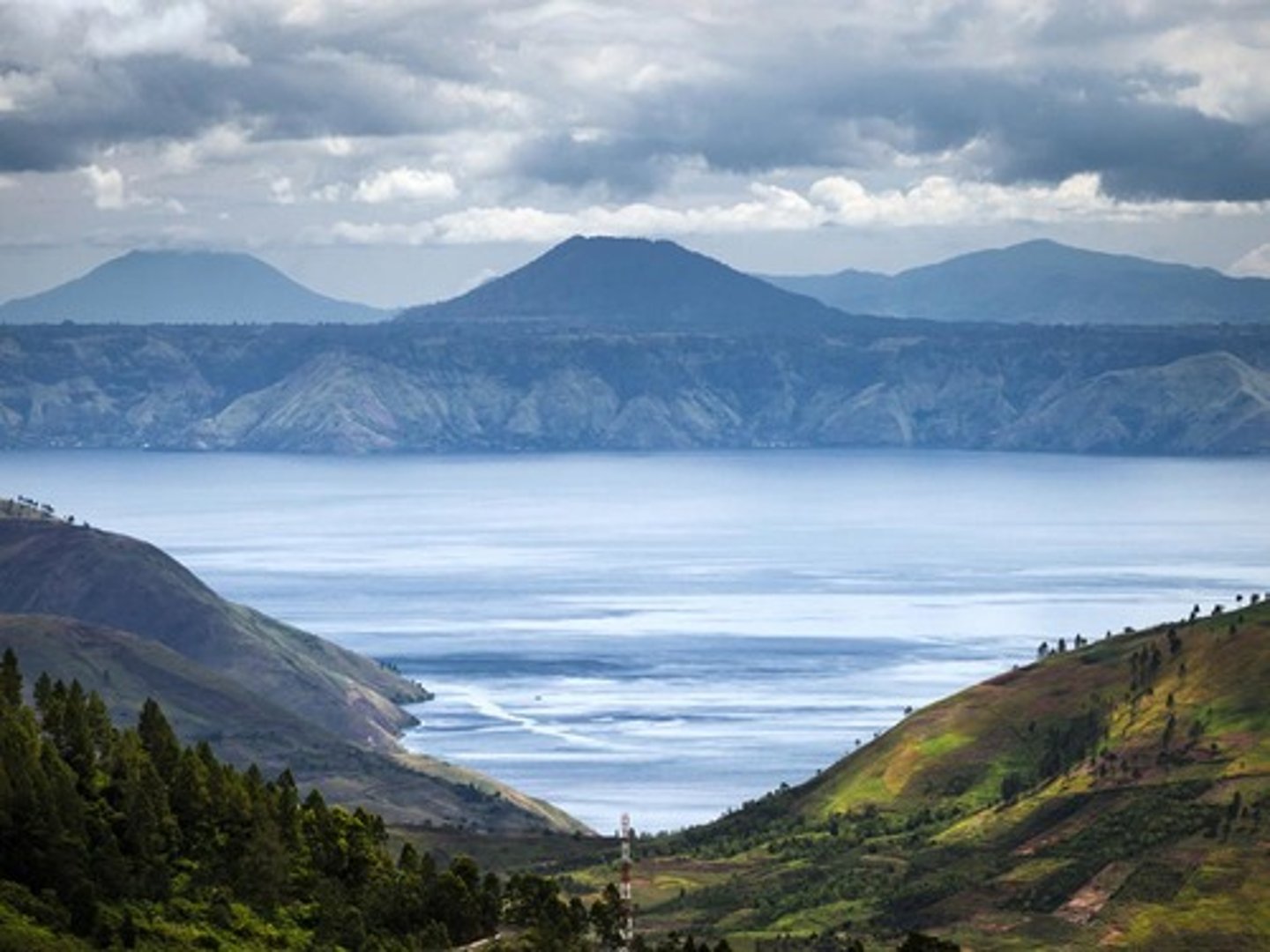
~74,000 years ago, Toba (colossal volcano in Sumatra) blew its top in the largest eruption in the past 2 million years --> gas and ashes spewed into the atmosphere --> spread around the world within weeks --> triggering a global "volcanic winter" lasting decades --> massive die-offs & near-extinction of the human species (down to 10,000 adults of reproductive age).
Life and Oxygen
-Oxygen entering the Earth's atmosphere billions of years ago had a profound influence on life.
Species
-A population that is capable of interbreeding to produce healthy, fertile offspring.
-Derived from a Latin word meaning "appearance."
+However, appearance alone cannot be used to tell one species from another.
What is wrong with the Definition of Species?
-Our earlier definition focused on interbreeding doesn't work for all species.
+Bacteria reproduce asexually.
+For extinct organisms, we can't know if they were capable of mating.
-For some organisms, we have to use appearance, or another means, to determine species groups.
Reproductive Barriers
-Anything that prevents individuals of closely related species from interbreeding.
+One or more reproductive barriers prevent members of different species from breeding.
The Reproductive Barriers
1) Behavioral Isolation
2) Mating Time Differences
3) Habitat Isolation
4) Mechanical Incompatibility
5) Gametic Incompatibility
6) Hybrid Weakness
Reproductive Barrier: Behavioral Isolation
-Members of a species often identify each other through specific rituals.
Reproductive Barrier: Mating Time Differences
-Many species are able to reproduce only at specific times.
Reproductive Barrier: Habitat Isolation
-If species live in slightlydifferent habitats, they may never meet.
Reproductive Barrier: Mechanical Incompatibility
-Members of different species often cannot mate because their anatomies are incompatible.
Reproductive Barrier: Gametic Incompatibility
-The gametes (sperm and egg of different species usually cannot fertilize each other.
Reproductive Barrier: Hybrid Weakness
-Offspring of two species may be unfit, or they may be sterile.
Speciation (Again)
-Speciation occurs when one ancestral species evolves into one or more new species.
-Some event separates a population:
+Time, space, or genetics.
-Populations then diverge along their own evolutionary path.
Graduated Model
-A species acquires small adaptations to its environment over millions of years.
+New species may form over long periods of time.
Punctuated Equilibrium Model
-There are periods of stasis interrupted by occasional bursts of speciation.
+New species may form relatively rapidly.
Cambrian Explosion
-Rapid diversification of most major animal groups marking the start of the Paleozoic era.
-530 Millions Years Ago.
**The rate of evolution was an order of magnitude higher than the normal rate. (It still required millions of years).
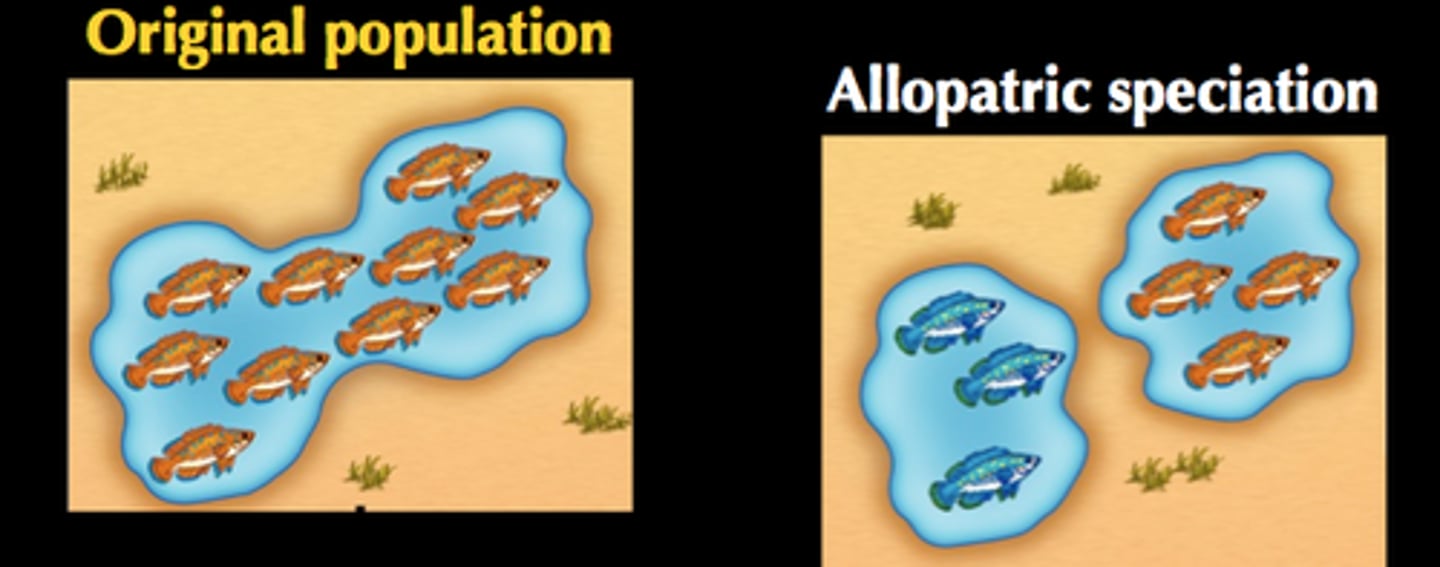
Allopatric Speciation
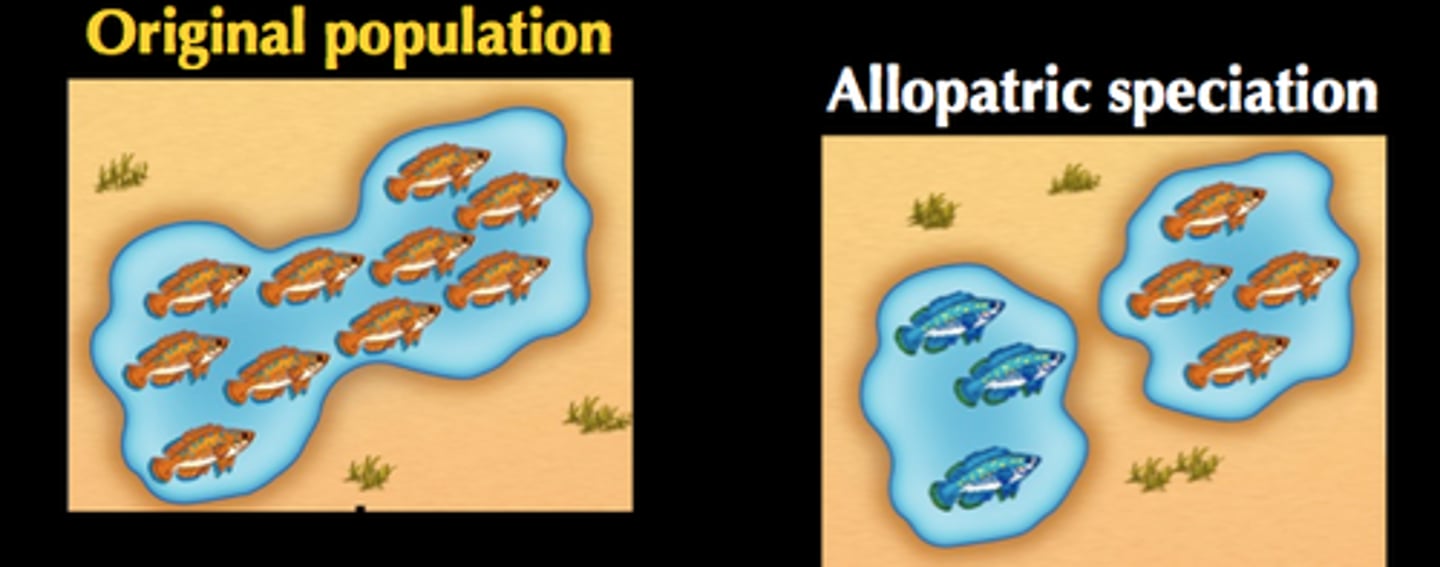
-May occur when a physical barrier isolates populations.
**New species may form after geographic isolation.
Sympatric Speciation
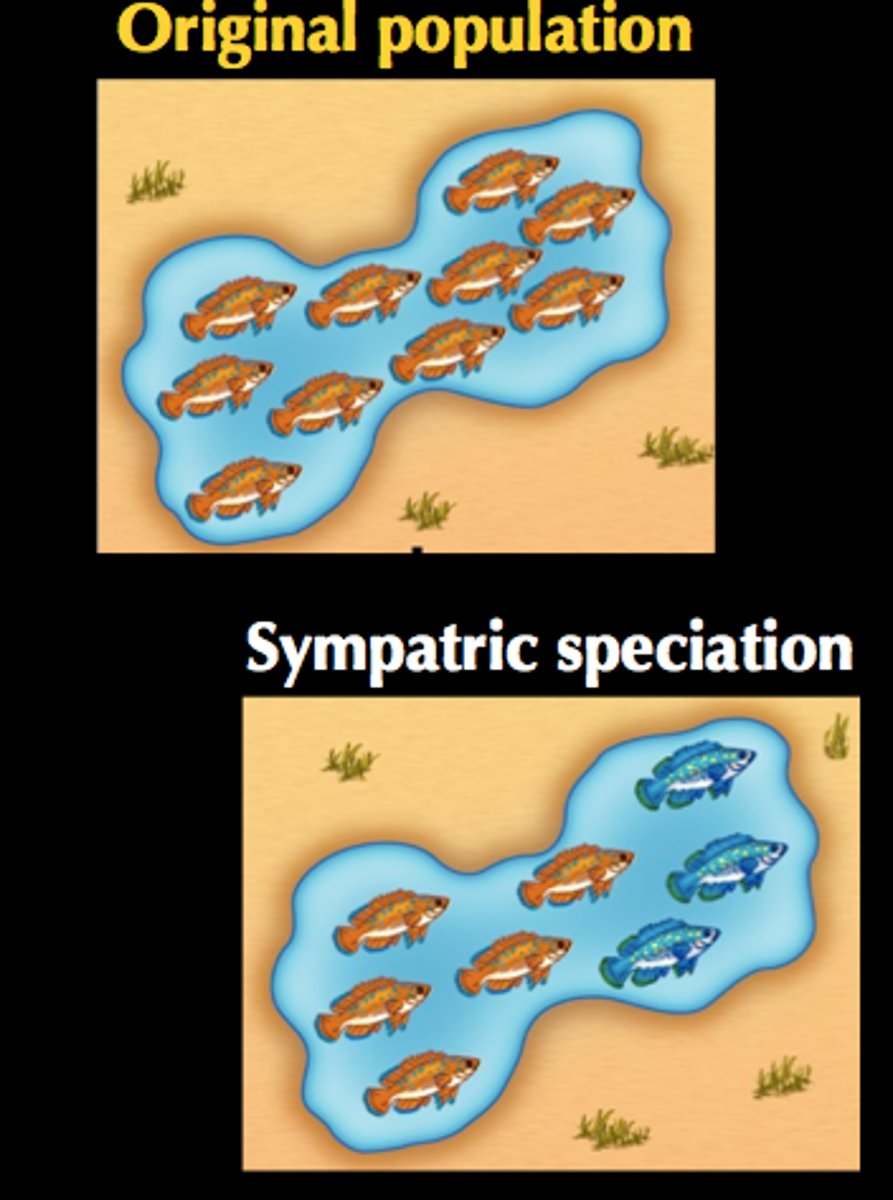
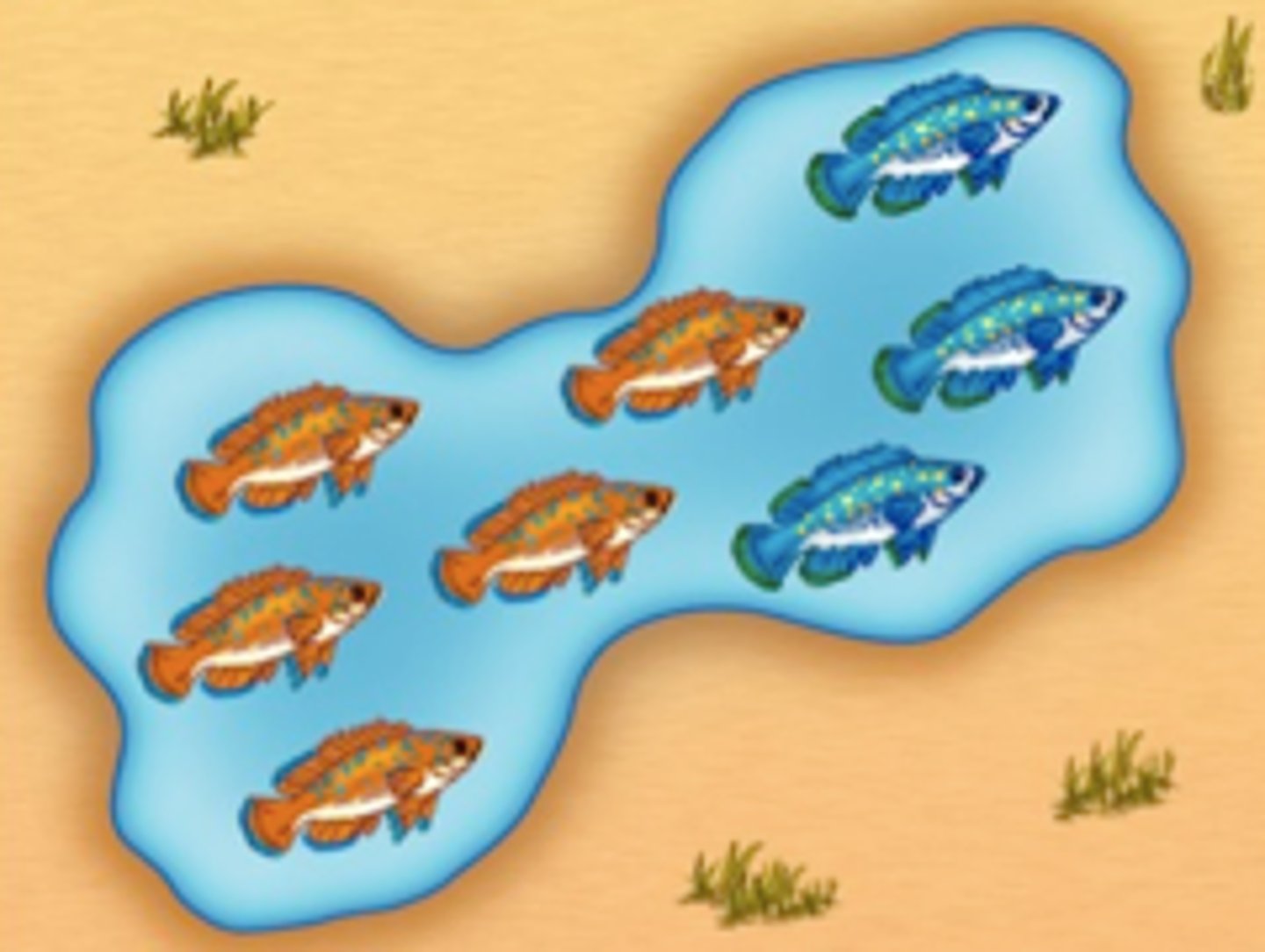
-May occur quite suddenly due to large-scale genetic changes. (There is no physical barrier).
**New species may form within a parent species.
Taxonomy
-The identification, naming, and classification of species.
+Taxonomy is the classification of life.
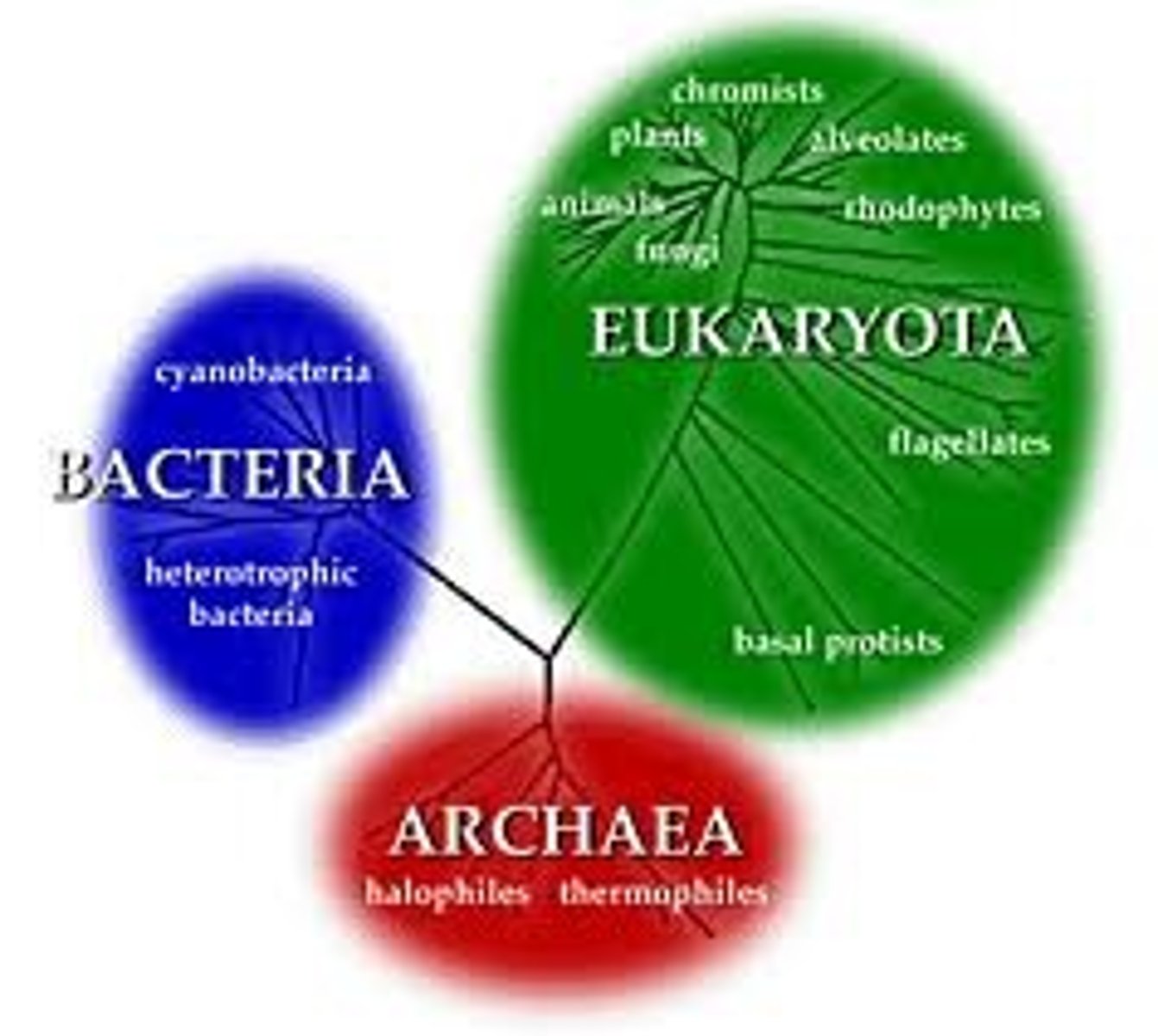
-All life is classified into one of three large groups called domains based on cell type.
Domains
-Three Large Groups that all life is classified into.
1) Bacteria
2) Archaea
3) Eukarya
**Slide 82 has a good chart. Get a refresher.
Taxonomic Hierarchy
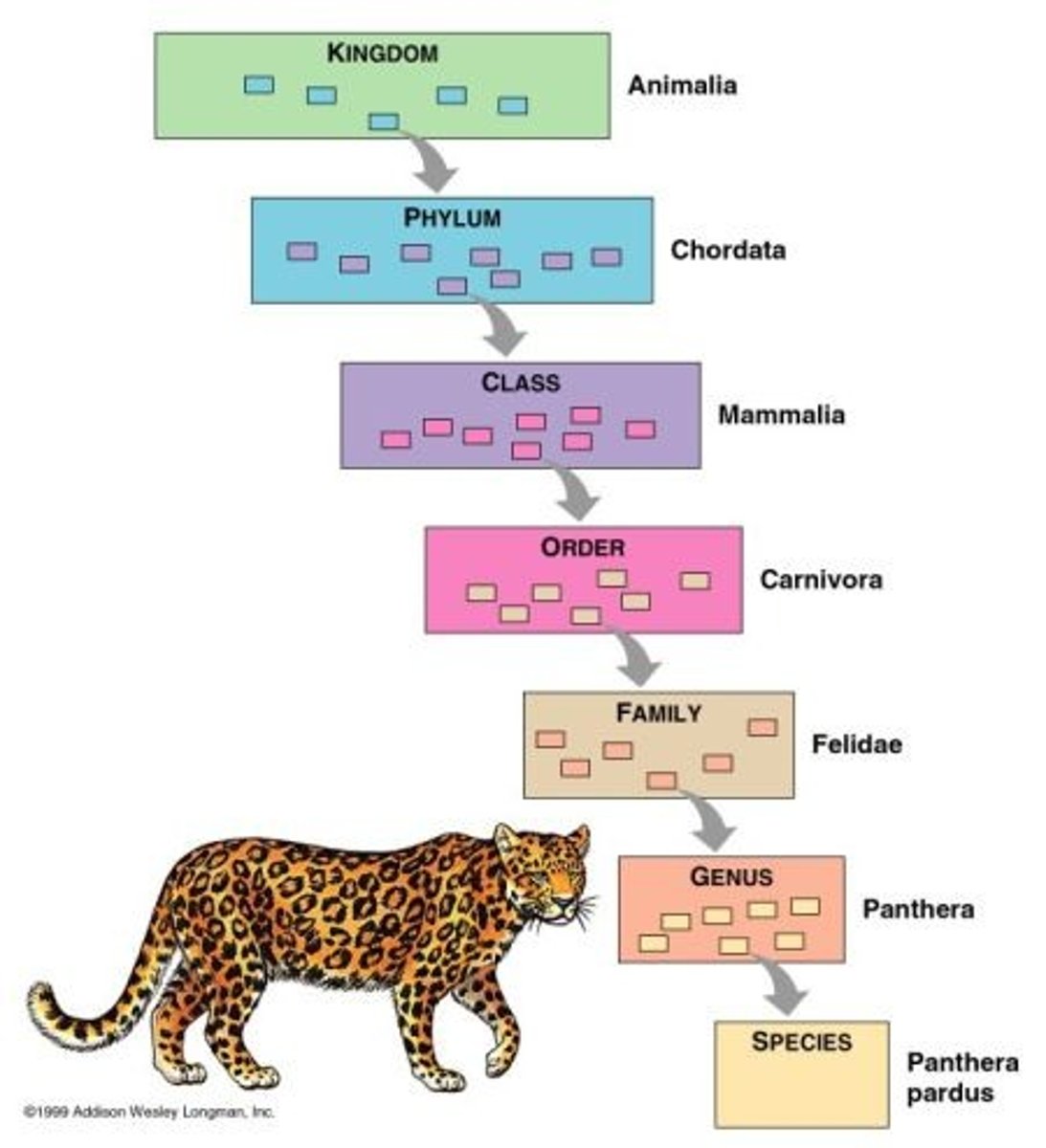
-An ordered series of progressively smaller categories.
-Domain ---> Taxonomic Hierarchy.
-The hierarchy ends with the species name.
**Review the Taxonomy Hierarchy Chart.
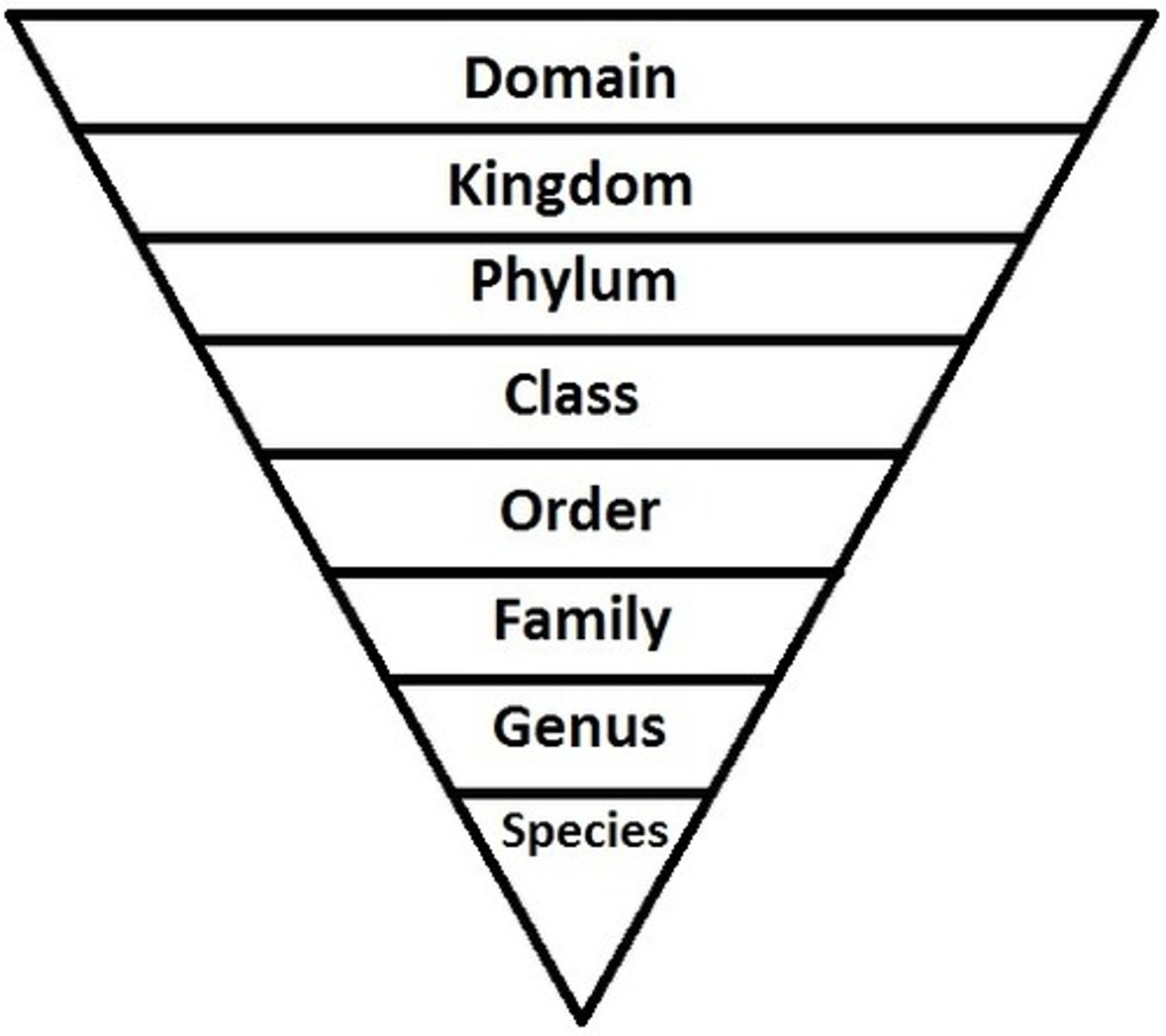
Taxonomy Hierarchy Levels
-Domain.
-Kingdom.
-Phylum.
-Class.
-Order.
-Family.
-Genus.
-Species.
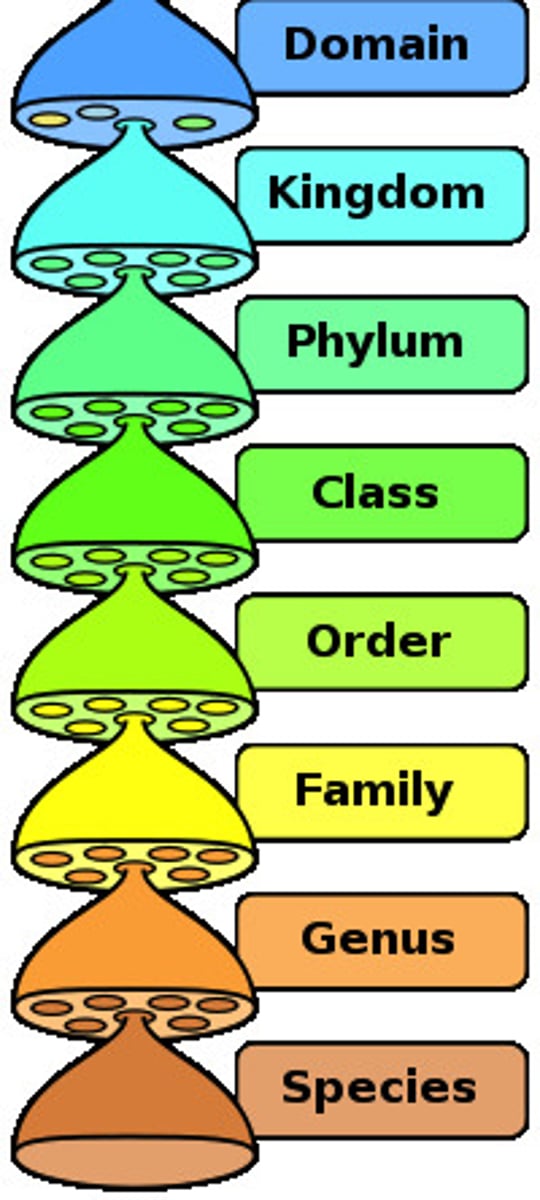
Taxonomy Mnemonic
King Philip Came Over For Good Soup!
How species are identified:
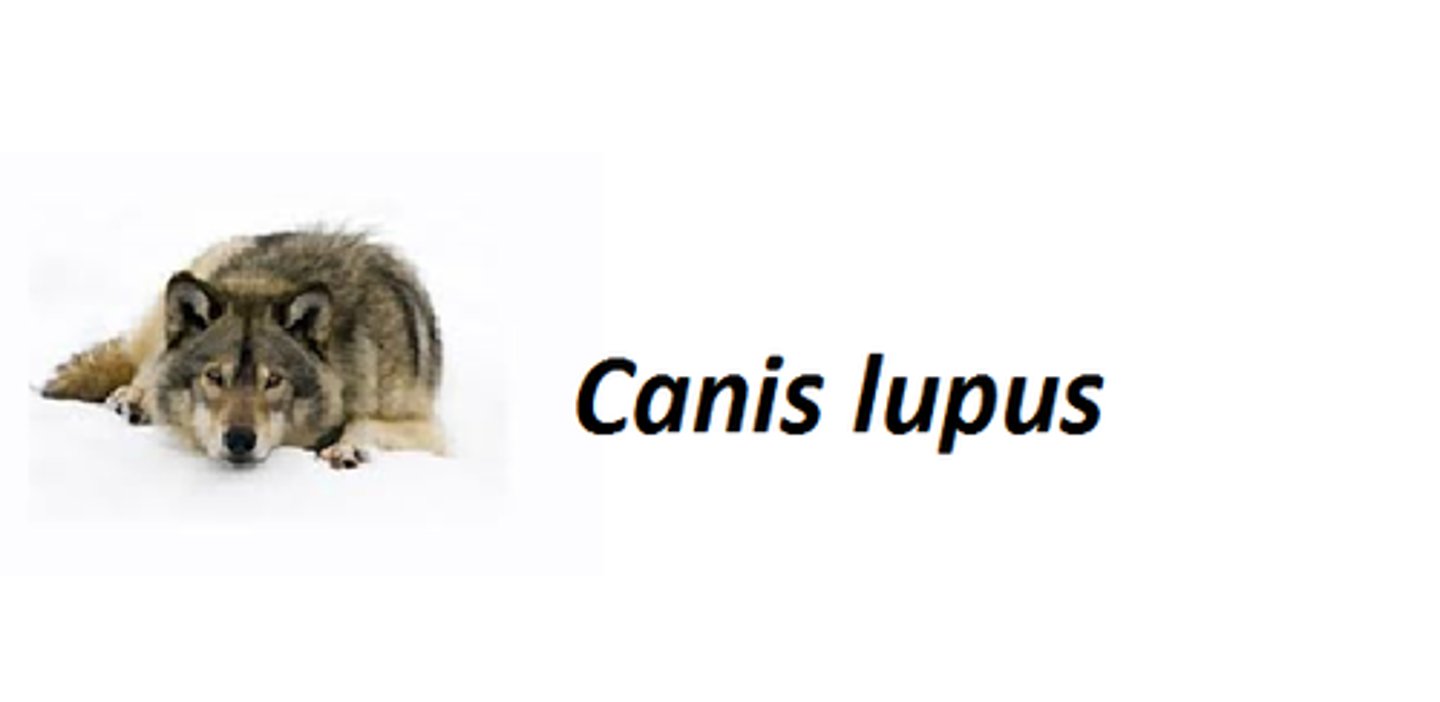
-Species are identified using the last two groups in the hierarchy: Genus species.
-This binomial (two-part) is sometimes called a "scientific name".
Phylogenetic Trees
-Branching diagrams that depict hypotheses about evolutionary relationships.
-One way to reflect the evolutionary history of organisms.
-Present a hypothesis about the evolutionary history of related species.
-Reading phylogenetic trees can provide insights into the interrelationships of life
+The tips of the tree represent groups of the most recently evolved species.
+To determine how closely related two species are, find their most recent common ancestor.
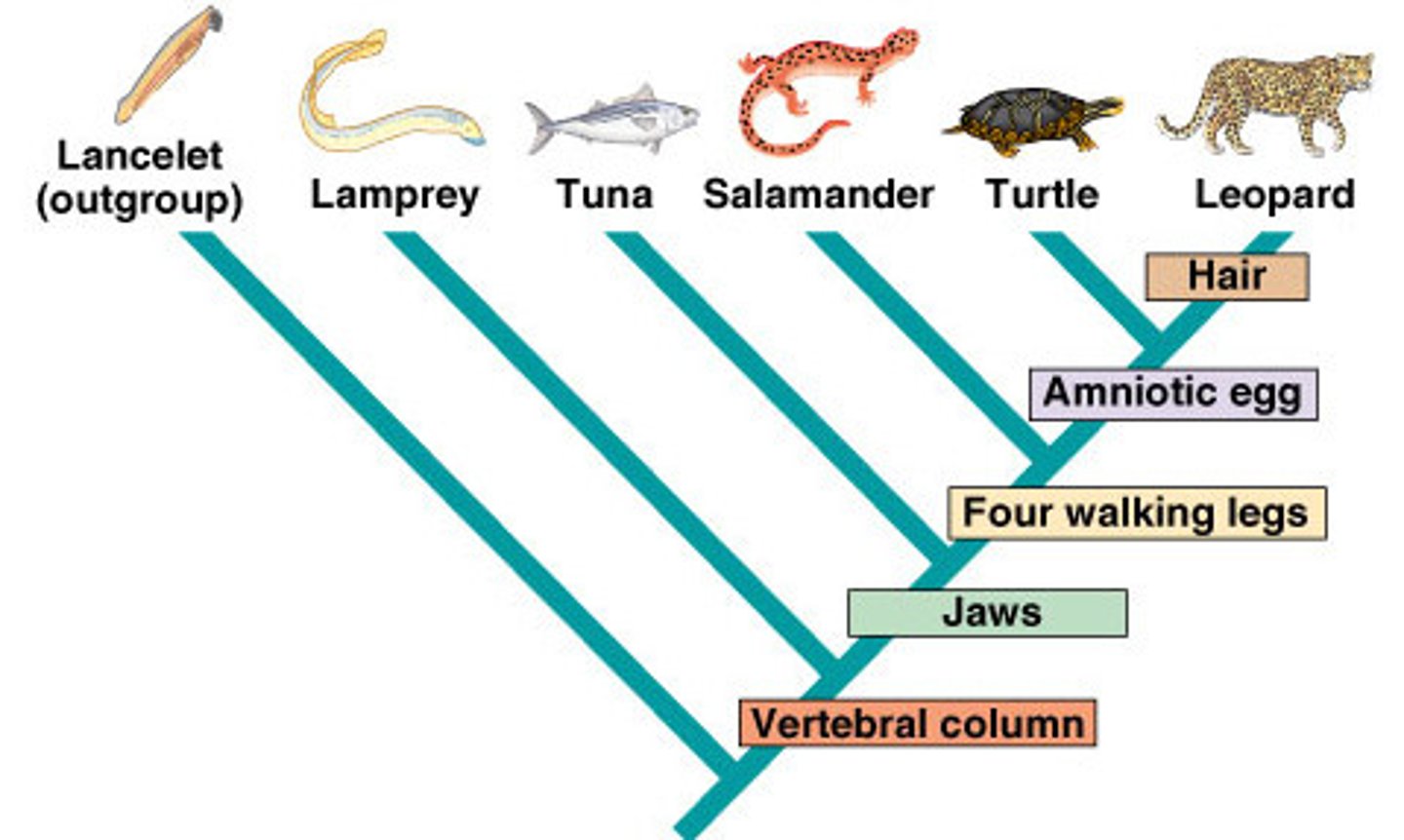
Clade
-Any group of species that consists of an ancestral species and all its descendants.
-Clades can be thought of representing a branch on the tree of life.
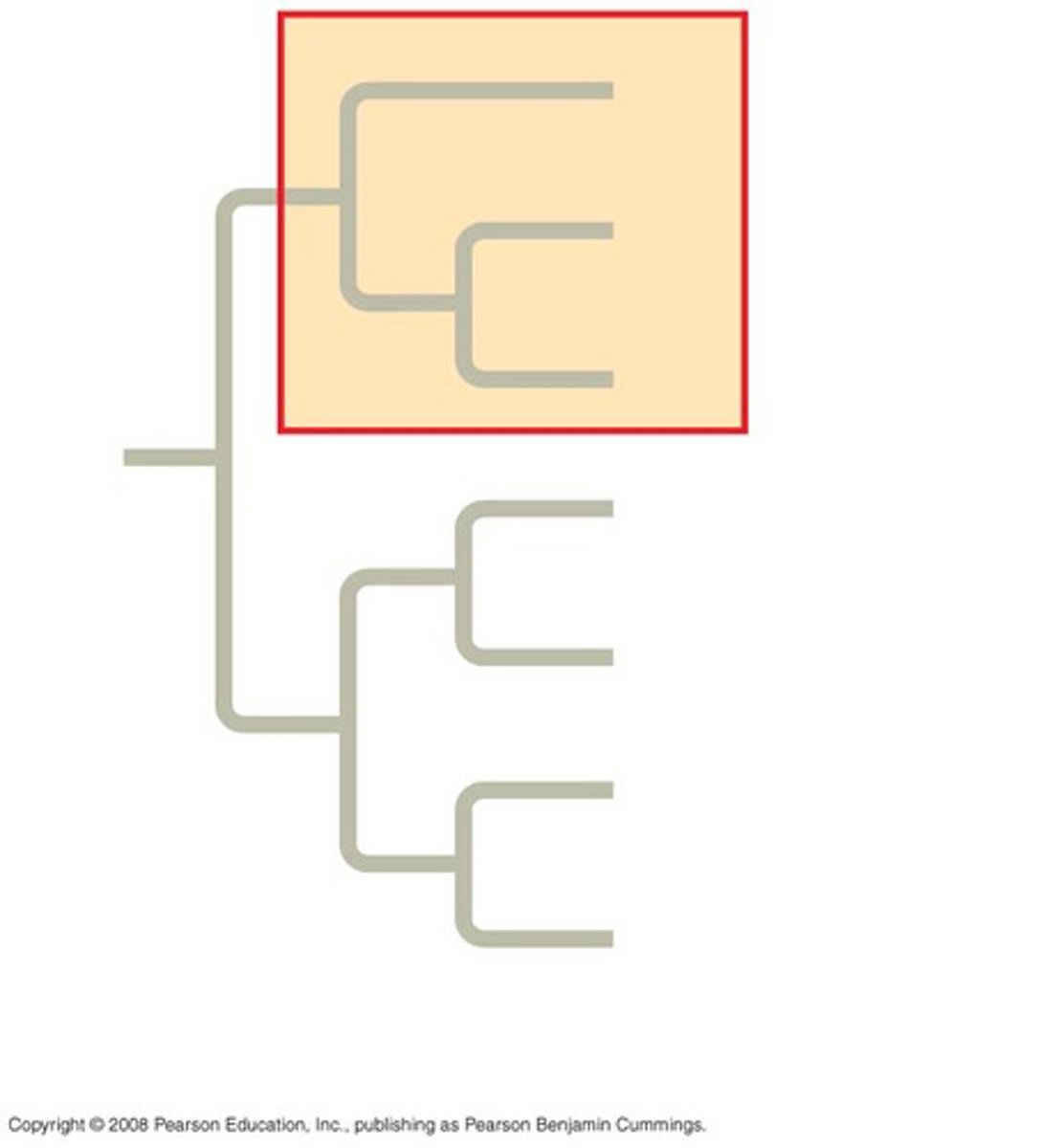
Cladistics
-The analysis of clades.
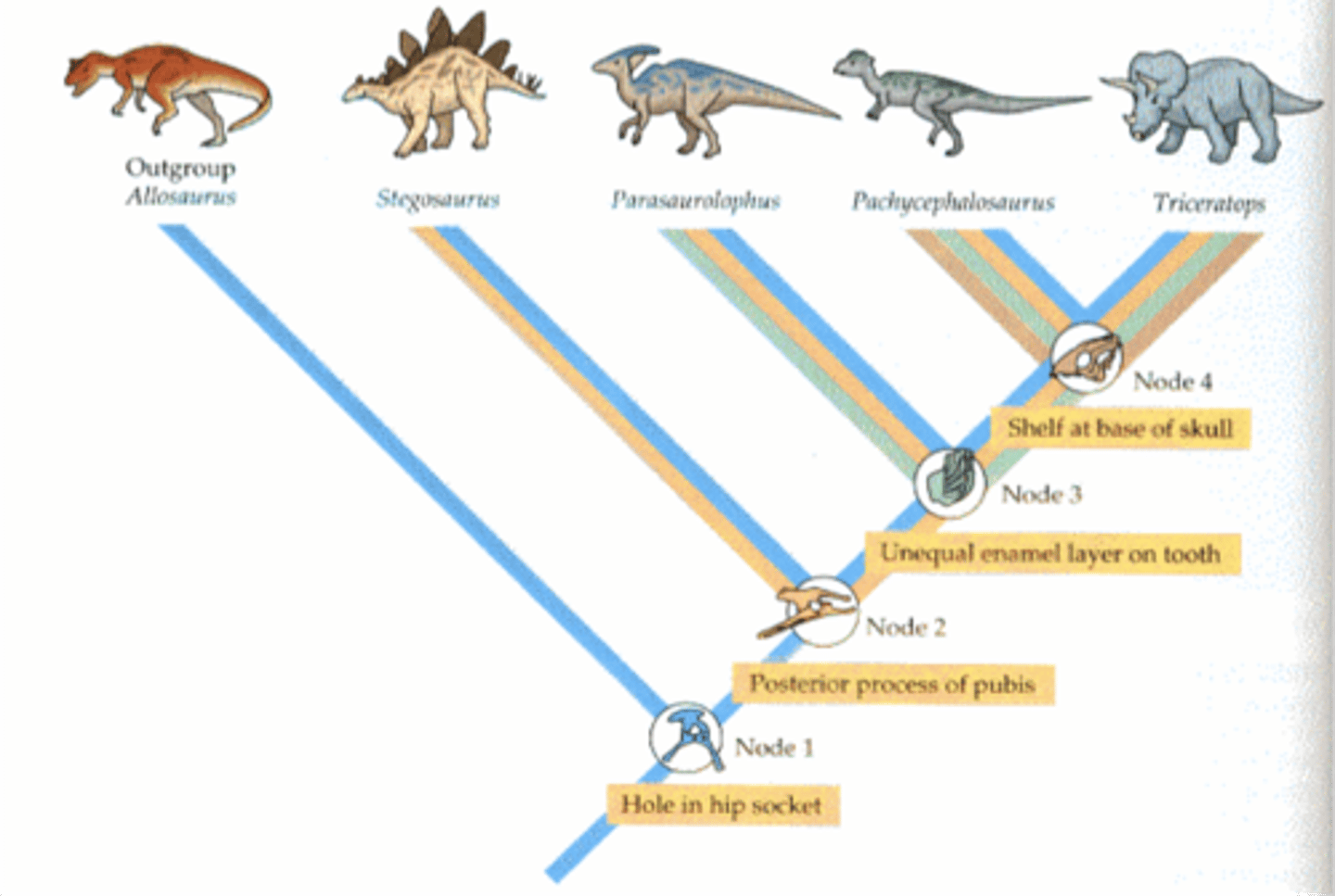
Tetrapods
-Vertebrate animals having four feet, legs or leglike appendages.
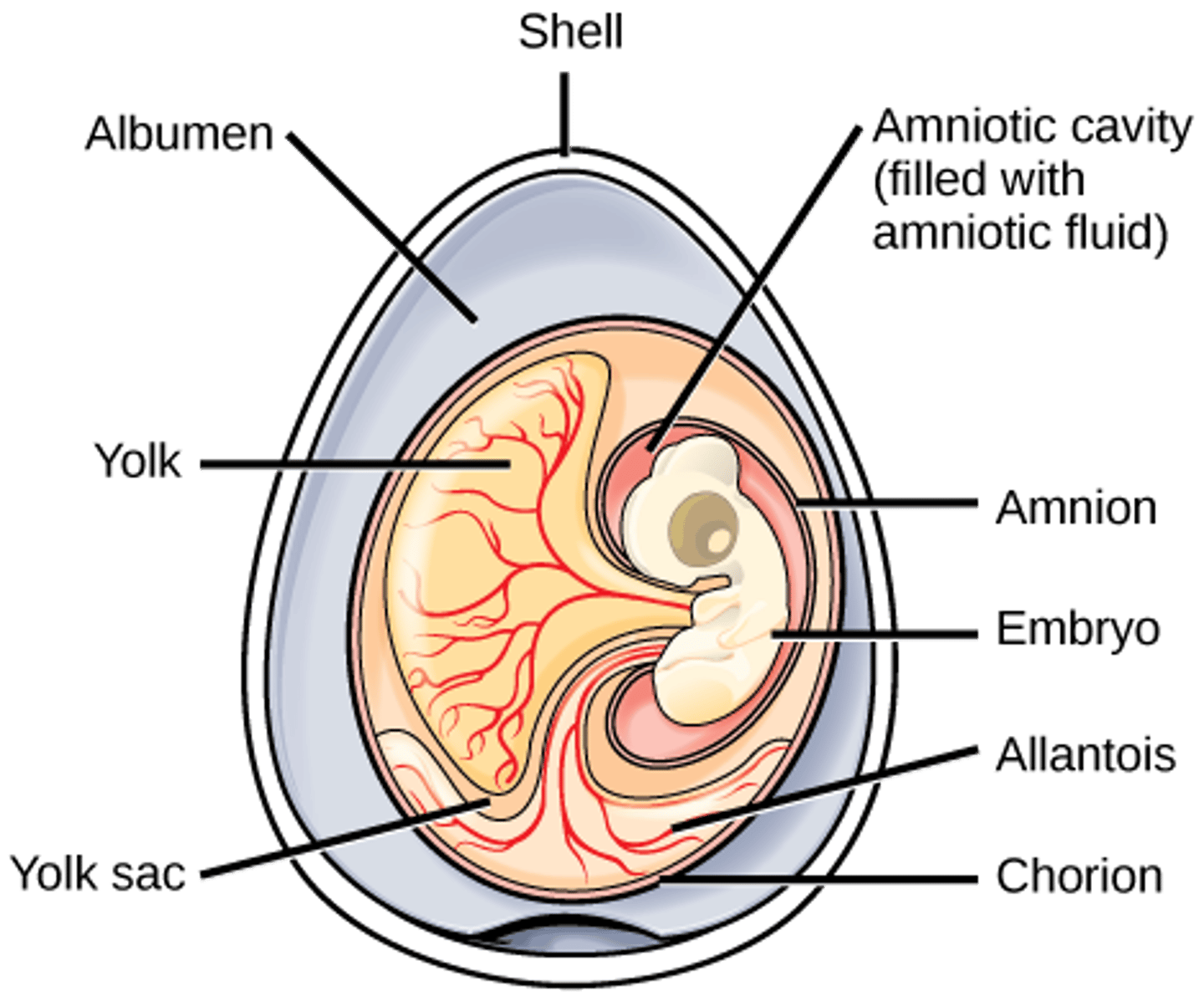
Amniotes
-Member of a clade of tetrapods that have an amniotic egg containing specialized membranes that protect the embryo; mammals, birds + reptiles.
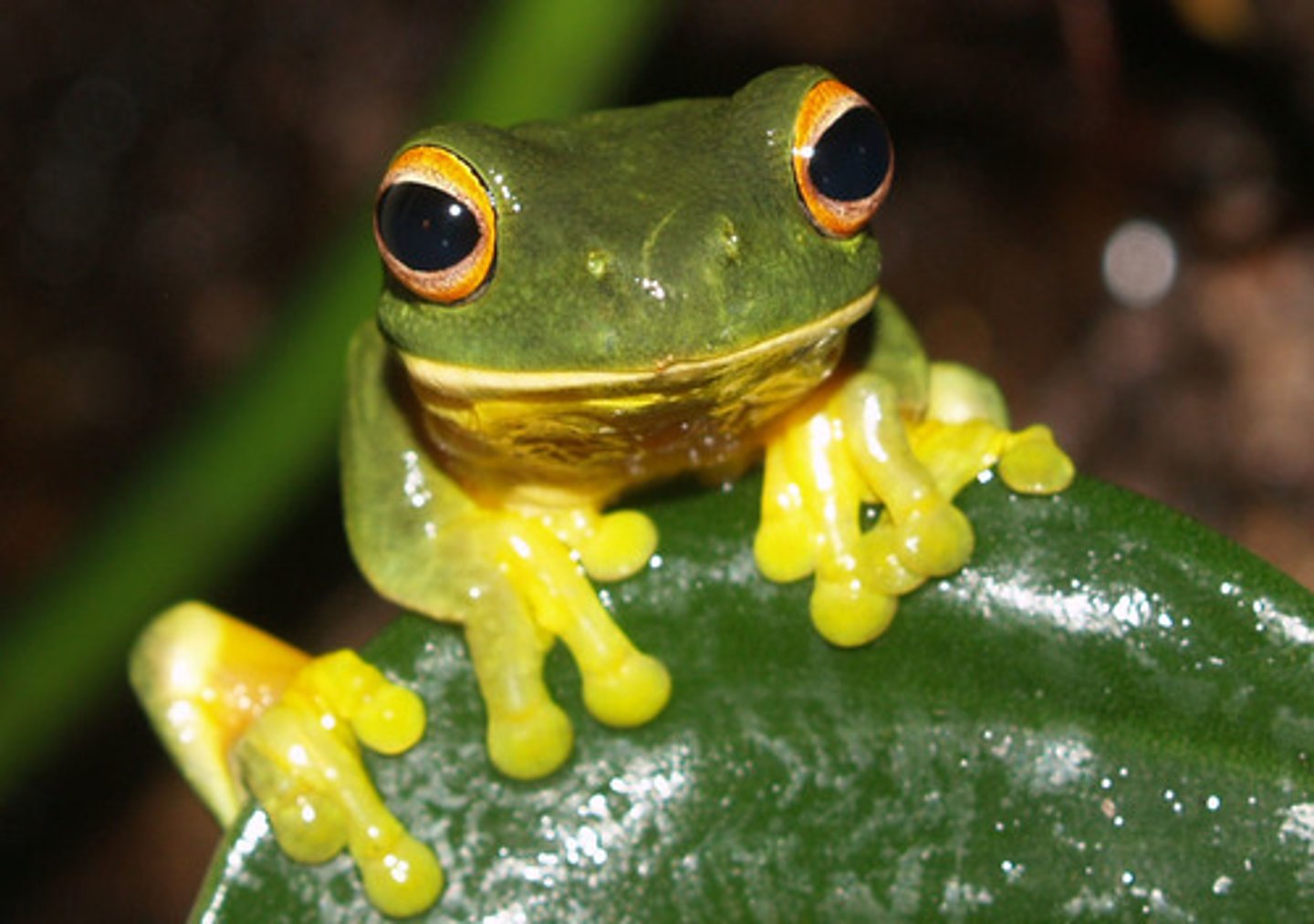
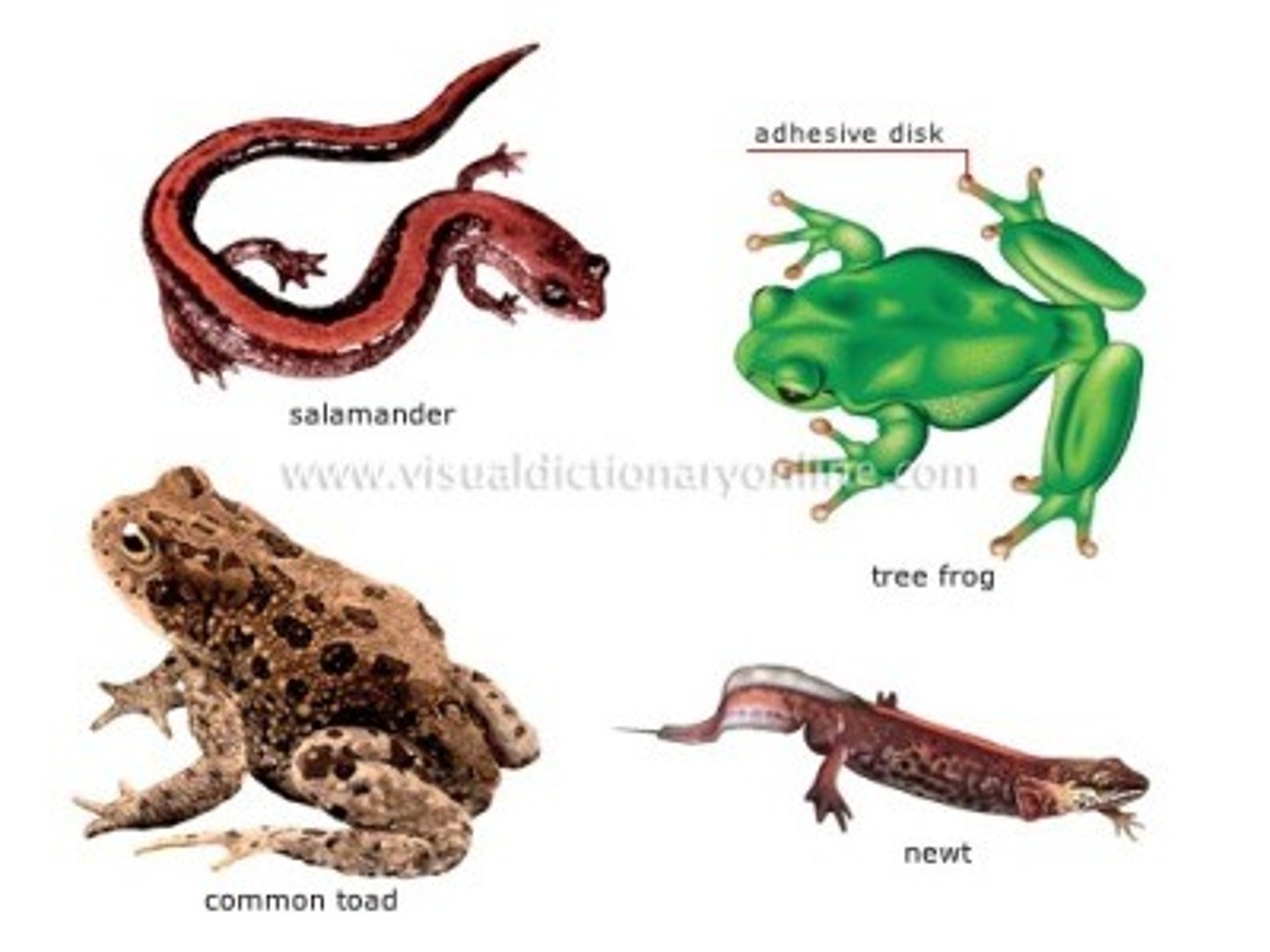
Amphibians
-Sister group to Amniotes.
+Amniotes = Reptiles + Mammals.
Reptilian tree: Snakes & Lizards Form a Single Clade
-Lepidosauria (tuatara, lizards & snakes) is the sister group to Archosauria (crocodilians, dinosaurs & birds) --> together = the Reptiles.