Biology- cell structure and microscopy
 Call Kai
 Learn
Learn Practice Test
 Spaced Repetition
 Match
Match Flashcards
 Knowt Play
1/43

There's no tags or description
Looks like no tags are added yet.
Name | Mastery | Learn | Test | Matching | Spaced | Call with Kai | Chat |
|---|
No analytics yet
Send a link to your students to track their progress
44 Terms
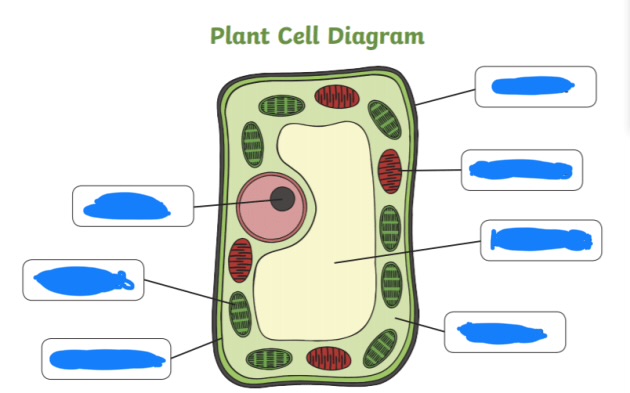
label the parts of a plant cell


label the parts of an animal cell
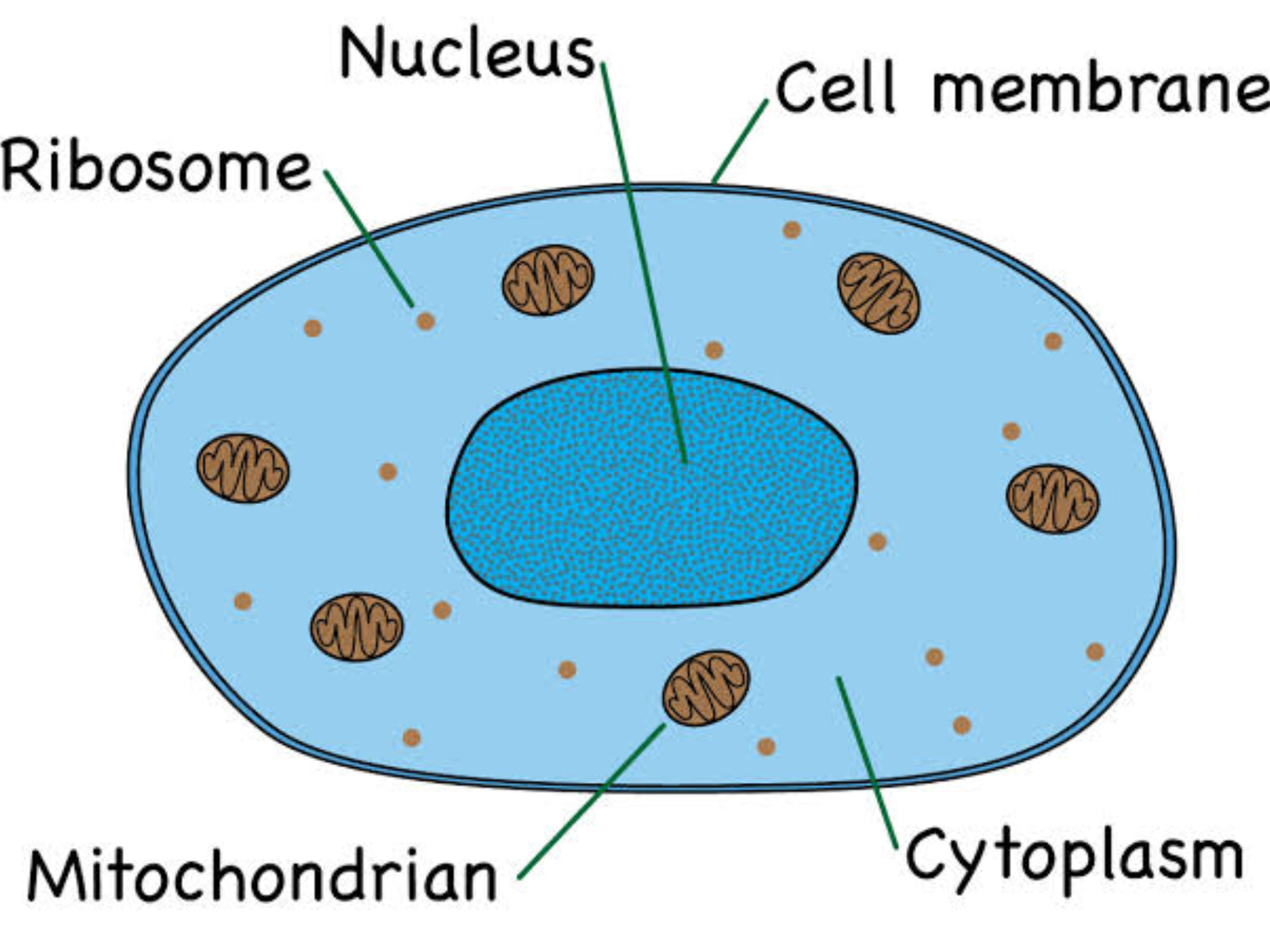
Nucleus function
contains the genetic material (DNA)
controls cell activity
Mitochondria function
produces energy for the cell
It also where most energy is released in respiration
Cell wall function
protects the cell
gives the cell a fixed shape
Cytoplasm function
jelly like fluid where chemical reacts happens (mainly water)
Cell membrane function
controls what goes in and out of the cell
Ribosomes function
Makes protein
Chloroplasts function
Absorbs loght energy for photosynthesis
Vacuole function
It is filled with cell sap to help keep the cell turgid (which is when you are filled with fluid and it pushes against the cell wall)
What are two things that are in the plant cell but not in the animal cell
Vacuole and Chloroplast
Eukaryotic cell
Complex cells which have a nucleus
Prokaryotic cell
Simple cells which do not have a nucleus

Is this a eukaryotic cell or prokaryotic cell and why
Eukaryotic cell because it has a nucleus

Is this eukaryotic cell or prokaryotic cell and why
Prokaryotic cell because it had no nucleus

Label this eukaryotic cell


Label this prokaryotic cell

What is the difference between a bacteria cell wall and a plant cell wall
Bacteria cell walls are more flexible than plant cell walls
What is the difference between the type of cells that the prokaryotic cells and eukaryotic cells are
prokaryotic cells and bacteria cells while eukaryotic cells are plant cels
What do some bacteria cells have
Some bacteria cells have a flagellum on the outside of the cell (not all cells!).
The flagellum are long, whip like structures that the bacteria can use to move the cells along through liquid.
Slime capsule function
Protects the bacteria from environmental dangers like antibiotics and desiccation
DNA loop function
Single circular strand of DNA not enclosed in a nucleus
It brings two genes that are far away from each other into close proximity which helps communicate with genes that are far away
Plasmids functions
Small rings of DNA that Casey extracted genes (e.g. antibiotic resistance)
So they carry extra genes which you do not need in every day survival but provide advantages in hatch environments. For example it provides antibiotic resistance so that the bacteria will not be killed when medicine is used and will multiply
Is a eukaryotic cell a yeast cell or plant cell
It is both a yeast cell and plant cell
What are ones key parts of prokaryotic cell
slime capsule, plasmid, DNA loop, flagella (not in all), cell wall, cell membrane, cytoplasm
What are yeast cells
Yeast are single celled structures (unicellular)
What are 2 different types of microscopes
light microscope
electron microscope
Light microscope function
combines 2 lenses to magnify what we see up to a thousands of times.
uses light waves to view objects
Electron microscope function
Used to see things in even more detail
This uses beams of electrons instead of light and can magnify millions of times.
Light microscope positives and negatives
low resolution - N
Lower degree of magnification - N
Some reasonable detail as you can see the whole organisms and few Sub-cellular structures with low resolution. - kind of P but can be better
Easier to carry -P
cheap - P
Electron microscope positives and negatives
high resolution -P
Higher degree of magnification -P
Higher detail can be observed as you can see sub cellular structures in good detail -P
too big - N
expensive - N

Label the parts of a microscope
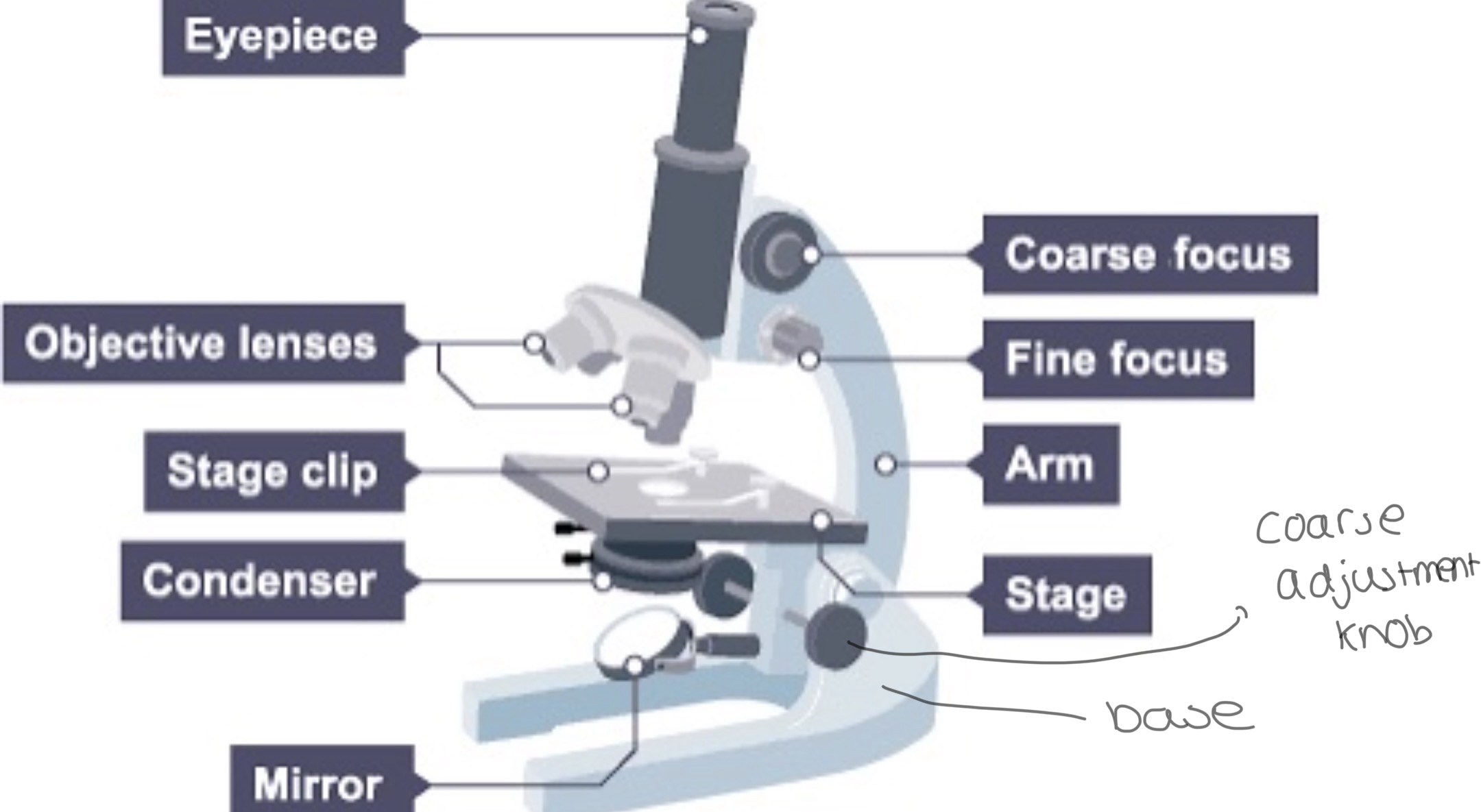
Hazards of microscope and what to do when this happens
iodine stain - handle stains and other liquids carefully
Broken glass - discard carefully to ensure you do not hurt yourself or anyone else
Eye accidents - keep goggles on at all time
Break slides - adjust the fine and coarse focus carefully
Magnification definition
The degree to which the size of an image is larger than the object itself
Resolution definition
The degree to which it is possible to distinguish between the objects between the 2 objects that are very close together (ie. How clearly the object appears)
What is the calculation for total magnification (for magnification settings)
Total magnification = eye piece x objective lens
Equation for size of image
Size of image = actual size x magnification
Equation for actual size (original size)
Actual size = size of image / magnification
Equation for magnification
Magnification = size of image is image / actual size
What are the magnification settings
40x, 100x, 400x, 1000x
How do you get from centimetres to millimetres to micrometres to nanometres
