Chapter 11- Appraising sampling and data collection in qualitative studies
 Studied by 0 people
 Call with Kai
 Learn
Learn Practice Test
 Spaced Repetition
 Match
Match Flashcards
 Knowt Play
1/32

There's no tags or description
Looks like no tags are added yet.
Name | Mastery | Learn | Test | Matching | Spaced | Call with Kai |
|---|
No study sessions yet.
33 Terms
Sampling in qualitative research
Who would be an information-rich data source? When should I talk to or what should I observe to maximize my understanding?
emerge to whom can I talk to observe that would confirm, challenge, or Rich my understanding?
Types
avoid random samples
volunteer sample (convenience)
Snowball sampling (network sampling)
volunteer sample (convenience)
When researchers allow participants to come forward and identify themselves
Snowball sampling (network sampling)
asking early informants to make referrals
May restrict sample
*purposive sampling
researchers deliberately choose the cases or type of cases that will best contribute to the study
sampling confirming and disconfirming cases
To test data saturation
maximum variation sampling
involves deliberately selecting cases with a range of variation on dimensions of Interest
Extreme case sampling
opportunities for learning from the most unusual and extreme informants
typical case sampling
selection of participants who illustrate are highly what is typical or average
Criterion sampling
studying cases that meet a predetermined Criterion of importance
Confirming cases
additional cases that fit researchers conceptualization and strength and credibility
Disconfirming cases
new cases that do not fit and serve to challenge researchers interpretations
Theoretical sampling
involves decisions about where to find data to develop an emerging Theory
Grounded theory studies
sample size
data saturation: sampling until no new information is obtained and redundancy is achieved
data quality can affect the number of participants to achieve
Sampling in Ethnography
Entree (mingling) → big net approach (infomral convos) → (interviews) possible key informants
key informants: knowledgeable about the culture and serve as researchers main link to the inside
help decide what to sample
sampling things as well as people (events, activities, records, artifacts, places)
Sampling in phenomenological
Small sample(<10)
all participants must have experienced the phenomenon, and they must be able to articulate what it is like or to have lived that experience
want people with demographic or other differences who have shared a common experience
Sampling in grounded Theory
theoretical sampling
Participants are selected serially in contingently
often convenient sampling → maximum variation sampling → emerging conceptualizations in form theoretical sampling process → collection until data saturation → final sampling for confirming and disconfirtbming cases
table of sampling in each tradition
critically appraising samples
Adequacy
Appropriateness
Transferability
Adequacy
the sufficiency and quality of the data the sample yielded
truly obtain saturation, informational adequacy, and richly textured and complete description or Theory
Transferability
similarity between study sample and other people whom the findings might be applied
Appropriateness
the methods used to select a sample was appropriate to select participants who can best supply information that meets the conceptual requirements
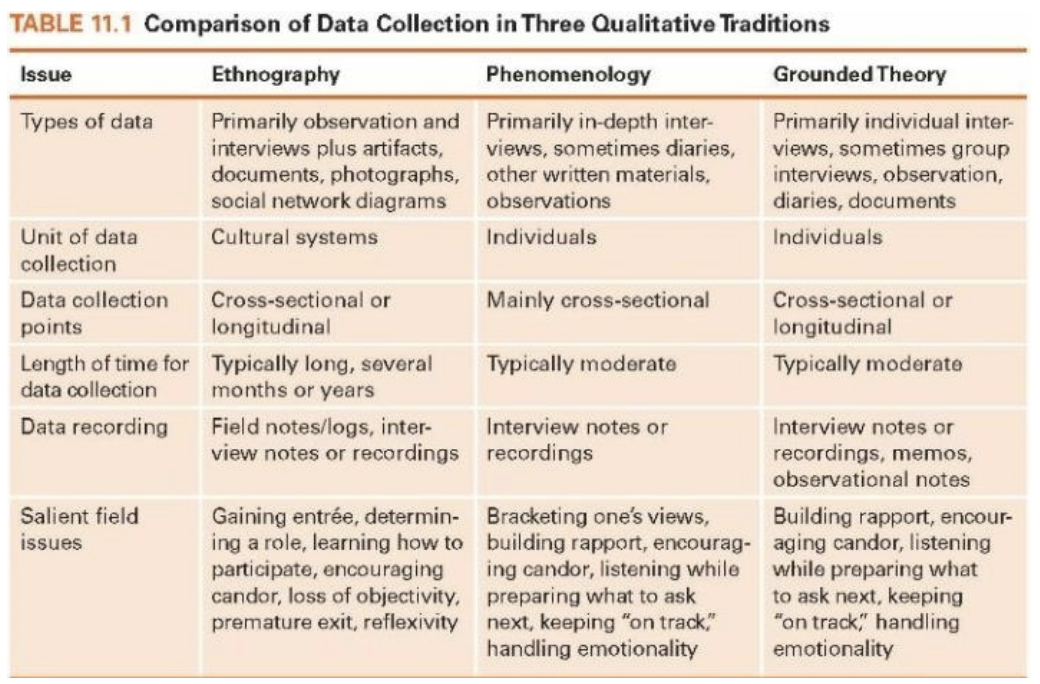
data collection
In-depth interviews are most common
also observation
self report techniques
In-depth interviews
to understand the behaviors and experiences of people as they occur in a naturalistic setting
physical setting, participants, activities, frequency and duration, process, and outcomes are all relevant
Direct observation
participant observation
take part in the functioning of the group under study and strive to observe, ask questions, and record information within the context and structures that are relevant to group members
may assume a fixed position throughout study but often evolves toward increasing participation over course
must gain entree And establish Rapport and trust with group
Log
a field diary Daily Record of events and conversation
field notes
broader and more interpretive, represent observer's efforts to record information and synthesize and understand the data
descriptive or reflective
self report techniques
unstructured interviews
semi-structured interviews
focus group interviews
personal Diaries
photo elicitation
unstructured interviews
no preconceived view of the information being gathered
Totally flexible
Grand tour questions
semi-structured interviews
researchers have a list of topics or broad questions that must be covered in a interview
use written topic guide to ensure all question areas are addressed
focus group interviews
5 to 10 people whose opinions and experiences are still listed simultaneously
Led by moderator
issue: Domination, social influence
personal Diaries
Provide intimate description of a person's everyday life
can be structured or unstructured
photo elicitation
involves an interview Guided by photographic images
photo voice: technique of asking participants to take photographs themselves and then interpret them
Observation data that must be collected
The physical setting
The participants
Activities
Frequency and duration
Process
Outcomes