Electrophillic Addition of Benzene
 Call Kai
 Learn
Learn Practice Test
 Spaced Repetition
 Match
Match Flashcards
 Knowt Play
1/7

There's no tags or description
Looks like no tags are added yet.
Name | Mastery | Learn | Test | Matching | Spaced | Call with Kai | Chat |
|---|
No analytics yet
Send a link to your students to track their progress
8 Terms
Why does benzene undergo electrophilic substitution rather than electrophilic addition?
Benzene's delocalised π system is a region of high electron density, which attracts electrophiles. However, addition would break the delocalised system permanently and destroy the aromatic stability — this is energetically very unfavourable. Substitution is preferred because after the electrophile attaches, a proton (H⁺) is lost, restoring the delocalised ring and regaining the aromatic stabilisation energy.
What are the reagents and conditions for the nitration of benzene, and what is the equation?
A nitrating mixture of concentrated nitric acid (HNO₃) and concentrated sulfuric acid (H₂SO₄) is used, at a temperature of 50°C (kept below 50°C to prevent multiple substitutions). The sulfuric acid acts as a catalyst — it generates the electrophile NO₂⁺ (the nitronium ion) and is regenerated at the end. The product is nitrobenzene (C₆H₅NO₂).
Overall: C₆H₆ + HNO₃ → C₆H₅NO₂ + H₂O (in the presence of conc. H₂SO₄)
How is the NO₂⁺ electrophile formed in nitration?
Concentrated sulfuric acid protonates concentrated nitric acid:
H₂SO₄ + HNO₃ → H₂NO₃⁺ + HSO₄⁻,
then H₂NO₃⁺ → NO₂⁺ + H₂O
This can also be shown overall as: HNO₃ + H₂SO₄ → NO₂⁺ + HSO₄⁻ + H₂O
The nitronium ion NO₂⁺ is the electrophile that attacks the benzene ring.

For the nitration mechanism specifically, what is the electrophile and how is it shown?
The electrophile is NO₂⁺ (the nitronium ion).
In step 1, a curly arrow goes from the π system of benzene to NO₂⁺, forming a bond between the ring carbon and the N of NO₂⁺. A positively charged intermediate forms.
In step 2, H⁺ is lost from the same carbon, the ring becomes re-aromatic, and H⁺ combines with HSO₄⁻ to regenerate H₂SO₄ (the catalyst). The product is nitrobenzene.
What are the reagents and conditions for the halogenation of benzene, and what is needed?
Benzene reacts with a halogen (Cl₂ or Br₂) in the presence of a halogen carrier. Halogen carriers include: aluminium chloride (AlCl₃), aluminium bromide (AlBr₃), iron(III) chloride (FeCl₃), iron(III) bromide (FeBr₃). The reaction occurs at room temperature.
For example, with Br₂ and FeBr₃: C₆H₆ + Br₂ → C₆H₅Br + HBr (bromobenzene is produced).
What is the role of the halogen carrier in halogenation, and how does it generate the electrophile?
The halogen molecule (e.g. Br₂) is non-polar and not reactive enough to attack the stable benzene ring.
The halogen carrier (e.g. FeBr₃) accepts a lone pair from one end of the Br₂ molecule:
FeBr₃ + Br₂ → FeBr₄⁻ + Br⁺.
This polarises the Br–Br bond and effectively generates a Br⁺ species (the electrophile). After the substitution is complete, the FeBr₄⁻ releases HBr and regenerates the FeBr₃ catalyst, so only a small amount of catalyst is needed.
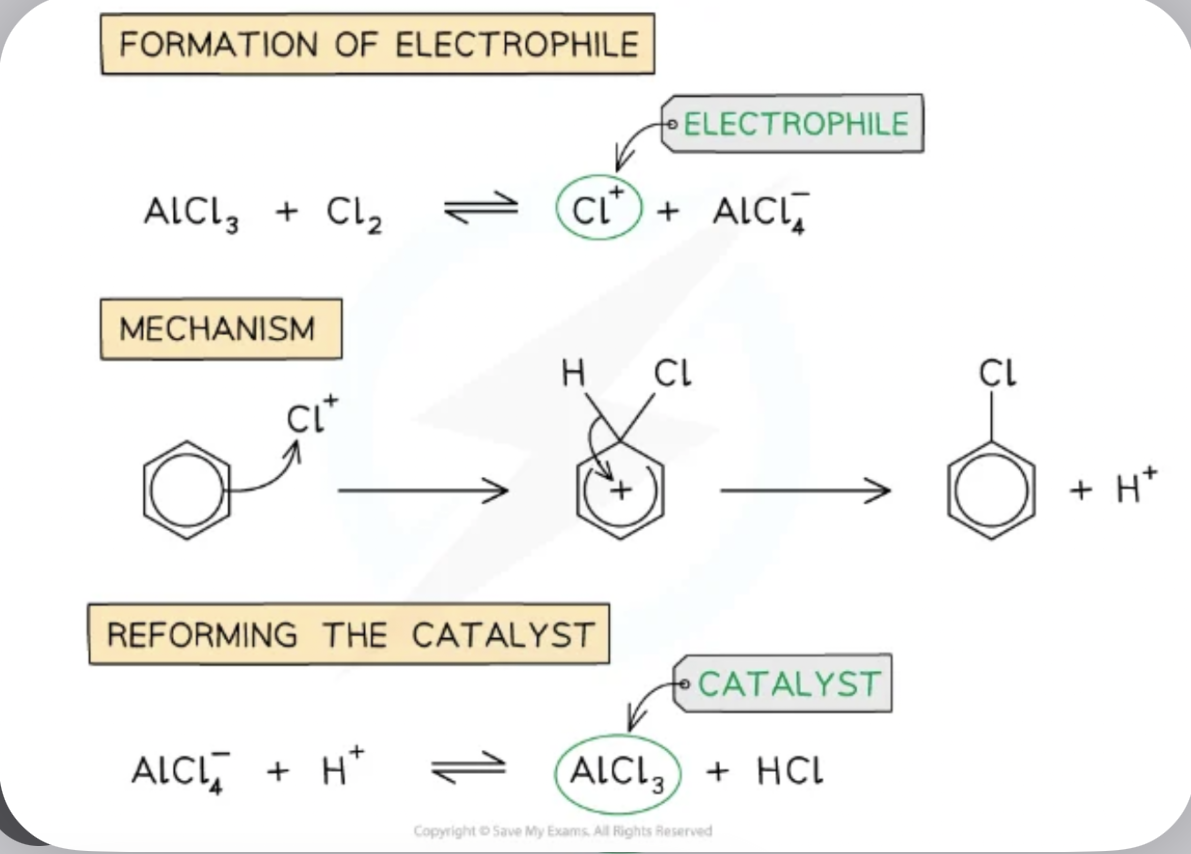
For the halogenation mechanism, can you write the electrophile as Br⁺ in the mechanism?
the electrophile can be assumed to be X⁺ (e.g. Br⁺). You do not need to show the full formation of Br⁺ from Br₂ and FeBr₃ in the mechanism itself, though you should be able to explain it in words. The mechanism then follows the same two-step pattern: Br⁺ attacks the π system forming the intermediate, then H⁺ is lost to restore aromaticity and FeBr₃ is regenerated (via the release of HBr).
Why do alkenes undergo electrophilic addition but benzene undergoes electrophilic substitution?
Electron Density: Alkenes have localized π electrons (high electron density; polarizes electrophiles directly). Benzene has delocalised π electrons (lower density; requires catalysts).
Aromatic Stability: Addition permanently breaks benzene's aromatic ring (≈152 kJ mol−1≈152kJmol−1 loss). Substitution retains aromaticity by releasing H+