DNA Replication + DNA Storage Diagram
 Call Kai
 Learn
Learn Practice Test
 Spaced Repetition
 Match
Match Flashcards
 Knowt Play
1/73

There's no tags or description
Looks like no tags are added yet.
Name | Mastery | Learn | Test | Matching | Spaced | Call with Kai | Chat |
|---|
No analytics yet
Send a link to your students to track their progress
74 Terms
What is the hereditary information of the cell contained in a double helix with major and minor grooves?
DNA
(Note: A, C, T, G)
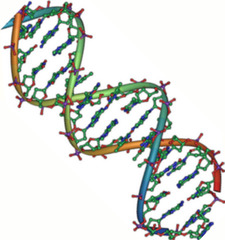
What structure consists of 5' to 3' phosphodiester bonds to form a sugar-phosphate backbone?
DNA backbone

What hereditary information has functional usage in the cell and varies per type?
RNA
(Note: A, U, C, G)

Which RNA is linear?
mRNA

Which RNA is clover shaped?
tRNA

Which RNA is globular?
rRNA

What process begins at origins of replication in the middle of a DNA molecule?
DNA replication

When DNA strands separate, what space forms that expand in both directions?
replication bubble
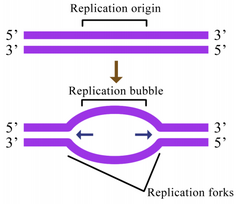
Which domain of organisms utilize one origin of replication?
prokaryotes

Which domain of organisms utilize multiple origins of replication?
eukaryotes

During which cellular stage is a second chromatid containing a copy of DNA assembled?
interphase
(Note: DNA replication overview)
During which specific phase of interphase is DNA replicated?
S phase
What must first happen to DNA before it can be replicated?
unzipped
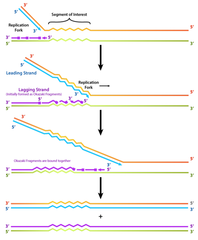
What type of replication is DNA replication?
semi-conservative
replication
(Note: one old strand
and one new strand)

Which DNA replication enzyme unzips DNA to form
replication fork?
Helicase
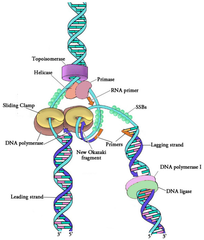
Which DNA replication enzyme keep DNA strands separate?
Single Stranded Binding
Proteins (SSBPs)

Which DNA replication enzyme eases the tension of coiled DNA by introducing nicks and cuts into the DNA strand?
topoisomerase
(Note: prevents knots)

Which DNA replication enzyme synthesizes the new strand of DNA?
DNA polymerase

Which DNA replication enzyme creates a small strip of RNA where DNA polymerase takes over to add DNA nucleotides?
primase
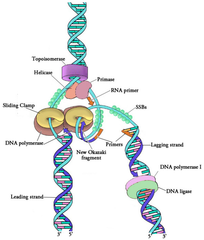
Which DNA replication enzyme 'glues' two strands of DNA together?
ligase

Which direction on the parent strand does DNA polymerase move?
3' → 5'

What is the direction of the new antiparallel strand synthesized by DNA polymerase?
5' → 3'

Which DNA strand is synthesized continuously?
leading strand

Which DNA strand is synthesized discontinuously?
lagging strand

What are fragments produced by DNA polymerase on the lagging strand?
Okazaki fragments

Which enzyme connects Okazaki fragments?
DNA ligase

Before DNA base pairs can be added to a new strand what addition is required?
RNA primer

RNA primers on each Okazaki fragment are replaced with DNA by which enzyme?
DNA polymerase I

Which DNA replication enzyme functions in DNA repair?
DNA polymerase I

Which DNA polymerase purely functions in replication?
DNA polymerase III

In which domain of organisms are DNA polymerases I, II and III present?
prokaryotes
(Note: won't be tested over eukaryotic polymerases for DAT)
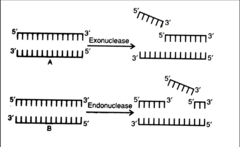
Which DNA replication enzymes have a 3' → 5' exonuclease function?
DNA polymerases I and III
3' → 5' exonuclease function allows polymerases to perform what action?
break the phosphodiester backbone on a single strand of DNA and remove a nucleotide
From which location on a DNA strand do exonucleases remove nucleotides?
only the end of a chain
Which DNA replication enzyme has some proofreading function?
DNA polymerase III
(Note: can go back and replace a nucleotide)
Which DNA replication enzyme has a 5' → 3' exonuclease function to remove the primer?
DNA polymerase I
In which direction can DNA polymerase I proofread while laying down a new nucleotide strand?
3' → 5'
How does the speed of replication in prokaryotes compare to the speed of replication in eukaryotes?
prokaryotes are almost 20x faster
(Note: eukaryotes have a complex genome)
In which direction does DNA polymerase I primarily break down the RNA primer via exonuclease function?
5' → 3'
(Note: replace with DNA nucleotides)

In prokaryotes, how is the strand without any errors modified after it has been successfully replicated?
methylated
(Note: prevents accidental repair)
In all cases of repair, which enzyme must come into seal the backbone after replication is finished?
DNA ligase

How is the energy for DNA elongation provided?
breaking the phosphate bonds of the 2 phosphates attached to each new nucleotide
Which part of the strand still needs to be replicated after the information-carrying DNA is replicated?
telomere

What is the function of telomeres?
protect the DNA
from degradation
by enzymes
What problem arises when there is not enough template strand at the end of a telomere?
primase cannot attach
Because DNA polymerase cannot build after removing RNA primer, what happens to the telomeres?
a section is lost with each replication cycle
(Note: RNA primer is destroyed by enzymes)
Why do prokaryotes not have an issue with telomere shortening?
their DNA is circular
and lacks telomeres

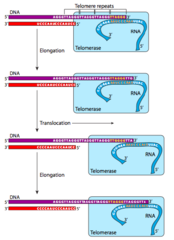
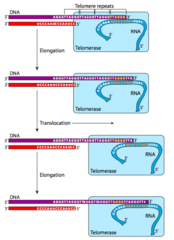
What does telomerase do to extend the template strand?
adding a short, repeating
sequence of DNA
(Note: there is still loss that
occurs, but now to an
unimportant section)
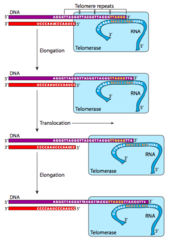
What nucleic acid group does telomerase possess that allows it to bind to the flanking 3' end of the telomere?
RNA template
(Note: complements the telomere

What is the enzyme that attaches to the end of the template strand and extends the template strand?
telomerase
What is the structure formed when DNA is coiled around bundles of 8-9 histone proteins
nucleosome
(Note: similar to
beads on a string)

What are the two types of chromatin that exist during interphase?
1. euchromatin
2. heterochromatin
Which chromatin is loosely bound to nucleosomes; present when DNA is actively being transcribed?
euchromatin
Which chromatin contains areas of tightly packed nucleosomes where DNA is inactive and appears darker?
heterochromatin
What are large tandem repeats of noncoding DNA concentrated at centromeres and ends of chromosomes?
satellite DNA
Which chromatin contains a large amount of satellite DNA?
heterochromatin
What are DNA segments that can move to a new location on either the same or different chromosome?
transposons (jumping genes)
A simple transposon consists of an insertion sequence that contains 1 gene that codes for what structure?
enzyme that transports itself
(Note: enzyme is transposase)
A complex transposon will code for which extra features?
replication and antibiotic resistance
What is the result if transposons are inserted into another region?
mutation
What type of DNA does most of the genome contain?
repetitive DNA
(Note: does not actually code for proteins or RNA)
What are former genes that have accumulated mutations over a long time and no longer produce a functional protein?
pseudogenes
How many genes are approximately present in the human genome?
~24,000
DNA primase
RNA primer
DNA ligase
DNA polymerase
lagging strand
Okazaki fragment
DNA polymerase
leading strand
helicase
single strand binding proteins
topoisomerase