All Of Biology
 Call Kai
 Learn
Learn Practice Test
 Spaced Repetition
 Match
Match Flashcards
 Knowt Play
1/338

There's no tags or description
Looks like no tags are added yet.
Name | Mastery | Learn | Test | Matching | Spaced | Call with Kai | Chat |
|---|
No analytics yet
Send a link to your students to track their progress
339 Terms
know the diagram for the male reproductive system

know the diagram for the female reproductive system

Describe the role of the sperm duct
Sperm passes through the sperm duct to be mixed with fluids produced by the glands before being passed into the urethra for ejaculation
Describe the role of the urethra
The rube running down the centre of the penis that can carry urine or semen. A a ring of muscle in the urthra prevents them from mixing
Describe the role of Epididymis
A coiled tube, 6-7cm long, attached to the back of each testicle that transports concentrates stores and matures sperm cells
Describe the role of the testis
Contained in a bay of skin (scrotum) it produces sperm and testosterone
Describe the role of Scrotum
Sac supporting the testes outside of the body to ensure sperm are kept at a temp slightl lower than body temp
Describe the role of the penis
Passes urine out of the body from the bladder and allows semen to pass into the vagina during intercourse
Describe the role of seminal vesicle
Produces Semen
Describe the role of the oviducts
Connects the ovary to the uterus, lined with ciliated cells to push released ovum, where fertilization occurs
Describe the role of the ovaries
contains ova that mature and develop when hormones are released
Describe the role of the uterus
Hollow muscular organ with a vascular lining where a fertilized egg (zygote) implants to develop a fetus
Describe the role of the Cervix
Ring of muscle at the lower end of the uterus linking the uterus to the vagina
Describe the role of the vagina
Muscular tube leading to the inside of a womans' body, where male's penis enters and sperm are deposited during intercourse
Describe the 4 stages of fertilization
Gametes are produced
Male gametes are transferred to the female gamete egg cell
Fertilization occurs- sperm fuse with the egg
Zygote is formed-develops into a new individual
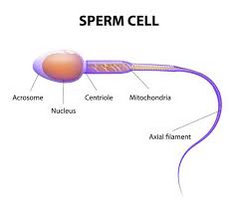
Describe how a sperm cell is adapted to its function
Have a flagellum for swimming
Lots of mitochondria for energy to swim
Acrosome containing enzymes to breakdown the outer layer of the egg
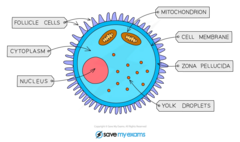
Describe how an egg cell is adapted to its function
Specialized outer layer- zona pellucida- when one of the sperm enters the egg the zona pellucida hardens the outer shell to not let any others in
Contains lots of mitochondria- for the sperm cell when it enters for energy
Can label an egg cell
Can label a sperm cell
Chromosomes for a Male and Female
Female XX
Male XY
Describe the role of the placenta in developing the embryo
Provides the embryo with nutrients and oxygen from the mothers blood which are essential for growth and development
Allows waste products from the embryo's blood to be removed
What goes from the mothers blood to the fetus
Oxygen
Nutrients
What goes from the fetus to the mother
Carbon dioxide
Urea
Why is the placenta efficient/adapted to its function
Large SA
Thin wall for efficient diffusion
Acts as a barrier to some toxins and athogens
How long is the average menstrual cycle
28 days
What are the 4 cycles in mensturation
Menstruation:Breakdown and shedding of the uterine lining
Follicular phase: The endometrium builds up and an egg matures in the ovary
Ovulation: The release of a mature egg from the ovary (usually day 14
Luteal phase: The uterus props for a ferilised egg, if no fertilization occurs the lining breaks down and the cycle repeats
Timings of Oestrogen and where it is released from
Released from the ovaries
RIse from d1- peak just before d14
The peak in oeastrogen occurs just before the egg is released
And stimulates the pituitary gland to release LHStimulates the uterus to replace the endometrium
Describe the role of Oestrogen in the menstrual cycle
stimulates the pituitary gland to release LH
Stimulates the uterus to replace the endometrium
Describe the role of progesterone in the menstrual cycle
Inhibits FSH and LH production
If fertilization does not occur- the fall in progesterone levels causes the uterine lining to break down (menstruation)
Timings of Progesterone and where it is released
Starts to rise on d14 and stays moderatly high until d 25 starts dipping
Describe the role of LH in the menstrual cycle
Causes ovulation to occur and stimulates the ovary to produce progesterone
Results in the formation of Corpus Luteum
Timings of LH and where it is released
Released from the pituitary gland
Released when oestrogen levels have peaked
peaks d14
Describe the role of FSH in the menstrual cycle
Responsible for egg maturation in the follicles of the ovary
Stimulates the follicles in the ovaries to secrete oestrogen after the egg has been released
How does the amniotic fluid protect the embryo/fetus
Protects it against sudden movements, and also provides a medium for the fetus to move in
Role and effects of oestrogen secondary characteristics
breast growth, widening of the hips, growth of pubic/underarm hair, and the start of the menstrual cycle.
Role and effects of testosterone secondary characteristics
deepening of the voice, increased muscle mass, broadening of shoulders, growth of facial/body hair, and the start of sperm production.
What Charactersistics must a organism follow to be classified as living
Movement
Respiration
Sensitivity
Control (their internal conditions)
Growth
Reproduction
Excrete
Nutrition (require it)
What is a eukaryotic cell?
A cell with a nucleus
What is a prokaryotic cell
A cell without a nucleus
Describe common features shown by plants
Multicellular, chloroplasts, cellulose cell walls, they store carbs as starch or sucrose. .
FLowering plants, maize
Describe common features of animals
Multicellular organisms
Theri cells do not contain chloroplasts
No cell walls
Often have nervous coordination
Oten store carbs as gylocegen
Examples: mammals (humans) insets (mosquito)
Deescribre common features of Fungi
No able to carry out photosynthesis
Body is usually orgainsed into mycelium made from threal like structures called hyphae which contain many nuclei
Some are single-celled
Have cell wals made of chitin
They feed by sparotrophic nutrition
May store carbs as gylcogen
Examples: Mucor, yeast
What is saprotrophic nutrition?
Extracellular secretion of digestive enzymes onto food material and absorption of the organic products
Define the term autotroph.
An autotroph is an organism that can produce its own food for energy.
What is the primary photosynthetic pigment in photosynthesis?
Chlorophyll
Do plants have an organ system
Yes, shoot system contains stem, leaves, flowers
Define the term organelle.
Organelles are structures within cells that carry out particular functions, e.g. the nucleus.
List the levels of organisation in complex multicellular organisms.
The levels of organisation should be listed in the following order:
Organelles
Cells
Tissues
Organs
(Organ) systems
Name three biological molecules present in living organisms.
Biological molecules present in living organisms include:
carbohydrates
proteins
lipids
What are carbohydrates?
Carbohydrates are molecules that contain the elements carbon, hydrogen, and oxygen.
What are the chemical elements present in proteins?
All contain carbon, oxygen, hydrogen and nitrogen.
Some Sulfur
From which smaller molecules are lipids built?
Lipids are fats and oils made up of fatty acids and glycerol.
What are the chemical elements present in lipids?
Lipids are made of carbon, oxygen and hydrogen.
Define the term monosaccharide.
A monosaccharide is a simple sugar like glucose or fructose.
Define the term disaccharide.
A disaccharide is formed when two monosaccharides join together.
Describe the common features of Protoctists
Microsocpic single-celled organisms.
Some like Amoeba live in pond water have features like animal cells
Others like Chlorella have chloroplasts and are more like plants
A pathogenic example is Plasmodium, causing malaria
Describe common features of bacteria
Microscopic single-celled organisms
Thery have a cell wall, cell membrane, cytoplasm and plasmids
Don't have nucleus but have a circular chromosome of DNA
Some bacteria can carry out photosynthesis but most feed off other living or dead organsims
Example Pneumococcus, pathogen causing pneumonia
What is a pathogen
Disease causing organism
Describe the common features of viruses
They are NOT living
Ther are smaller than bacteria
Parasitic and can only reproduce inside living cells
They infect every type of living organism
Wide variety of shapes and sizes
No cellular structure but have a protien coat and contail one type of nucleic acide either DNA or RNA
Examples: Tobacco mosaic virus causing the discolouring of the leaves by tobacco plants
The influenza birus, cuases the flu
HIV virus, causes AIDS
What is the food test for Protein
Biuret test - blue to purple
What is the food test for Reducing Sugars
Benedict's test- blue to red, orange, yellow based on strength
What is the food test for starch
Iodine test
Yellow-Blue/black
What is the food test for fats
Ethanol- Cloudy emulsion formed
What is an enzyme?
A biological catalyst that speeds up the rate of the reaction without being used up in that reaction
Describe how the increase or decrease in temp can affect the enzyme function
As temperature increases towards this optimum, particles have more kinetic energy, so enzyme and substrate collide more often, so the rate of reaction increases.
Above the optimum, extra heat starts to break bonds that hold the enzyme's active site in its specific shape.
This changes the shape of the active site, so the substrate no longer fits; the enzyme is denatured and the reaction rate falls sharply. NO LONGER COMPLEMENTARY
At very low temperatures, enzymes are not denatured, but they work slowly because there is little kinetic energy, so few collisions.
Describe a practical to investigate how enztme activity can be affected by changes in temperature
C (Change) - Temperature of the reaction mixture (e.g. 10,20,30,40,50.60.70.80)
O (Organism) - The same enzyme source: amylase from the same type and concentration each time.
R (Repeat) - Repeat each temperature at least 3 times and calculate a mean time for starch breakdown.
M (Measure) - Measure the time taken for iodine to stop turning blue‑black (time for all starch to be digested).
S (Same) - Keep these the same:
same volume of amylase and starch
same concentration of amylase and starch
same pH (e.g. with a buffer)
how can enzyme activity be affected by changes in pH
If pH moves away from the optimum (either more acidic or more alkaline), it can change the charges on amino acids in the enzyme.
This disrupts the bonds that hold the enzyme's active site in its specific shape.
If the pH is very different from the optimum, the enzyme can become denatured, meaning its shape is permanently changed and it no longer functions. No longer Complementary
Describe a practical to affect how enzyme activity can be affected by changes in pH
C (Change) - pH of the reaction mixture (e.g. pH 4, 6, 7, 8, 9) using different buffer solutions.
O (Organism) - Same enzyme source: amylase of the same type and concentration each time.
R (Repeat) - Repeat each pH at least 3 times and calculate a mean time for starch breakdown.
M (Measure) - Measure the time taken for iodine to stop turning blue‑black (time for all starch to be digested).
S (Same) - Keep these the same:
same temperature (e.g. same water bath)
same volume of amylase, starch, and buffer
same concentration of amylase and starch
What is diffusion
The movement of particles from an area of high concentration to an area of low concentration down a concentration gradient
What is osmosis
The net movement of free water molecules from an area of high WP to an area of low WP through a partially permeable membrane
What is active transport
the movement of particles from an area of lower concentration to an area of higher concentration, against the concentration gradient, which requires energy
Describe factors that can affect the rate of movement of substances in and out of cells
Surface area : volume ratio Cells or organisms with a larger SA:VOL have more membrane surface for substances to cross per unit volume, so substances move in and out faster.
Distance The shorter the distance for diffusion (e.g. thin alveolar walls), the faster substances move. A thicker barrier slows the rate.
Temperature Higher temperature gives particles more kinetic energy, so they move and collide more, increasing the rate of diffusion (and speeding enzyme‑controlled active transport).
Concentration gradient A steeper concentration gradient (big difference in concentration between two sides) causes a faster net movement of particles; as the gradient becomes less steep, the rate slows.
Describe an experiment to investigate the rate of diffusion in non-living substances
Make agar jelly cubes containing a coloured pH indicator.
Place cubes in acid and observe how fast the colour changes from the outside in.
Smaller cubes (higher SA:VOL) change colour faster, showing faster diffusion.
Describe an experiment to investigate the rate of osmosis in living substances
Living (potato in different concentrations):
Cut equal‑sized potato cylinders and place them in different concentrations of sugar or salt solution.
Leave for a set time, then dry and weigh them.
Mass increases in dilute solution (water moves in), and decreases in concentrated solution (water moves out) by osmosis.
CHemical and word equation for aerobic respiration
glucose+oxygen→carbon dioxide+water+ (energy 38ATP)
C6H12O6+6O2→6CO2+6H2O+38ATP
Chemical and word equation for anaerobic respiration
Word equation: glucose→lactic acid
Symbol equation: C6H12O6→2C3H6O3+2ATP
Chemical and word equation for anaerobic respiration in yeast
Word equation: glucose→ethanol+carbon dioxide
Symbol equation:C6H12O6→2C2H5OH+2CO2
How does respiration produce ATP
The release of energy from glucose which is used to make ATP
What does ATP provide
Energy for cells
Investigate the evoluation of CO2 from respiring seeds
Investigating CO2 evolution (germinating vs boiled seeds):
Set up two flasks or test tubes:
A: germinating seeds (soaked and starting to grow)
B: boiled / dead seeds or glass beads (control)
Add hydrogencarbonate indicator (or limewater) to each:
Hydrogencarbonate turns yellow if CO22 increases.
Plug with cotton wool and leave in a warm place.
Compare colour change: germinating seeds release CO22 by respiration; the control should show little or no change.
Investigate the evoluation of heat in seeds
Investigating heat evolution:
Put germinating seeds in a thermos flask with a thermometer; set up another identical flask with boiled seeds or beads as a control.
Fit a lid with holes for the thermometers.
Record the temperature in both flasks over time.
The flask with germinating seeds will show a greater temperature rise, showing that respiration releases heat.
Describe gas exchange in the lungs
In the lungs:
Air in the alveoli has a high concentration of oxygen, blood arriving has low oxygen.
Oxygen diffuses from alveoli into blood down its concentration gradient.
Blood arriving has high carbon dioxide, alveoli air has lower CO2, so CO2 diffuses from blood into alveoli to be exhaled.
Can label a diagram for lungs ribs ect

Describe how the intercostal muscles and the diaphragm change during inhalation
The external intercostal muscles contract, pulling the ribs upwards and outwards.
The diaphragm contracts, moving downwards and becoming flatter.
This increases the volume of the thorax, so pressure inside the lungs decreases, and air moves into the lungs.
Describe how the intercostal muscles and the diaphragm change during exhalation
The external intercostal muscles contract, pulling the ribs upwards and outwards.
The diaphragm contracts, moving downwards and becoming flatter.
This increases the volume of the thorax, so pressure inside the lungs decreases, and air moves into the lungs.
How are alveoli best adapted for gas exchange
They have a very large surface area (millions of tiny sacs) so more gas can diffuse at once.
Their walls are extremely thin (one cell thick), giving a short diffusion distance.
They have a good blood supply from a dense network of capillaries, keeping the concentration gradient steep for O2 and CO2
The alveoli are moist, so gases dissolve, making diffusion easier.
Describe th econsequences of smoking on the lungs
Tar damages cilia in the airways so mucus is not cleared; this leads to bronchitis and more infections.
Tar also damages alveolar walls, reducing their surface area and elasticity, causing emphysema - gas exchange becomes less efficient, so the person gets breathless.
Carcinogens in cigarette smoke can cause lung cancer.
Describe th econsequences of smoking on the circulatory system
Nicotine increases heart rate and blood pressure, putting extra strain on the heart.
Carbon monoxide binds to haemoglobin, reducing the blood's ability to carry oxygen.
Chemicals in smoke damage the lining of arteries, leading to atherosclerosis (fatty deposits), which can cause coronary heart disease and heart attacks.
What is Coronary Heart Disease
Coronary heart disease (CHD) is when the coronary arteries (the arteries that supply the heart muscle with blood) become narrowed or blocked by fatty deposits (atheroma) in their walls.
This means:
Less oxygen and glucose reach the heart muscle.
The heart muscle cannot respire aerobically properly, so it gets less energy.
If a coronary artery becomes completely blocked, part of the heart muscle dies, causing a heart attack.
Describe a pracrical to investigate the effect of exercise on the release of CO2 and breathign rate
C (Change) - Amount/intensity of exercise (e.g. time spent stepping, or no exercise vs exercise).
O (Organism) - The same person (or same age group) for all repeats.
R (Repeat) - Repeat the exercise at least 3 times and calculate a mean breathing rate/CO2 result.
M (Measure) -
Count breaths per minute before and after exercise.
Observe change in limewater (more/cloudier means more CO22) or colour change in hydrogencarbonate indicator.
S (Same) - Keep these the same:
same duration and type of exercise (e.g. 2 minutes of step‑ups at same speed)
same person (if possible)
same time of day and similar temperature
What should a balanced diet include
Appropriate portions of carbs, protein, lipids, vitamins and minerals, water and fibre
What is the funcion and possible sources of carbohydrates
Function: main source of energy for respiration.
Sources: bread, rice, pasta, potatoes
What is the funcion and possible sources of
Function: growth and repair of tissues; making enzymes and hormones.
Sources: meat, fish, eggs, dairy, beans, lentils, nuts.
What is the funcion and possible sources of
Function: energy store, insulation, protection of organs, making cell membranes.
Sources: butter, oils, nuts, seeds, oily fish.
What is the funcion and possible sources of vitamin A
Function: good vision (especially in dim light), healthy skin and immune system.
Sources: liver, dairy, oily fish, carrots, leafy vegetables.
What is the funcion and possible sources of Vitamin C
Function: making collagen, helps wound healing, keeps skin and gums healthy, prevents scurvy.
Sources: citrus fruits, berries, peppers, tomatoes, green vegetables.
What is the funcion and possible sources of Vitamin D
Function: helps absorb calcium; needed for strong bones and teeth.
Sources: sunlight on skin, oily fish, eggs, fortified foods, dairy.
What is the funcion and possible sources of Calcium
Function: strong bones and teeth, blood clotting, muscle function.
Sources: milk, cheese, yoghurt, leafy green vegetables.
What is the funcion and possible sources of iron
Function: needed to make haemoglobin in red blood cells (carries oxygen).
Sources: red meat, liver, beans, spinach, fortified cereals.
What is the funcion and possible sources of water
Function: main part of blood and cytoplasm, transport, temperature control, dissolves substances, needed for reactions.
Sources: drinks, fruits, vegetables, soups.