Art History Exam 1
 Call Kai
 Learn
Learn Practice Test
 Spaced Repetition
 Match
Match Flashcards
 Knowt Play
1/43

There's no tags or description
Looks like no tags are added yet.
Name | Mastery | Learn | Test | Matching | Spaced | Call with Kai | Chat |
|---|
No analytics yet
Send a link to your students to track their progress
44 Terms

What is this statues name, date, and place
Lion Man
38,000 BCE
Found in Hohlenstein-Stadel Germany

What is this statue made of and significance regarding that
Mammoth ivory
Using all material of what they’re hunting

Why was this object built? What are some questions on its significance?
Used as a toy, spiritual ritual, telling stories?
Does not stand on its own - meant to be handled
Could it be a bear?
Creative - lion man doesn’t actually exist - using imagination
Intentional notches on its arm - what do they mean?
Therioanthrope
human-animal hybrid
Ex: lion man

What is this statue’s name, date, and place?
Node woman / Venus or Woman of Willendorf
25,000 BCE
Willendorf Austria
From Italy but found in Austria

What is this statue’s material?
Limestone
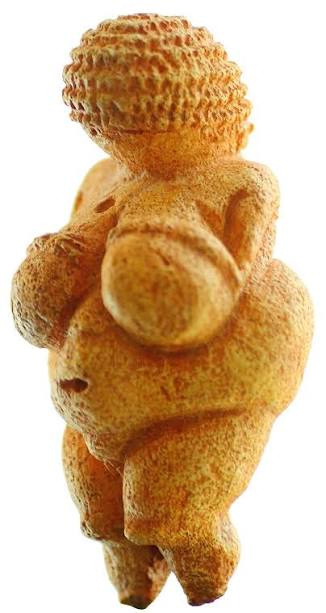
What are some themes, questions, thoughts about this statue?
Very common kind of figurine
Exaggerated body type - symbolizing fertility, abundance, childbirth?
No neck/face - not of a specific woman - intention bands around face
Represents a deity?
More than enough to eat - positive thing/idea
Very tiny arms and legs
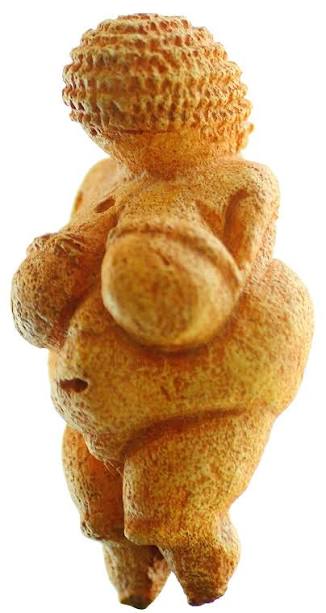
What’s the possible function of this statue?
Can’t stand on own - not for display
Can wrap string around neck to make into a necklace
Could it be used as a teaching tool?
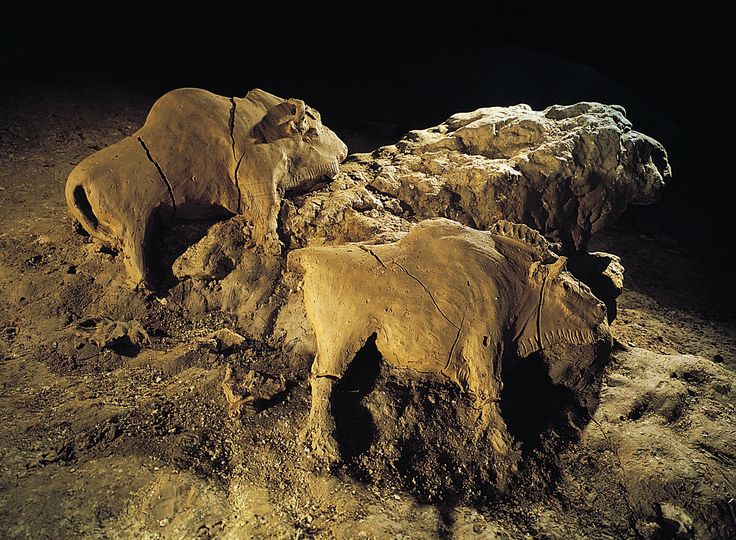
What is the name of this statue? What is its date and place of origin?
Bull and cow bison clay reliefs
Le Tuc d’Audoubert, France
15,000 BCE
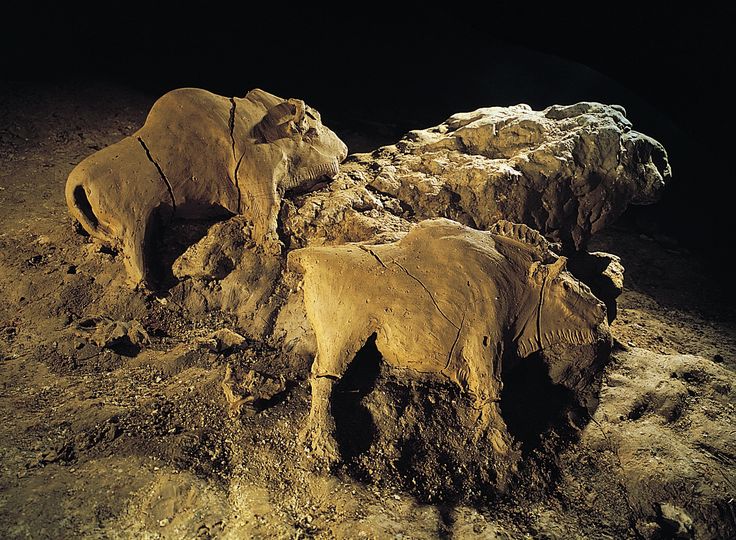
What is this statue’s material?
grey: limestone rock
Light tan: clay from la Salle des Bisons
Dark tan: clay from la Salle des Talons
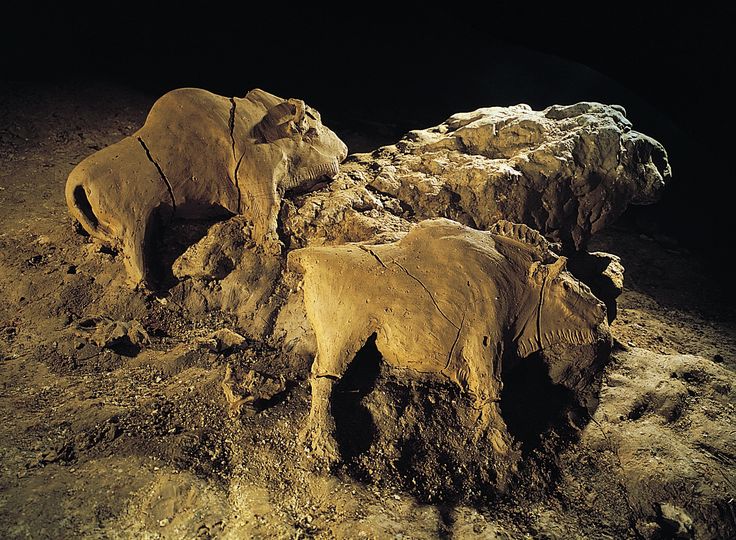
What are some of the findings, themes, and questions about this statue?
Manipulating cave environment in symbolic way
Using the cave not just for sleeping and shelter
Exploring the cave
Footprints around from both children and adults - is it for an initiation ritual? did children also help built this statue?
Found very deep in cave - probably not just for fun
Got clay from a different cavern

What are these images of? What do they mean? Where were they found? What date?
Human footprint in clay floor
Broken cave bear skull surrounded by footprints
Humans finding these skulls and using them for a purpose - display, storytelling, etc?
Le Tuc d’Audoubert France
15,000 BCE
What's the background information about caves and art?
Caves used for shelter- use main entrance
Not living far back - could get lost, harder to get out, very dark, animals
Caves are complex - many passages and levels
Artwork usually far back in cave
People do navigate the caves
Intentionally seeking out the back
Special occasions- don’t regularly venture
Neanderthal
Extinct human relatives who lived in Europe/Asia; evidence suggests they used pigments and made/used symbolic or decorative objects. Recent findings that they did make art
Homo Sapiens
Our species; created much of the surviving Paleolithic cave art and portable art studied in art history.
Hunter-gatherer-fisher groups
People survived by hunting animals, gathering plants, and fishing rather than farming. Important context for why animals appear so often in Paleolithic art.
humans were migratory - to follow big game and gather seasonal nuts and berries
Coming across other humans or neanderthals
Personal adornment (body art)
Decorating the body through things like beads, jewelry, pigments, etc. Shows that artistic/symbolic expression wasn't limited to caves.
has come to identify as a form of art
Ivory
Material from animal tusks; carved to create portable sculptures.
Clay
Moldable earth material used to create forms/sculptures and sometimes found in caves.
Red ochre
Natural iron-rich earth pigment that produces reddish colors; used in prehistoric art/body decoration.
used in a lot of cave paintings
therianthropes
Figures combining human and animal characteristics. Potentially connected to beliefs, rituals, or supernatural ideas, although interpretations are uncertain.
Aboriginal Australians
Indigenous peoples of Australia with very old and continuing artistic traditions. UDnderstanding traditions involving land, animals, ancestors, and spirituality.
Dreamtime / The Dreaming
Aboriginal Australian concept involving ancestral beings, creation, land, law, and continuing spiritual relationships.X
X-ray style
Artistic style showing both the outside and internal features of animals/figures. Associated especially with Aboriginal Australian art.
Eland
Large African antelope. Especially important in San rock art and associated with spiritual/ritual significance.
Auroch
Large extinct wild cattle; ancestors/relatives of domestic cattle. Frequently represented in prehistoric European cave art.
Cave lion
Extinct large lion represented in Paleolithic cave art.
Used in statues or paintings
Abstract
Art that does not attempt to represent subjects realistically/naturalistically; may use simplified shapes, signs, patterns, etc.
Naturalistic
Depicts subjects in a way that resembles their appearance in nature. Paleolithic animals can be surprisingly naturalistic.
Sculpture in the round
Fully three-dimensional sculpture meant to exist independently rather than being attached to a background. Can generally be viewed from multiple sides
Relief
Sculpture that projects from or is carved into a background/surface rather than being completely freestanding.
Shaman/Shamanism
A shaman is a spiritual/ritual specialist believed in some cultures to communicate with or interact with a spirit world, often through altered states. Shamanism is one interpretation scholars have proposed for some prehistoric art—not something we can know for certain.
San / Bushmen
Indigenous peoples of southern Africa with important rock-art traditions. San practices have sometimes been used by scholars as comparisons when interpreting prehistoric art.T
Trance dance
San ritual involving dancing and altered states of consciousness; connected to healing/spiritual practices and interpretations of some San rock art
Scientific methods of dating art
Thermoluminescence dating
C-14 Dating
Uranium-Series isotope dating
Archaeological context of dating art
Stratigraphy: using layers of sediment and rock
Artifacts from the same level date to the same period
Can establish a relative chronology based on deposit of layers
Can only be specifically dated when combined with scientific
Stylistic Analysis of Dating Art
More subjective
Based on the principle that style is culturally determined and changes over time
Similar styles date contemporaneously
Subjective
Examples of formal qualities that can be period-specific
Materials (example: bronze not till certain time)
Technologies (example: printing press)
Method of manufacture
First intentional burials
Body inhumed in flexed position, red ochre, flowers
Indicates a concern with the afterlife, symbolic thinking
Form of creative expression
Burying with care
Abstract thinking beyond the physical
First artistic creations
Small and portable since they are on the move (exception: cave and rock art)
Symbolic and creative thinking, high-level cognitive abilities
Dominate imagery: animals and plants around them
Far fewer images of humans, most female
NOT unique to Homo sapiens