PHYSICS OMG IM GONNA DIE
 Call Kai
 Learn
Learn Practice Test
 Spaced Repetition
 Match
Match Flashcards
 Knowt Play
1/154

There's no tags or description
Looks like no tags are added yet.
Name | Mastery | Learn | Test | Matching | Spaced | Call with Kai | Chat |
|---|
No analytics yet
Send a link to your students to track their progress
155 Terms
What is frequency?
Cycles per second
What is the period?
Cycles per second
What is the wavelength?
The distance between two consecutive points on successive waves
How do you calculate the period?
1/frequency
If the frequency of a wave is 8 Hz, then how much of the wave passes in 1 second (period)?
1/8th (Inverse)
What does a displacement-time graph show?
The amplitude, frequency, and period of a wave
How do you calculate the velocity of a wave?
v=fλ
If there are 6 waves per minute, and the distance between each crest is 10m, how do you solve?
Frequency=6/60=0.1Hz
∴λ=0.1/1 = 10m
v=fλ
0.1×10 = 1m/s

What is the frequency of thsi wave?
Can’t tell. Time for one λ to occur is known, but the magnitude of λ is not

What is the frequency of this wave
Can’t tell. Magnitude of λ is known, frequency is not
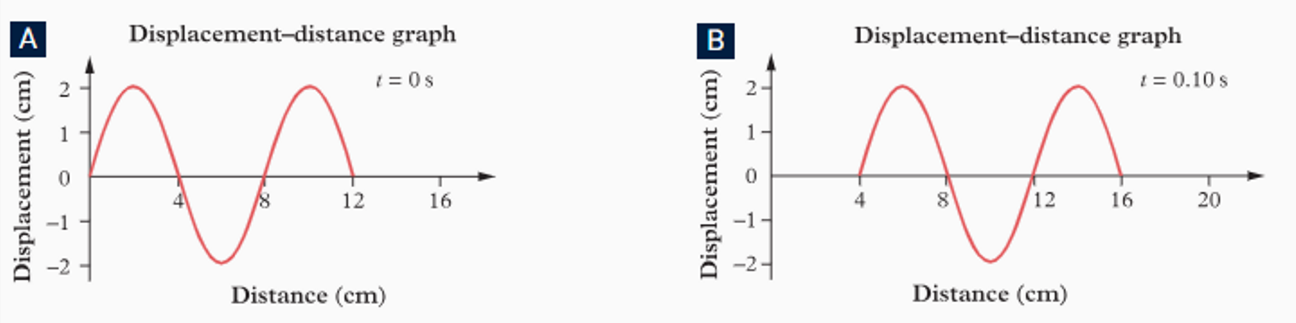
How do you calculate frequency in these two graphs
Crest moves 4cm in 0.1 seconds. λ is known to be 8cm, so it takes 0.2 seconds to complete a full cycle. This is the period, so take the inverse (1/0.2), which = 5 Hz
What unit must wave velocity be in
Meters
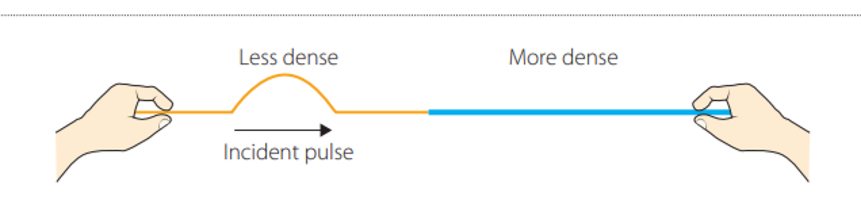
What happens when a wave is transmitted through a more dense substance?
It is reflected underneath the axis, whilst a secondary smaller wave continues along the more dense medium
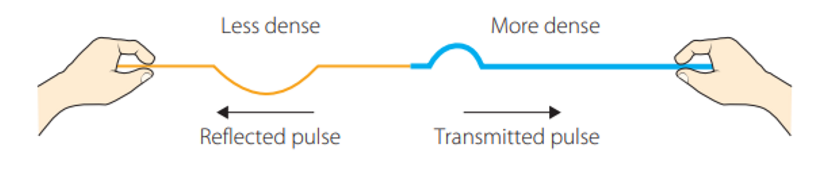
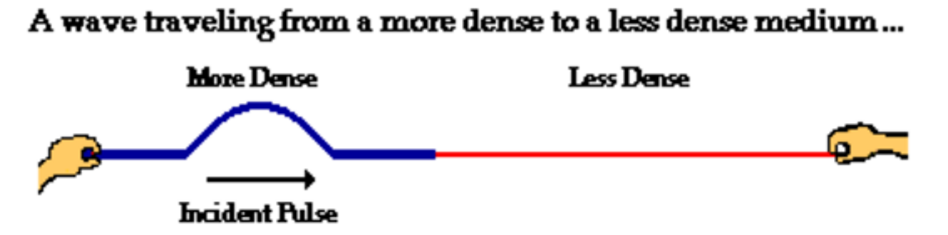
What happens when a wave is transmitted through a less dense substance?
It is reflected back normally, whilst a secondary larger wave continues along the less dense medium

What is the law of reflection?
θI=θr
What is the angle of incidence?
The incoming wave
What is the angle of reflection?
The reflected wave
What are standing waves
Waves that are stationary rather than travelling through a medium
What does a small gap do in terms of diffraction
Creates waves that have increasingly larger angles going away from the wall

What does a large gap do in terms of diffraction
Creates waves that have marginally larger angles going away from the wall
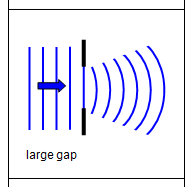
What does a small wavelength do in terms of diffraction
Creates waves that move almost in a straight line going away from the wall

What does diffraction at an edge do
Creates waves that somewhat curve back after the edge
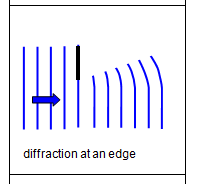
What does diffraction around an obstacle do
The waves eventually close back in after going around the obstacle

What are vectors?
Quantities that contain magnitude AND direction (e.g. 5m/s North)
What are scalars?
Quantities that contain just magnitude (e.g. 5m/s)
How can vectors be symbolised?
F ˜F →F
How do you draw vector arrows?
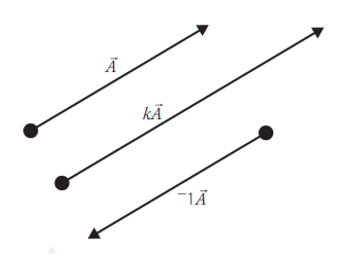
What is distance?
The total length of the path travelled
What is displacement?
The shortest straight-line change in position from start to finish
How do you find distance?
Add path lengths
How do you find displacement
Find the magnitude of the quickest path (as well as direction)
How do you find average speed
DISTANCE CHANGE
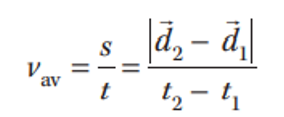
How do you find average velocity?
DISPLACEMENT CHANGE
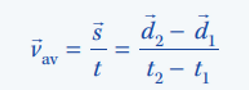
What does the gradient in a distance-time graph represent?
Speed
What does a negative gradient in a distance-time graph represent?
Returning/Going backward
How do you calculate velocity on a time-distance graph
Find the gradient
How do you calculate displacement on a velocity-time graph
Find the area underneath the curve
How do you calculate acceleration on a velocity-time graph
Find the gradient
How do you calculate acceleration?
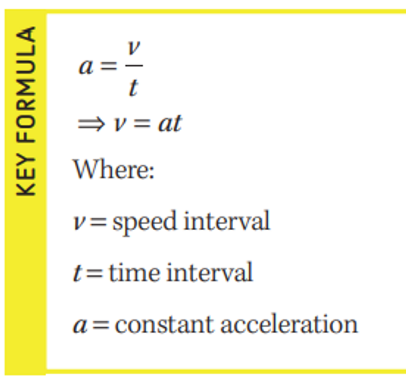
How do you calculate displacement when something is dropped (gravity)?
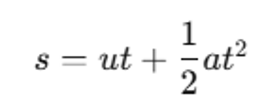
What differences are there in the gravity/displacement formula when something is thrown upward
Acceleration is -9.8 m/s, initial velocity stays positive
What is the formula for Newton’s Second Law
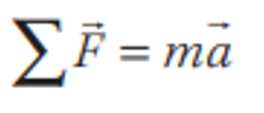
What is Earth’s Gravity?
9.8m/s2
What does it mean for acceleration when something is moving at a constant speed?
a=0
Formula for frictional force?
Ff=Fa-Fnet
Steps to find frictional force?
Use Ff=Fa-Fnet
Determine Fa, m, a
Use F=ma to determine net force
Is momentum a scalar or a vector
Vector
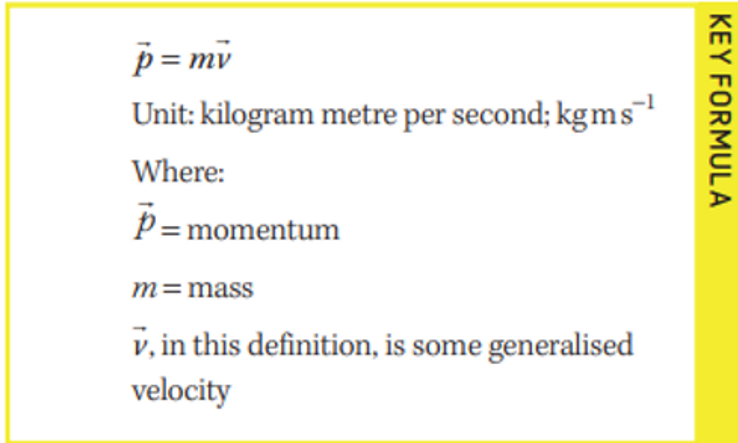
What is the formula for momentum
p=mv
How do you find the total momentum of a system?
Find the total momentum of all objects and add together.
How do you find total change in momentum?
Use p=mv for different values, and find the difference.
How do you find impulse?
∆p=Ft
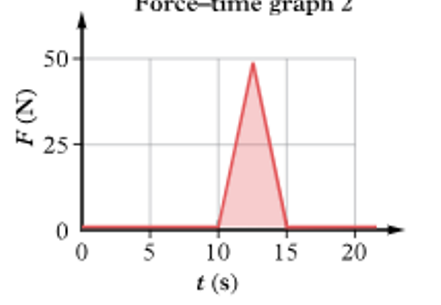
How do you determine impulse on a Force-time graph
Area under the curve
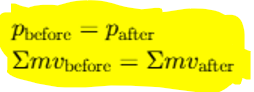
What is the law of conservation of mass?
That the amount of momentum in a system is always the same
What are elastic collisions?
When objects collide and bounce off of each other
What are inelastic collisions
When objects collide and remain bounded
What is work/mechanical work?
It is the force multiplied by the distance moved in the direction of force
What are the two types of mechanical energy?
Potential and Kinetic
What is kinetic energy?
The energy an object has when it is moving
What is the law of conservation of energy
Energy cannot be created nor destroyed
How do you calculated work done?
W=FD (Force x distance)
How do you calculate work done on a force-displacement graph
Area under the curve
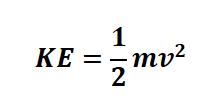
What is the formula for Kinetic Energy?
What is the formula for Gravitational Potential Energy?

How do you interpret and energy-time graph?
xyz
What is the period in terms of frequency
1/frequency
What’s the amplitude?
The height from the origin
What is diffraction
When waves bend behind a barrier or the wavefront is broken up into many smaller pieces
What is polarisation
When light has been filtered so it only vibrates in one single direction
What is superposition
The resulting wave when multiple waves collide
How do you draw superposition
Add the y coordinates of each wave and draw at that point
What is resonance
The frequency of an outside push that creates the biggest wave
What is natural frequency
The normal speed at which a disturbed object moves/vibrates

What part of a wave is this?
Crest
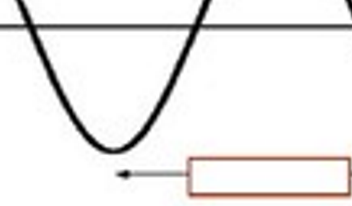
What part of the wave is this
Trough
What is
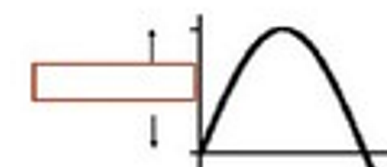
What part of the wave is this
Amplitude
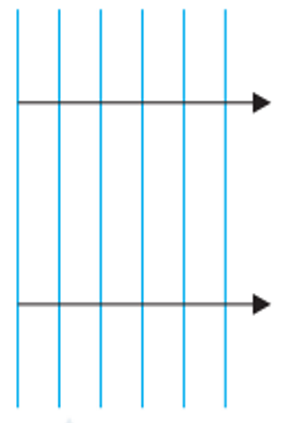
What is this?
Plane Wavefront
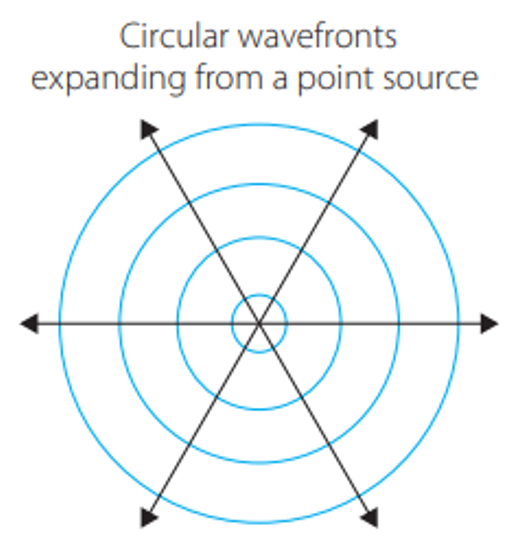
What is this?
Circular Wavefront
What are the two ways waves can transfer energy?
Transverse or longtitudinal
What is frequency?
Cycles per second
What is period?
Seconds per cycle
What is a rarefaction?
The point in a longitudinal wave when the particles are the furthest
What is reflection?
Where the incoming wave hits a surface and bounds back into the original medium
What is the law of reflection?
Where angle of incidence equals the angle of reflection

What is refraction
When an incoming wave passes through a boundary into a medium usually of a different density
How do you find the speed of sound in air?
v=v₀°c + 0.6T

How do you find the frequency of a sound wave in a medium?
ƒ=v/λ