Week: 2 Lecture 2 Childhood Amnesia
 Call Kai
 Learn
Learn Practice Test
 Spaced Repetition
 Match
Match Flashcards
 Knowt Play
1/9

There's no tags or description
Looks like no tags are added yet.
Name | Mastery | Learn | Test | Matching | Spaced | Call with Kai | Chat |
|---|
No analytics yet
Send a link to your students to track their progress
10 Terms
Why study memory development?
Central to learning and problem solving, findings can guide design of age-appropriate methods to improve learning
Core component of general intelligence Has important applied implications, for example, children’s eyewitness memory in forensic settings.
Describe continuities in early memory development?
there are gradual increases in retention duration and capacity, that is, there is a quantitative shift rather than a qualitative shift in memory systems
These continuities are affected by
Time since encoding
Length of exposure at encoding
Encoding specificity - match between contexts present at encoding and retrieval.
How do you study infant memory?
The Mobile and Train Task Mobile task involves measuring babies kicking behaviour as a function of conjugate reinforcement – kicking allows the mobile to move which is an appetitive activity Train task involves measuring toddles kicking behaviour as a function of reinforcement → kicking in this case, allows the train to run along a track They find that the behaviour increases proportionately to age
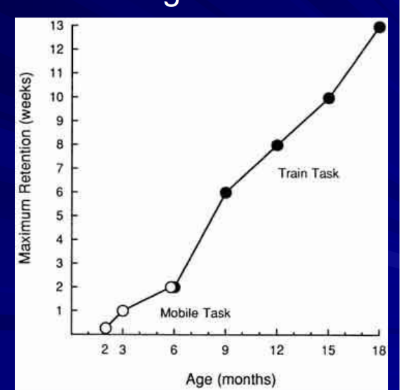
Describe evidence for encoding specificity?
Recall is best when the retrieval context matches the encoding context
. For example, classic work with adults → tested if learning was underwater vs. on land, or if testing was underwater or on land. Found that when the recall environment matched the environment during learning, recall was better (32-38% compared to 23-34%).
Experiments comparing the retention ratio in the Mobile task in infants either with the same blanket or a different blanket at test or during learning. They found that infants are more sensitive to the encoding specificity than older infants.
Describe discontinuity in infant memory?
infant amnesia → there is a discontinuous relationship between autobiographical memory before 2.5-3 years old and age that does not track with the normal rate of memory development to those who are older. Most people struggle to report memories that are before 2 and ½ years of age.
What are some suggested theories that could explain infant amnesia?
Infants don’t form long-term memories
INCORRECT - Perris et al → tested infant memory of audio localisation, infants were exposed to nice sound from the left or the right. Trained to look more at the left or at the right, found exposure groups still showed more memory 1-2 years later , compared to controL
Forgetting - people forget naturally, we can only remember max. 18 years in the past
INCORRECT - people can remember things past 18 years old when you are old yourself
Repression - we repress memories because they are too dark for baby us to handle - link to oedipus syndrome/penis envy
INCORRECT - most early memory emotional neutral or positive
Correct? —→ Childhood amnesia as a function of self-concept - we don’t develop memories until we have clear self-concept, and self-concept does not develop until a certain age
Representational formats + encoding specificity
Describe Self-concept evidence as a theory for Infantile Amnesia ?
: We don’t develop memories until we have a clear self-concept, and self-concept does not develop until a certain age. Aka you cannot develop what has happened to YOU until you know you are a person.
This is normally tested using a mirror-mark –Rouge Test → wherein children will remove a mark on themselves or to their mirror-self. Remove mark on themselves = understanding of self-concept vs. on their mirror-self = no understanding of self-concept
However, there are problems with this –
There is a clear distinction between self and others emerges by 12-18 months – this does not reflect poorer recall periods during infancy.
Assumes that there is a major discontinuities in development - in contrast with most evidence about child development;
Describe Representational formats and encoding specificity as a theory for Infantile Amnesia?
Argues that Infantile Amnesia may occur as children don’t yet have the vocabulary to explain and therefore remember specific autobiographical memory, and that there is a mismatch in recall, as children may remember sensor-motor actions, but don’t have the vocabulary to describe the task. -
Evidence for this comes from the incredible Shrinking Machine Task
There were 3 x groups - 3 year olds vs. 2 ½ years olds vs. 2 years olds
In this experiment, a child's capacity to verbally describe an event is initially described. All children are exposed to the incredible shrinking machine tasks. 6 and 12 months later, children are given verbal, photographic and re-enactment retrieval tests. Additionally, the verbal capacity is assessed again.
They found that across all age groups, children generally did better in the photographic and the re-enactment retrieval tests compared to the verbal test. They also found that children cannot verbally describe events that weren’t a part of their encoding initially.
How can the phenomenon of childhood amnesia be explained?
Encoding specificity Language Development → mismatch Disagrees with the idea that there is qualitative change in memory processing.
What is the recoverability of infant memories?
Should be sceptical given work on encoding specificity → Evidence regression to an earlier cognitive stage does not occur, adults respond like adults in cognitive test No better at verbal recognition of objects from early childhood.