Intro to Psychology Areas and Applications - Chapter 14: Stress, Coping, Health
 Call Kai
 Learn
Learn Practice Test
 Spaced Repetition
 Match
Match Flashcards
 Knowt Play
1/128

There's no tags or description
Looks like no tags are added yet.
Name | Mastery | Learn | Test | Matching | Spaced | Call with Kai | Chat |
|---|
No analytics yet
Send a link to your students to track their progress
129 Terms
Chronic Disease (Modern Context)
Diseases that are more prevalent today because people are living longer while frequently engaging in unhealthy behaviors.
Mind-Body Relationship
The concept that 'everything psychological is simultaneously biological,' where brain functioning allows the mind to emerge, and the mind can change the brain's structure and function.
Brain Composition (Average Human)
Consists of approximately 86 billion neurons, 85 billion glial cells, and trillions of synapses.
Brain Energy Consumption
The brain utilizes 20% of the body's oxygen and up to 60% of the body's glucose as fuel.
Ketones
The alternative fuel source the brain utilizes during fasting or when following a ketogenic diet.
Atherosclerosis
A condition that can damage blood vessels and reduce blood flow to the brain, increasing the risk of stroke, cognitive decline, and vascular dementia.
Action Potential Electrolytes
The electrical signals of neurons that depend critically on sodium (Na+) and potassium (K+) obtained from the diet.
Neurotransmitter Precursors
Amino acids obtained from food, such as:
Tryptophan (from soy, seafood, beef)
Phenylalanine
Glutamine (from meat, poultry, eggs)
Evolutionary Biases in Infants
Innate survival aids, such as the universal rejection of bitter tastes and the preference for the mother's body odor and breast milk.
Evolutionary Trade-offs
The principle that every body feature is a compromise;
e.g A thinner radius bone allows for wrist mobility and tool use but is susceptible to the Colles fracture.
Neural Tube
The structure that begins to form in the third week of embryonic development.
Brain Volume at Age 6
The point at which the brain reaches 90% of its adult volume.
Traditional Medicine (Approach)
Focuses on the breakdown of the body and its defenses, often treating specific parts rather than the 'whole person' (mind, social status, culture).
Health Psychology
A new interdisciplinary field focusing on the role of psychology in maintaining health and preventing/treating illness, including topics like anger management and medical compliance.
Sympathetic Nervous System
The division of the autonomic nervous system that prepares the body for action by dilating pupils, increasing heart rate, and inhibiting digestion.
Parasympathetic Nervous System
The division of the autonomic nervous system that promotes relaxation by constricting pupils, decreasing heart rate, and stimulating digestion.
Stress
An uncomfortable emotional experience accompanied by predictable biochemical, physiological, and behavioral changes.
Stress (con’t)
Any circumstances that threaten or are perceived to threaten one’s well-being and that thereby tax one’s coping abilities
e.g. Threats to physical safety, long-range security, self-esteem, reputation, peace of mind, etc
Stress and disasters
People may think of tornadoes, hurricanes, floods, and earthquakes when they hear the word stress
Stress and disasters (con’t)
Studies conducted in the aftermath of natural disasters typically find elevated rates of psychological problems and physical illness in the communities affected by them
e.g. The 2019 Australian bushfires and the 2020 Newfoundland blizzard
Stress and everyday events
Tasks such as losing your phone, car trouble, and gift shopping can be stressful
Stress and everyday events (con’t)
They can have a considerable impact on mental health and are predictive of vulnerability to obsessive-compulsive disorders, depressive disorders, and a variety of anxiety disorders
Perceived Stress Scale (PSS)
The most widely used psychological instrument for measuring how much life situations are perceived as unpredictable, uncontrollable, and overloaded.
Health effects of stress
Psychopathology, increased risk for memory loss, heart disease, arthritis, ulcers, asthma, and migraines
Emotional responses
Feelings such as
Annoyance, anger, and rage
Apprehension, anxiety, and fear
Dejection, sadness, and grief
Positive emotions and lifespan
People who experience a high level of positive emotions appear to live longer than others and have protection against heart disease
Cohen et al. (1991) Study Result
Research demonstrating that when exposed to a cold virus, participants with higher levels of stress were more likely to develop a cold.
Emotion-Focused Coping Skills
Strategies to manage the emotional response to stress, such as exercise, meditation, taking a bath, or giving yourself a pep talk.
Problem-Focused Coping Skills
Strategies that address the stressor directly, such as time management, asking for support, and creating a to-do list.
Locus of Control
The extent to which people believe they have power over events in their lives.
Autogenic Training
A stress management technique developed by Johannes Heinrich Schultz in 1932 using visual imagery and body awareness to activate the parasympathetic nervous system.
Biopsychosocial model
A perspective suggesting that physical illness results from the interaction of psychological, biological, and sociocultural factors.
Health psychology
A field of study concerned with how psychological factors influence health promotion and maintenance, and the prevention of disease.
The subjectivity of stress
How one chooses to notice, appraise or interpret a stressful situation
e.g.Many people find flying in an airplane somewhat stressful, but frequent fliers may not be bothered at all
Cognitive appraisals
Personalized perceptions of threats, categorized into primary and secondary appraisals, which determine how a person experiences stress.
Primary appraisal
An initial evaluation of whether an event is:
Irrelevant to you
Relevant but not threatening
Stressful
e.g. How one would determine whether you saw an upcoming psychology exam as stressful
Secondary appraisal
An evaluation of your coping resources and options for dealing with the stressful situation
e.g. How one would determine how stressful the exam appeared, in light of your assessment of your ability to deal with the event.
Reappraisal.
When one assesses a stressful situation again
Frustration
A major type of stress that occurs when a goal is blocked or a desire is left unmet. (when you want something and you can’t have it)
e.g. Traffic jams, difficult commutes, and annoying drivers
Conflict
A major type of stress that occurs when two or more incompatible motivations compete for expression.
Change
A type of stress involving the need to adapt to new situations or life challenges.
Life changes
Any substantial alterations in one’s living circumstances that require readjustment
Social Readjustment Rating Scale (SRRS)
Assigns numerical values to 43 major life events meant to reflect the magnitude of the readjustment required by each change
Criticisms of the Social Readjustment Rating Scale (SRRS)
It doesn’t measure change exclusively, and rather assesses a wide range of varied kinds of stressful experiences
Pressure
A type of stress involving expectations or demands to behave in certain ways.
e.g. Salespeople are usually under pressure to move merchandise. Stand-up comedians are under intense pressure to make people laugh
Approach-approach conflict
A type of conflict in which a person is torn between two positive goals; is the least stressful type of conflict
e.g. choosing between pizza and spaghetti.
Avoidance-avoidance conflict
A type of conflict in which a person is torn between two negative goals; are most unpleasant and highly stressful
e.g. choosing between unemployment and a painful backache.
Approach-avoidance conflict
A type of conflict in which only one goal is under consideration, but it has both positive and negative aspects,
e.g. a date with an attractive person that may lead to rejection.
Vacillation
When one goes back and forth, beset by indecision
Coronary heart disease
A reduction in blood flow in the coronary arteries, which supply the heart with blood.
Coronary heart disease (con’t)
Accounts for about 90 percent of heart-related deaths
Risks for coronary heart disease (con’t)
Smoking, lack of exercise, high cholesterol levels, and high blood pressure
High blood pressure (hypertension) statistics in Canada
One-quarter of Canadians between the ages of 20 and 79 suffer from high blood pressure, with 20% being unaware they had it
Social Readjustment Rating Scale (SRRS)
A scale developed by Holmes and Rahe that assigns mean life event values to various stressors, such as the death of a spouse (100), divorce (73), and marriage (50).
Inverted-U-hypothesis
The hypothesis that increased arousal is associated with improved performance up to an optimal level, after which higher arousal leads to poorer performance.
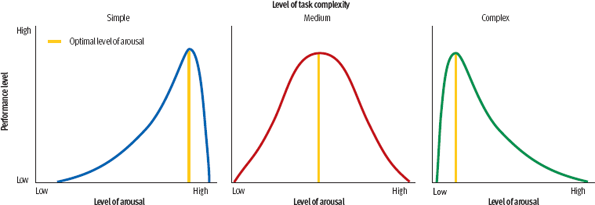
Inverted-U-hypothesis (con’t)
When performance is plotted as a function of arousal, the resulting graphs approximate an upside-down U
Inverted-U-hypothesis (III)
As a task becomes more complex, the optimal level of arousal (for peak performance) tends to decrease
Fight-or-flight response
A physiological reaction to threat proposed by Cannon that mobilizes the organism for action for attacking (fight) or fleeing (flight) an enemy
Tend-and-befriend
When people form strong social connections so that when they are stressed they can call on said connections for help
General adaptation syndrome
Selye’s model of the body’s physiological response to stress; is divided into three phases: alarm, resistance, and exhaustion.
Alarm reaction
The first phase of the general adaptation syndrome in which the body mobilizes its resources for resistance after a brief initial shock.
Stage of resistance
The second phase of the general adaptation syndrome in which physiological arousal stabilizes and levels off, eventually beginning to decline.
Stage of exhaustion
The third phase of the general adaptation syndrome in which the body's resources are depleted, leading to health problems (diseases of adaptation).
Catecholamines
Hormones secreted by the adrenal medulla during stress that increase cardiovascular response, respiration, perspiration, and blood flow to active muscles.
Effects of catecholamines
The body is mobilized for action
e.g. Respiration and oxygen consumption speed up, pupils dilate, digestive processes are inhibited
Corticosteroids
Hormones secreted by the adrenal cortex that increase protein and fat mobilization, access to energy stores, and decrease inflammation in the event of an injury
Coping
The term used for behavioural responses to stress, which can range from giving up to constructive problem-solving.
e.g. If one is failing a class, they might increase their study efforts, get help, or give up
Learned helplessness
A passive behavioural response to stress, identified by Seligman, involving giving up and blaming oneself
Learned helplessness (con’t)
Produced by exposure to unavoidable aversive events beyond one’s control
Catastrophic thinking
A term introduced by Ellis for a response to stress characterized by unrealistically negative appraisals of and problematic responses to a situation.
Negative self-talk
Can contribute to the development of depressive disorders
Self-indulgence
When stressed-out people engage in unwise patterns of eating, drinking, spending money, and so forth
Internet addiction
Excessive gaming, preoccupation with sexual content, or obsessive socializing
Internet addiction traits
Excessive time online
Anger and depression when thwarted from being online
An escalating need for better equipment and connections
Adverse consequences, such as arguments and lying about Internet use, social isolation, and reductions in academic or work performance
Internet addiction statistics
Around 6 percent of the population
Defence mechanisms
Are largely unconscious and ineffective reactions that shield individuals from the unpleasant emotions so often elicited by stress
Self-deception or denial
Are how defence mechanisms are accomplished through distorting reality so it doesn’t appear so threatening.
Constructive coping
Relatively healthful efforts that people make to deal with stressful events through:
Confronting problems directly
Reasonably realistic appraisals of your stress and coping resources
Learning to recognize, and in some cases regulate, potentially disruptive emotional reactions to stress
The effectiveness of coping
No strategy of coping can guarantee a successful outcome, and is simply meant to connote a healthful, positive approach, without promising success
Optimism
A general tendency to expect good outcomes, which leads to relatively good physical health, more effective immune functioning, increased longevity, etc
Why’s optimism beneficial to health
Optimists cope with stress in more adaptive ways than pessimists do, such as taking action, maintaining social connections, and emphasizing the positives in their appraisals of stressful events
How does conscientiousness promote longevity?
People who are high in conscientiousness are less likely than others to exhibit unhealthy habits, such as excessive drinking, drug abuse, dangerous driving, smoking
People tend to rely on constructive coping strategies, and they’re persistent in their efforts, so they may handle stressors better than others.
How does conscientiousness promote longevity? (con’t)
It appears to promote better adherence to medical advice and more effective management of health problems
It’s associated with higher educational attainment and job performance, which both foster career success and increased income, leading to higher socioeconomic status
Hardiness
A constellation of attitudes, beliefs, and behavioural tendencies that consists of three components: commitment, control, and challenge
Hardiness (con’t)
People tend to approach difficult tasks as challenges, they viewed their work as important, and they were committed to it, and they saw themselves as in control of their time and efforts.
Burnout
A syndrome composed of three components: exhaustion, cynicism, and lowered self-efficacy, often caused by work overload and lack of control.
Exhaustion
Includes chronic fatigue, weakness, and low energy
Cynicism
Is s manifested in highly negative attitudes toward oneself, one’s work, and life in general
Reduced self-efficacy
Involves declining feelings of competence at work, which give way to feelings of hopelessness and helplessness
Burnout and the workplace
Is associated with increased absenteeism and reduced productivity at work, as well as increased vulnerability to a variety of health problems
Causes of burnout
Overload
Struggling with interpersonal conflicts at work
Lack of control over work responsibilities and outcomes
Inadequate recognition for one’s work
Too many demands or work hours
Causes of burnout (con’t)
For those who make $100,000 per year or more, their jobs are the main cause of their stress.
For those who make less than $100,000, it is finances that are the major source of stress
Burnout and school
Trying to balance the demands of performing well at school, easing financial pressures, and maintaining a personal life puts students at risk for burnout
Post-traumatic stress disorder (PTSD)
A disorder characterized by symptoms such as flashbacks, emotional arousal, nightmares, anxiety, and guilt related to a major traumatic event
e.g. Sexual assault, physical assault, witnessing a death, or witnessing a natural disaster such as a wildfire
PTSD and childbirth
Women who witnessed the events of 9/11 when they were pregnant and those who gave birth during the Holocaust had children with smaller heads, a thinner cortex, and lower cortisol levels
Post-traumatic stress disorder (PTSD) statistics
Nearly 45% of surveyed first responders report symptoms of it.
Type A personality
A personality pattern featuring three elements: strong competitiveness, impatience and time urgency, and anger and hostility.
Type A personality (con’t)
Are ambitious, competitive, and hard-driving perfectionists who are exceedingly time-conscious and drive themselves with many deadlines
Type A personality (III)
They’re more irritable and hostile, as well as quick to anger; their risk of coronary disease is 2 - 3 times higher
Type B personality
Relatively relaxed, patient, easygoing, amicable behaviour