Geography
 Call Kai
 Learn
Learn Practice Test
 Spaced Repetition
 Match
Match Flashcards
 Knowt Play
1/15

Earn XP
Description and Tags
Key textbook information Chapter 10
Name | Mastery | Learn | Test | Matching | Spaced | Call with Kai | Chat |
|---|
No analytics yet
Send a link to your students to track their progress
16 Terms
What is Human Wellbeing?
Human wellbeing is the recognition that everyone around the world, regardless of geography, age, culture, religion or political environment, aspires to live well. Wellbeing is not necessarily bound by income, rather, it is an individual’s thoughts and feelings about how well they are doing in life, contentment with material possessions and having relationships that enable them to achieve their goals. Many factors impact upon an individual’s ability to live well including war, conflict, social fragmentation, inequality, poverty, malnourishment as well as access to resources.
What is wellbeing?
A good or satisfactory condition of existence; a state characterized by health, happiness, prosperity and welfare.
What is wellbeing often associated with?
the concept of a good life.
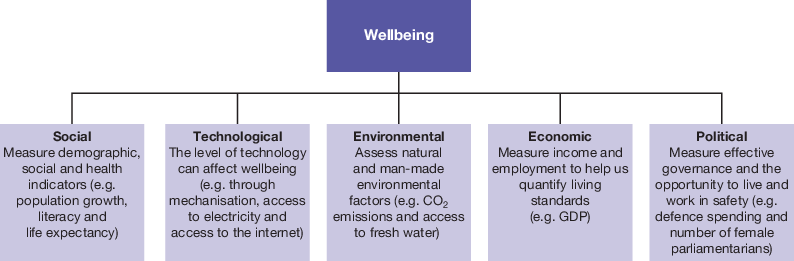
What are the indicators of wellbeing? categories
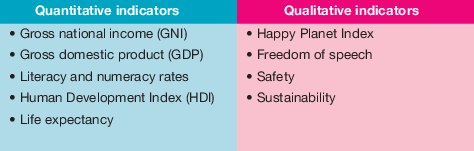
What can indicators of wellbeing be classified as?
quantitative and qualitative indicators
What is quantative and qualative indicators? examples
Quantitative indicators, with a numerical value, are used to compare changes over time and between places. Qualitative indicators are subjective over both time and place and harder to compare.
What are the broad categories for classifying indicators?
Economic indicators measure the economy and its performance.
Social indicators include demographic, social and health measures.
Environmental indicators assess social and economic development, and gauge the health of the environment in which we live.
Political indicators consider the effectiveness of governments at improving people’s standard of living through the provision of essential services.
Technological indicators are used in fields such as transport, industry, agriculture, mining and communications.
What is MEDC and LEDC and NIC
describe development levels in economic, social, environmental and political spheres.
one that is modernising and changing rapidly, experiencing swift economic growth. Emerging economies (EEs) also see rapid economic growth but face significant political, monetary or social challenges.
First world and third war
The terms first, second and third worlds originated during the Cold War.
The first world included Western industrialised nations and their former colonies (North America, Western Europe, Japan and Australasia).
The second world comprised the Soviet Union and its Communist bloc allies (the former USSR, Eastern Europe and China).
The third world referred to all other countries, and over time, it came to describe poorer countries with lower living standards.
The second world ceased to exist when the Soviet Union collapsed in 1991. However, the term is sometimes still used to describe countries in the middle band in terms of human development.
What is HDI
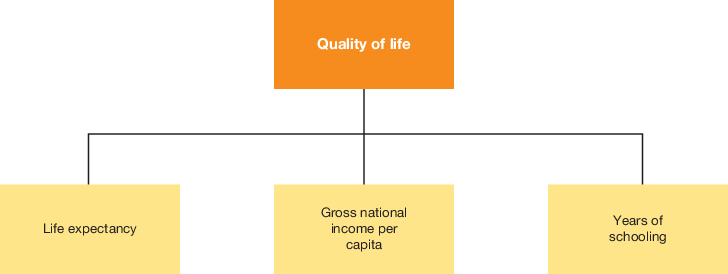
Measures standard of living and wellbeing by measuring life expectancy, education and income.
What is the HPI
It was developed as an alternative to traditional measures like GDP, aiming to highlight the importance of sustainable wellbeing, how well people are living and the sustainability of the resources being used. The Happy Planet Index (HPI) maps the extent to which countries across the globe produce long, happy and sustainable lives for the people that live in them. The cartogram in FIGURE 1 uses colour shading to show each country’s HPI score, while their sizes reflect population.
Each of the three component measures — life expectancy, experienced wellbeing and ecological footprint — is given a traffic-light score based on thresholds for good (green), middling (amber) and bad (red) performance. These scores are combined to an expanded six-colour traffic light for the overall HPI score. To achieve bright green (the best of the six colours), a country would have to perform well on all three individual components.
What is the ANDI?
The Australian National Development Index (ANDI), which was approved in 2015, incorporates 12 indicators measuring elements of progress including health, education, justice and Aboriginal and Torres Strait Islander Peoples’ wellbeing. Measures such as this demonstrate a new direction in articulating wellbeing, recognising that happiness is not directly proportional to our bank balance or how long we expect to live. This new measure of wellbeing will reflect what is important to Australians to feel happy as individuals, as well as the happiness of our communities. It will allow Australians to measure the future we want.
How is life expectancy calculated?
based on a country’s conditions in a given year, measures how long we can expect to live from birth
What is life expectancy closely interconnected with?
Child mortality. Countries with high under-five mortality rates generally have low life expectancy
What do women in low-income countries face?
maternal mortality risk of 1 in 233, compared to 1 in 7692 in high-income countries. Within LEDCs, women’s health and wellbeing are often worse than men’s across most age groups. Ending gender discrimination, achieving gender equality, and empowering women and girls are key elements of the United Nations’ Sustainable Development Goals (SDGs). SDGs 3 and 5 outline targets related to women’s health and wellbeing, with reducing maternal mortality rates being a key aim.
What is poverty?
Poverty is a key economic factor that leads to variations in human wellbeing, as it often limits access to essential services like healthcare, education, and clean water, which are crucial for a good quality of life. The United Nations defines poverty as:
A denial of choices and opportunities, a violation of human dignity. It means not having enough to feed and clothe a family, not having a school or clinic to go to, not having the land on which to grow one’s food or a job to earn one’s living. It means susceptibility to violence, and it often implies living in marginal or fragile environments, without access to clean water or sanitation.