18 Male Infertility
 Call Kai
 Learn
Learn Practice Test
 Spaced Repetition
 Match
Match Flashcards
 Knowt Play
1/46

There's no tags or description
Looks like no tags are added yet.
Name | Mastery | Learn | Test | Matching | Spaced | Call with Kai | Chat |
|---|
No analytics yet
Send a link to your students to track their progress
47 Terms
10 days post partum
At the latest, both testicles should be distended into the scrotum by 16 weeks but not considered cryptoorchid until *6 MONTHS*
When should testicles be distended into the scrotum by?
TRUE
TRUE OR FALSE: cryptorchidism in dogs is hereditary
*Administer hCG* = it will more than double testosterone if testes are present
May also test for Anti-Mullerian hormone
What do you administer to diagnose cryptoorchidism in dogs?
Give 500 IU (small/medium dogs) or 1000 IU (large dogs). Test at 4 and 8 hours, baseline Testosterone should more than double if testicles are more than present
You can administer hCG to dogs to determine whether or not they are cryptoorchid. How does it work?
Bilateral orchiectomy (because if one is torsed, it is likely the other will)
How do you treat testicular torsion?
Testicular tumor
What broad category of tumor is second most common tumor (after skin tumors) in dogs?
Sertoli
What is the *most common* testicular tumor of the dog?
May feminize dog bc of estrogen secretion
What do steroli cell tumors in dogs tend to do? What effect do they have?
With testicular tumors there will be lack of pain on palpation, but you may also use ultrasound and biopsy
How do you differentiate testicular tumors from Brucellosis?
true, some tumors may just cause atrophy of the OPPOSITE testicle (like sertoli)
TRUE OR FALSE: ALL tumors cause testicular enlargement
Cryptorchidism
What increases incidence for tumors in testicles?
A shows an atrophied testicle
B shows enlargement
tumors: sertoli or seminoma
What is happening here? Likely differential?

Enlargement in inguinal testes
Differential: sertoli cell tumor
What is this?

FEMINIZATION (hyperestrogen): alopecia, comedones, hyperpigentation, testicular atrophy, nipples enlarged (gynecomastia)
Tumor: sertoli cell tumor
Describe what you're seeing in this male dog and what could be causing it

ALP is low in seminal fluid (under 5000 U/L) = not able to ejaculate fully
How can incomplete ejaculation be related to azoospermia in dogs (lack of sperm in ejaculate)? What causes it?
Low sperm count in ejaculate
What is oligospermia?
200 million progressively motile spermatozoa
How many spermatozoa do you need in ejaculate to ensure good conception rates in a dog?
Penis, prepuce, vagina, mucous membranes
Name the common places to see TVT's (transmissible venereal tumor)
Transmissible venereal tumor
This tumor is transmitted by contact with mucous membranes and physically has a different number of chromosomes (*59 +/-5 chromosomes, when dogs have 78*)
TVT (transmissible venereal tumor)
What is your top differential here?
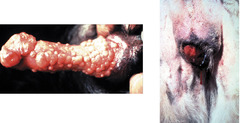
TVT
What is your top differential here?

Urethral prolapse
What is this pathognomonic "red pea" at the tip of the penis?

English Bulldogs
Which animal is genetically predisposed to urethral prolapse?
Surgical removal
How do you treat urethral prolapse in male dogs?
Priapism
This is unnatural penile temescence, an erection that won't go away
Benign prostatic hyperplasia
What is the most commonly diagnosed prostatic disease in dogs?
Older *intact* male dogs
What is the most common signalment for benign prostatic hyperplasia?
Benign Prostatic hyperplasia
A dog presents with serosanguinous urethral discharged. Owner says the poop looks "ribbon-y" (which you determine is rectal tenesmus), and on palpation the dog has caudal abdominal pain. You palpate the prostate transrectally to find it is normally smooth, bilobed, symmetrical, not painful, with no lumps or bumps. Thoughts?
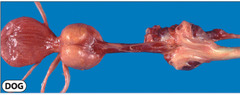
Younger = lies on pelvic floor close to pelvic brim
Older = prostate lies over pelvic brim, falling cranially into abdomen
What is the difference in size of the prostate in older versus younger dogs?
BASCIALLY incidence increases as the dog gets older and by 10-12 years old basically ALL intact stud dogs have it
5 years = 60% of intact dogs have it
6 = 80%
9 years = 95% have it
10-12 years = 100%
Talk about the clinical relevance of benign prostatic hyperplasia in dogs at the ages of:
1. 5 years old
2. 6 years old
3. 9 years old
4. 10-12 years old
Prostatic enlargement (benign prostatic hyperplasia)
What is this?

1. acute bacterial prostatitis
2. chronic bacterial prostatitis
3. prostatic adenocarcinoma
4. prostatic and paraprostatic cysts
Name a couple things that should be on your differentials list for benign prostatic hyperplasia?
Acute bacterial prostatitis
This BPH differential is typically associated with *FEVER*, depression, pain on rectal palpation, neutrophilia, and bacteriuria
Chronic bacterial prostatitis
This BPH differential is associated with *recurrent lower urinary tract infections*
Prostatic adenocarcinoma
This BPH differential is typically associated with *poor appetite, weight loss, hind limb weakness*, dysuria, hematuria, and dyschezia
Prostatic and paraprostatic cysts
This BPH differential can cause palpable abdominal cystic masses filled with yellow orange fluid
Hemorrhage, which likely would've shown hematuria
What is this, seen with prostate disease?

Chronic prostatitis
What is this, shrunken and hard with scar tissue?

*Prostatic Wash*
BPH = uniform cells
Neoplasia = variable cells
Septic = inflammatory cells
Palpation is great to tell if there is a prostate problem. But what is the BEST way to differentiate between BPH, Neoplasia, and septic prostate?
E. coli
What is the most common cause of bacterial prostatitis?
*Castration*
What is the treatment of choice for prostatic disease, the only DEFINITIVE TREATMENT?
Prostatic enlargement
What do you see?
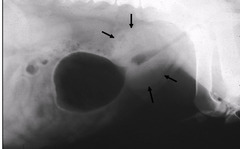
a. BPH
On ultrasound, the prostate is enlarged, symmetrical and still biloped, but echogenicity is mottled and there are small cystic regions present
a. BPH
b. prostatitis
c. neoplasia
d. abscess
b. prostatitis
On ultrasound, the prostate is enlarged, symmetrical and mottled
a. BPH
b. prostatitis
c. neoplasia
d. abscess
c. neoplasia
On ultrasound the prostate is enlarged, asymmetrical, with heterogenous echogenicity with some hyperechoic foci, and the texture is distorted
a. BPH
b. prostatitis
c. neoplasia
d. abscess
d. abscess
On ultrasound, the prostate is enlarged, asymmetrical, mottled, and shows echogenic fluid for texture
a. BPH
b. prostatitis
c. neoplasia
d. abscess
DES (diethylsilbestrol), 5a-reductase inhibitors (Finasteride)
CASTRATION is the treatment of choice for prostatic disease like BPH. If the owner doesnt want to do that, what else can you do?