Exam 2 - 507: Pharmacology of Antidepressants
 Call Kai
 Learn
Learn Practice Test
 Spaced Repetition
 Match
Match Flashcards
 Knowt Play
1/34

There's no tags or description
Looks like no tags are added yet.
Name | Mastery | Learn | Test | Matching | Spaced | Call with Kai | Chat |
|---|
No analytics yet
Send a link to your students to track their progress
35 Terms
Learning Objectives
Describe the pathophysiology of depression
Classify the individual antidepressants in drug classes
Describe the mechanism of action (MOA) of the different groups of antidepressants
Explain the side effects of the different groups of antidepressants
Explain possible drug-food interactions
Explain possible drug-drug interactions
Assess different antidepressants for their use in therapy
What is the pathophysiology of depression?
Cann occur as depression only or
Alternating with periods of mania (Bipolar disorder)
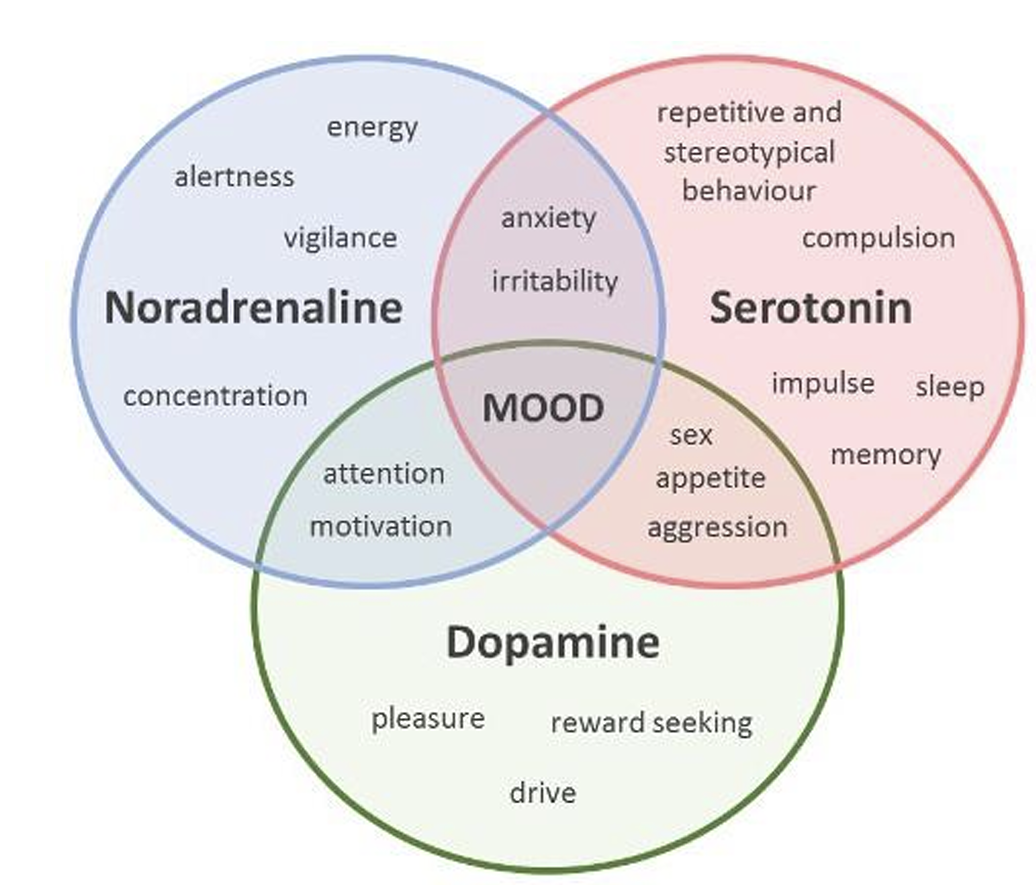
What is the monoamine hypothesis?
Deficiency & imbalance of the neurotransmitters
Serotonin (5-HT = 5-hydroxytryptamine)
Norepinephrine (NE, Noradrenaline)
And their inter-relationship with dopamine
Antidepressant therapy aims to correct transmitter deficiency/imbalance
What is the functional group found in common monoamines?
NH2 - amines
What are the anitdepressant agents we use?
1. Tricyclic Antidepressants (TCAs)
2. MonoamineOxidaseInhibitors(MAOIs)
3. Selective Serotonin Reuptake Inhibitors(SSRI)
4. Selective Noradrenaline Reuptake Inhibitors (NARIs)
5. Selective 5-HT/NE Reuptake Inhibitors(SNRIs)
6. AtypicalAntidepressants
How can serotonergic and noradrenergic transmitter concentrations be increased/balanced?
Electrical signal is translated into a chemical signal
Transmission is facilitated by the neurotransmitter
Neurotransmitter is recycled by reuptake in pre-synaptic cell NET
Partially repackaged and reused, partially destroyed by enzyme MAO
By increasing or decreasing the amount of neurotransmitter in the synaptic cleft, medications can make it more or less likely that a message will be transmitted to the next cell
What the MOA of MAO inhibitors?
MAO is an enzyme that breaks down transmitter that isn’t stored in vesicles = cellular housekeeping
MAO inhibitors increase the amount of neurotransmitter that is capable to be released in the synapse
Inhibition of MAO prevents degradation of neurotransmitters and therefore increase their availability
What are the two subtypes of MAO inhibitors? Which NT do they prefer?
MAO-A → prefers 5-HT, but also metabolizes NE and DA
MAO-B → prefers DA
Inhibition of which subtype, A or B, is responsible for antidepressant effect?
MAO-A inhibition
Which MAO-Is have irreversible effect?
Isocarboxazide
Phenelzine
Tranylcypromine
These drugs form covalent bonds with NTs
Which MAO-I has a reversible effect?
Moclobemide
Which MAO-I is selective for MAO-B Parkinson treatment (depletion of dopamine)?
Selegiline
Why are MAO-Is not used commonly today?
Drug-drug and drug-food interaction due to MAO in GI to metabolize tyramine.
MAO inhibition leads to tyramine build-up.
What is the tyramine effect?
It is a severe irreversible/nonselective MAOI side effect
Life threatening hypertension
Nonselective = inhibits MAO-A & B (MAO-A = intestinal & brain, MAO-B hepatic enzymes)
Amines such as tyramine from dietary sources accumulate and exert their effects systemically
How to tricyclic antidepressants (TCAs) exert their effect?
Interfering with reuptake. The cell is recycling the neurotransmitter.
TCAs block the channel that takes them back into the presynaptic cell.
Neurotransmitter stays in the synaptic cleft longer, which increases the likelihood to bind to the postsynaptic receptor.
What is the MOA of TCAs?
Inhibit the reuptake of 5-HT & NE
Different TCAs have different level of selectivity: e.g. Desipramine more selective NET than SERT inhibitor
TCAs block many other receptors: alpha-adrenergic, histamine, and muscarinic receptors
Inhibition of which receptors leads to what side effects?
Inhibition of:
Alpha receptor: orthostatic hypotension& dizziness
Histamine receptor: sedation
Muscarinic receptors: anticholinergic effects like blurred vision, dry mouth, constipation, urinary retention
Cardiac Na+ channels: antiarrhythmic effect, can lead to cardiac conduction abnormalities
Which TCA’s are used today?
Amitriptyline (Elavil)
Amoxapine(Asendin)
Clomipramine(Anafranil)
Desipramine(Norpramin)
Doxepin(Sinequan)
Imipramine(Tofranil)
Maprotiline(Ludiomil)
Nortriptyline (Pamelor)
Protriptyline (Vivactil)
What is the MAO os SSRIs? Besides depression, what else can they be used for?
Inhibition of serotonin reuptake only
Also used for psychiatric disorders besides depression: anxiety, PTSD,OCD
What generation antidepressant drug are SSRIs?
2nd generation
What generation antidepressant are TCAs and MAO-Is?
1st generation
Which side effects are seen with SSRI use?
Serotonin syndrome risk if taken with other substances that increase serotonin
CNS: Increased heart rate, insomnia
Spinal: Sexual side effects (erectile dysfunction)
GI & CNS: vomiting & diarrhea
Withdrawal: temporary deficiency in synaptic serotonin = headache, nausea, vomiting, sleep disturbances, agitation
What are our SSRI agents?
Citalopram(Celexa)
Escitalopram (Lexapro)
Fluoxetine (Prozac)
Paroxetine (Paxil)
Sertraline (Zoloft)
What are NARIs and what is their MOA?
Selective Noradrenaline reuptake inhibitors
They inhibit the reuptake of noradrenaline only
What are NARI's their role in therapy?
Effective only on Noradrenaline reuptake
Treatment option for people who have not responded to SSRIs
Which NARIs are used?
Atomoxetine (Strattera) - for ADHD
Reboxetine (Edronax)
What are SNRIs and what is their MOA?
SNRIs = Selective 5-HT/NE Reuptake Inhibitors(SNRIs)
They inhibit the reuptake of NEand HT-5
What other uses do SNRIs have?
Effective in fibromyalgia and neuropathy pain
What side effects are seen with SNRI use?
Comparable to SSRI
Increased blood pressure and heart rate
Which SNRIs do we use?
Venlafaxine (Effexor)
Desvenlafaxine (Pristiq)
Duloxetine(Cymbalta)
Levomilnacipran (Fetzima)
What are our atypical antidepressants?
Bupropion (Wellbutrin)
Mirtazapine (Remeron)
Trazodone (Desyrel)
Nefazodone (Serzone)
Vilazodone (Viibryd)
Vortioxetine (Trintellix & Brintellix)
They have unique MOAs
What is Bupropion’s MOA and other uses?
Weak NE and DA reuptake inhibitor
Used for nicotine withdrawal symptoms
What is Mirtazapine’s MOA and other uses?
Presynaptic alpha-2 receptor antagonist
Increases neuronal transmission, antihistaminic
What are Trazodone’s and Nefazodone’ MOA?
Reuptake of serotonin and block postsynaptic serotonin receptors of subtype A
Activation of subtype 5-HT 2A contributes to depression.
Antihistaminic and blocks alpha-1 receptor (=sedative effects)
What is Vilazodone’s MOA?
Stimulates 5HT receptors and SERT inhibition