micro chap 5 quiz
 Call Kai
 Learn
Learn Practice Test
 Spaced Repetition
 Match
Match Flashcards
 Knowt Play
1/38

There's no tags or description
Looks like no tags are added yet.
Name | Mastery | Learn | Test | Matching | Spaced | Call with Kai | Chat |
|---|
No analytics yet
Send a link to your students to track their progress
39 Terms
Which genus includes the causative agent for malaria?
Plasmodium
Which protist is a concern because of its ability to contaminate water supplies and cause diarrheal illness?
Giardia lamblia
A fluke is classified within which of the following?
Platyhelminthes
A nonsegmented worm is found during a routine colonoscopy of an individual who reported having abdominal cramps, nausea, and vomiting. This worm is likely which of the following?
nematode
A segmented worm has male and female reproductive organs in each segment. Some use hooks to attach to the intestinal wall. Which type of worm is this?
cestode
Mushrooms are a type of which of the following?
basidiocarp
Which of the following is the most common cause of human yeast infections?
Candida albicans
Which of the following is an ascomycete fungus associated with bat droppings that can cause a respiratory infection if inhaled?
Histoplasma capsulatum
Which polysaccharide found in red algal cell walls is a useful solidifying agent?
agar
Which is the term for the hard outer covering of some dinoflagellates?
theca
Which protists are associated with red tides?
dinoflagellates
You encounter a lichen with leafy structures. Which term describes this lichen?
foliose
Which of the following is the term for the outer layer of a lichen?
the cortex
The fungus in a lichen is which of the following?
an ascomycete
The plasma membrane of a protist is called the _________.
plasma membrane
Animals belong to the same supergroup as the kingdom _________.
Opisthokonta
Flukes are in class _________.
Trematoda
A species of worm in which there are distinct male and female individuals is described as _________.
dioecious
Nonseptate hyphae are also called _________.
coenocytic
Unicellular fungi are called _________.
yeasts
Some fungi have proven medically useful because they can be used to produce _________.
antibiotics
Structures in chloroplasts used to synthesize and store starch are called _________.
pyrenoids
Algae with chloroplasts with three or four membranes are a result of _________.
secondary endosymbiosis
What are kinetoplastids?
Kinetoplastids are a group of protists in the phylum Euglenozoa, characterized by the presence of a kinetoplast, a large mass of DNA within a single mitochondrion.
Aside from a risk of birth defects, what other effect might a toxoplasmosis infection have?
It can cause flu-like symptoms, seizures, or neurological issues in individuals with weakened immune systems.
What is the function of the ciliate macronucleus?
The macronucleus controls the metabolic and developmental functions of a ciliate.
What is the best defense against tapeworm infection?
Proper cooking of meat and maintaining good hygiene.
Which genera of fungi are common dermatophytes (fungi that cause skin infections)?
Trichophyton, Microsporum, Epidermophyton.
What is a dikaryotic cell?
A cell containing two genetically distinct nuclei, important in the reproductive cycle of fungi.
What is a distinctive feature of diatoms?
Diatoms have cell walls made of silica, forming unique and ornate patterns.
Why are algae not considered parasitic?
Algae are primarily autotrophic, obtaining their energy through photosynthesis, unlike parasites that rely on hosts for nutrients.
Which groups contain the multicellular algae?
Rhodophyta (red algae), Phaeophyta (brown algae), and Chlorophyta (green algae).
What are three ways that lichens are environmentally valuable?
They act as bioindicators of air quality. 2. They contribute to soil formation. 3. They serve as a food source for various animals.
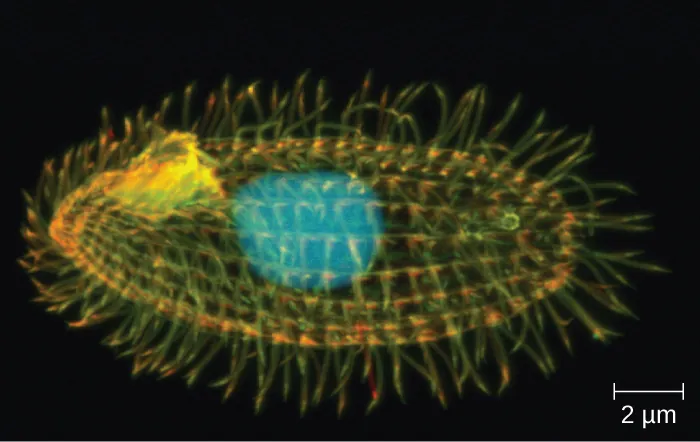
The protist shown has which of the following?
pseudopodia
flagella
a shell
cilia
cilia
Protist taxonomy has changed greatly in recent years as relationships have been re-examined using newer approaches. How do newer approaches differ from older approaches?
Older approaches classified protists mainly by their physical characteristics, such as shape, movement, and appearance. Newer approaches use DNA sequencing and molecular (genetic) analysis to determine evolutionary relationships, resulting in a more accurate classification of protists.
What characteristics might make you think a protist could be pathogenic? Are certain nutritional characteristics, methods of locomotion, or morphological differences likely to be associated with the ability to cause disease?
Pathogenic protists are usually parasitic, invade host tissues, and often form cysts to survive and spread. Movement alone does not determine whether a protist causes disease.
Given the life cycle of the Schistosoma parasite, suggest a method of prevention of the disease.
Avoid contact with freshwater contaminated with infected snails and improve sanitation to prevent the parasite from spreading.
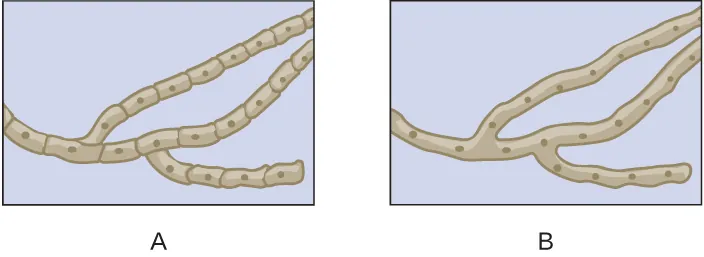
Which of the drawings shows septate hyphae?
Correct answer: ✅ A
Why?
Septate hyphae have cross-walls (septa) that divide the hyphae into compartments.
Drawing A clearly shows these cross-walls.
Drawing B lacks septa, so it represents aseptate (coenocytic) hyphae.
Explain the benefit of research into the pathways involved in the synthesis of chitin in fungi.
Research on chitin synthesis can help develop antifungal drugs that target fungal cell walls without harming human cells, since humans do not have chitin.