lecture 27 - prokaryotic transcription cont.
 Call Kai
 Learn
Learn Practice Test
 Spaced Repetition
 Match
Match Flashcards
 Knowt Play
1/31

There's no tags or description
Looks like no tags are added yet.
Name | Mastery | Learn | Test | Matching | Spaced | Call with Kai | Chat |
|---|
No analytics yet
Send a link to your students to track their progress
32 Terms
what is an operon
a functional cluster of genes found primarily in bacteria and archaea that share a single promoter and are transcribed together into a single messenger RNA (mRNA) molecule
Coordinately controlled by a single promoter
eg, lac operon, trp operon
basic operon structure
Structure (5'→3'):
Regulatory sequences:
Activator binding site
Promoter (contains −35 and −10 elements)
Operator (repressor binding site)
Structural genes (A, B, C): transcribed together as a single unit (one mRNA, multiple genes/proteins)
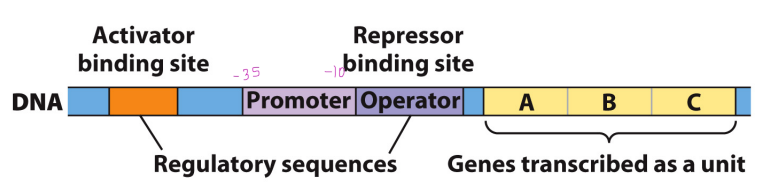
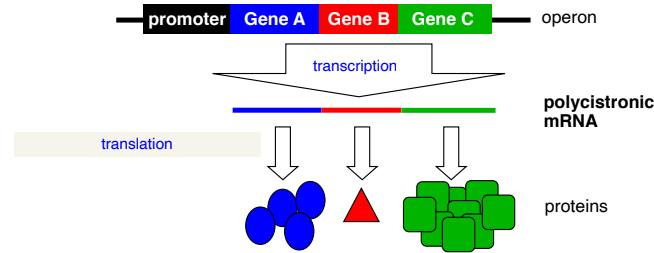
How Are Multiple Genes in an Operon Expressed from One mRNA?
All genes within an operon are transcribed together onto a single mRNA: polycistronic mRNA (multiple genes/cistrons on one transcript)
Each gene on the mRNA can be translated independently — so many proteins may be made from one gene, and only a few from another (on the same transcript)
Transcription terminators may exist at the ends of individual genes within the operon — meaning some transcripts are made in higher quantities than others
Operons commonly contain 2–6 genes; some contain 20 or more
Definitions: positive regulation, negative regulation, effector
Positive regulation: gene expression is increased/activated by a regulatory protein (an activator) binding DNA and helping RNA polymerase transcribe the gene (e.g., CRP-cAMP on the lac operon)
Negative regulation: gene expression is decreased/blocked by a regulatory protein (a repressor) binding DNA (typically the operator) and physically preventing RNA polymerase from transcribing the gene (e.g., LacI on the lac operon)
Effector: a small molecule that binds a regulatory protein (repressor or activator) and changes its shape/activity, thereby switching gene expression on or off in response to a cellular signal (e.g., allolactose, cAMP, tryptophan)
General role of effectors in prokaryotic gene regulation
→ Effectors are how bacteria sense their environment and translate that signal into a change in gene expression.
An effector is typically a small molecule whose concentration reflects some condition in the cell (e.g., presence of a sugar, nutrient scarcity)
It binds directly to a regulatory protein (repressor or activator), causing a conformational change
This conformational change either activates or inactivates the regulatory protein's ability to bind DNA
Examples and what they act on:
Allolactose (effector/inducer) → binds LacI repressor → inactivates it → de-represses the lac operon
cAMP (effector) → binds CRP → activates it → CRP can now bind DNA and stimulate transcription
Tryptophan (effector/co-repressor) → binds Trp repressor → activates it → represses the trp operon
Without effectors, gene expression would be static — effectors let the cell turn genes on or off exactly when their products are needed (or not needed), conserving energy and resources
the lac operon
a set of genes in bacteria like E. coli that are responsible for the uptake and breakdown of lactose
negative and positive regulation in bacteria
How Does E. coli Use Lactose, and What Signals the Cell to Turn On the lac Operon?
E. coli prefers glucose as its carbon/energy source
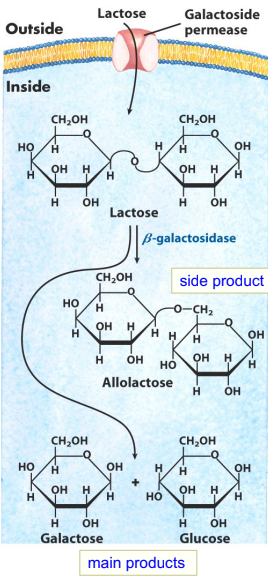
If lactose is available, E. coli can use it — but must hydrolyze it into glucose + galactose using the enzyme β-galactosidase
β-galactosidase is normally produced at very low levels (only induced when needed)
Lactose transport into the cell: via galactoside permease (membrane transporter)
β-galactosidase reaction:
Main products: galactose + glucose
Side product: allolactose (an isomer of lactose)
Allolactose is the inducer of the lac operon — its presence signals that lactose is available, triggering expression of the operon's genes
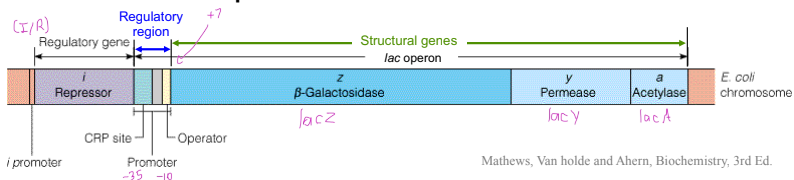
structure of the lac operon
Three structural genes: lacZ, lacY, lacA — all coding for enzymes involved in lactose metabolism
lacZ → β-galactosidase
lacY → permease
lacA → acetylase
when are the genes lacZ, lacY, and lacA expressed?
Normally expressed at very low levels (repressed)
When lactose is present → induced ~1000-fold higher expression
Expression is even higher when glucose is absent
Purpose of this regulation: β-galactosidase is only made when needed — when its substrate (lactose) is present and the "easier" carbon source (glucose) is absent
What Controls the lac Operon, and How Is the Repressor Gene Related to It?
A regulatory gene, lacI, is adjacent to but not part of the lac operon
lacI codes for the lac repressor protein, LacI (lac inhibitor)
lacI has its own promoter (independent of the lac operon's promoter)
In the absence of lactose, LacI binds to the lac operator
The operator overlaps with the lac promoter, so repressor binding blocks transcription
Gene vs. Protein Naming Convention
Gene names: italicized, not capitalized (e.g., lacI)
Protein names: capitalized, not italicized (e.g., LacI)
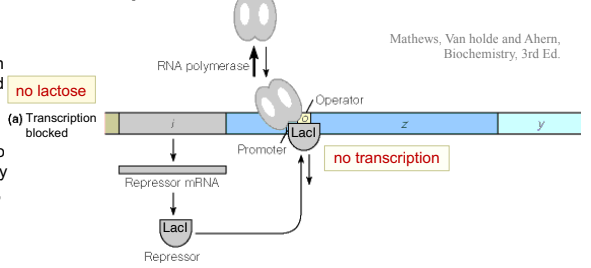
explain negative regulation of the lac operon - in the absence of lactose
The lac operon is in a repressed state
LacI repressor is bound to the operator
RNA polymerase is blocked from transcribing the structural genes
Result: no transcription
explain negative regulation of the lac operon - in the presence of lactose
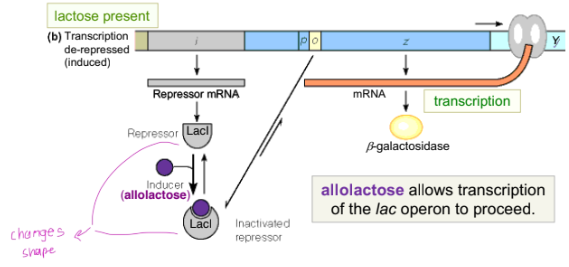
Lactose is converted to glucose + galactose by existing β-galactosidase (present at low levels even when repressed)
β-galactosidase also isomerizes some lactose into allolactose
Allolactose = effector/inducer of the lac operon
Allolactose binds to the LacI repressor, causing a conformational change ("changes shape")
This causes LacI to dissociate from the operator
Prevents additional repressor from rebinding the operator
Result: RNA polymerase can now transcribe the operon → transcription proceeds (e.g., β-galactosidase is made)
Why Doesn't the lac Operon Reach High Transcription Levels from Allolactose Alone?
The lac operon has a weak (low-efficiency) promoter
Even when allolactose (and lactose) is present, transcription doesn't occur at high levels without additional help
How Does Glucose Absence Activate the lac Operon via CRP
Expression of the lac operon is activated when glucose is absent
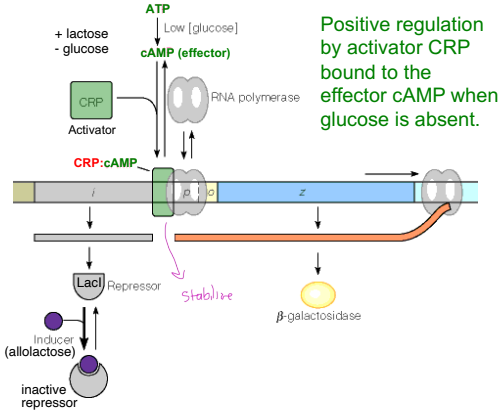
The cell produces high levels of cAMP, which binds to CRP (cAMP receptor protein) to form an active cAMP-CRP complex. This complex binds to the promoter site and helps RNA polymerase bind efficiently to transcribe the lactose-metabolizing genes
CRP IS A positive regulator
When glucose is low, cAMP levels rise (cAMP = effector)
cAMP binds CRP, causing a conformational change that increases CRP's affinity for the lac promoter
CRP-cAMP binds directly to the lac promoter, which:
Stimulates transcription by binding directly to RNA polymerase
Distorts the DNA, which may help RNA polymerase bind more effectively
How Do Negative and Positive Regulation Work Together in the lac Operon
Negative regulation: LacI repressor blocks transcription; allolactose de-represses the operon when lactose is present
Positive regulation: CRP-cAMP binds the promoter and activates transcription when glucose is absent
what is cAMP produced by
cAMP is produced by the enzyme adenylate cyclase
How Does cAMP Act as a 'Sensor' for Glucose Levels to Regulate the lac Operon?
cAMP is produced by the enzyme adenylate cyclase
Adenylate cyclase is inhibited (indirectly) by glucose
High [glucose]:
cAMP levels are low
CRP is not an effective activator
Known as "catabolite repression"
Low [glucose]:
cAMP is made in high levels
cAMP binds CRP → cAMP:CRP complex binds the lac promoter → enhances RNA polymerase binding/transcription
cAMP = "sensor" for glucose levels — only present in high concentrations when glucose is absent
What Two Conditions Must Be Met for Full Expression of the lac Operon?
Lactose must be present → releases the LacI repressor (negative regulation lifted)
Glucose must be absent (or very low) → allows CRP to act as an activator (positive regulation engaged)
Result: lacZ is only efficiently transcribed when lactose is present and glucose is absent — exactly when it's actually needed
What Are the Three Regulatory Scenarios for the lac Operon?
no lactose present
lactose present, no glucose
lactose present, glucose present
no lactose present
lac operon switched off (repressed)
Essentially no lac mRNA made, regardless of [glucose]
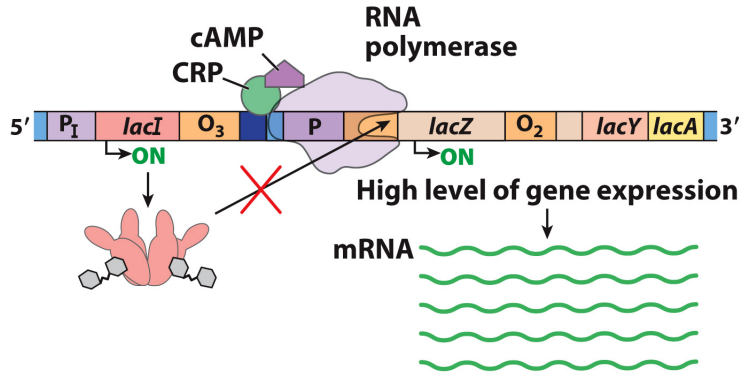
lactose present, no glucose
Allolactose produced → binds and inactivates LacI repressor
No glucose → [cAMP] is high → cAMP:CRP binds promoter, stimulates transcription
Result: high level of transcription (both negative regulation lifted AND positive regulation active)
![<ul><li><p><strong>Allolactose</strong> produced → binds and <strong>inactivates LacI repressor</strong></p></li><li><p>No glucose → <strong>[cAMP] is high</strong> → cAMP:CRP binds promoter, <strong>stimulates transcription</strong></p></li><li><p>Result: <strong>high level of transcription</strong> (both negative regulation lifted AND positive regulation active)</p></li></ul><p></p>](https://assets.knowt.com/user-attachments/e44f87b7-2c57-4e10-85e4-9b1106ffb7c2.png)
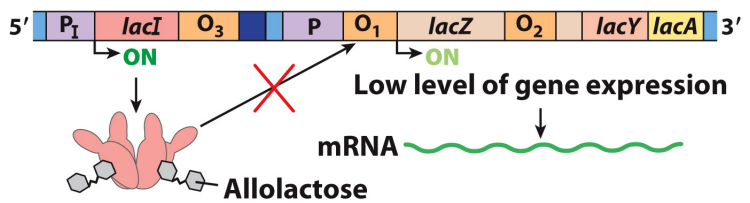
lactose present, glucose present
Allolactose produced → binds and inactivates LacI repressor
Glucose present → [cAMP] is low → CRP cannot help transcription ("catabolite repression")
Result: only low level of transcription — no need for β-galactosidase if glucose is already available as a carbon source
![<ul><li><p><strong>Allolactose</strong> produced → binds and <strong>inactivates LacI repressor</strong></p></li><li><p>Glucose present → <strong>[cAMP] is low</strong> → CRP <strong>cannot help</strong> transcription ("<strong>catabolite repression</strong>")</p></li><li><p>Result: only <strong>low level of transcription</strong> — no need for β-galactosidase if glucose is already available as a carbon source</p></li></ul><p></p>](https://assets.knowt.com/user-attachments/c1ffac0b-5042-4eed-9194-115b3834e8eb.png)
glucose high, cAMP low, lactose abset
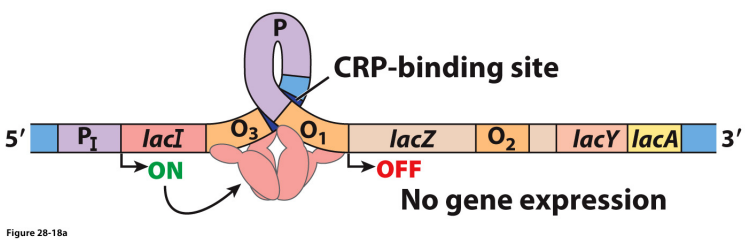
glucose low, cAMP high, lactose absent
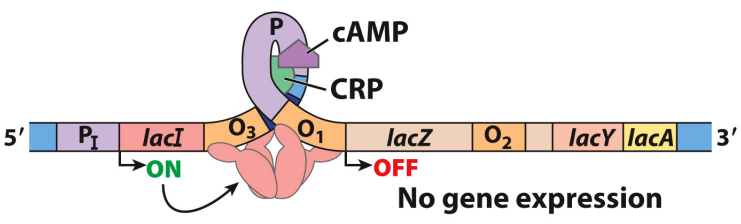
glucose high, cAMP low, lactose present
glucose low, cAMP high, lactose present
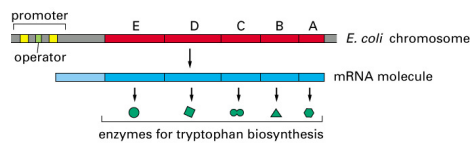
What Genes Does the trp Operon Encode, and When Is It Transcribed?
Five genes (E, D, C, B, A) encode enzymes for tryptophan (Trp) biosynthesis
Operon is only transcribed when Trp is needed (i.e., when Trp levels are low)
When external Trp is high, Trp binds the trp repressor, which then binds the trp operator → represses transcription
How Does Tryptophan Act as a Co-Repressor of the trp Operon?
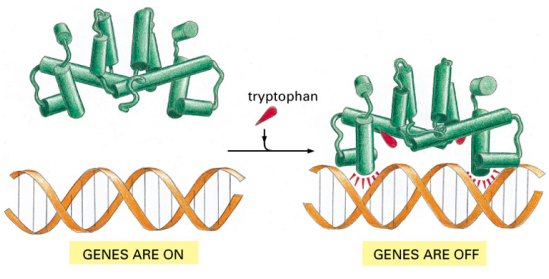
Trp binds the repressor (repressor alone is inactive), causing a conformational change
This allows the repressor to bind the trp operator, blocking transcription
Low [Trp]: repressor does not bind operator → operon is transcribed (genes ON)
High [Trp]: repressor is activated by Trp → binds operator → genes OFF
This is an example of feedback inhibition — the end product (Trp) shuts down its own biosynthesis pathway
![<ul><li><p><strong>Trp binds the repressor</strong> (repressor alone is <strong>inactive</strong>), causing a conformational change</p></li><li><p>This allows the repressor to <strong>bind the <em>trp</em> operator</strong>, <strong>blocking transcription</strong></p></li><li><p><strong>Low [Trp]:</strong> repressor does <strong>not</strong> bind operator → operon is <strong>transcribed</strong> (<strong>genes ON</strong>)</p></li><li><p><strong>High [Trp]:</strong> repressor is <strong>activated</strong> by Trp → binds operator → <strong>genes OFF</strong></p></li><li><p>This is an example of <strong>feedback inhibition</strong> — the end product (Trp) shuts down its own biosynthesis pathway</p></li></ul><p></p>](https://assets.knowt.com/user-attachments/66ae8589-b87f-45d1-908d-69f7c923ae32.png)
How Does Tryptophan Binding Change the Shape of the trp Repressor?
Trp binding induces a conformational change in the trp repressor dimer
This change enables the repressor to bind tightly to the trp operator
Without Trp bound: repressor cannot bind operator → genes ON
With Trp bound: repressor binds operator → genes OFF
How Does the trp Repressor Physically Block Transcription?
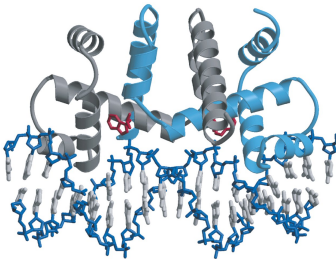
Like the Lac repressor and CRP, the Trp repressor dimer binds the trp operator via helix-turn-helix motifs
The operator site overlaps with the promoter
Therefore, Trp repressor binding blocks RNA polymerase's access to the promoter, preventing transcription
lac vs trp operons
Metabolic Pathway: The
lacoperon is catabolic (breaks down molecules), whereas thetrpoperon is anabolic (synthesizes molecules). [1, 2]Default State: The
lacoperon is default "off," as it is wasteful to produce lactose-digesting enzymes if lactose isn't available. Thetrpoperon is default "on," as the cell constantly needs to synthesize amino acids unless a sufficient supply is already present. [1, 2, 3]Regulatory Molecule: In the
lacoperon, the presence of allolactose (a form of lactose) acts as an inducer by unbinding the repressor and turning the genes on. In thetrpoperon, the presence of tryptophan acts as a co-repressor, activating the repressor protein and turning the genes off.