24.1 Electric Potential
 Call Kai
 Learn
Learn Practice Test
 Spaced Repetition
 Match
Match Flashcards
 Knowt Play
1/8

There's no tags or description
Looks like no tags are added yet.
Name | Mastery | Learn | Test | Matching | Spaced | Call with Kai | Chat |
|---|
No analytics yet
Send a link to your students to track their progress
9 Terms
Definition of Electric Potential
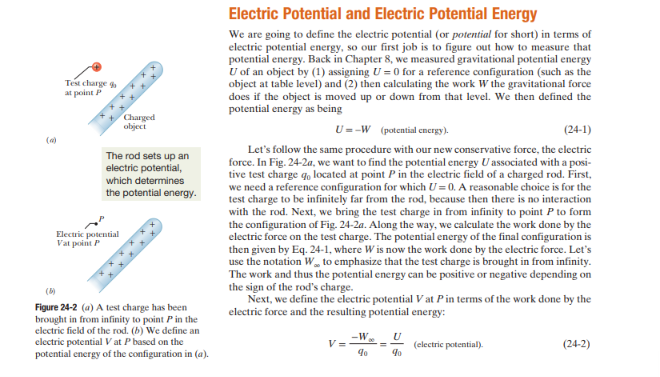
From a conceptual standpoint, electric potential is defined as the amount of electric potential energy per unit of charge when a positive test charge is brought in from an infinite distance. The process for determining the electric potential is as follows:
Electric potential (V) is ALWAYS an intrinsic property of a source charge’s electric field; it is irrelevant what the TEST charge is. The only object upon which the electric potential is dependent is the source charge generating the electric field.
We must first identify the work done by the electric field by identifying the change in potential energy from one point to another; we define the initial electric potential energy to be the case in which the source and test charge are at an infinite distance from one another. Since no interaction exists between the electric field (from the source charge) and the test charge, there is no electric potential energy.
We bring the source charge closer to the test charge in order to determine the final electric potential energy. Once we have the final electric potential energy, we can compute the work as being the difference in electric potential energy.
From there, we define the electric potential (V) as being the quotient of the work done as the source charge goes from infinity to closer and the test charge itself.
We define V = -Winfinity/q0 or V = U/qo; where U is the change in potential energy or just the final potential energy (since there was no potential energy to begin with).
From this definition, we acknowledge that the electric potential is always a scalar value and never a vector; furthermore, electric potential can be positive or negative depending on the charge polarity.
Extension of Electric Potential
It is absolute vital to note that the electric potential is a RATE quantity in the same way how speed is a RATE quantity relative to distance; they both express distance and energy (respectively), but one is a collective and the other is a rate value exclusively.
Electric Potential Energy (U) → The total potential charge that a particle or system of particles has due to its position in the electric field.
Electric Potential (V) → The electric potential energy stored PER unit of charge in the electric field.

Units Defined
A special unit is assigned to represent electric potential: the volt, which is defined as 1 joule/coulomb.
With this definition in mind, the unit for electric field can be converted from 1 N/c to 1 Volt/Meter.
Change in Electric Potential
The change in electric potential between any two points in an electric field is defined as the VOLTAGE of the points. Mathematically, the voltage is defined as the difference in the final electric potential and the initial electric potential: V = Vf - vi
Change in Electric Potential Energy
The only way in which the total electric potential energy of the particle system can change is if the electric potential changes from a point i to f:
U = qV → Delta(U) = (q)Delta(V)
It must also be noted that the electric force (the force that causes the change in energy to begin with) is conservative, thus the change in electric potential energy is path-independent. We can take any path from point I to Point F and obtain the same value for the work and change in electric potential energy all the same throughout the analysis.

Work Done by the Electric Field
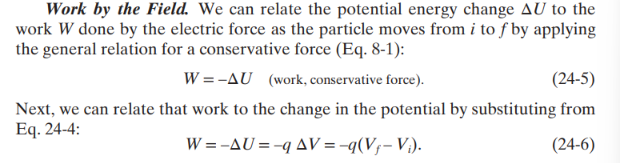
Recall that the work done by a conservative force is always the negative of the change in the total potential energy of the system; the logic behind this is due to the fact that as the kinetic energy increases (due to positive work being done), that energy must come from somewhere: the potential energy. Think of a spring: its increase in kinetic energy can only occur because of the fact that a change in the potential energy has occurred (a decrease at that).
We define W = -U; recall that U = qV, so we have:
Conservation of Mechanical Energy in the Electric Field
If the particle moves throughout the electric field with no forces acting on it other than the electric due, then we realize that the mechanical energy of the system is conserved. Thus, we have:
Ui + Ki = Uf + Kf
Delta(K) = -Delta(U)

Work by An External Force
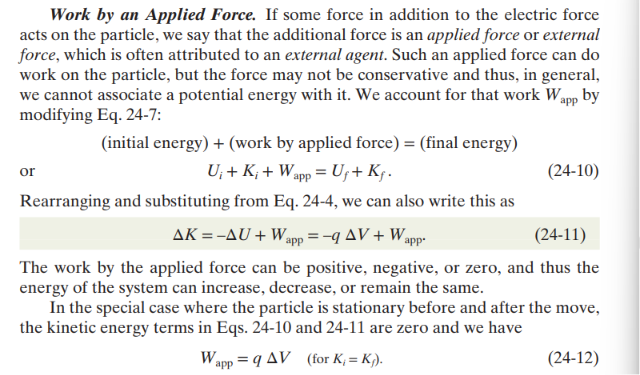
In the instance that an external force is applied, then we must also consider the work done by that force in relation to its contribution to the final energy of the system:
The Electron-Volt
The electron-volt (eV) is defined as the work required to move a single elementary charge (e, such as the electron or proton) through a potential difference of 1 volt.
