BIOC Lecture 7
 Call Kai
 Learn
Learn Practice Test
 Spaced Repetition
 Match
Match Flashcards
 Knowt Play
1/12

There's no tags or description
Looks like no tags are added yet.
Name | Mastery | Learn | Test | Matching | Spaced | Call with Kai | Chat |
|---|
No analytics yet
Send a link to your students to track their progress
13 Terms
C
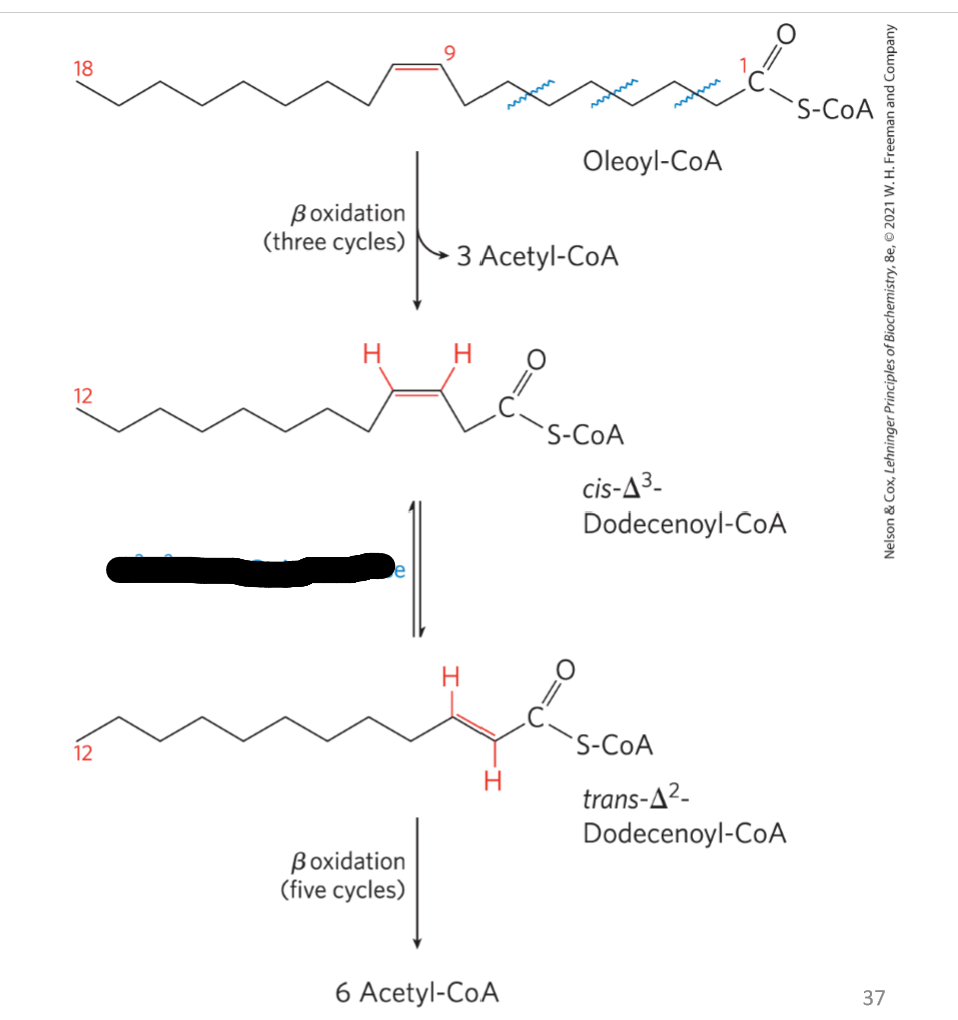
What enzyme is needed to convert this cis-Δ³-enoyl-CoA to trans-Δ²-enoyl-CoA and where does this have to happen?
Δ³, Δ²-enoyl-CoA isomerase and away from the TFP before coming back for steps 2-4

What about when it’s a polyunsaturated fatty acid (Pt.1)?
Same enzyme of Δ³, Δ²-enoyl-CoA isomerase

What about when it’s a polyunsaturated fatty acid (Pt.2)?
2,4-dienoyl-CoA reductase and enoyl-CoA isomerase
What does NADPH not do that NADH does?
NADPH does not add electrons to the ETC

(Quick tangent for some review from last year) Name the configurations
D-sugar and L-sugar

(Quick tangent for some review from last year) Name the configurations
L-amino acid and D-amino acid
What are we left when dealing with an odd-number fatty acid chain?
Acetyl-CoA (2 carbons) and propionyl-CoA (3 carbons); the latter goes through 3 more oxidation steps
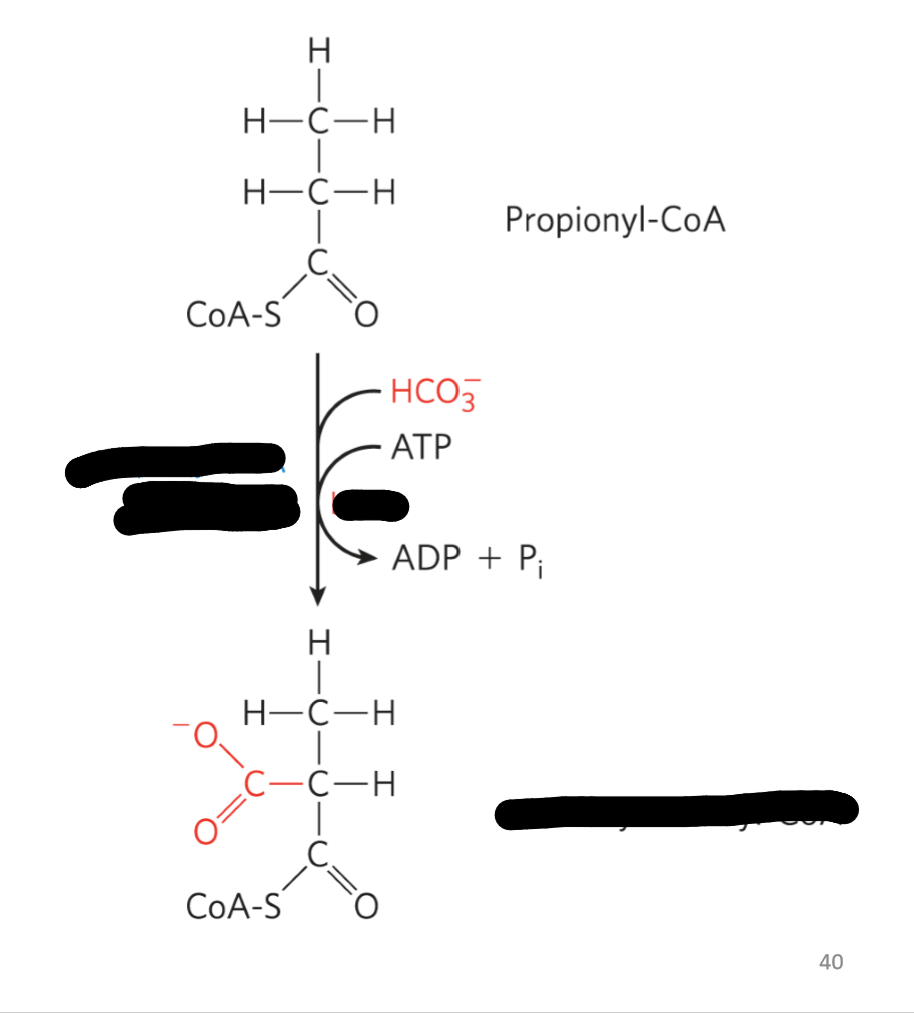
First Step: Enzyme? Cofactor? Product?
Propionyl-CoA carboxylase; biotin; D-methylmalonyl-CoA

Second Step: Enzyme? Product?
Methylmalonyl-CoA epimerase; L-methylmalonyl-CoA
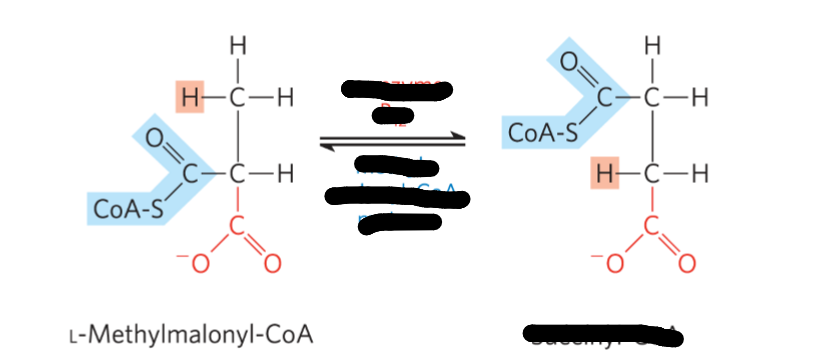
Third Step: Enzyme? Coenzyme? Product?
Methylmalonyl-CoA mutase; coenzyme B12; Succinyl-CoA
What is nice about Succinyl-CoA after the Third Step?
It is an intermediate of the TCA cycle that can produce 5 ATP
Compared to acetyl-CoA, how many ATP does propionyl-CoA produce?
Compared to 10 ATP, propionyl-Co produces 4 ATP (technically 5 ATP from succinyl-CoA in the TCA cycle, but the biotin takes one ATP)