Med Surge 1 practice questions
 Call Kai
 Learn
Learn Practice Test
 Spaced Repetition
 Match
Match Flashcards
 Knowt Play
1/86

There's no tags or description
Looks like no tags are added yet.
Name | Mastery | Learn | Test | Matching | Spaced | Call with Kai | Chat |
|---|
No analytics yet
Send a link to your students to track their progress
87 Terms

a. anterior
b. posterior
c. Septal
d. Inferior
d. inferior
2. A client has chest pain rated at an 8 on a scale from 1-10. The 12-lead EKG reveals ST elevation in the inferior leads and elevated troponin levels. Which intervention below will help reduce myocardial oxygen demand and deter the infarction from further growing?
a. Administer 324mg of aspirin
b. Keep the patient from exerting himself
c. Administration of epinephrine, intravenously
d. Place the patient on oxygen 2L/m by nasal cannula
d. Place the patient on oxygen 2L/m by nasal cannula
3. A client has a throbbing headache when nitroglycerin is ... angina. The nurse should instruct the client that:
a. The client should be in a supine position to alleviate the headache
b. The pain should be treated with morphine
c. Nitroglycerin should be avoided if the client is experiencing this side effect
d. Acetaminophen or ibuprofen can be taken for this common side effect
d. Acetaminophen or ibuprofen can be taken for this common side effect
A hospitalized patient with a history of chronic stable angina tells the nurse that she is having chest pain. The nurse bases his actions on the knowledge that ischemia
a. Indicates that irreversible myocardial damage is occurring
b. Will always progress to myocardial infarction
c. Is frequently associated with vomiting and extreme fatigue
d. Will be relieved by rest, nitroglycerin, or both
d. Will be relieved by rest, nitroglycerin, or both
Your chest pain patient shows an ST elevation in leads I, aVL, V5 and V6. What type of MI is the patient having?
a. Transmural MI
b. Septal
c. Inferior wall
d. Lateral wall
d. Lateral wall
Fatty streaks in the coronary arteries can, over time, develop into plaque and atherosclerosis. Which food is best to improve HDL cholesterol?
a. Coconut oil
b. Olive oil
c. Lard
d. Peanut oil
b. Olive oil
The nurse knows that when assessing a client suspected of having a myocardial infarction it is most important to ask to which of the following?
a. “What medications are you currently taking?”
b. “How long ago did the symptoms start?”
c. “Have you ever had similar symptoms in the past?”
d. “Have you had a lot of stress lately?”
b. “How long ago did the symptoms start?”
The nurse is caring for a client who recently experienced a myocardial infarction and has been started on clopidogrel (Plavix) 75mg daily. Which item below is not necessary to include when teaching about taking clopidogrel?
a. The client should take clopidogrel with food
b. The client may bruise more easily and ay experience bleeding gums
c. The client should report unexpected bleeding or bleeding that lasts a long time
d. Clopidogrel works by preventing platelets from sticking together and forming a clot
a. The client should take clopidogrel with food
Ms. R is a sixty year old who takes 81mg aspirin per day to protect against having an MI. She now presents to your ER with chest pain and is given 325mg of aspirin. What is the rationale for giving a higher dose of aspirin?
a. To prevent a possible thrombus in the coronary artery from growing larger
b. To prevent headache cause by nitroglycerin
c. To help dissolve the thrombus that has formed in the coronary artery
d. For its analgesic effect
a. To prevent a possible thrombus in the coronary artery from growing larger
Your patient is to receive a fibrinolytic to break-up a thrombus responsible for the STEMI he is experiencing. What finding would exclude the patient from being a candidate this therapy?
a. The patient has a history of synchronized cardioversion
b. The patient’s nephew is a hemophiliac
c. The patient had received the medication for a thrombolytic stroke five days prior
d. The patient has just been given nitroglycerin
c. The patient had received the medication for a thrombolytic stroke five days prior
The client who experiences angina has been told to follow a low-cholesterol diet. Which meal would be best?
a. baked liver, green beans and coffee
b. Hamburger, salad, and milkshake
c. Fried chicken, green beans, and skim milk
d. Spaghetti with tomato sauce, salad, and coffee
d. Spaghetti with tomato sauce, salad, and coffee
What is the rationale for putting a patient in acute decompensation heart failure in the High Fowler’s position with the legs flat on the mattress? (SATA)
a. This position facilitate rapid endotracheal intubation
b. It will make breathing easier
c. It will encourage blood flow to the heart
d. It will discourage blood return to the heart
b. It will make breathing easier
d. It will discourage blood return to the heart
13. Your patient’s echocardiogram report indicates that she ... ejection fraction of 21%. Which nursing diagnosis would ...
a. Decreased activity tolerance
b. Powerlessness
c. Knowledge deficit
d. Ineffective airway clearance
a. Decreased activity tolerance
A compensatory mechanism for heart failure that leads to inappropriate fluid retention and worsening workload of the heart
a. Ventricular hypertrophy
b. Ventricular dilation
c. Sympathetic nervous system activation
d. Neurohormonal response leading fluid retention
d. Neurohormonal response leading fluid retention
As a suicide attempt, M.H. took 30 tablets of 40mg furosemide (Lasix). The nurse should frequently assess for which findings?
a. Tachycardia, hypotension, slow cap refill and coarse crackles in the lungs as
evidence of worsening cardiogenic shock
b. Hyperkalemia
c. Urinary incontinence
d. Tachycardia, hypotension and slow capillary refill as a sign of hypovolemic shock
d. Tachycardia, hypotension and slow capillary refill as a sign of hypovolemic shock
The nursing diagnosis that best applies to your patient with compensated heart failure is:
a. Altered nutrition
b. Imparted gas exchange
c. Decreased compliance to therapy
d. Potential for activity intolerance
d. Potential for activity intolerance
Which two are indications that a client with a history of left-sided heart failure has developed pulmonary edema? (SATA)
a. Tachycardia
b. Anorexia
c. Dependent edema
d. Distended jugular veins
e. Coarse crackles upon auscultation
a. Tachycardia
e. Coarse crackles upon auscultation
A patient with chronic heart failure and atrial fibrillation is treated with a digitalis glycoside (Digoxin) and a loop diuretic. To prevent possible complications of this combination of drugs, which three should the nurse do to assure safe administration? (SATA)
a. Teach the patient how to take a pulse rate
b. Monitor serum potassium levels
c. Teach the patient about dietary restriction of potassium
d. Keep an accurate measure of intake and output
a. Teach the patient how to take a pulse rate
b. Monitor serum potassium levels
d. Keep an accurate measure of intake and output
Immediately after cardioverting your patient, he goes into a normal sinus rhythm. What would be your next action?
a. Activate the rapid response team
b. Perform CPR for three minutes and shock again
c. Check the pulse
d. Assess for consciousness
c. Check the pulse
An older adult with a history of heart failure is admitted to the emergency department with via paramedic ambulance with pulmonary edema in High Fowler’s position. His skin is cool, diaphoretic and the patient is gasping for air. What should the first intervention
be?
a. Invert a foley catheter
b. Apply high flow oxygen
c. Take a full set of vital signs
d. Prepare for intubation
b. Apply high flow oxygen
While assessing the patient admitted to the unit with heart failure, the nurse notes jugular venous distention (JVD) while sitting in Semi-Fowler’s position at about 45 degrees. What action should the nurse do next?
a. Document it in the patient’s record
b. Obtain vital signs, include oxygen saturation
c. Check for ankle edema and pulmonary edema
d. Have the patient perform the Valsalva maneuver
c. Check for ankle edema and pulmonary edema
The nurse is caring for a patient with aortic stenosis. Which assessment data obtained by the nurse would be most important to report to the health care provider?
a. A thrill is palpated at the second intercostal space, right sternal border
b. The patient complains of chest pressure when ambulating
c. The point of maximum impulse (PMI) is at the left midclavicular line
d. A loud systolic murmur is heard along the right sternal border
b. The patient complains of chest pressure when ambulating
While caring for a patient with aortic stenosis, the nurse identifies a nursing diagnosis of acute pain related to decreased coronary blood flow. An appropriate nursing intervention for this patient would be to
a. Teach the patient to use sublingual nitroglycerin for chest pain
b. Raise the head of the bed 60 degrees to decrease venous return
c. Promote rest to decrease myocardial oxygen demand
d. Teach the patient about the need for anticoagulant therapy
c. Promote rest to decrease myocardial oxygen demand
Which clinical finding would most likely indicate decreased cardiac output in a patient with aortic valve regurgitation?
a. Early onset of dementia
b. A wide QRS on the EKG and cardiac monitor
c. Shortness of breath on minimal exertion and diastolic murmur
d. Femoral venous distention and new-onset atrial fibrillation
c. Shortness of breath on minimal exertion and diastolic murmur
The nurse is caring for a 64 yo patient admitted w mitral valve regurgitation. Which information obtained by the nurse when assessing the patient should be communicated to the HCP immediately?
a. The patient has diffuse bilateral crackles
b. The patient has a loud systolic murmur across the precordium
c. The patient has a palpable thrill felt over the left anterior chest
d. The patient has 4+ peripheral edema
a. The patient has diffuse bilateral crackles
The nurse is caring for a patient with chronic constrictive pericarditis. Which assessment finding reflects a more serious complication of this condition
a. Fatigue
b. Thickened pericardium on echocardiography
c. Peripheral edema
d. Jugular venous distention
d. Jugular venous distention
A client returns from a cardiac catheterization procedure with a bandage over the right groin. An unlicensed personnel assigned to the client reports that the client’s right foot is cool to the touch. The most important action the nurse should do is
a. Check the foot every 15 mins
b. Call the providers and report the findings
c. Compare it to the temp of the opposite foot and compare pedal pulses
d. Loosen the bandage
b. Call the providers and report the findings
A client has returned from the cardiac catheterization lab after a balloon valvuloplasty formitral stenosis. Which finding requires immediate nursing action
a. There is a low, grade 1 intensity mitral valve regurgitation murmur upon auscultation
b. SPO2 is 94% on o2 2L/min via nasal cannula
c. The client has become more somnolent
d. UO decreased from 60mL/hr to 40mL/hr
c. The client has become more somnolent
29. Priority nursing management for a patient with myocarditis includes interventions related to (SATA)
a. Providing quiet environment
b. Decreasing cardiac workload
c. Meticulous skincare
d. Antibiotic prophylaxis
a. Providing quiet environment
b. Decreasing cardiac workload
Your patient has returned from the cardiac catheterization lab. Which post procedure assessment parameter will assure large amounts of blood loss do not go undetected afterward? (SATA)
a. Assessment for equal pedal pulses
b. Determination of the resp rate
c. Frequent assessment of the arterial or venous access site
d. The ability to move all extremities
a. Assessment for equal pedal pulses
c. Frequent assessment of the arterial or venous access site
The patient has ST segment changes that suggest an acute inferior wall myocardial infarction. Which lead would be best for monitoring this patient
a. V6
b. V2
c. II
d. I
c. II
A patient’s heart monitor shows a pattern of undulations of varying contours andamplitude with no measurable ECG pattern. The patient is unconscious, apneic, and pulseless. Which action should the nurse take first
a. Immediately perform two mins of high quality cpr and then defibrillation
b. Prepare for endotracheal intubation
c. Ventilate with a bag valve mask device
d. Give epinephrine IV
a. Immediately perform two mins of high quality cpr and then defibrillation
The nurse needs to quickly estimate the heart rate for a patient with a regular heart rhythm. Which method will be best to use
a. Calculate the number of small squares between one QRS complex and the next
and divide into 1500
b. Count the number of large squares in the R-R interval and divide by 300
c. Print a 1-min electrocardiogram strip and count the number of QRS complexes
d. Use the 3-second markers to count the number of QRS complexes in 6 seconds and multiply by 10
d. Use the 3-second markers to count the number of QRS complexes in 6 seconds and multiply by 10
Which lab result for a patient with multifocal premature ventricular contractions (PVCs) is most important for the nurse to communicate to the HCP
a. Serum potassium of 2.9
b. Blood glucose of 243
c. Serum sodium of 134
d. Serum chloride of 92
a. Serum potassium of 2.9
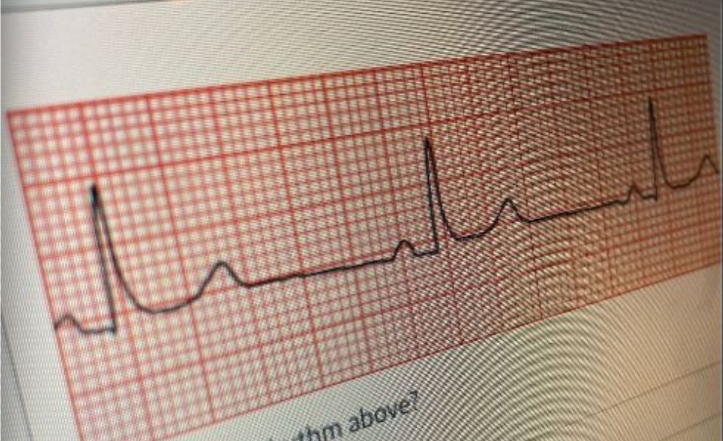
i. Ventricular fibrillation
ii. Supraventricular tachycardia
iii. Bradycardia sinus rhythm
iv. Normal sinus rhythm
iii. Bradycardia sinus rhythm
The nurse has received change of shift report about the following patients on the PCU. Which patient should the nurse see first
a. A patient with second degree AV block type 1, rate 60, who is dizzy when ambulating
b. A patient whose implantable cardioverter-defibrillator fired twice today and has a
dose of amiodarone due
c. A patient who is in a sinus rhythm, rate 98 and regular, recovering rom an
elective cardioversion 2 hours ago
d. A patient with atrial fibrillation, rate 88 and irregular, who has a dose of warfarin due
b. A patient whose implantable cardioverter-defibrillator fired twice today and has a dose of amiodarone due
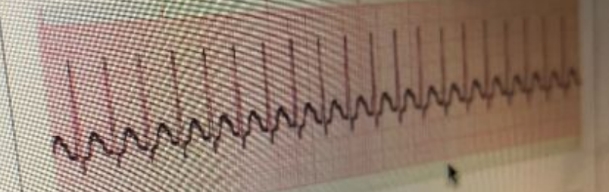
What is the ECG rhythm above
i. Supraventricular tachycardia
ii. Sinus tachycardia
iii. Ventricular tachycardia
iv. Normal sinus rhythm
i. Supraventricular tachycardia
To determine whether there is a delay in impulse conduction through the ventricles, the nurse will measure the duration of the patients
a. P wave
b. QRS complex
c. Q wave
d. PR interval
b. QRS complex
A patient who was admitted with a MI experiences a 45 second episode of ventricular tachycardia, then converts to sinus rhythm with a heart rate of 98 bpm. Which action should the nurse take next
a. Document the rhythm and continue to monitor the patient
b. Immediately notify the HCP
c. Perform synchronized cardioversion per agency dysrhythmia protocol
d. Prepare to give IV amiodarone per agency dysrhythmia protocol
d. Prepare to give IV amiodarone per agency dysrhythmia protocol
A 19 yo student comes to the student health center at the end of the sem complaining that “my heart is skipping beats.” an ECG shows occasional unofficial premature ventricular contractions. What action should the nurse take next
a. Start supplemental O2 at 2-3 L/min via nasal cannula
b. Ask the patient about current stress level and caffeine use
c. Have the patient taken to the nearest ED
d. Insert an IV for emergency use
b. Ask the patient about current stress level and caffeine use
A patient develops sinus bradycardia at a rate of 32 bpm, has a BP of 80/42 and is complaining of feeling faint. Which action should the nurse take next
a. Apply the transcutaneous pacemaker pads
b. Give the scheduled dose os diltiazem
c. Have the patient perform valsava maneuver
d. Recheck the heart rhythm and BP in 5 mins
a. Apply the transcutaneous pacemaker pads
A patient who is on the telemetry unit develops atrial flutter, rate 150, with associated dyspnea and chest pain. Which action is included in the hospital dysrhythmia protocol should the nurse do first (SATA)
a. Obtain a 12 lead ECG
b. Give supplemental O2 at 2-3 L via nasal cannula
c. Notify the HCP of he change of rhythm
d. Assess the patient’s VS including O2 sat
a. Obtain a 12 lead ECG
b. Give supplemental O2 at 2-3 L via nasal cannula
Which action should the nurse perform when preparing a patient with supraventricular tachycardia for cardioversion who is alert and has a BP of 110/60
a. Provide assisted ventilation w a bag valve mask divide
b. Give a sedative before cardioversion is implemented
c. Turn the synchronizer switch to off
d. Set the defibrillator energy to 360 joules
b. Give a sedative before cardioversion is implemented
When analyzing the rhythm of a pt ECG, the nurse will need to investigate further upon finding a
a. PR interval of 0.18 s
b. QT interval of 0.38 s
c. QRS interval of 0.14 s
d. Isoelectric ST segment
c. QRS interval of 0.14 s
Which action by a new RN who is orienting at the telemetry unit indicates a good understanding of the treatment of heart dysrhythmias
a. Turns the synchronizers switch to on
b. Prepared defibrillator settings at 360 joules for a patient whose monitor shows asystole
c. Injects IV adenosine
d. Gives the prescribed dose of ...
c. Injects IV adenosine
A 20 yo patient has a mandatory ECG before playing soccer. Found sinus bradycardia, rate 52. BP 114/54 and the student denies health problems. Which action by the nruse is most appropriate
a. Tell the student to stop playing if dyspnea occurs
b. Obtain more details about student health history
c. Refer the student to a cardiologist for further teaching
d. Allow the student to participate on the soccer team
d. Allow the student to participate on the soccer team
A client with a known history of heart failure (aka congestive heart failure) states she has gained 7 pounds this week. In assessing the situation, it would be most important for the nurse to
1. Examine the client’s legs and sacral area
2. Immediately administer furosemide (Lasix).
3. Auscultate the lungs for a pericardial friction rub.
4. Weigh the patient and compare it with the patient's baseline.
4. Weigh the patient and compare it with the patient's baseline.
Prior to administering morphine IV push to a client with chest pain, the nurse should
1. notify the doctor that giving IV morphine is not within the scope of a register nurse’s
practice.
2. check the blood pressure.
3. do a neurological assessment
4. evaluate the 12 lead EKG.
2. check the blood pressure.
rationale: because Morphine will drop BP
A client with chest pain 10/10 and a blood pressure of 137/91 is prescribed intravenous nitroglycerin drip at 10 micrograms per minute. After 10 minutes the patient has a headache, feels a little dizzy and has a blood pressure of 111/68. Which order below would the nurse anticipate from the doctor?
1. Administer another aspirin 324mg
2. Place the patient in the Trendelenburg position.
3. Perform a complete neurological assessment.
4. Lower the nitroglycerin drip to 5 micrograms/min.
4. Lower the nitroglycerin drip to 5 micrograms/min.
rationale: Common SE is headache.
You're caring for a patient who is experiencing an anterior wall myocardial infarction. Which history finding below would exclude her from thrombolytic therapy?
1. The patient had surgery earlier in the week.
2. The patient has a history of atrial fibrillation
3. The chest pain started while the patient was asleep.
4. The chest pain started five hours ago.
1. The patient had surgery earlier in the week.
*Fibrinolytic therapy will dissolve new and OLDER clots. Odds are that the clot is not fully healed, so there will be HEMORRHAGE.
The nurse is caring for a client who has become unresponsive, the blood pressure is 80/40mmHg and SpO2 is 90% on 50% face mask and has a respiratory rate of 18. The nurse should:
1. begin chest compressions.
2. ventilate the client with a bag mask device.
3. remove the family from the room.
4. call the rapid response team.
4. call the rapid response team.
The patient returns to your unit after a successful elective cardioversion. Which two below are NOT a goal of cardioversion?
1. That the patient regains consciousness.
2. That the patient converts to a sinus rhythm
3. That emboli are flushed out of the left ventricle.
4. That the procedure is performed without shocking a member of the healthcare team.
1. That the patient regains consciousness.
RATIONALE: Even when you cardiovert, we want the patient to convert back into normal sinus rhythm. We DO NOT want anyone else to be shocked. We DO want a NORMAL SINUS.
3. That emboli are flushed out of the left ventricle.
WRONG:
2. That the patient converts to a sinus rhythm
· This is a goal of defibrillation
4. That the procedure is performed without shocking a member of the healthcare team.
· This is a goal
Good dental care is an important measure in reducing the risk of endocarditis. What should a teaching plan include to promote good dental care in a client with mitral stenosis? (SATA)
1. Get regular dental checkups.
2. Brush teeth at least twice a day.
3. Avoid use of an electric toothbrush
4. Floss the teeth at least once a day.
1. Get regular dental checkups.
2. Brush teeth at least twice a day.
4. Floss the teeth at least once a day.
The nurse is teaching a client with heart failure how to avoid complications and future hospitalizations. The nurse is confident that the client has understood the material when the patient is able to cite which three symptoms?
1. Having to sleep while sitting up in a reclining chair
2. Becoming increasingly short of breath at rest.
3. Craving for salt.
4. Weight gain of 2 pounds or more in a day.
1. Having to sleep while sitting up in a reclining chair
2. Becoming increasingly short of breath at rest.
4. Weight gain of 2 pounds or more in a day.
Your 77-year-old patient was brought to the emergency room from nursing home with an indwelling Foley Catheter. There is cloudy urine in the Foley bag. Her vital signs are: BP 112/67, HR 117, RR 28 and labored, and her temperature,101.7F rectally. Her lungs are clear. Which test would have the lowest priority?
1. Arterial Blood Gases
2. CBC and UA
3. Chest x-ray
4. Lactate levels
3. Chest x-ray
· There is respiratory distress, but the priority is their UI
The nurse is admitting an older adult to the hospital. The echocardiogram report revealed left ventricular enlargement. The nurse notes 2+pitting edema in the ankles when getting the client into bed. Based on this finding, what should the nurse do first?
1. Assess respiratory status
2. Weigh the client.
3. Draw blood for BNP levels
4. Insert a Foley catheter
1. Assess respiratory status
RATIONALE:
Left ventricular enlargement can indicate LV failure
ADPIE?
The nurse teaches a client with heart failure to avoid taking furosemide (Lasix) after 5PM. The primary reason for this is to prevent:
1. Electrolyte imbalances
2. Nausea and/or vomiting
3. Excretion of excessive fluids accumulated during the night.
4. Sleep disturbances.
4. Sleep disturbances.
RATIONALE: NOCTURIA
A patient in the ICU is found to have sepsis due to infection of and central venous line. He has a lactate of 6.1. He weighs 100 kg. The physician orders a fluid resuscitation dose of crystalloid intravenous fluids. How much should he receive?
1. 2000ml over 8 hours.
2. 3,000 ml as quickly as possible
3. 1200ml over one hour.
4. 300ml over 20 minutes.
2. 3,000 ml as quickly as possible
What is the major goal for a client with heart failure?
1. Improve respiratory status
2. Enhance comfort
3. Decrease peripheral edema
4. Increase cardiac output
4. Increase cardiac output
Your patient with pulmonary edema and coarse crackles upon auscultation is to receive 40mg Lasix intravenously. The dose you have on hand is a 10ml vial with 10mg/ml. How many mL’s should you administer? Show your work.
Your Answer:
We are ordering to give 40 mg Lasix. and the vial is saying there is 10 mg in every ml. so i
would add 10 mg 4 times to give me the desires amount. SO, THE ANSWER WOULD BE 40 ml
A client has a throbbing headache when nitroglycerin is taken for angina. The nurse should instruct the client that;
1. acetaminophen can be taken for this common side effect.
2. the client should be in a supine position to alleviate the headache
3. The pain should be treated with morphine.
4. nitroglycerin should be avoided if the client is experiencing this serious side effect.
1. acetaminophen can be taken for this common side effect.
RATIONALE: Tylenol can be taken to alleviate headache
Smoking is a modifiable risk of smoking. Which below is an effect of smoking?
1. Total blood cholesterol level > 220
2. It increases blood viscosity and workload on the heart
3. Elevated fasting blood glucose concentration
4. Loss of estrogen.
2. It increases blood viscosity and workload on the heart
RATIONALE: Smoking makes your blood thicker on TOP of causing endovascular injury
Fatty streaks in the coronary arteries can, over time, develop into plaque and atherosclerosis. Which food is best to improved HDL cholesterol?
1. Dairy Products
2. Chicken
3. Salmon
4. Peanut oil
3. Salmon
RATIONALE: FISH OILS ARE AMAZING àOMEGA 3
Which part of the heart is having a myocardial infarction when ST elevations are seen in leads I, aVL, V5 and V6?
1. Anterior wall
2. The septum
3. Inferior wall
4. Lateral wall
4. Lateral wall
Which intervention below will raise cardiac afterload?
1. Administration of IV fluids
2. Administration of vasopressors.
3. Elevation of the head of the bed
4. Administration of furosemide (Lasix)
2. Administration of vasopressors.
Fajardo’s 12-lead EKG was negative for an MI. Which of Mr. Fajardo’s two lab results would the cardiologist be most interested in before taking the patient to the cardiac catheterization lab?
1. Elevated triglycerides and cholesterol
2. Elevated troponin levels.
3. Elevated INR, PT, PTT
4. Low homocysteine levels.
2. Elevated troponin levels.
RATIONALE: Confirms heart attack
3. Elevated INR, PT, PTT
RATIONALE: Increased risk for bleeding
The nurse and CNA/associate are on the telemetry unit caring for four patients. Which task is appropriate to assign to the CNA?
1. Transporting the patient to the radiology department.
2. Teaching the patient about the treadmill stress test scheduled for the next day.
3. Assessing the patient after return from a trans-esophageal echocardiogram.
4. Checking the insertion site for a patient recovering from a coronary angiogram
(cardiac catheterization lab procedure).
1. Transporting the patient to the radiology department.
In teaching a patient about coronary artery disease, the nurse explains that the changes that occur in the disorder include all below except:
1. Development of angina due to a decreased blood supply to the heart muscle.
2. Abnormal levels of cholesterol, especially low-density lipoproteins.
3. Chronic vasoconstriction of coronary arteries leading to permanent vasospasm.
4. Accumulation of lipid and fibrous tissue within the coronary arteries.
3. Chronic vasoconstriction of coronary arteries leading to permanent vasospasm.
RATIONALE: This is sickle cells disease
You are caring for a patient who is receiving IV dobutamine (Dobutrex). You know the drug is ordered because it
1. produces diuresis.
2. decreases systemic vascular resistance (SVR)
3. improves contractility
4. increases systemic vascular resistance (SVR).
3. improves contractility
RATIONALE: Positive inotropes
Assessment of an IV cocaine user with infective endocarditis should focus on which signs and symptoms? (two)
1. Map like lesions on the skin.
2. Splinter hemorrhages of the nail beds.
3. Painful, swollen joints.
4. Presence of Osler's nodes
2. Splinter hemorrhages of the nail beds.
4. Presence of Osler's nodes
A 78yo man has confusion and temperature of 104 degrees. He is a diabetic with purulent drainage from his right heel. After an infusion of 3 liters of normal saline, his assessment findings are BP 84/40, Heart rate of 110, respiratory rate of 42 and shallow, cardiac output 8L/minute. The patient’s symptoms are most likely indicative of ______
1. Impending renal failure
2. Sepsis
3. Multiple organ dysfunction syndrome
4. Septic shock
4. Septic shock
Which below (three) are treatment modalities for the management of cardiogenic shock? (SATA)
1. Trendelenburg position to facilitate blood return.
2. Inocor to increase contractility
3. Circulatory assist devices such as an intraaortic balloon pump
4. Dobutamine to increase contractility
2. Inocor to increase contractility
3. Circulatory assist devices such as an intraaortic balloon pump
4. Dobutamine to increase contractility
Your MI patient has gone into cardiac arrest and is in ventricular fibrillation. Which two below should be assured before attempting to deliver a shock?
1. The patient has been sedated.
2. The patient is intubated.
3. Assure that no members of the code blue team are touching the patient.
4. The “synch” button is off.
3. Assure that no members of the code blue team are touching the patient.
4. The “synch” button is off.
Upon completion of the 12 lead EKG, your analysis finds upright p and r waves in lead aVR. You should
1. Check the patient for responsiveness
2. Notify the physician immediately
3. Not be concerned
4. Correct lead placement and repeat the exam.
4. Correct lead placement and repeat the exam.
Your chest pain patient shows an ST elevation in leads II, III and aVF. What type of MI is the patient having?
1. Inferior wall
2. Septal
3. Transmural MI
4. Lateral WalL
1. Inferior wall
While giving Mr. Decatur discharge instructions after being hospitalized for a heart attack. The nurse know he understands the purpose of taking an ACE inhibitor when he says
1. " prevent heart enlargement and heart failure."
2. “I will take the medication when I feel short of breath”.
3. “the medication is meant to keep my blood pressure down.”
4. “the medication will help me retain fluids so my heart has plenty of volume to pump.”
1. " prevent heart enlargement and heart failure."
Mr. Johnson was recently diagnosed with pericarditis and is now experiencing JVD, thready pulses and air hunger. What procedure should the nurse prepare the patient for?
1. Angioplasty
2. Cardioversion
3. Echocardiogram
4. Pericardiocentesis
4. Pericardiocentesis
· THE BOOK SAID IT
Which below is the nurses’ priority while taking care of populations with beta streptococcus pharyngitis?
1. To supply clean, sterile syringes to patient abusing IV drugs
2. To have family members screened.
3. Instructing the patient to seek immediate treatment for eradication of the beta strep organism.
4. To wear knee braces for painful joints.
3. Instructing the patient to seek immediate treatment for eradication of the beta strep organism
Your patient is hospitalized due to frequent episodes of ventricular tachycardia and has an ejection fraction of 8%. He is not responding well to medication. Which two interventions will bring back your patient's cardiac output?
1. Anticipate the insertion of a ventricular assist device by the cardiac surgeon.
2. Locate a compatible donor for heart transplant surgery.
3. Administer Digoxin as ordered.
4. Administration normal saline bolus.
1. Anticipate the insertion of a ventricular assist device by the cardiac surgeon.
2. Locate a compatible donor for heart transplant surgery.
After receiving 2 liters of normal saline for septic shock, your patient has a blood pressure of82/47. Upon updating the physician on condition the nurse might expect an order for (2 responses)
1. Repeat lactate level.
2. Methyprednisolone (Solumedrol) slow IV push.
3. Digitalis (Digoxin) slow IV push.
4. Norepinephrine (Levophed) IV drip.
1. Repeat lactate level.
4. Norepinephrine (Levophed) IV drip.
The interventional cardiologist is evaluating Mrs. T for suitability to receive fibrinolytics to dissolve the clot (thrombus) causing her heart attack. Which findings below would disqualify her from having fibrinolytics? (multiple)
1. Rectal bleeding
2. Recent surgery.
3. Allergy to fibrinolytics
4. The patient has a clotting disorder
1. Rectal bleeding
2. Recent surgery.
3. Allergy to fibrinolytics
4. The patient has a clotting disorder
Eighty percent of the people who die of trauma actually die of
1. unrecognized cardiac tamponade.
2. hypovolemia
3. cardiac bruising
4. sepsis
Hypovolemia
For patients in sepsis, which priority comes immediately after or during fluid resuscitation?
1. Determination if the patient has a living will.
2. Administration of antibiotics.
3. A repeat lactate level.
4. A 12-lead EKG.
2. Administration of antibiotics.
Which parameters below do not support a decision to continue fluids resuscitation? (SATA)
1. SBP 99
2. Repeat Lactate 1.53
3. pH 7.33
4. MAP 54
REAL ANSWER:
2. repeat lactate 1.53
Old
1. SBP 99
4. MAP 54
Which nursing diagnosis would not apply to the patieWhich nursing diagnosis would not apply to the patient with rheumatic fever?
1. Decreased cardiac output
2. Fatigue
3. Impaired mobility
4. Impaired skin integrity
4. Impaired skin integrity
Your patient on nitroglycerin paste (one inch to the front of the chest), suddenly develops a headache and a blood pressure of 87/57. Your first intervention would be:
1. Apply or increase his oxygen to 6L/min
2. Remove the medication from his skin.
3. Elevate the head of the bed.
4. Call the rapid response team.
2. Remove the medication from his skin.
Your patient begins to complain of severe chest pain 10/10 and expresses fear that he will die. He is pale and diaphoretic. Which intervention below would be most effective for your patient at this time?
1. Aspirin sublingual
2. Morphine IVP
3. Nitroglycerine sublingual.
4. oxygen
2. Morphine IVP
RATIONALE: Morphine both decreases chest pain and decrease anxiety