Enteric Nervous System, Visceral Sensation & Clinical Concepts
 Call Kai
 Learn
Learn Practice Test
 Spaced Repetition
 Match
Match Flashcards
 Knowt Play
1/36

There's no tags or description
Looks like no tags are added yet.
Name | Mastery | Learn | Test | Matching | Spaced | Call with Kai | Chat |
|---|
No analytics yet
Send a link to your students to track their progress
37 Terms
What is the enteric nervous system (ENS)?
The ENS is a complex network of neurons within the wall of the gastrointestinal (GI) tract that can function independently of the CNS.
💡 Often called the “second brain.”
Why is the ENS called the “second brain”?
Because it:
Has complex neural networks
Integrates information locally
Can function independently of the CNS
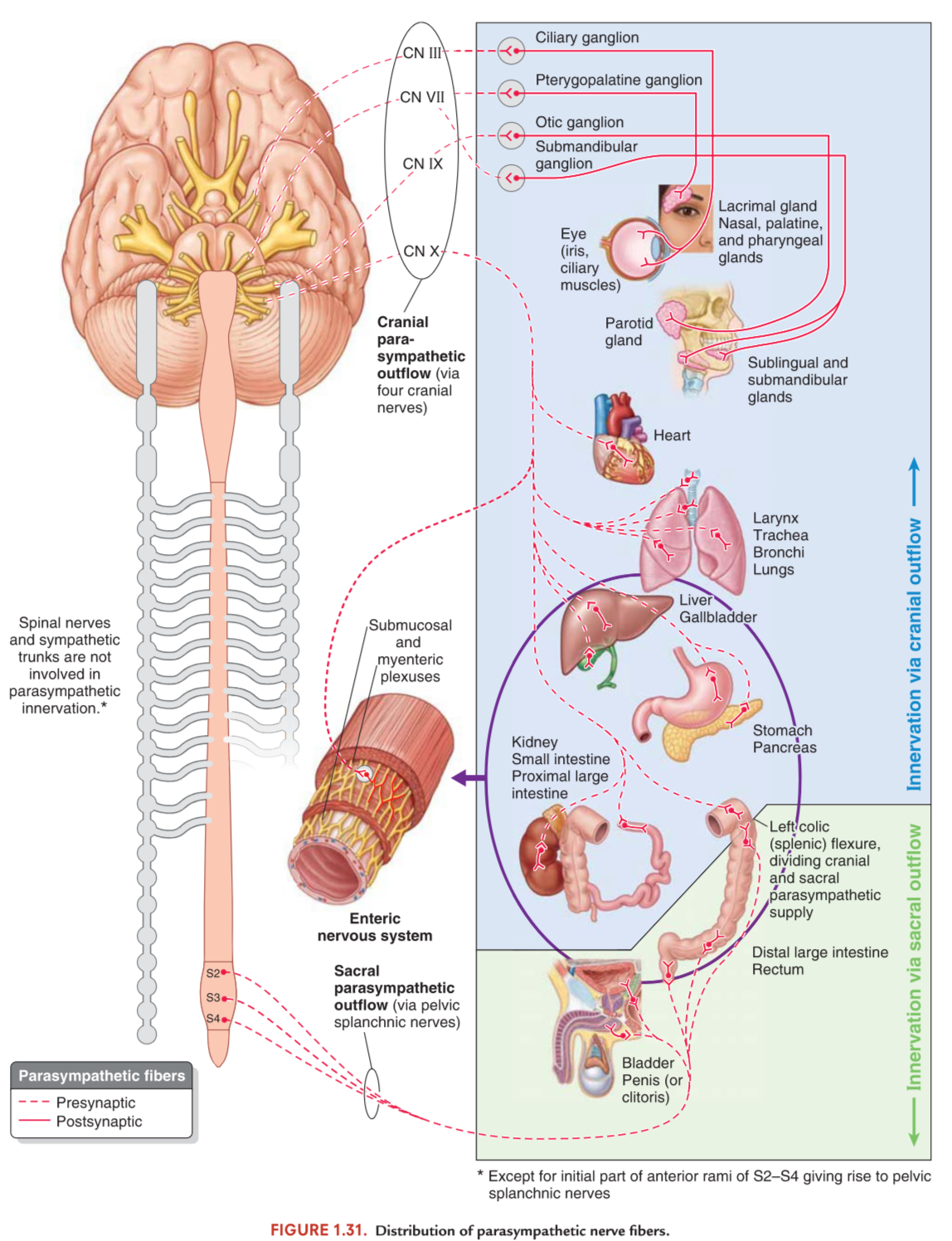
What are the two plexuses of the enteric nervous system?
Myenteric plexus
Submucosal plexus
Where is the myenteric plexus located?
Within the muscular wall of the GI tract.
What is the function of the myenteric plexus?
Controls GI muscle activity and motility (peristalsis).Controls GI muscle activity and motility (peristalsis).
Where is the submucosal plexus located?
Deep to the mucosa within the wall of the GI tract.
What is the function of the submucosal plexus?
Regulates:
Secretions
Blood flow
Activity of the gut lining
Besides motor neurons, what other neurons are found in the ENS?
Interneurons
Intrinsic primary afferent neurons
What do intrinsic primary afferent neurons do?
Receive local sensory information and initiate local reflexes.
Which GI functions are controlled by local enteric reflexes?
Peristalsis
Secretions
Vasomotion
Immune activity
How do the sympathetic and parasympathetic systems affect the ENS?
They modulate ENS activity but do not control it completely.
What is the overall role of the sympathetic nervous system?
Prepares the body for stress (“fight or flight”) by mobilising energy.
What is the overall role of the parasympathetic nervous system?
Maintains homeostasis by promoting rest, digestion and energy conservation
What is the primary function of the sympathetic nervous system?
Regulation of blood vessels
How are most blood vessels affected by increased sympathetic activity?
Vasoconstriction
What happens if sympathetic activity decreases?
Vasodilation
Which blood vessels undergo sympathetic vasodilation?
Coronary vessels
Skeletal muscle vessels
External genitalia
What is vasomotion?
Constriction or dilation of blood vessels under autonomic control.
What information do visceral afferent fibres usually carry?
Information about the body’s internal environment.
Why are we usually unaware of visceral afferent information?
Because it is processed unconsciously to regulate visceral reflexes.
What do visceral reflexes regulate?
Functions such as:
Heart rate
Blood pressure
Respiration
Vascular resistance
When visceral sensation reaches consciousness, how is it usually perceived?When visceral sensation reaches consciousness, how is it usually perceived?
As pain.
Why is visceral pain difficult to localise?
Because visceral afferent fibres have fewer pain receptors and less precise sensory pathways than somatic nerves.
What stimuli can produce visceral pain? 6
Sudden distension
Spasm
Strong contraction
Chemical irritation
Mechanical stimulation
Ischaemia
What is ischaemia?
Inadequate blood supply to a tissue.
Why is ischaemia a common cause of visceral pain?
Because reduced blood supply lowers the threshold for pain receptors.
Does normal visceral activity usually produce conscious sensation?
No.
Only abnormal stimulation usually produces pain.
Which autonomic fibres do most visceral reflex fibres accompany?
Parasympathetic fibres.Parasympathetic fibres.
Which autonomic fibres do most visceral pain fibres accompany?
Sympathetic fibres.
Most visceral pain from the heart and abdominal organs travels with which division of the ANS?
Sympathetic fibres.
Somatic pain vs visceral pain
Somatic | Visceral |
Well localised | Poorly localised |
Skin, muscles, joints | Internal organs |
Visceral reflex fibres vs visceral pain fibres
Reflex | Pain |
Mainly parasympathetic | Mainly sympathetic |
Sympathetic vs parasympathetic overall roles
Sympathetic | Parasympathetic |
Fight or flight | Rest and digest |
Catabolic | Anabolic |
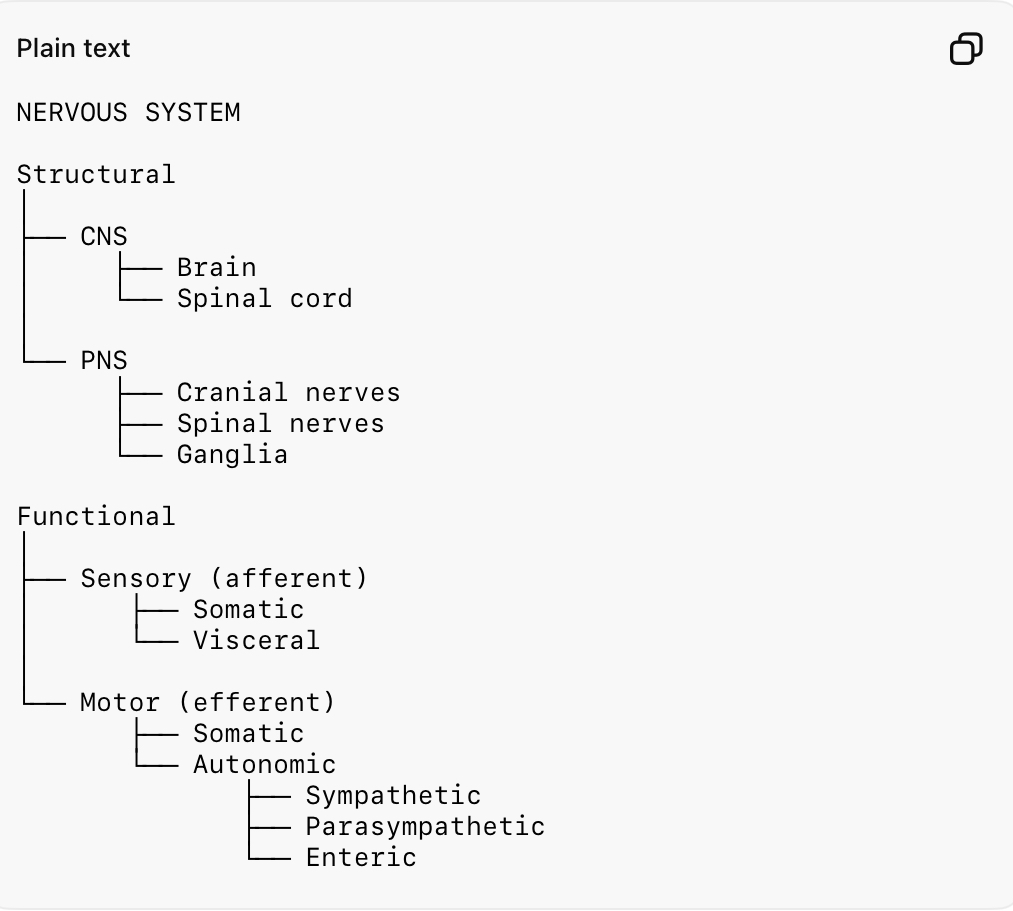
What are the three divisions of the visceral motor system?
Sympathetic
Parasympathetic
Enteric
Summarise the enteric nervous system.
“Second brain”
Two plexuses:
Myenteric
Submucosal
Controls GI motility and secretion
Functions independently
Modulated by sympathetic and parasympathetic systems
Where is the myenteric plexus?
Where is the submucosal plexus?
Which one controls muscle?
Which one controls the mucosa?
Summarise the organisation of the nervous system.