Project Management Final
 Studied by 0 people
 Call Kai
 Learn
Learn Practice Test
 Spaced Repetition
 Match
Match Flashcards
 Knowt Play
1/78

Earn XP
Description and Tags
Verzuh Ch 10.3, 12, 13, 19, 11, 24
Name | Mastery | Learn | Test | Matching | Spaced |
|---|
No study sessions yet.
79 Terms
3 types of resources in project management
Work resources
Material resources
Cost resources
Work resources
People, equipment - assign by time
Material resources
Materials (concrete, bricks, boxes) - assign by quantity
Cost resources
Other (Airfare, lodging, training) - assign $ every time it occurs
Overallocation
Overallocation happens when you have more assigned to a resource than you have of a resource
Examples of overallocation
* One person assigned to do a full day’s work on two different tasks, whether in the same project or different projects
* Five people assigned as programmers when you only have two available to the project
* One equipment assigned to two different tasks for a full day on the same day
How to find overallocations in a project?
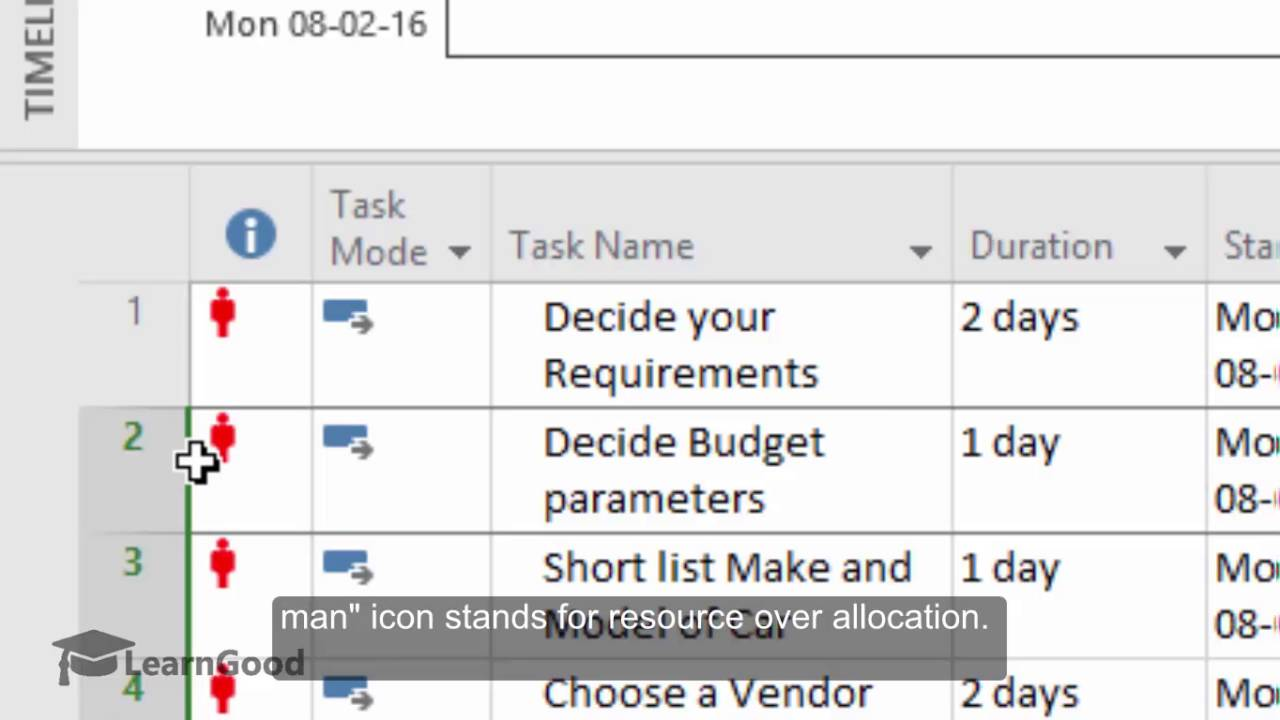
Gantt chart indicators column displays red icons beside tasks with overallocated resources
To identify specific overallocated resources, refer to the 'Resource Usage' view
Resource leveling
Delaying or splitting tasks so resources are no longer overallocated
focuses only on people and equipment resource types
materials needed are dictated by specifications
4-step process to level resources
Forecast resource requirements for initial schedule
Identify resource peaks
At each peak, delay noncritical tasks within their float
Eliminate remaining peaks by reevaluating work package estimates
Benefits of resource leveling include
Make resources be used at a consistent, reasonable rate
Requires less management, avoiding repeatedly adding and removing resources
Improves morale via job stability, avoiding underallocation
Enables use of just-in-time inventory policies for subcontractors or other expensive resources
3 types of cost estimates include:
Ballpark estimate
Order of magnitude estimate
Detailed estimate
Ballpark estimate (Idea evaluation)
Results of a gut feeling from an expert
Used to evaluate whether it would be useful to get a more accurate estimate
Order of magnitude estimate (Project selection)
Few hours of effort comparing proposed project to past projects
Used to formally initiate a project
Detailed estimate (Project management)
Includes all schedule and resource information + a forecast of a project’s budget and cash flow
Used to manage the project and evaluate its success
4 common estimating techniques include:
Phased estimating
Apportioning
Parametric estimates
Bottom-up estimating
Phased estimating
Eliminate cost and schedule for only one phase of the project at a time
Apportioning
A top-down estimate dividing the total project estimate into smaller pieces using similar past projects to derive a formula
Good for project selection (order of magnitude estimate)
Parametric estimate
quantitative technique which seeks basic unit of work to act as a multiplier to size the entire project
Good for project selection (order of magnitude estimate)
Bottom-up estimating
All tasks are estimated and then combined
Good for managing project (detailed estimate)
How to build the Detailed Budget Estimate?
a bottom-up estimating technique where individual project tasks are estimated and then aggregated into a total project estimate;
- sources of data
- internal labor cost
- use burdened labor rate
- don't leave out staffing cost
- internal equipment cost
- estimating resources used
- estimating resources used on multiple projects
- external labor and equipment costs
- material costs
3 levels of authority a project can be balanced
Project level authority
Business case level authority
Enterprise level authority
Project level authority
Needs authorization from PM and team
Keep project on track
Business case level authority
Needs authorization from all the stakeholders
Reevaluate business case for project (cost, schedule, quality goals)
Enterprise level authority
Needs authorization from the firm
Confronts constraints of insufficient equipment, personnel, and budget
3 techniques for shortening project schedules
Crashing
Fast tracking
Reducing scope
Crashing activities
Obtaining the greatest amount of schedule compression for the least incremental cost
Reduce duration of critical path tasks
Fast tracking activities
Overlapping tasks that are traditionally done in sequence.
Fast-track tasks on critical path because the length of critical path = project duration
Reducing scope
Cutting tasks associated with delivering that scope
Reducing project scope is a last resort - if product functionality is reduced, value is reduced.
Primary Focus of measuring project status
Measuring schedule performance
Measuring cost performance
Earned Value Analysis (EVA)
Industry standard way to measure a project’s progress, most helpful for cost management
Provide schedule & budget variances along the way
Forecast its final cost
How EVA is performed?
EVA offers an integrated view of a project with 3 fundamental measures in terms of monetary values:
Planned Value (PV)
Earned Value (EV)
Actual Cost (AC)
Derived Measures of EVA (current progress)
Cost Variance (CV) = EV - AC
difference between budgeted cost & actual cost for completed work by status date.
Cost Performance Index (CPI) = EV / AC
measure of cost efficiency expressed as the ratio of budgeted cost to actual cost for completed work
Schedule Variance (SV) = EV - PV
difference between work completed & work planned to be completed by status date.
Schedule Performance Index (SPI) = EV/PV
measure of schedule efficiency expressed as the ratio of earned value to planned value.
Cost Variance (CV)
EV - AC
The difference between the budgeted cost & actual cost for completed work by the status date
negative = over budget
Cost Performance Index (CPI)
EV / AC
A measure of cost efficiency
<1 = over budget
Schedule Variance (SV)
EV - PV
The difference between work completed & work planned to be completed by the status date
negative = behind schedule
Schedule Performance Index (SPI)
EV / PV
A measure of schedule efficiency
<1 = behind schedule
Derived Measures of EVA (forecasting)
Budget at Completion (BAC)
Estimate at Completion (EAC)
Estimate to Completion
(ETC) = EAC - ACVariance at Completion
(VAC) = BAC - EAC
Budget at Completion (BAC)
Approved budget for the project
Estimate at Completion (EAC)
Revised estimate of total project cost
If the CPI is expected to be the same for the remainder of the project:
EAC = BAC/CPI
If future work will be accomplished at the planned rate:
EAC = AC + (BAC-EV)
If the initial plan is not valid:
EAC = AC + Bottom-up ETC
Estimate to Completion (ETC)
EAC - AC
Expected cost to finish all remaining project work
Variance at Completion (VAC)
BAC - EAC
Estimated difference in cost at completion of project
negative = over budget
3 fundamental measures of EVA
Planned Value (PV)
“How much work should be done?”Earned Value (EV)
“How much work was actually done?”Actual Cost (AC)
“What did the work that was actually done actually cost?”
Planned Value (PV)
“How much work should have been done?”
Budgeted cost of work that should have been completed by the status date
Earned Value (EV)
“How much work was actually done?”
Budgeted cost of work that has been completed (earned) by the status date
Actual Cost (AC)
“What did the work that was actually done actually cost?”
The actual cost of work completed by the status date
Baseline
A comparison point
Cost and schedule baselines determined
Important for measuring project status demonstrating variance from baselines by status date
Cost and schedule baselines
Represent the original project plan as approved by the stakeholders
Status date
A date that is set for reporting the project progress
Important for measuring project status by demonstrating variance from baselines on the status date
Waterfall development process
A sequential, one-way development process
Establish a clear project scope early in the life cycle
Each phase must be fully completed before the next one can begin
Agile
Umbrella term for iterative and incremental delivery
Agile development process
Emphasizes collaboration between development teams & business experts
Scrum is an agile framework
Agile is more iterative than the waterfall process
Manifesto for Agile Software Development
Individuals and interactions over processes and tools
Working software over comprehensive documentation
Customer collaboration over contract negotiation
Responding to change over following a plan
Twelve Principles of Agile development (1-4)
1. Our highest priority is to satisfy the customer through early and continuous delivery of valuable software.
2. Welcome changing requirements, even late in development. Agile processes harness change for the customer's competitive advantage.
3. Deliver working software frequently, from a couple of weeks to a couple of months, with a preference to the shorter timescale.
4. Business people and developers must work together daily throughout the project.
Twelve Principles of Agile development (5-8)
5. Build projects around motivated individuals. Give the environment and support needed, trust them to get the job done.
6. The most efficient and effective method of conveying information to and within a development team is face-to-face conversation.
7. Working software is the primary measure of progress.
8. Agile processes promote sustainable development. The sponsors, developers, and users should be able to maintain a constant pace indefinitely.
Twelve Principles of Agile development (9-12)
9. Continuous attention to technical excellence and good design enhances agility.
10. Simplicity – the art of maximizing the amount of work not done – is essential.
11. The best architectures, requirements, and designs emerge from self-organizing teams.
12. At regular intervals, the team reflects on how to become more effective, then tunes and adjusts its behavior accordingly.
Scrum framework
An agile framework for managing project or product development effort
Consists of roles, artifacts, activities/events and guidelines
Helps teams deliver products in short cycles, enabling fast feedback, continual improvement, and rapid adaptation to change
3 Scrum team roles
Product owner
Development team
Scrum master
Product owner (Scrum)
Maximizing the value of the product and the work of the development team
Clarify what the product should do (knows requirements)
Prioritize the list of potential improvements
Development team (Scrum)
Building the actual product, contains skills required to perform:
requirement definition, design, development, and testing (cross-functional team)
Team chooses how to best accomplish work, rather than being directed externally (self-organizing)
Make + keep commitments to product owner and members are accountable to each other (accountable as a team)
Scrum Master (Scrum)
Ensuring Scrum is understood and used skillfully by the team:
Understand and promote Scrum roles and practices within the Scrum team and the organization
Protect the team from being distracted or losing focus
Scrum Activities / Events
Sprint
Sprint planning
Daily Scrum
Sprint review
Sprint retrospective
Sprint
The Scrum Team delivers a new iteration of the working product every Sprint
Each Sprint lasts between 1-4 weeks
A sprint has an established scope
Sprint planning
A meeting at the beginning of each sprint to decide what can be delivered in this sprint and plan how to achieve this delivery
Product owner: establishes priority of product backlog, decides what to be produced
Development team: Decides scope to be taken on during sprint & plans work
Scrum master: Facilitation & coaching development team and product owner
Output: sprint goal, sprint backlog
Daily Scrum
Daily 15-minute meeting, where each member addresses 3 topics:
Accomplishments since previous meeting
Task focus for the coming day
Any impediments encountered
Scrum master can leave with a list of impediments to resolve
Sprint review
A meeting at the end of each sprint in review
Scrum team: delivers result of sprint to customer
Customer: accepts or rejects result, providing feedback to team to shape product
Output: revised product backlog
Sprint retrospective
An end-of-sprint meeting for the Scrum team to reflect on effectiveness and make adjustments prior to the next sprint
Interpersonal communication, tools, team processes
How much of sprint product commitment was reached? What factors contributed to or impeded productivity?
Output: a list of changed behaviors to adapt in the next sprint
Scrum Artifacts
User story
Product backlog
Sprint backlog
Task board
Sprint burndown chart
User Story
Agile requirements are defined by user stories
Describes specific interaction or activity the user will have with the product
Product owner is the only person who has the authority to add user stories or change the priority of user stories
Product Backlog
List of requirements related to the product
Constantly evolving based on what is known at a particular time
Collaborative refinement (by product owner and development team)
Sprint Backlog
List of requirements related to current sprint
Collaboratively created by development team
Regularly updated during sprint
Real-time picture of all work in current sprint
Task Board
shows task status - updated at daily scrum
3 types of task status:
Not started
In Progress
Completed
Sprint Burndown Chart
Visual chart to show whether the development team is on track to meet the goal of a sprint
Constructed at sprint planning session
Shows effort vs. time
Key Factors for Effective Scrum
A product that can be delivered incrementally
Self-managing teams are mature
Scrum must be embraced by everyone
Project Management Institute (PMI)
The Project Management Institute (PMI) is an international professional society for project managers founded in 1969
PMI is the governing body for both PMP and CAPM
PMP & CAPM
The Project Management Professional (PMP) and Certified Associate in Project Management (CAPM) are professional certifications by PMI.
PMP (Project Management Professional)
An internationally recognized professional certification similar to the CPA license within the accounting field.
CAPM (Certified Associate in Project Management)
A professional designation that is meant to bridge one’s entrance into the PMP designation.
Students can join PMI at a reduced fee and earn the CAPM certification
PMBOK Guide
The Project Management Body of Knowledge (PMBOK) published by PMI is a guide reflecting how project management is best practiced today.
PMI Infinity
PMI offers an AI personal assistant for project professionals that helps embrace AI in daily project management needs.