BIO 80 1 EXAM
 Call Kai
 Learn
Learn Practice Test
 Spaced Repetition
 Match
Match Flashcards
 Knowt Play
1/85

There's no tags or description
Looks like no tags are added yet.
Name | Mastery | Learn | Test | Matching | Spaced | Call with Kai |
|---|
No analytics yet
Send a link to your students to track their progress
86 Terms
What is biology?
Biology is the scientific study of life
What is science?
Science is a body of knowledge about the natural world; a collection of unified insights about nature, the evidence of which is an array of facts.
Scientific facts
are objective and verifiable observations;
observations that have repeatedly been confirmed and
accepted as “true”. AKA theories:
Theory
A theory is a well-substantiated explanation of some aspect of the natural world that can incorporate facts, laws, inferences, and tested hypotheses
• Newton’s Theory of “Universal Gravitation”
• Einstein’s Theory of Relativity
• Darwin’s Theory of Natural Selection
Scientific method
Observation, questions, hypothesis & predictions, experimentation, analysis & conclusion.
Science is cyclical
True
four other principles of science
Scientific inquiry is only related to natural
explanations for natural phenomena
(Any scientific hypothesis or claim must be falsifiable)
Every assertion regarding the natural world is
subject to challenge and revision based on
evidence
Science invokes the principle of parsimony
(Occam’s Razor)
Science doesn’t tell you how to use scientific
knowledge
Scientific Ethics
“The relationship between general moral orientations and the problems of generating and applying scientific knowledge”
Characteristics of Life
1. Energy Processing
• Living things need an outside source of materials and energy to
maintain their organization and carry on life’s activities
• Food provides nutrient molecules, which are used as building
blocks or energy sources
2. Regulation
• Living things need to keep themselves stable in temperature,
moisture level, nutrient level, salt, acidity, and other factors critical
to maintaining life
• This is called homeostasis– the process by which a cell or
organism maintains internal conditions within certain boundaries
3. Response to the environment
• Living things can sense and respond to environmental stimuli
4. Growth and development
• Life only comes from life
• Every type of living thing can reproduce in some way
• Reproduction transmits DNA from generation to
generation
• All living things grow and develop
5. Order
• Life is characterized by highly ordered structure and
organization
6. Evolutionary adaptation
• Adaptations are modifications that make organisms
suited to their way of life
The branch of biology concerned
with naming and classifying species
Taxonomy
Currently recognized domains
Bacteria, Archaea, and Eukarya
Currently recognized kingdoms
Archaea, Bacteria, Protista,
Fungi, Plantae, and Animalia
used to name each species
Binomial nomenclature: coined by Carlous Linneus
The first name designates
the species’ _____
genus: group of
closely related organisms
The second name is
specific epithet: unique for
each species within a genus
Theory of evolution
provides a framework
for understanding how the diversity of life on
Earth arose
• Central theme is gradual change over time
Three observations about life
1. Organisms are well suited (adapted)
for life in their environments
2. Life shares many unifying
characteristics
3. Life is incredibly diverse
Aristotle
384-322 BCE
Darwin challenged his idea of the scala naturae
(Species organized into a complex structure where humans are at top).
James Hutton
1795
Proposed gradualism- earths geological features can be explained by gradual mechanisms.
Darwin connection: Darwin also thought humans could relate and evolve the same way.
Charles Lyell
1795
Uniformatarianism; The same geological processes are operating today as in the past, at the same rate.
Lyell's Principles of Geology provided Darwin with the concept of deep time and gradual change, which proved essential for Darwin to formulate his theory of evolution by natural selection.
Thomas Malthus
1798
Essay on the principle of population: human growth is exponential and resource growth is linear.
Darwin applied this economic concept to the natural world. He realized that since all animals produce more offspring than limited environmental resources can support, individuals born with advantageous variations are more likely to survive, reproduce, and pass those traits to the next generation
Jean-Batiste Lamarck
1809
Jean-Baptiste Lamarck (French zoologist) hypothesized that species
evolve through use and disuse of body parts and the inheritance of
acquired characteristics:
1. Organisms become more complex over time
2. The environment applies stresses to those organisms
3. In response to those stresses, the organism develop new
parts or otherwise change to alleviate the stresses
4. Changes that occurred during the organism’s life are passed
on to its offspring
George Cuvier
1812
Proposed catastrophism: catastrophic events are responsible
for mass extinctions and formation of all landforms
Darwin adapted Cuvier’s empirical evidence of extinction and the fossil record, replacing Cuvier's "catastrophes" with natural selection
Lyell published his principles of geology in what year
1830
Darwin travels around the world on HMS beagle in what year and what was found
1831-1836
Found ocean fossils high in the Andes
While on the HMS beagle, Darwin was:
1. Reading Lyell’s Principles of Geology
Reading Malthus’ Principles of Population
3. Thinking about overproduction and
competition
4. Marveling in the beauty and diversity of
plankton in the open ocean
5. Appreciating the diversity of life!
Adaptions
Characteristics
of organisms that enhance
their survival and
reproduction in specific
environments
What year does Darwin write his essay on descent with modification
1844
In Origin of Species, Darwin never used the word evolution, but
described this process as____
Descent with modification
Descent
All organisms are related
through descent from an
ancestor that lived in the remote
past
What does Wallace send Darwin and what year
1858- his hypothesis of natural selection
When was the origin of species published
1859
Origin of species influenced by ___________________________
Influenced by Aristotle’s Scala naturae, gradualism in geology, Cuvier, Lamarck, voyage on the Beagle, and Wallace
Evolution, as described by Charles Darwin, is based on four central ideas:
1. Descent with modification
2. Common ancestry
3. Adaptation
4. Natural selection
Observations of Natural Selection
Observation 1: Species produce more offspring than are needed to replace the parents and maintain the population.
Observation 2: Despite producing many offspring, adult population sizes usually remain fairly constant.
Observation 3: Natural resources (food, water, space, etc.) are limited and limiting - can restrict population growth.
Observation 4: Individuals within a population vary in their traits.
Observation 5: Much of this variation is heritable, meaning offspring inherit traits from their parents.
Observation 6: Humans use artificial selection to breed organisms with preferred heritable traits.
Natural Selection Inferences
Inference 1: There must be a struggle for
existence in nature, with too many individuals
and not enough resources.
Inference 2: The struggle for existence is not
random, but selective
AKA survival of the fittest!
Inference 3: Populations change over time as
the frequency of advantageous traits
increases
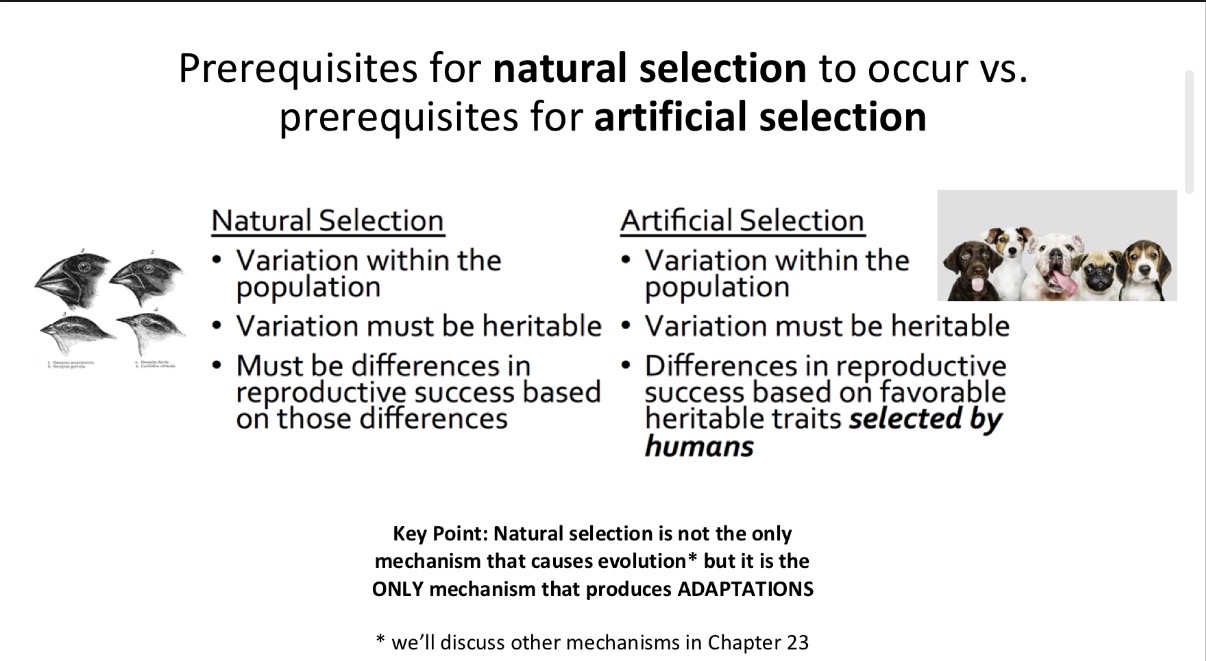
Prerequisites for natural selection to occur vs prerequisites for artificial selection
When did George Mandel publish his work on the patterns of inheritance in pea plants
1866
When were chromosomes discovered
1882
When was the term genetics coined
1905
When was the first images of DNA
1951
When was the structures of dna described
1953
What is evidence for evolution?
Anatomical and molecular homologies
The fossil record
Biogeography
Experimental evidence (direct observation)
Molecular homologies
genes shared among
organisms inherited from a
common ancestor
Vestigial structures
remnants of features that served
a function in the organism’s
ancestors
Convergent evolution
is the evolution of similar, or
analogous, features in distantly related groups
Analogous traits arrise
when groups independently adapt
to similar environments in similar ways
Homologous traits share
common ancestry but (typically)
serve different functions
Biogeography
the geographic distribution of species
• Influenced by continental drift: slow movement of continents over
millions of years
• Based on evolution and continental drift, we can predict
biogeography
• We can use evolution and continental drift to explain biogeography
Allele
Form of a gene
Convergent evolution does not provide information about
Ancestry
Analogous traits serve
similar functions but evolved
independently through convergent evolution
Microevolution
change of allele frequencies within a population over time.
Microevolution can result from______
• Natural Selection
• Sexual Selection
• Genetic Drift
• Gene flow
• Mutation
Macroevolution results in the formation of
new species or large groups of living things
Genetic variation
variation in
heritable traits, is a prerequisite
for evolution by natural selection
Gene
Unit of heredity
Genotype
The combination of alleles
Heterozygote
Possessing different alleles
Homozygote
Possessing two of the same
allele
Dominance
One allele masking the other in the heterozygous condition
Phenotype
An organisms appearance; observable traits or characteristics of an organism
Discrete characters
phenotypic differences
that occur on an “either-or” basis
e.g., Mendel’s pea plants
Quantitative characters
phenotypic differences that vary along a continuum e.g., coat color in horses is influenced by multiple genes
New alleles arise by
mutation: a change in the
nucleotide sequence of an organism’s DNA
The effects of the mutations on the survival and
reproduction of organisms is the basis of____
Natural selection
Chromosome
cellular structure
containing DNA; consists of a pair of
sister chromatids
Homologous Chromosomes
pair of
chromosomes with the same genes;
one from each parent
Sexual reproduction increases genetic diversity in what ways
During meiosis, genetic diversity is generated in two ways:
○ 1: Independent assortment: the random distribution of homologous
chromosomes during meiosis.
○ 2: Crossing over: homologous chromosome exchange reciprocal
portions of themselves
● After meiosis, further genetic diversity is generated via:
○ 3: Random fertilization
species
a group of individuals that
are capable, through reproduction, of
sharing alleles with one another
Population
a group of a single species
living together in a specific area
Gene pool
all the alleles present in all
the individuals in a population
Allele frequency
how common an
allele is in the population
Conditions for hardy Weinberg equilibrium
No mutations
Random mating
No natural selection
Extremely large population in size
No gene flow
Sexual Selection
a form of natural
selection that can affect the frequency of
alleles in a gene pool.
○ Occurs when differences in
reproductive success arise because of
differential success in mating.
Intrasexual selection
direct competition
among individuals of one sex (often males) for mates of the
opposite sex
Intersexual selection
Intersexual selection (between sexes): AKA mate choice,
when individuals of one sex (usually females) are choosy in
selecting their mates
Genetic drift
Causes allele frequency to change randomly
Bottleneck effect
a sudden reduction in the number of alleles present in a population.
By chance alone, certain alleles may be more common among survivors, while others
are less common or absent.
Founder effects
: a change in allele frequencies
that occurs when a new population is established
Genetic drift Key points
Can change allele frequencies through chance variation in survival or
reproduction
Is more significant in small populations
Can cause allele frequencies to “drift” randomly
Can lead to a loss of genetic variation within populations
Can lead to the fixation of deleterious alleles
Gene flow
The movement of alleles into or out of a population
due to the movement of fertile individuals or their
gametes.
Neutral Variation
genetic variation that does not confer a selective advantage or disadvantage … yet!
Diploidy
In diploid eukaryotes, a considerable amount of genetic variation is hidden from selection in the
form of recessive allele
Balancing selection
Occurs when natural selection maintains stable frequencies of two or more phenotypic forms in a
population