U2 Topic-7 (Intermolecular forces
 Call Kai
 Learn
Learn Practice Test
 Spaced Repetition
 Match
Match Flashcards
 Knowt Play
1/9

There's no tags or description
Looks like no tags are added yet.
Name | Mastery | Learn | Test | Matching | Spaced | Call with Kai | Chat |
|---|
No analytics yet
Send a link to your students to track their progress
10 Terms
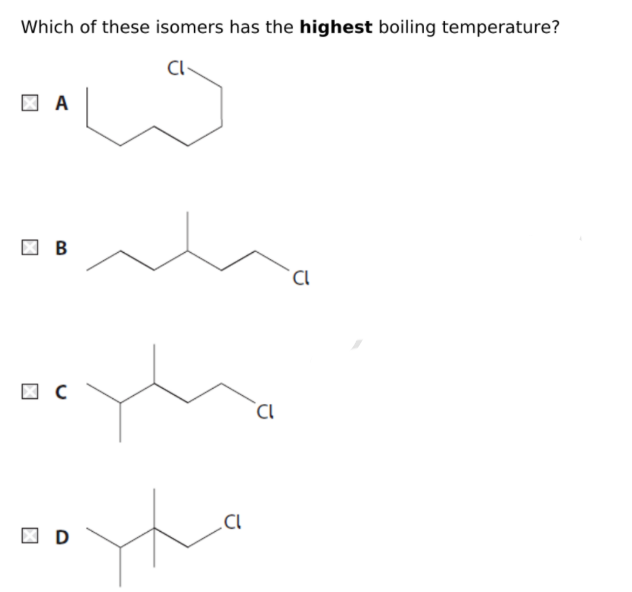
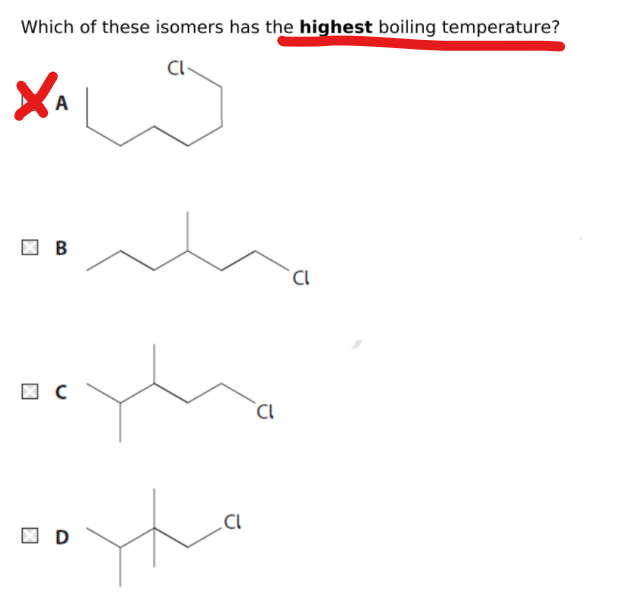
The more branching in the molecule = less points of contact between adjacent molecules
therefore overall London force is lower
since A has no branches it has strongest London force and so highest B.P
Hydrogen bonding is the strongest intermolecular force.
State with reason whether the following has Hydrogen bond:
HF
HI
Carboxylic acids like CH3COOH
HF = has H-bonding, due to F being very electronegative
HI = no H-bonding as Iodine is not very electronegative
Carboxylic acids like CH3COOH = has H-bonding, due to presence of OH group
Explain whether each of these molecules have hydrogen bonding:
CH3CH2NH2 (ethylamine)
CH4
CH3OH (methanol)
CH4
CH3CH2NH2 (ethylamine) = has H-bonding, presence of N-H bond
CH4 = no H-bonding, as no N, O, F bonded to it
(CH4, CCl4, H2S and PH3 also have no H-bonding)
CH3OH (methanol) = has H-bonding due to OH group
Amides (CH3CONH2) = has H-bonding because of N–H and lone pairs on O
(allows strong hydrogen bonding)
Define hydrogen bonding (2marks)
This is an intermolecular interaction between a hydrogen atom of a molecule (or molecular fragment) bonded to an atom which is more electronegative than hydrogen and another atom in the same or a different molecule
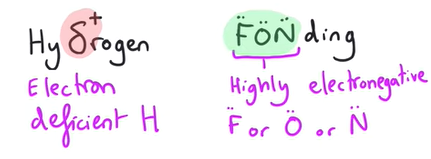
the 3 electronegative atoms are: F, N or O
hydrogen atom must become slightly positive

Q. says between molecules so intermolecular forces and covalent is NOT INTERmolecular but INTRAmolecular
also HI has no hydrogen bonding (as I is not electronegative enough)
no ions so ionic bond not possible
therefore answer is London forces

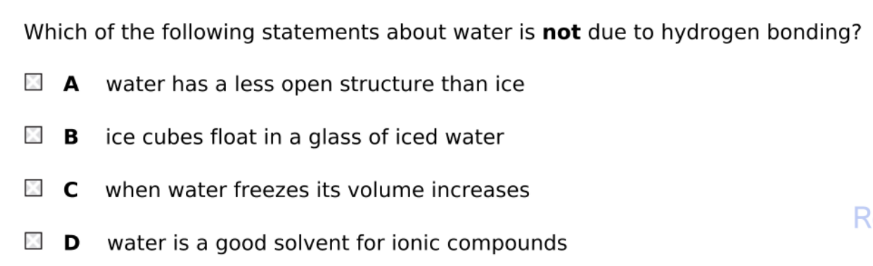

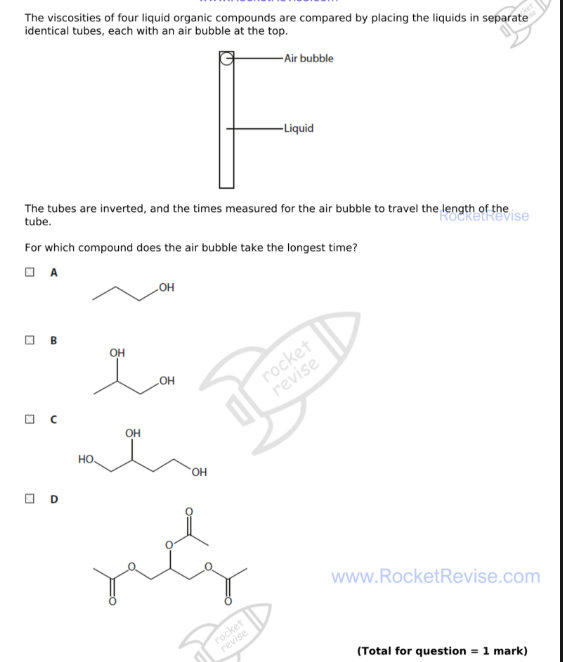
More hydrogen bonding increases a liquid's viscosity because it creates strong intermolecular forces that resist flow

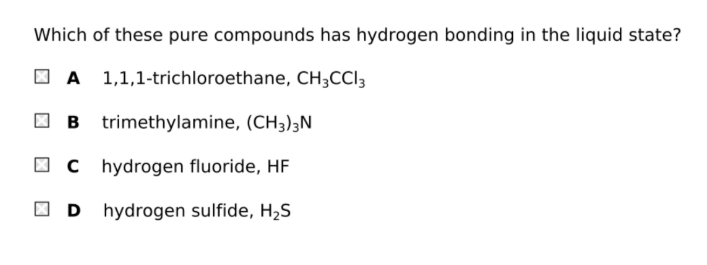
trimethylamine (CH3)3N –→ No hydrogen bonding.
Although it contains nitrogen, all the hydrogen atoms are bonded to carbon atoms, not to the nitrogen atom.
