CFA Mock Exam 3 Session A
 Call Kai
 Learn
Learn Practice Test
 Spaced Repetition
 Match
Match Flashcards
 Knowt Play
1/14

There's no tags or description
Looks like no tags are added yet.
Name | Mastery | Learn | Test | Matching | Spaced | Call with Kai | Chat |
|---|
No analytics yet
Send a link to your students to track their progress
15 Terms
Allocation Effect
(sector portfolio weight - sector bench weight)*(sector bench return - total bench return)
sector selection effect
Sector benchmark weight *(Sector portfolio return–Sector benchmark return)
interaction effect
Sector interaction effect = ( Sector portfolio weight–Sector benchmark weight)*(Sector portfolio return–Sector benchmark return)
GIPS - link past performance
1. Substantially all the investment decision makers are employed by the new firm
2. The decision-making process remains substantially intact and independent within the new firm, and
3. The new firm has records that document and support the reported performance.
GIPS - composite returns calculation
The monthly return is calculated for each constituent portfolio. The portfolio returns are then weighted using their beginning-of-period asset values to arrive at the composite return.
The monthly return is calculated for each constituent portfolio. The portfolio returns are then weighted using a combination of their beginning-of-period asset values and daily external cash flows to arrive at the composite return.
The beginning-of-period portfolio values are summed to get the beginning-of-period composite value, the daily portfolio external cash flows are summed to get the daily composite external cash flows, and the end-of-period portfolio values are summed to get the end-of-period composite value. These composite values are then used to compute the composite return.
GIPS Valuation Hierarchy
1. Objective, observable, unadjusted quoted market prices for identical investments in active markets on the measurement date
2. Quoted prices for similar investments in active markets
3. Quoted prices for identical or similar investments in markets that are not active (markets in which there are few transactions for the investment, the prices are not current, or price quotations vary substantially over time and/or between market makers)
4. Market-based inputs, other than quoted prices, that are observable for the investment
5. Subjective, unobservable inputs.
Empirical vs modified duration
Modified duration is calculated using the change in benchmark yield. For credit bonds, this assumes that the credit spread will remain constant when the benchmark yield changes, so that the change in yield on the bond is the same as the change in the benchmark yield
bench yield SEPARATE from credit spread
Asset Manager - org changes
Managers must disclose significant personnel or organizational changes that have occurred
Record Retention - years
Unless otherwise required by local law or regulation Managers should keep records for at least seven years
change in equity of portfolio
-MD(change in yield)
contribution of factor to variance
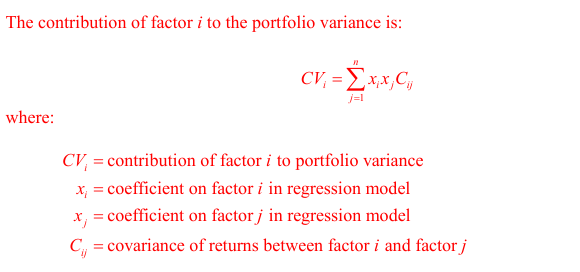
vcv matrix
from asset returns - consistent and unbiased
factor model - inconsistent and biased, number of covariances needed is less
Bond Portfolio - change in price
-sum(key rate dur * change in yield)
empirical duration
compares historical bond price changes to the corresponding benchmark yield changes - captures lowered sensitivity to the benchmark yield
immunize single liab
market value of the assets should equal or exceed the present value of the liability, the Macaulay duration of the asset portfolio should be very close to the Macaulay duration of the liability (alternatively, their modified durations should be very close to each other, or their BPVs should be very close to each other), and the convexity should be minimized