Electricity & Circuits Concepts & Vocab
 Call Kai
 Learn
Learn Practice Test
 Spaced Repetition
 Match
Match Flashcards
 Knowt Play
1/53

There's no tags or description
Looks like no tags are added yet.
Name | Mastery | Learn | Test | Matching | Spaced | Call with Kai | Chat |
|---|
No analytics yet
Send a link to your students to track their progress
54 Terms
Electricity
a form of energy caused by a flow of particles called electrons in a conductor
Electric Current
the flow of electric charges in a circuit
Battery
a device made with two metals in an electrolyte solution that transforms chemical energy into electrical energy
Ampere
the unit used to measure electric current
Voltage
the electric potential difference supplied by a battery, generator, or other charge pump
Electric Circuit
an electrical device that provides a path for current to flow
Resistance
use of energy for current to resist the flow of electric current (measured in Ohms)
Resistor
a device in a circuit that uses the electric current to do work
Ohm’s Law
the scientific principle that shows the relationship between current, voltage, and resistance
Coulomb’s Law
the force between two particles; the product of the charges divided by the square of their distance
Volt
the unit to measure voltage
Ohm
the unit that measures resistance
Series Circuit
a circuit in which one path for the current exists
Parallel circuit
an electric circuit with more than one pathway for the current to flow
Circuit Breaker
an automatic device for stopping the flow of current in unsafe situations
Separation of Charges
electric charges are distributed unevenly, leading to areas of positive and negative charge (creates an electric field)
Equivalent Resistance
the total amount of resistance that affects the amount of current in a circuit
Electric Potential Difference
the difference in EPE per unit charge between two points in a circuit, also known as voltage
Why does a separation of charges have to be created before an electric current can be produced?
a separation of charges requires the use of energy which is stored as electric potential energy; creating a positive and negative side will make the charges move to produce an electric current
How is a separation of charges produced?
energy is used to create the force that will make the particles separate (work); the energy used to do work becomes the battery’s potential energy; then, when the oppositely charged ends are connected, the electrons will move from the negative terminal toward the positive terminal
The work done to create the voltage will become ______
the battery’s potential energy
The law of conservation of energy and the work-energy theorem relate to electric fields, voltage, and work because _______
energy cannot be created or destroyed, only transformed; the work done to separate charges results in EPE (voltage) that can be converted into electrical energy
Which property of a circuit drops across a resistor in a series circuit?
voltage (decreases as the current moves through the components of a circuit)
Why will a series circuit shut down if any resistor doesn’t work?
the current flows through each component of the circuit and is interrupted if one fails to function
In a parallel circuit, multiple paths exist for the various resistors. Why will 9 out of 10 work even if one doesn’t function?
each resistor is connected to the voltage source; if one resistor fails, current can still flow through the other path
What happens in a circuit if the switch is open? Why?
the circuit is incomplete; an open switch creates a break in the path, stopping the current
TRUE or FALSE: If left alone, positive and negative charges would mingle together and form an arrangement where positives and negatives were evenly distributed.
true; positive and negative charges naturally move to minimize potential energy, resulting in uniform distribution
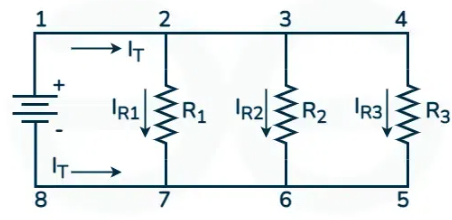
Is this a parallel or series circuit?
parallel
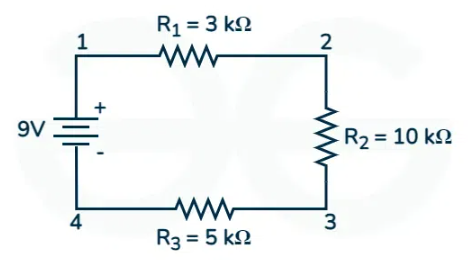
Is this a parallel or series circuit?
series
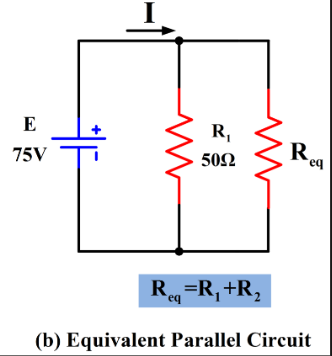
Is this a parallel or series circuit?
parallel
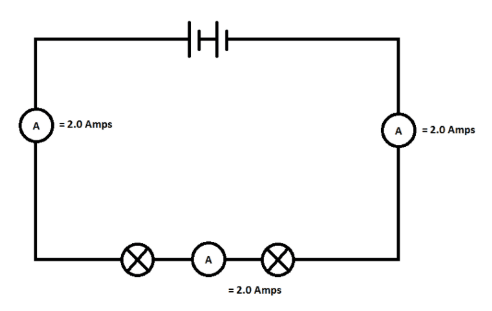
Is this a parallel or series circuit?
series
Conventional Current
current flows from positive to negative (before the electron was discovered)
For current to exist, _____
there must be voltage
Schematic
a diagram of the components of an electric circuit
TRUE or FALSE: In nature, positive and negative charges are repelled by each other and will separate into sections of all positive and all negatives on their own.
false
TRUE or FALSE: Resistors in a parallel circuit receive the amount of voltage necessary to make their devices work.
true
TRUE or FALSE: In a parallel circuit, the voltage is the same for every branch of the circuit.
true
TRUE or FALSE: In a parallel circuit with multiple resistors, every resistor must work or the entire circuit shuts down.
false
TRUE or FALSE: The electric potential difference of a source is measured in volts.
true
TRUE or FALSE: The voltage supplies energy that allows the device to work.
true
TRUE or FALSE: A “voltage drop” occurs when some of the energy in the conductors is used to make a resistor function.
true
Why must batteries be arranged in positive-negative-positive-negative order?
there must be an attraction between oppositely charged particles to cause the charges to move; it creates the current
Why do scientists still use the ideas concerning “conventional current”?
the concept of conventional current, which is the flow of positive charges towards negatives, has been established for many years before the electron was discovered.
Separating charges requires _____
doing work to push electrons away from where they naturally want to be
Separation is created when _____
some energy source (chemical reactions or friction) does work to move electrons
Work done to create the voltage becomes _____
stored electrical potential energy
Ohm’s Law states that _____
if resistance goes up, current goes down
In a series circuit, the current is _____
the same everywhere
In a series circuit, the voltage is _____
shared between components
In a series circuit, the resistance of the components is ______
combined (all added together)
In a parallel circuit, the current is _____
shared between components
In a parallel circuit, the voltage is _____
the same everywhere
In a parallel circuit, the resistance of the components is _____
not combined
Which property of a circuit drops across a resistor in a parallel circuit?
current