Biology Module 3
 Call Kai
 Learn
Learn Practice Test
 Spaced Repetition
 Match
Match Flashcards
 Knowt Play
1/65

There's no tags or description
Looks like no tags are added yet.
Name | Mastery | Learn | Test | Matching | Spaced | Call with Kai | Chat |
|---|
No analytics yet
Send a link to your students to track their progress
66 Terms
define selection pressures
features that affect an organism’s ability to survive in its ecological niche
define abundance
how many members of species live throughout ecosystem
what causes abundance to increase/decrease?
immigration/emigration of species
influx/deflux of predators/prey
change in structure
define extinct & give example
no longer present e.g. tasmanian tiger/thylacine
define extant & give example
still existing in high numbers e.g. cane toads
define extirpate & give example
no longer exist in specific area
define endangered & give an example
limited number in the wild e.g. tasmanian devil
what are the biotic selection pressures? give an example
availability of mates to reproduce with
survical of offspring
number of competitors/prey/availability of food
number of predators
presence of disease
e.g. coconut crab; limited food (selection pressure) drove evolution of long legs to allow crabs to climb coconut trees & strong claws to crack coconut
what is the impact of introduced species/pests on agriculture?
invade farms with animals/crops
eat grass needed for sheep & cattle
compete with farmers’ crops for water, nutrients from soil & sunlight
what is the impact of introduced species/pests on native wildlife?
compete for food & habitat, cause disease, predators of native wilflife
reduce biodiversity of native species
what is the impact of introduced species/pests on soils?
introduced plants & weeds have shallower roots, hence do not protect soil as much from rain & wind & cause soil erosion/land degradation
what is population density/size determined by?
birth (fatality)
immigration
emigration
death (mortality)
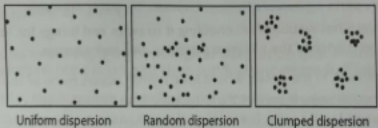
geographic distribution
population explosions (growing exponentially over long periods)
what are the types of geographic distribution? (identify & draw)
what are the abiotic selection pressures?
topography: shape of land, affects water runoff & soil type, create microclimates
aspect: direction a slope faces; causes variatio in amount of sunlight received by an area of land
altitude: height of land mass above sea leve, increased altitude = air pressure/oxygen/temperature decrease
organism tolerance: ability to survive within physical conditions of environment, every organism has a tolerance range (range of conditions it can survive)
why were cane toads introduced?
introduced to Queensland from Hawaii to biologically control cane beetle in sugarcane plantations
was the introduction of cane beetles successful?
failure; beetles lived too high up on canes, cane toads rapidly reproduce & eat anything → became invasive
what were the selection pressures & evolution caused by cane toads?
spatial sorting: toads at “invasion front” evolved to have longer, stronger legs & directional movement, allowing travel of 50-60km per year
physiological impact: rapid movement → older, faster toads more prone to spinal arthritis
impact on native predators: cane toads secrete toxic bufotoxin (severe selection pressure for native predators e.g. red-bellied black snakes)
predators that eat toads die → snakes evolved to develop smaller heads to prevent swallowing adult toads
why was the prickly pear introduced to Australia?
introduced to Australia from South America for cochineal dye industry & as livestock food source
why did prickly pears become invasive?
lcked natural selection pressures (e.g. native predators, specific diseases) → spread rapidly, covering 25 million ha of agricultural land
what were the positive/negative selection pressures & evolution caused by prickly pears?
positive: arid Aus climate & fertile soils allowed prickly pear to outcompete native flora
negative: scientists introduced Cactoblastis cactorum (moth) from SA as biological control agent
moth larvaes fed inside cactus pads → plant died & collapsed
quickly reduced prickly pear distribution by 99%
what are structural adaptations? give examples
modification of species structures that give organism advantage in particular environment
SA:V e.g. ears of elephant as cooling mechanism during hot temperatures
body coverings e.g. fur, feather for warmth/heat
dentition e.g. K9’s sharp teeth, herbivores have flat top teeth
vascular body parts e.g. plants with large channels for water transport
what are physiological adaptations? give examples
affect functioning at different levels of organisation, including:
biochemical reactions in organelles e.g. photosynthesis, respiration
camouflage e.g. camels metabolise fat-storing humps to produce metabolised water
evaporating cooling e.g. sweating; moisture evaporates from skin & draws away body heat
countercurrent heat exchange e.g. penguins; warm blood leaves bird’s body core & travels down leg through arteries
torpor
CAM photosynthesis
frost tolerance
regulation of salinity
what are behavioural adaptations? give examples
actions that an organism takes to improve survival/reproduction
seeking/leaving shade/shelter
huddling
migration
tropism
nastic movement
non-directional responses to stimuli
associated with plants
movement due to changes in turgor or growth
e.g. decrease in turgor pressure causes shrinkage, increase brings swelling
construct a flow chart of the finches of the Galapagos islands
mainland finches (common ancestor) → selection pressure (e.g. food, temp) → migration to nearby islands → adapt to selection pressure on those islands → speciation (new species)
define natural selection/survival of the fittest
process by which organisms best suited to environment survive & reproduce, passing on favourable traits
what are the 5 characteristics of natural selection?
Organisms produce more offspring than can survive
Variation occurs amongst species
Variations are passed onto offspring
Some variations help individuals survive
Over time, favourable traits cause population change
what is the process of natural selection?
Variation between individuals in any given species
When faced with selection pressure, not all individuals in a species live to reproduce
Individuals with less favourable variations die, while those with favourable traits survive
Those who survive reproduce & pass favourable traits onto offspring
what are the types of biodiversity & define species evenness? give examples
Genetic: total number of genetic characteristics in genetic make-up of species e.g. human eye & hair colour
Gives robustness to survive changing conditions
Safeguards against new pests & environmental change
wild species of crops contain a large natural gene pool
Should be maintained for genetic diversity of future & future breeding
Decrease in genetic diversity lead to lack of genetic vigour or strength
Species: measure of diversity of different species in ecological community e.g. coral reef (thousands of species of fish, turtles, etc.)
Species evenness
If number of individuals within a species if fairly constant across communities then it is said to have high evenness
High evenness leads to greater diversity
Ecological: variation of different ecosystems found in region
e.g. Great Barrier Reef (shallow coral reefs, seagrass meadows, mangrove forests)
Many ecosystems that are resistant to human impact show high level of biodiversity
define adaptive radiation
process in which organisms diversify rapidly from ancestral species into multitude of new forms, particularly when change in environment makes new resources available, alters biotic interactions, opens new environmental niche
what is the order of evolution?
Organic molecules - methane
First membranes
Prokaryotic autotrophic cells - bacteria & archaea
First eukaryotes
First multicellular organisms
Colonial organisms
define & describe microevolution
Microevolution: describes changes that take place over period of time
Does not result in speciation
Changes lead to change in population due to changes in frequency of alleles found in that population
Gene may have multiple alleles (e.g. blood alleles: A, B, O)
define & describe macroevolution
Macroevolution: result of numerous changes due to microevolution
Result in speciation
Very slow process
E.g. development of Homo sapiens took place over millions of years
what are the forces that change population & allele frequencies (for both evolution types)? define & give examples
Mutations: changes in genetic code, leads to variation
Gene flow: exchange of alleles between populations
When new population migrates & joins another population, leads to change in frequency of alleles in population
E.g. bees transferring pollen from one flower to another
Genetic drift: change in allele frequencies in population as a result of chance
When alleles naturally change through generation
Occurs in small populations
Main triggers: founder & bottleneck effect
Founder effect: small population is isolated & forms new population
E.g. species can’t cross river, forms new species
Genetic bottleneck: large population dramatically reduced in size, therefore reducing genetic variation
E.g. going through sudden loss of food source
define speciation
development of new species from pre-existing species
define allopatric, allo & patric
Allopatric: when population becomes divided by geographical barrier, resulting in reproductive isolation
Allo = different
Patric = homeland
define peripatric & peri
Peripatric: small population becomes isolated at edge of range of parent population
Peri = around
define sympatric & sym
Sympatric: populations become divided so that gene flow is interrupted between 2 groups, populations inhabit different microhabits within larger geographical area
Sym = together
define parapatric & para
Parapatric: gene flow is reduced/halted due to factors that result in population occupying different niche
Para = beside
evolution of horse: cause, ancestor, selection pressure, advantages
Result of accumulating microevolutionary changes & thus speciation
Ancestral horse lived 52 million years ago & was only 10kg
Selection pressure: grasslands gradually overtaking forests & side toes shrinking → horses increased in weight → reduction to middle toe
Advantages of one toe:
High-speed running & dodging sideways
Jumping
Covering 100 miles a day (if properly trained)
what do playtpuses show similar features to?
birds, reptiles & mammals; webbed feet, venom gland, hair on body
what does genetic evidence suggest
suggests that monotremes split off first evolved
what was the first split between
marsupials & mammals
how do platypuses reproduce?
lay egg with yolk
how do platypuses hunt?
locate prey with eyes closed by sensing electric pulses given off by muscles
what kind of evolution is the platypus?
macroevolution
convergent evolution: define, give an example, reason for similarity
Convergent evolution: process by which two not closely related species become more phenotypically similar due to environmental pressures that are similar
Evolution occurs through natural selection of similar features in unrelated organisms
E.g. dolphins (mammals) & sharks (fish) have streamlined bodies ti boost speed when swimming
Reason for similarity: sharing similar niche in environment
divergent evolution: define, give an example, reason for similarity
Divergent evolution: process of two or more related species becoming less similar
Separated populations diverge, whether by random factors e.g. genetic drift or natural selection
E.g. ancestral finishes arrive on Galapagos islands & evolved into different species of finches with different beaks, diets, ecological niches
Reason for similarity: relatively common ancestor
what does punctuated equilibrium suggest?
suggests that over geological time, main selective pressure for a species will be stable, yet evolution has rapid movements where transitional forms aren’t preserved (i.e. does not follow pattern; rapid movement then no change then change again)
explain Darwin’s description of evolution
Darwin described evolution as gradual change over time
If true, then fossil record would show gradual change in species over time with many intermediate fossils (must be remembered: fossilisation is rare)
Intermediate fossils would demonstrate that microevolutionary steps gradually accumulated leading to speciation
However, fossil record often does not show this with there being large gaps
Rarity of process may have led to gaps
1972, theory of Punctuated equilibrium proposed by Stephen Jay Gould & Niles Eldredge to explain what was seen in fossil record
Suggested that gaps did represent time with no evolutionary change (times in which populations were stable)
Periods of stability punctuated by rapid evolutionary changes in response to environmental change
what is the evidence that supports Darwin & Wallace’s Theory of Evolution by Natural Selection?
biochemistry
comparative anatomy
analogous structures
vestigial structures
biogeography
transition fossils
DNA hybridisation
how does biochemistry support Darin & Wallace’s Theory of Evolution by Natural Selection? give examples
Genes tell which amino acids needed to build proteins needed
Mutations over time alter amino acids that are the building blocks for these proteins
The more similar the amino acids, the more recently they had a common ancestor
Biochemical evidence: analysis & comparison at molecular level (e.g. humans & chimpanzees)
how does comparative anatomy support Darin & Wallace’s Theory of Evolution by Natural Selection? give examples
Comparative anatomy (divergent evolution): comparison of anatomical features (e.g. cat & human)
Homologous structures: those similar in related organisms because they were inherited from common ancestor
Although they have same basic structure, they lack same function in descendants
Five part limbs (pentadactyl limbs) of vertebrates considered to be similar structures
Diagram indicates they have common ancestor & underwent divergent evolution
how do analogous structures support Darin & Wallace’s Theory of Evolution by Natural Selection? give examples
Analogous structures (convergent evolution): feature that evolved in two unrelated organisms for the same purpose
Still evidence for evolution because they show an accumulation of adaptations over time
Do not come from a common ancestor
E.g. human eyes & octopus eyes
define vestigial structures & give examples
structures that functioned in ancestral organisms but have no function in present-day organisms (e.g. human tailbone & appendix)
how does comparative embryology support Darin & Wallace’s Theory of Evolution by Natural Selection? give examples
Comparative embryology (divergent evolution): comparison of embryos (e.g. humans & fish)
During embryonic development, all terrestrial animals have non-functional gill slits (reflection of aquatic common ancestor) & most have tails at some stage of development
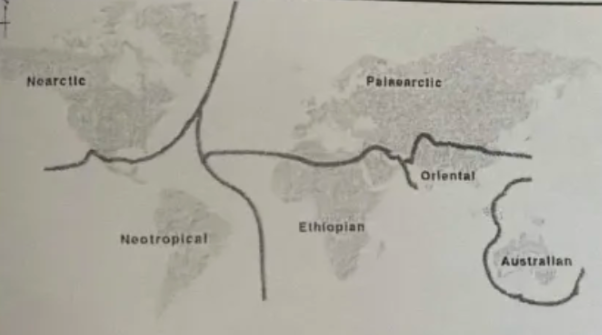
how does biogeography support Darin & Wallace’s Theory of Evolution by Natural Selection? give examples + the major biogeographical zones
Finding closely related species in same region rather than randomly placed around the world suggests evolution from common ancestor
Some exceptions to this (above dot point) because of continental drift
E.g. large flightless birds only found in continents in the Southern Hemisphere (Africa: ostrich, PNG: cassowary, Australia: emu)
World is divided into 6 major biogeographical zones
Boundaries drawn according to distribution of vertebrate groups
Regions are based on the relationships of birds
how do transition fossils support Darin & Wallace’s Theory of Evolution by Natural Selection? give examples
Show there are intermediate forms of distinct branches e.g. archaeopteryx has bird features (tail, teeth in beak, wings) and dinosaur features (beak, long neck, warm blood?)
Fossils
Show progression of evolution from simple to complex organisms
Helps determine lineages of now extinct organism by examining fossils & comparing them to other extinct & modern species
how does DNA hybridisation support Darin & Wallace’s Theory of Evolution by Natural Selection?
Separate strands of DNA from two species & mix together
More binding to form double strands = closer relationship
what are the techniques used to date fossils & the evidence produced?
relative age
absolute dating
radiometric dating
relative dating
index fossils
describe the technique relative age dating & give an example
If fossil is lower in rock strata than another fossil then the fossil is older
Gives evidence of life that has become extinct (e.g. trilobites)
describe the technique absolute dating & give an example
Determines how long ago a fossilised organism lived by studying radioactive elements
E.g. carbon 14 used
Knowledge of how long it takes for carbon-14 to decay to a lighter form determines the percentage of it remained in the fossil, thus determining age
Igneous layers (e.g. volcanic ash) are good to help with ageing layers of strata
describe the technique relative dating
Compares age of one fossil or rock with another to determine which is older
Relies on two basic facts:
Sedimentary rocks form strata (first & oldest stratum is found at bottom, younger & newer sediments then settles on top)
Fossils are the same age as the rocks they are found in
Sometimes lowest strata is not the oldest; rock layers may fold over each other & can be turned upside down by earth movements
define & describe the technique index fossils
Index fossils: fossils that can be used to compare the ages of strata in different locations
Comparing layers like this is called stratigraphy
To be used as an index fossil, species must:
Have been fairly widespread in where it lived
Have lived in a fairly narrow period of time
Have been abundant
Be easy to identify
what kinds of cane toads reproduced more & what did that lead to?
Faster & larger cane toads reproduced more → whole population is slowly getting faster
why will cane toads continue to reproduce?
No selection pressures on cane toads → will continue to reproduce at exponential rates
explain the modern-day example of evolution: non-resistant bacteria
Non-resistant bacteria exist → bacteria multiply by the millions (some will mutate) → some mutations make the bacterium drug resistant (in the presence of drugs, only drug resistant bacteria survive) → drug resistant bacteria multiply & thrive