All pathways and some important proteins (Exam 2)

0.0(0)
Studied by 0 people
call kaiCall Kai
Locked
learnLearn
examPractice Test
spaced repetitionSpaced Repetition
heart puzzleMatch
flashcardsFlashcards
GameKnowt Play
Card Sorting

1/38

flashcard set

Earn XP

Description and Tags

Exam 2

Last updated 10:00 PM on 8/25/26
Name
Mastery
Learn
Test
Matching
Spaced
Call with Kai
Chat

No analytics yet

Send a link to your students to track their progress

39 Terms

1
New cards

Aquaporins

provide quick channel movement of water and are faster than osmosis. Is selective to only water. Only allows water to pass. Hydronium and hydroxide ions are not allowed to pass through. Residues contribute to selectivity. Asn residues prevent proton hopping via H-bonds. Arg allows positively charged ions to be expelled

2
New cards

SERCA PUMP steps

1. Ca2+ and ATP bind; N domain moves

2. Phosphoryl group transferred to Asap351 in P domain 

3. Phosphorylation leads to conformational changes, releasing Ca2+ to the lumen

4. A domain moves causing release of ADP

5. P domain becomes dephosphorylated

6. A domain resets

7. P, T, and S domains reset to E1 conformation

Also has an A P and N domain
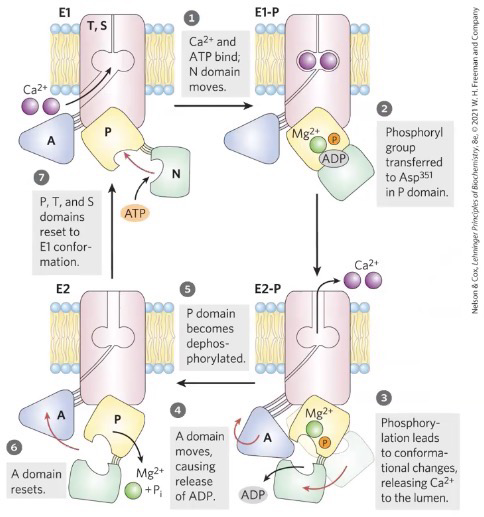
<p><span style="background-color: transparent;"><span>1. Ca2+ and ATP bind; N domain moves</span></span></p><p><span style="background-color: transparent;"><span>2. Phosphoryl group transferred to Asap351 in P domain&nbsp;</span></span></p><p><span style="background-color: transparent;"><span>3. Phosphorylation leads to conformational changes, releasing Ca2+ to the lumen</span></span></p><p><span style="background-color: transparent;"><span>4. A domain moves causing release of ADP</span></span></p><p><span style="background-color: transparent;"><span>5. P domain becomes dephosphorylated</span></span></p><p><span style="background-color: transparent;"><span>6. A domain resets</span></span></p><p><span style="background-color: transparent;"><span>7. P, T, and S domains reset to E1 conformation</span></span></p><p><span style="background-color: transparent;"><span>Also has an A P and N domain</span></span></p>
3
New cards

ATP-Binding Cassette (ABC) Transporters

pumps out of cell against a concentration gradient; Two ATPs bind to two Nucleotide binding domain, hydrolysis of ATP allows molecule to move; Commonly used to move toxic materials outside of cell
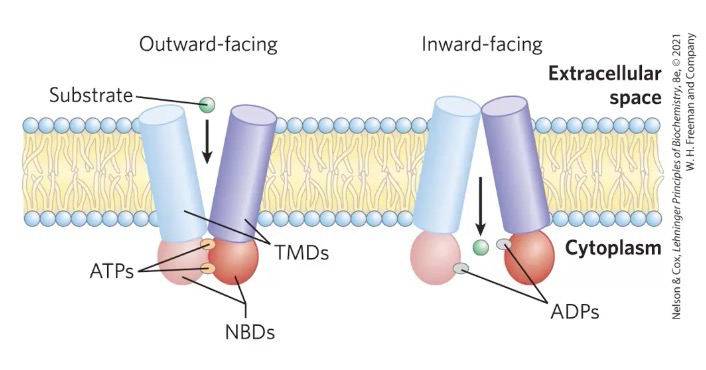
<p><span style="background-color: transparent;"><span>pumps out of cell against a concentration gradient; Two ATPs bind to two Nucleotide binding domain, hydrolysis of ATP allows molecule to move; Commonly used to move toxic materials outside of cell</span></span></p>
4
New cards

Cystic Fibrosis Transmembrane Conductance Regulator (CFTR)

an ATP gated ion channel that regulates fluid and salt balance; Although a channel, it’s classified as an ABC protein because it has two ATP binding cassettes, in this case ATP is used only to open the channel, not to transport, functions as an ion transport once opened; specific to Cl- but can also transport bicarbonate (HCO3-) (Leaky channel); particularly important for epithelial cells

5
New cards

CFTR operation

When CFTR is closed: R domain phosphorylated,  No ATP bound to NBD

When CFTR is open: R domain phosphorylated, ATP bound to NBDs

To close CFTR after opening: R domain dephosphorylated and no ATP bound to NBDs
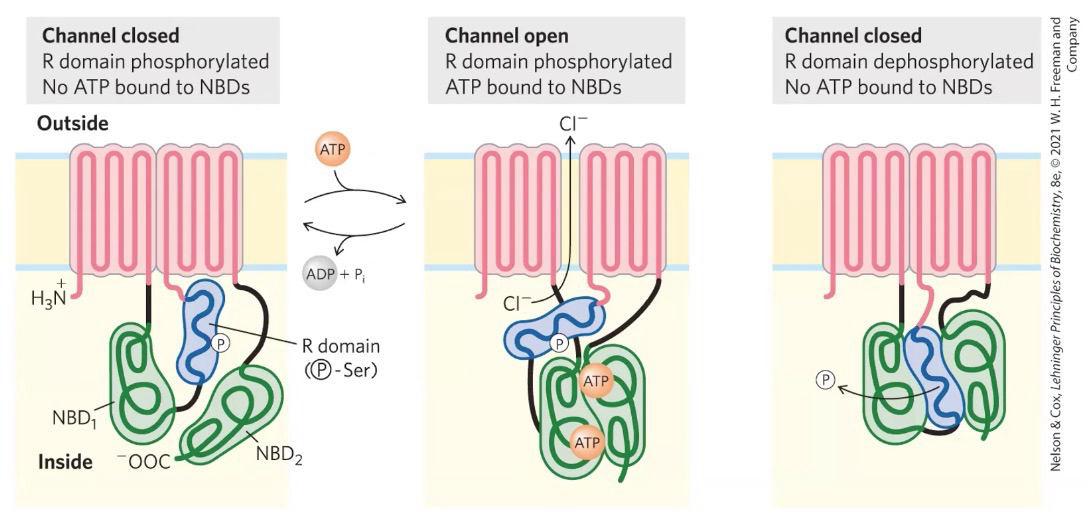
<p><span style="background-color: transparent;"><span>When CFTR is closed: R domain phosphorylated,&nbsp; No ATP bound to NBD</span></span></p><p><span style="background-color: transparent;"><span>When CFTR is open: R domain phosphorylated, ATP bound to NBDs</span></span></p><p><span style="background-color: transparent;"><span>To close CFTR after opening: R domain dephosphorylated and no ATP bound to NBDs</span></span></p>
6
New cards

β-adrenergic receptor; Process of operation

Ex of GPCR

Steps:

  1. Epinephrine binds to specific receptor (β-adrenergic receptor)

  2. Hormone-receptor complex causes GDP bound to Gsα to be replaced by GTP, activating the complex (No conversion, just exchange)

  3. Activated Gsα separates from Gsβγ and moves to adenylyl cyclase and activates it. Many Gs proteins can be activated by one receptor

  4. Adenylyl cyclase (effector enzyme) catalyses formation of cyclic AMP (second messenger); (ATP → cAMP)

  5. cAMP activates PKA

  6. Phosphorylation of cellular proteins by PKA causes cellular response to epinephrine

  7. cAMP is degraded (via phosphodiesterase), reversing the activation of PKA

Note the GPCR is not a channel or transporter; if there’s a signal, response continues, it does not enter cell
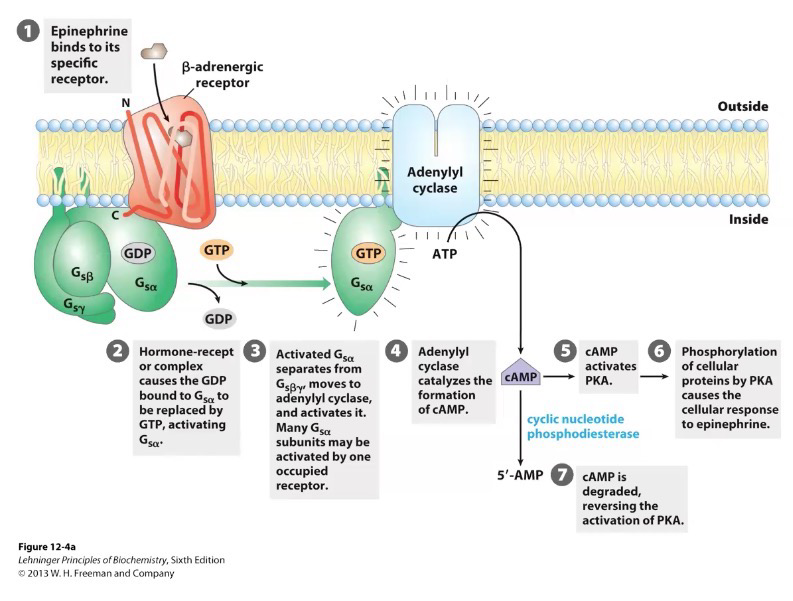
<p>Ex of GPCR</p><p>Steps:</p><ol><li><p>Epinephrine binds to specific receptor (β-adrenergic receptor)</p></li><li><p>Hormone-receptor complex causes GDP bound to G<sub>s</sub><span><sub><span>α</span></sub><span> to be replaced by GTP, activating the complex (No conversion, just exchange)</span></span></p></li><li><p><span><span>Activated </span></span>G<sub>s</sub><span><sub><span>α</span></sub><span> separates from G</span><sub><span>sβγ</span></sub><span> and moves to adenylyl cyclase and activates it. Many G</span><sub><span>s</span></sub><span> proteins can be activated by one receptor</span></span></p></li><li><p><span><span>Adenylyl cyclase (effector enzyme) catalyses formation of cyclic AMP (second messenger); (ATP → cAMP)</span></span></p></li><li><p><span><span>cAMP activates PKA</span></span></p></li><li><p><span><span>Phosphorylation of cellular proteins by PKA causes cellular response to epinephrine</span></span></p></li><li><p><span><span>cAMP is degraded (via phosphodiesterase), reversing the activation of PKA</span></span></p></li></ol><p>Note the GPCR is not a channel or transporter; if there’s a signal, response continues, it does not enter cell</p>
7
New cards

cAMP activation of protein kinase A (PKA)

Kinase phosphorylates target residues on protein (PKA does T and S)

cAMP (4) binds to 2 regulatory subunits (2 cAMPs each) and releases 2 inhibitor sequences to activate PKA

Can deactivate PKA function via phosphatases
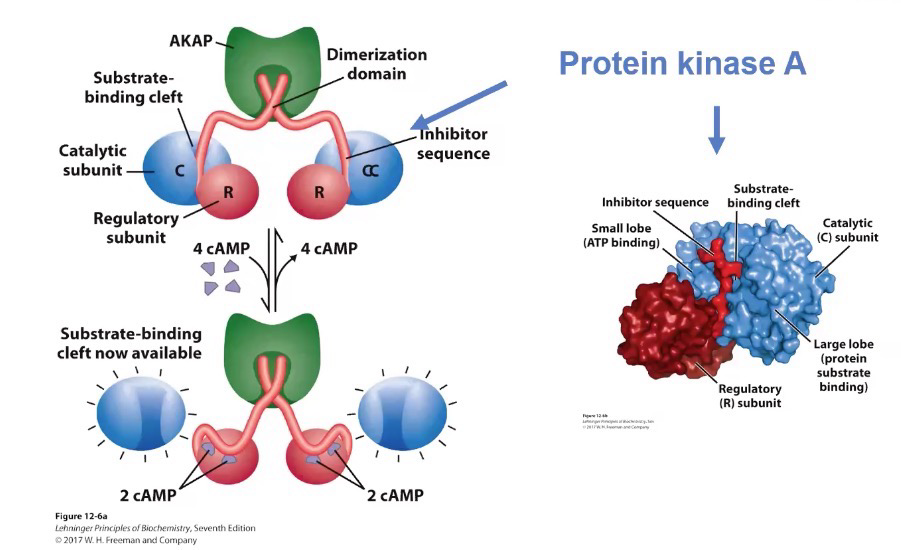
<p>Kinase phosphorylates target residues on protein (PKA does T and S)</p><p>cAMP (4) binds to 2 regulatory subunits (2 cAMPs each) and releases 2 inhibitor sequences to activate PKA</p><p>Can deactivate PKA function via phosphatases</p>
8
New cards

Other GPCRs: Effector enzyme Phospholipase C

Overall, similar in process to β-adrenergic receptor, it simply serves a different function

In this case, Gα binds to Phospholipase C and activates phosphatidyl inositol diphosphate (PIP: membrane lipid)

Releases two second messengers:

  1. Inositol triphosphate (IP3): Activates a gated Ca2+ channel, which activates protein kinase C

  2. Diacylglycerol (DAG): Diffuses down the membrane to also activate protein kinase C, which takes a PIP2 and cleaves it into IP3, activating another Ca2+ channel
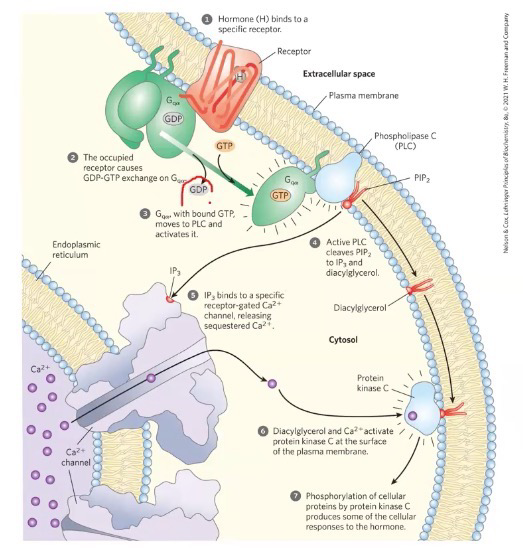

<p>Overall, similar in process to β-adrenergic receptor, it simply serves a different function</p><p>In this case, G<span><sub><span>α</span></sub><span> binds to Phospholipase C and activates phosphatidyl inositol diphosphate (PIP: membrane lipid)</span></span></p><p><span><span>Releases two second messengers:</span></span></p><ol><li><p><span><span>Inositol triphosphate (IP</span><sub><span>3</span></sub><span>): Activates a gated Ca</span><sup><span>2+</span></sup><span> channel, which activates protein kinase C</span></span></p></li><li><p><span><span>Diacylglycerol (DAG): Diffuses down the membrane to also activate protein kinase C, which takes a PIP</span><sub><span>2</span></sub><span> and cleaves it into IP</span><sub><span>3,</span></sub><span> activating another Ca</span><sup><span>2+</span></sup><span> channel</span></span></p></li></ol><p></p>
9
New cards

Process of Insulin Receptor (INSR) in regulating gene expression

  1. Insulin binds to INSR and causes autophosphorylation on its carboxyl-terminal Tyr residues

  2. Insulin receptor then phosphorylates IRS1 on its Tyr residue

  3. The phosphorylated Y on IRS1 then binds to a SH2 domain on Grb2, which then recruits an SOS domain that will bind to Ras (G protein), which will release GDP and bind to GTP

  4. Activated Ras binds and activates Raf-1

  5. Raf-1 phosphorylates MEK on two Ser residues. MEK then phosphorylates ERK on a Thr and a Tyr residue.

  6. ERK then translocates into the nucleus and phosphorylates nuclear transcription factors such as Elk1

  7. Phosphorylated Elk 1 joins SRF to stimulate transcription and translation of a set of genes needed for cell division

Notice cell division; this is why INSR is considered a cell growth factor

10
New cards

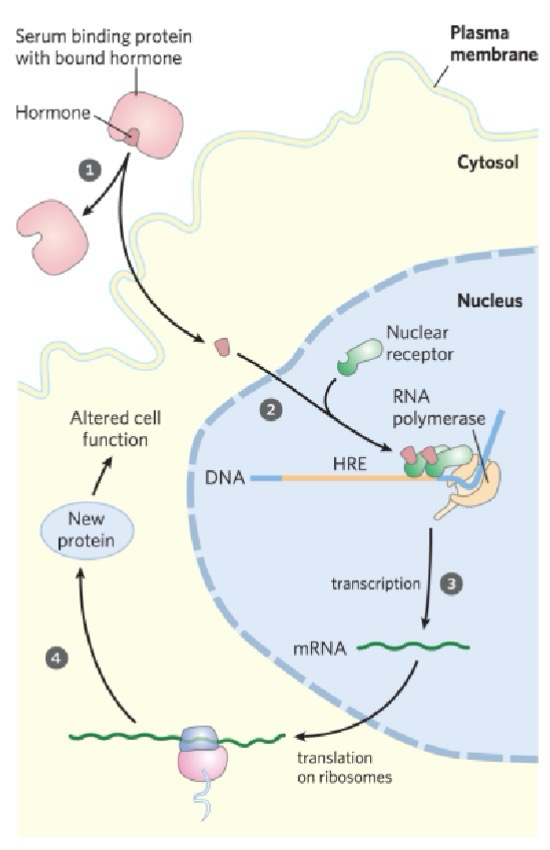
Nuclear hormone receptor - they're not integral membrane proteins, they are receptors that will be found in the


nucleus. Ligand diffuses through simple diffusion. Initiates gene transcription
<p><br><span><span>nucleus. Ligand diffuses through simple diffusion. Initiates gene transcription</span></span></p>
11
New cards

Insulin in regulation of metabolism

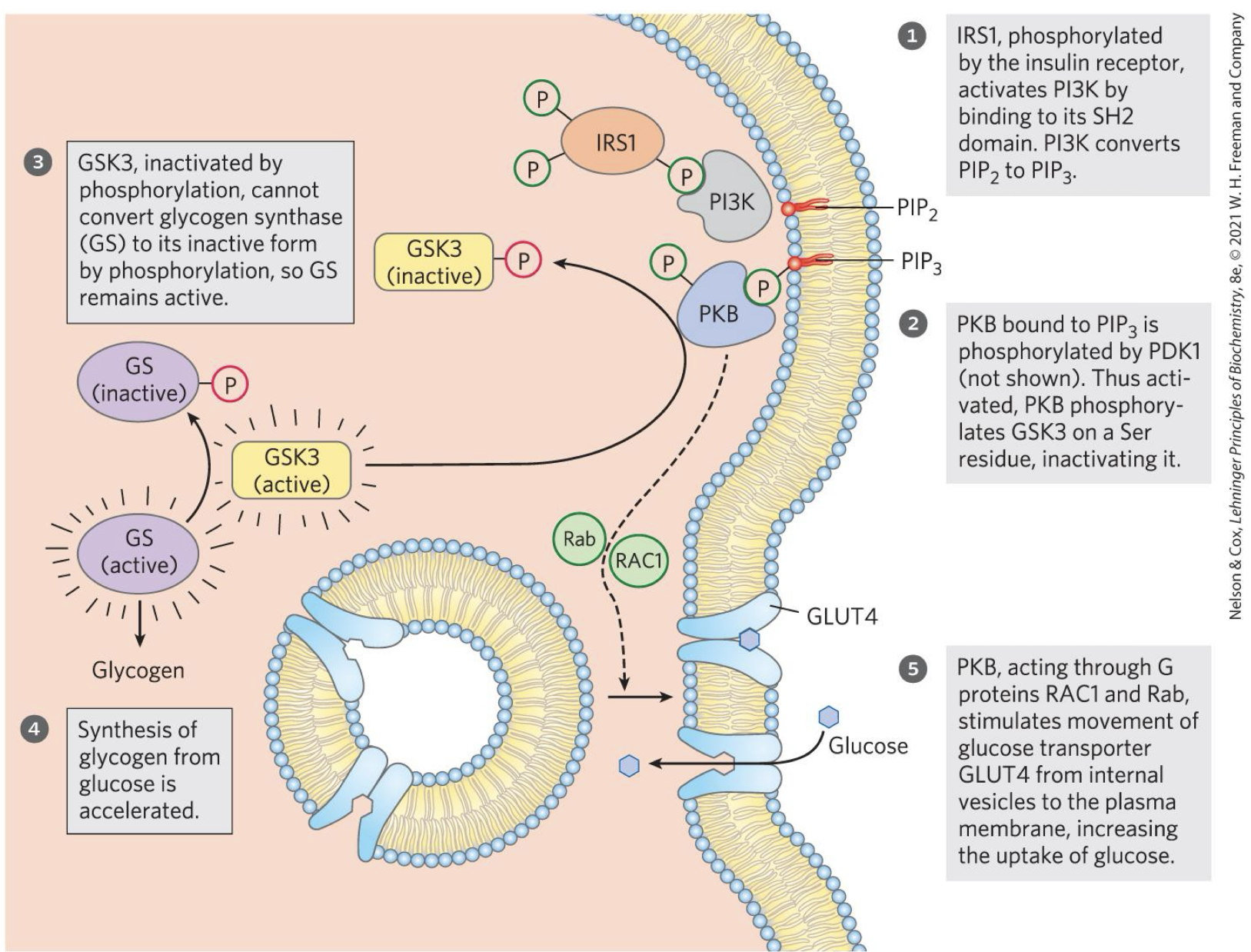
  1. IRS1 is phosphorylated and activates PI3K via SH2 site binding

  2. PIP2 from PI3K is converted to PIP3

  3. PIP3 is phosphorylated by PDK1, which activates PKB and causes GSK3 to be phosphorylated

  4. This allows glycogen synthase to remain active and continue glycogenesis

  5. PBK then activates a G-protein complex along with Rab and RAC1, stimulating the movement of glucose transporter GLUT4 from an internal vesicle onto the plasma membrane, increasing glucose uptake

<ol><li><p>IRS1 is phosphorylated and activates PI3K via SH2 site binding</p></li><li><p>PIP<sub>2</sub> from PI3K is converted to PIP<sub>3</sub></p></li><li><p>PIP<sub>3</sub> is phosphorylated by PDK1, which activates PKB and causes GSK3 to be phosphorylated</p></li><li><p>This allows glycogen synthase to remain active and continue glycogenesis</p></li><li><p>PBK then activates a G-protein complex along with Rab and RAC1, stimulating the movement of glucose transporter GLUT4 from an internal vesicle onto the plasma membrane, increasing glucose uptake</p></li></ol><p></p>
12
New cards

Steps of the preparatory phase of glycolysis (1-5); Which is and isn’t reversible

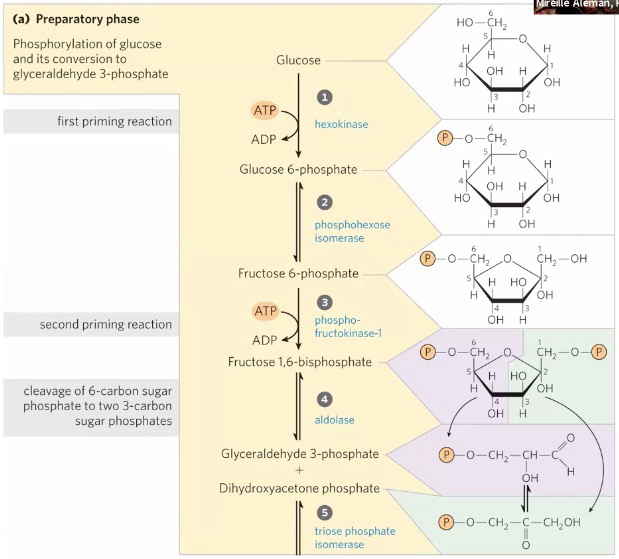
  1. Phosphorylation of Glucose to Glucose 6-phosphate (G6P) via hexokinase (Needs ATP and Mg2+); Irreversible

  2. Phosphohexose isomerase (Needs Mg2+) opens the G6P and turns it into Fructose 6-phosphate (F6P); Reversible

  3. F6P is converted into Fructose 1,6-bisphosphate (F16BP) via phosphofructokinase-1 (PFK-1) (Needs ATP and Mg2+); “commitment step” glycolysis MUST continue from this point; rate-limiting; irreversible

  4. F16BP is cleaved via aldolase to create Dihydroxyacetone phosphate (DHAP) and Glyceraldehyde 3-phosphate (GA3P); Reversible

  5. DHAP is converted to GA3P via triose phosphate isomerase; reversible

You end up with two GA3P
<ol><li><p>Phosphorylation of Glucose to Glucose 6-phosphate (G6P) via <strong>hexokinase</strong> (Needs ATP and Mg<sup>2+</sup>); Irreversible</p></li><li><p><strong>Phosphohexose isomerase</strong> (Needs Mg<sup>2+</sup>) opens the G6P and turns it into Fructose 6-phosphate (F6P); Reversible</p></li><li><p>F6P is converted into Fructose 1,6-bisphosphate (F16BP) via <strong>phosphofructokinase-1 (PFK-1) </strong>(Needs ATP and Mg<sup>2+</sup>); “commitment step” glycolysis MUST continue from this point; rate-limiting; irreversible</p></li><li><p>F16BP is cleaved via <strong>aldolase</strong> to create Dihydroxyacetone phosphate (DHAP) and Glyceraldehyde 3-phosphate (GA3P); Reversible</p></li><li><p>DHAP is converted to GA3P via <strong>triose phosphate isomerase</strong>; reversible</p></li></ol><p>You end up with <strong>two</strong> GA3P</p>
13
New cards

Steps of the payoff stage of glycolysis (6-10)

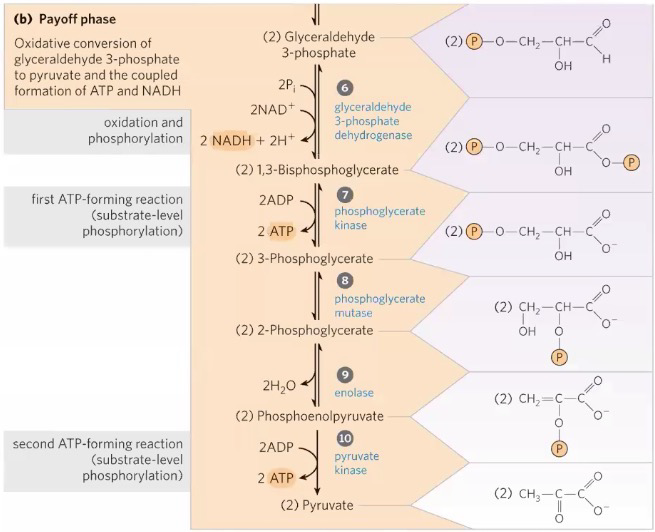
Remember: Each step results in two products for every one input of D-glucose (Basically, the steps happen twice)

  1. GA3P + inorganic phosphate (HPO4-2) makes 1,3-Bisphosphoglycerate (13-BPG) via glyceraldehyde 3-phosphate dehydrogenase (GAPDH). A reduction reaction that uses NAD+ (Converted to NADH + H+). Note: This reaction does not use ATP like the other phosphorylation reactions previously in this pathway.

  2. 12-BPG is used to phosphorilate ADP via phosphoglycerate kinase (Needs Mg2+), which creates 3-Phosphoglycerate (3PG) and ATP

  3. 3PG is converted into 2-phosphoglycerate (2PG) via phosphoglycerate mutase (Needs Mg2+)

  4. 2PG is converted to phosphoenolpyruvate (PEP) via enolase (Dehydration reaction)

  5. PEP is used to phosphorylate ADP via pyruvate kinase (Needs Mg2+ and K+), which creates pyruvate and ATP; Irreversible

<p>Remember: Each step results in <strong>two </strong>products for every <strong>one</strong> input of <sub>D</sub>-glucose (Basically, the steps happen twice)</p><ol start="6"><li><p>GA3P + inorganic phosphate (HPO<sub>4</sub><sup>-2</sup>) makes 1,3-Bisphosphoglycerate (13-BPG) via <strong>glyceraldehyde 3-phosphate dehydrogenase (GAPDH)</strong>. A reduction reaction that uses NAD<sup>+</sup> (Converted to NADH + H<sup>+</sup>). Note: This reaction does not use ATP like the other phosphorylation reactions previously in this pathway.</p></li><li><p>12-BPG is used to phosphorilate ADP via <strong>phosphoglycerate kinase </strong>(Needs Mg<sup>2+</sup>), which creates 3-Phosphoglycerate (3PG) and ATP</p></li><li><p>3PG is converted into 2-phosphoglycerate (2PG) via<strong> phosphoglycerate mutase</strong> (Needs Mg<sup>2+</sup>)</p></li><li><p>2PG is converted to phosphoenolpyruvate (PEP) via <strong>enolase</strong> (Dehydration reaction)</p></li><li><p>PEP is used to phosphorylate ADP via<strong> pyruvate kinase</strong> (Needs Mg<sup>2+</sup> and K<sup>+</sup>), which creates pyruvate and ATP; Irreversible</p></li></ol><p></p>
14
New cards

Mnemonic for Glycolysis Products

Gross - glucose

Guys - glucose-6-phosphate

Favor - fructose-6-phosphate

Fat Butts - fructose-1,6-bisphosphate

Good - glyceraldehyde-3-phosphate

Boys - 1,3-bisphosphoglycerate

Prefer - 3-phosphoglycerate

Pretty - 2-phosphoglycerate

Pink - phosphoenol pyruvate

Pussies - pyruvate

15
New cards

Mnemonic for Glycolysis Enzymes

Honestly: Hexokinase

Ignoring: Isomerase (Phosphohexose)

Penis: Phosphofructokinase-1

And: Adolase

Instead: Isomerase (Triose phosphate)

Getting: Glyceraldehyde 3-phosphate dehydrogenase

Pussy: Phosphoglycerate Kinase

Makes: Mutase

Everything: Enolase

Perfect: Pyruvate Kinase

16
New cards

Glucose-Alanine cycle

  • Alanine can undergo alanine amino transferase to make pyruvate

  • Muscles store their own glycogen pool that can be used to make glucose, then to pyruvate. Pyruvate undergoes alanine amino transferase, moves to the liver, is converted back to pyruvate, converted to glucose, then shipped into blood as glucose

  • Also safely transports ammonia (NH4+) to the liver for removal


<ul><li><p><span style="background-color: transparent;"><span>Alanine can undergo alanine amino transferase to make pyruvate</span></span></p></li><li><p><span style="background-color: transparent;"><span>Muscles store their own glycogen pool that can be used to make glucose, then to pyruvate. Pyruvate undergoes alanine amino transferase, moves to the liver, is converted back to pyruvate, converted to glucose, then shipped into blood as glucose</span></span></p></li><li><p><span style="background-color: transparent;"><span>Also safely transports ammonia (NH</span><sub><span>4</span></sub><sup><span>+</span></sup><span>) to the liver for removal</span></span></p></li></ul><p></p>
17
New cards

Cori cycle


Glycogen in muscles makes lactate, which goes into the blood and moves to the liver, where ATP can make glucose from lactate. (prevents lactic acidosis)

<p><br><span><span>Glycogen in muscles makes lactate, which goes into the blood and moves to the liver, where ATP can make glucose from lactate. (prevents lactic acidosis)</span></span></p>
18
New cards

Reactions of Gluconeogenesis (The bypasses)

Bypass 1: Pyruvate → Oxaloacetate → Phosphoenolpyruvate (PEP)

  1. Pyruvate is shipped into the mitochondria (Via mitochondrial pyruvate carriers). Pyruvate carboxylase (mitochondrial enzyme) creates oxaloacetate. (Needs ATP, biotin (From vitamin B7), a CO2 carrier bicarbonate (HCO3-), and acetyl-CoA as an allosteric activator)

  2. Oxaloacetate is converted to Malate via malate dehydrogenase and moved to the cytosol where it is converted back. Phosphoenolpyruvate carboxykinase (PEPCK) then converts oxaloacetate to PEP and CO2 (Needs GTP).

Malate conversion requires energy, but it ends up being net neutral when it’s converted back to oxaloacetate

PEPCK exists in both the mitochondria (For lactate processing) and the cytosol (For gluconeogenesis)

Bypass 2: Fructose 1,6-bisphosphate (F16BP) → Fructose 6-phosphate (F6P)

  1. Via Fructose 1,6-bisphosphatase (FBPase-1), Needs H2O and creates Pi byproduct

Bypass 3: Glucose 6-phosphate (G6P) → Glucose

  1. Via Glucose 6-phosphatase (Found in ER), Needs H2O and creates Pi byproduct

Bypasses 2 and 3 are spontaneous (-ΔG)

<p>Bypass 1: Pyruvate → Oxaloacetate → Phosphoenolpyruvate (PEP)</p><ol><li><p>Pyruvate is shipped into the mitochondria (Via mitochondrial pyruvate carriers). <strong>Pyruvate carboxylase</strong> (mitochondrial enzyme) creates oxaloacetate. (Needs ATP, biotin (From vitamin B<sub>7</sub>), a CO<sub>2</sub> carrier bicarbonate (HCO<sub>3</sub><sup>-</sup>), and acetyl-CoA as an allosteric activator)</p></li><li><p>Oxaloacetate is converted to Malate via <strong>malate dehydrogenase</strong> and moved to the cytosol where it is converted back. <strong>Phosphoenolpyruvate carboxykinase (PEPCK)</strong> then converts oxaloacetate to PEP and CO<sub>2 </sub>(Needs GTP).</p></li></ol><p>Malate conversion requires energy, but it ends up being net neutral when it’s converted back to oxaloacetate</p><p>PEPCK exists in both the mitochondria (For lactate processing) and the cytosol (For gluconeogenesis)</p><p>Bypass 2: Fructose 1,6-bisphosphate (F16BP) → Fructose 6-phosphate (F6P)</p><ol><li><p>Via <strong>Fructose 1,6-bisphosphatase (FBPase-1)</strong>, Needs H<sub>2</sub>O and creates P<sub>i</sub> byproduct</p></li></ol><p>Bypass 3: Glucose 6-phosphate (G6P) → Glucose</p><ol><li><p>Via <strong>Glucose 6-phosphatase</strong> (Found in ER), Needs H<sub>2</sub>O and creates P<sub>i</sub> byproduct</p></li></ol><p>Bypasses 2 and 3 are spontaneous (-ΔG)</p>
19
New cards

Steps of reducing hydrogen peroxide into water, why is this necessary?

  1. G6P is converted to 6-Phosphoglucono-δ-lactone via glucose-6-phosphate dehydrogenase (G6PD), this requires NADP+ and creates NADPH + H+

  2. These by-products are used by glutathione reductase to produce NADP+ and convert glutathione disulfide (GSSD) to two molecules of reduced glutathione (GSH)

  3. 2GSH is used by glutathione peroxidase to convert H2O2 to two water molecules. The 2GSH is converted back to GSSG

This is necessary to prevent harmful radical formation (OH-) in the body

GSH also inhibits hydroxyl free radicals from causing damage to the body
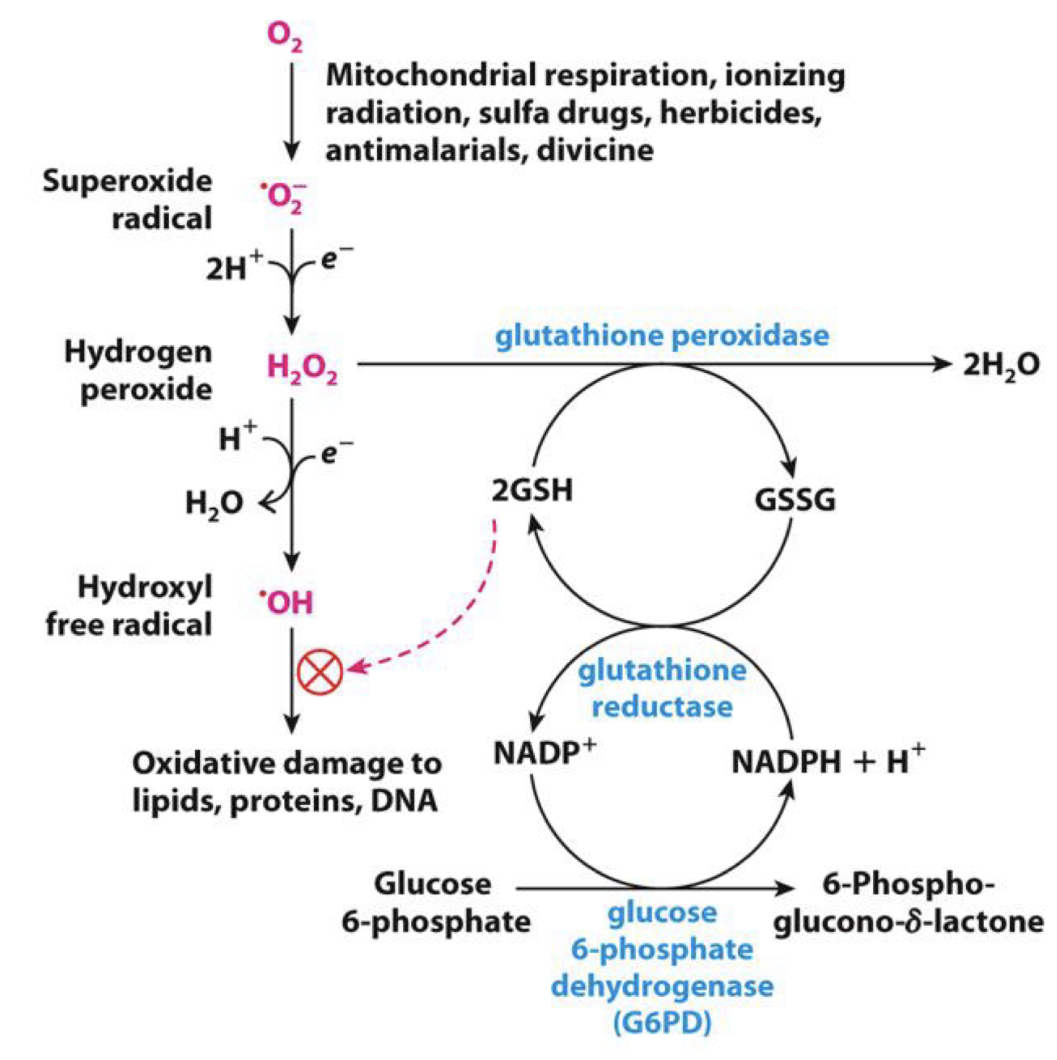
<ol><li><p>G6P is converted to 6-Phosphoglucono-δ-lactone via <strong>glucose-6-phosphate dehydrogenase (G6PD)</strong>, this requires NADP<sup>+</sup> and creates NADPH + H<sup>+</sup></p></li><li><p>These by-products are used by<strong> glutathione reductase </strong>to produce NADP<sup>+</sup> and convert glutathione disulfide (GSSD) to two molecules of reduced glutathione (GSH)</p></li><li><p>2GSH is used by<strong> glutathione peroxidase</strong> to convert H<sub>2</sub>O<sub>2</sub> to two water molecules. The 2GSH is converted back to GSSG</p></li></ol><p>This is necessary to prevent harmful radical formation (OH<sup>-</sup>) in the body</p><p>GSH also inhibits hydroxyl free radicals from causing damage to the body</p>
20
New cards

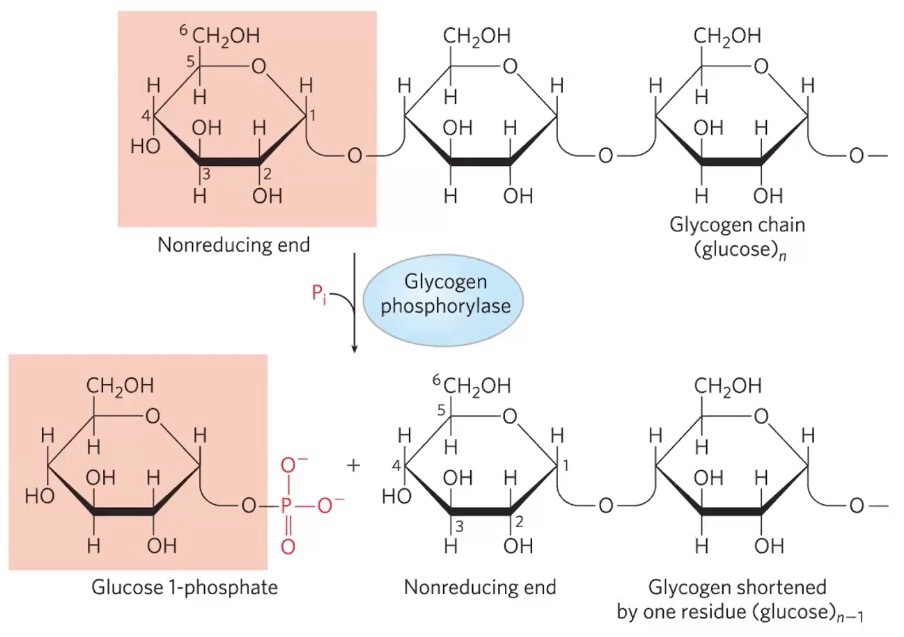
Glycogen phosphorylase - catalyze the phosphorolytic cleavage of

non-reducing end of glycogen chains

  • A form is active

  • B form is inactive

Needs Pi

<p>non-reducing end of glycogen chains</p><ul><li><p><span style="background-color: transparent;"><span>A form is active</span></span></p></li><li><p><span style="background-color: transparent;"><span>B form is inactive</span></span></p></li></ul><p>Needs P<sub>i</sub></p>
21
New cards

Debranching enzyme


Once glycogen has been reduced to 4 glucose on one branch, it will act as a transferase and transfer 3 of the 4 glucose onto the linear chain onto another linear chain on the non-reducing end and act as a glucosidase to release the remaining (α1→6) glucose (not G1P).

<p></p><p>Once glycogen has been reduced to 4 glucose on one branch, it will act as a transferase and transfer 3 of the 4 glucose onto the linear chain onto another linear chain on the non-reducing end and act as a glucosidase to release the remaining (α1→6) glucose (not G1P).</p>
22
New cards

Phosphoglucomutase catalyzes

glucose 1-phosphate into glucose 6-phosphate

  • In order to use it in other pathways

  • Saves 1 ATP for glycolysis and increases the net ATP production to 3 (Bc hexokinase needs ATP)

  • Primarily in muscle (think energy needs)

Reversible

23
New cards

To build glycogen we need; What enzyme and substrates/products?

activated sugar nucleotides (UDP-glucose); UTP + G1P turns into UDP-glucose + PPi via UDP-glucose pyrophosphorylase
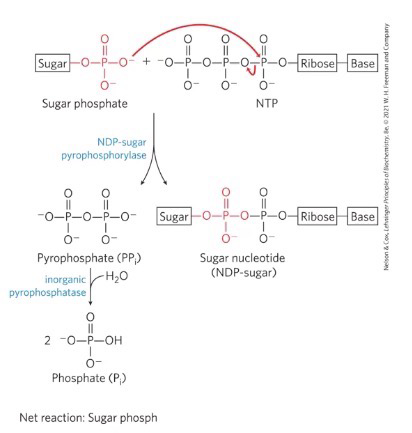
<p>activated sugar nucleotides (UDP-glucose); UTP + G1P turns into UDP-glucose + PP<sub>i</sub> via UDP-glucose pyrophosphorylase</p>
24
New cards

Glycogen synthase

Catalyzes transfer of glucose from UDP glucose to growing glycogen (α1→4) from the non-reducing end; Also has a and b form (active/inactive)

25
New cards

How is pyruvate processed under anaerobic conditions? Why is this necessary?


Under hypoxic/anaerobic conditions, pyruvate accumulates, and there’s a low level of NAD+ necessary to continue glycolysis. Lactate/ethanol fermentation solves this issue by processing pyruvate into lactate or ethanol and CO2, and producing NAD+; this allows glycolysis to continue
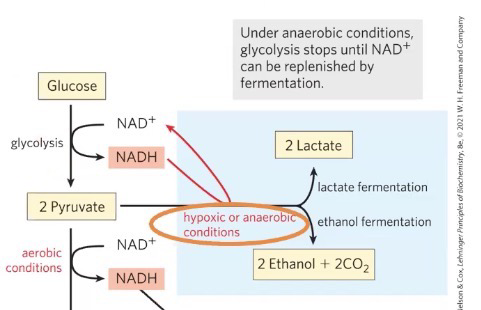
<p><br><span><span>Under hypoxic/anaerobic conditions, pyruvate accumulates, and there’s a low level of NAD</span></span><sup>+</sup><span><span> necessary to continue glycolysis. Lactate/ethanol fermentation solves this issue by processing pyruvate into lactate or ethanol and CO</span></span><sub>2,</sub><span><span> and producing NAD</span></span><sup>+</sup><span><span>; this allows glycolysis to continue</span></span></p>
26
New cards

Lactate dehydrogenase


Pyruvate + NADH + H+ → L-Lactate + NAD+; certain parts of the body produces lactase for certain processes
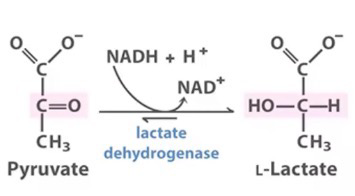
<p></p><p>Pyruvate + NADH + H<sup>+</sup> → L-Lactate + NAD<sup>+</sup>; certain parts of the body produces lactase for certain processes</p>
27
New cards

Pyruvate Dehydrogenase Complex (PDH); Basic information

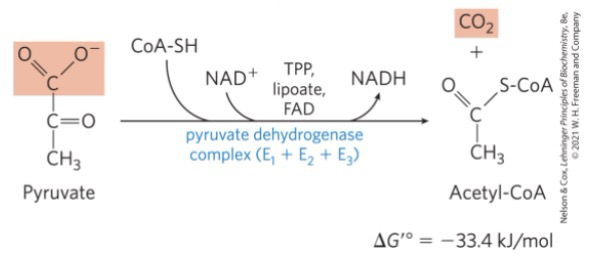
Function: Processes pyruvate into Acetyl-CoA and CO2 (First CO2 releasing process)

Three main enzymes: E1, E2, and E3

Also contains regulatory kinase and phosphatase; Each complex contains several subunits of the E complex; Overall reaction is a large -ΔG
<p>Function: Processes pyruvate into Acetyl-CoA and CO<sub>2</sub> (First CO<sub>2</sub> releasing process)</p><p>Three main enzymes: E<sub>1,</sub> E<sub>2,</sub> and E<sub>3</sub></p><p>Also contains regulatory kinase and phosphatase; Each complex contains several subunits of the E complex; Overall reaction is a large -ΔG</p>
28
New cards

E1 name, function, and cofactor information


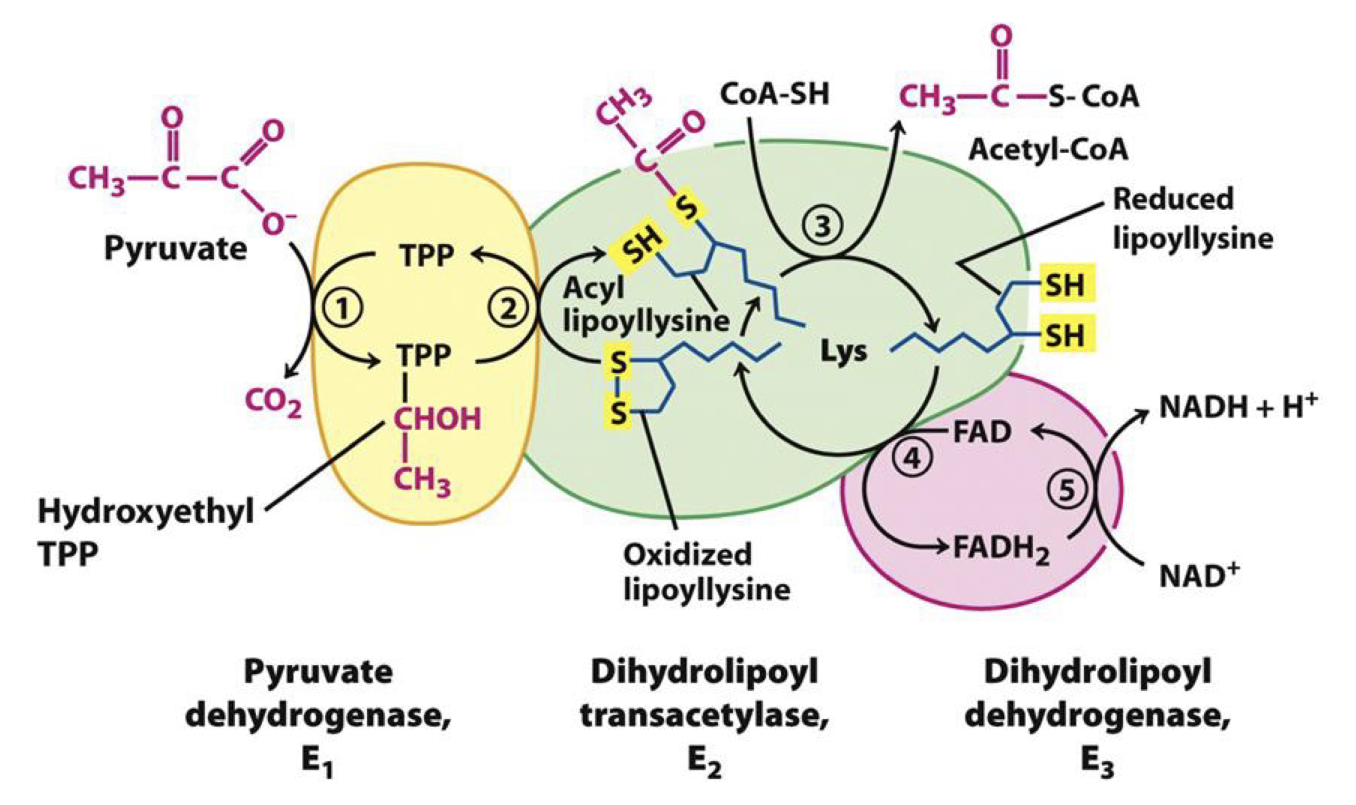
  • Pyruvate Dehydrogenase: Pyruvate goes through decarboxylation reaction, releasing CO2 and generating Hydroxyethyl TPP

  • Cofactors - Thiamine pyrophosphate (TPP)

    • From Thiamine/Vitamin B1; Contains C-H group on thiazolium ring that participates in E reaction

<p></p><ul><li><p><strong>Pyruvate Dehydrogenase:</strong> Pyruvate goes through decarboxylation reaction, releasing CO<sub>2</sub> and generating Hydroxyethyl TPP</p></li><li><p>Cofactors - Thiamine pyrophosphate (TPP)</p><ul><li><p>From <strong>Thiamine/Vitamin B1</strong>; Contains C-H group on thiazolium ring that participates in E reaction</p></li></ul></li></ul><p></p>
29
New cards

E2 name, function, and cofactor information

  • Dihydrolipoyl transacetylase: Oxidized lipoyllysine (on E2) takes the hydroxyethyl group from TPP and reduces it to form acyl lipoyllysine (Thiol ester). The acetyl structure is then transferred onto CoA-SH to form Acetyl-CoA. Leaves lipoyllysine in reduced state.

  • Cofactor - Coenzyme A (CoA-SH) and Lipoic acid (lipoate)

    • CoA-SH: From pantothenic acid/Vitamin B5; Contains a reactive thiol group (thiazolium ring) that forms a thioester with acetate to produce acetyl-CoA; written as CoA-SH to show it hasn’t yet formed a thioester bond

    • Lipoate: Provides reactive disulfide that can participate in reaction; Bound to Lys in E2; Oxidized has ring structure → reduced to two disulfide bonds → acetylated in the E2 reaction; Is on the enzyme


<ul><li><p><strong>Dihydrolipoyl transacetylase: </strong>Oxidized lipoyllysine (on E<sub>2</sub>) takes the hydroxyethyl group from TPP and reduces it to form acyl lipoyllysine (Thiol ester). The acetyl structure is then transferred onto CoA-SH to form Acetyl-CoA. Leaves lipoyllysine in reduced state.</p></li><li><p>Cofactor - Coenzyme A (CoA-SH) and Lipoic acid (lipoate)</p><ul><li><p>CoA-SH: From <strong>pantothenic acid/Vitamin B5</strong>; Contains a reactive thiol group (thiazolium ring) that forms a thioester with acetate to produce acetyl-CoA; written as CoA-SH to show it hasn’t yet formed a thioester bond</p></li><li><p>Lipoate: Provides reactive disulfide that can participate in reaction; Bound to Lys in E<sub>2</sub>; Oxidized has ring structure → reduced to two disulfide bonds → acetylated in the E<sub>2</sub> reaction; Is on the enzyme</p></li></ul></li></ul><p></p>
30
New cards

E3 name, function, and cofactor information

  • Dihydrolipoyl dehydrogenase: Reoxidizes lipoyllysine to restore function via FAD. The FADH2 formed is reduced using NAD+, creating NADH + H+

  • Cofactor - Flavin adenine dinucleotide (FAD) and NAD+

    • FAD: From Riboflavin/Vitamin B2; B2 is also a precursor to flavin mononucleotide (FMN); FAD and FMN both participate in redox reactions; Tightly bound to enzyme so reduction and oxidation occur in the same spot; Can be reduced twice: FAD → FADH (Semiquinone intermediate) → FADH2

    • NAD+: From Niacin/nicotinic acid/vitamin B3; Accepts 2H at once: NAD+ → NADH (no intermediate); mobile electron carrier


<ul><li><p><strong>Dihydrolipoyl dehydrogenase:</strong> Reoxidizes lipoyllysine to restore function via FAD. The FADH<sub>2</sub> formed is reduced using NAD<sup>+</sup>, creating NADH + H<sup>+</sup></p></li><li><p>Cofactor - Flavin adenine dinucleotide (FAD) and NAD<sup>+</sup></p><ul><li><p>FAD: From <strong>Riboflavin/Vitamin B2</strong>; B2 is also a precursor to flavin mononucleotide (FMN); FAD and FMN both participate in redox reactions; Tightly bound to enzyme so reduction and oxidation occur in the same spot; Can be reduced twice: FAD → FADH (Semiquinone intermediate) → FADH<sub>2</sub></p></li><li><p>NAD<sup>+</sup>: From<strong> Niacin/nicotinic acid/vitamin B3</strong>; Accepts 2H at once: NAD<sup>+</sup> → NADH (no intermediate); mobile electron carrier</p></li></ul></li></ul><p></p>
31
New cards

Reactions of The Citric Acid Cycle (TCA cycle)

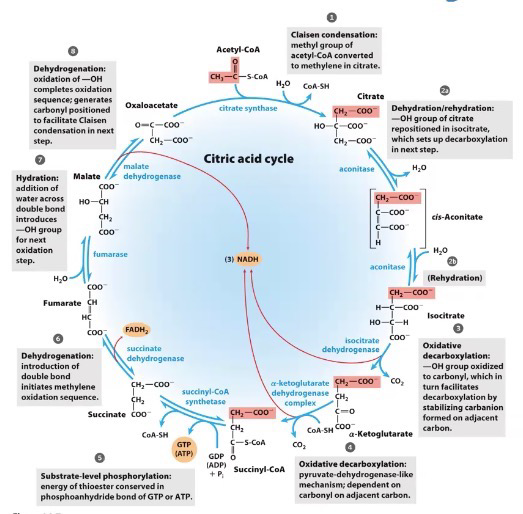
  1. Acetyl-CoA + Oxaloacetate/OAA (Gluconeogenesis) → Citrate via Citrate synthase (Creates CoA-SH byproduct); Large -ΔG; Irreversible

  2. Citrate → Isocitrate via aconitase; Dehydrating and rehydrating to move an OH group (Tert to Sec alc), creating a more accessible area for reduction

  3. Isocitrate → α-Ketoglutarate (α-KG) via Isocitrate dehydrogenase (Needs NAD(P)+), creates NAD(P)H + H+ + CO2 as byproduct; Irreversible

  4. α-KG → Succinyl-CoA via α-Ketoglutarate dehydrogenase complex (Needs CoA-SH + NAD+), creates NADH + CO2 byproduct; This complex is similar to PDH (Has all 3 Ex subunits); Irreversible

  5. Succinyl-CoA → Succinate via succinyl-CoA synthetase (substrate-level phosphorylation), removes CoA group (CoA-SH), and turns GDP/ADP to GTP/ATP

  6. Succinate → Fumarate via succinate dehydrogenase (Needs FAD), makes FADH2 byproduct

  7. Fumarate → L-Malate via fumarase

  8. L-Malate → Oxaloacetate via L-malate dehydrogenase (Needs NAD+) NADH + H+ byproduct

If not specified, reversible

Notes: Step 8: Oxaloacetate sink (Low concentration) drives the reaction forward

There are several ways to enter the TCA cycle
<ol><li><p>Acetyl-CoA + Oxaloacetate/OAA (Gluconeogenesis) → Citrate via <strong>Citrate synthase</strong> (Creates CoA-SH byproduct); Large -ΔG; Irreversible</p></li><li><p>Citrate → Isocitrate via <strong>aconitase</strong>; Dehydrating and rehydrating to move an OH group (Tert to Sec alc), creating a more accessible area for reduction</p></li><li><p>Isocitrate → α-Ketoglutarate (α-KG) via<strong> Isocitrate dehydrogenase</strong> (Needs NAD(P)<sup>+</sup>), creates NAD(P)H + H<sup>+</sup> + CO<sub>2</sub> as byproduct; Irreversible</p></li><li><p>α-KG → Succinyl-CoA via <strong>α-Ketoglutarate dehydrogenase complex</strong> (Needs CoA-SH + NAD<sup>+</sup>), creates NADH + CO<sub>2</sub> byproduct; This complex is similar to PDH (Has all 3 E<sub>x</sub> subunits); Irreversible</p></li><li><p>Succinyl-CoA → Succinate via <strong>succinyl-CoA synthetase</strong> (substrate-level phosphorylation), removes CoA group (CoA-SH), and turns GDP/ADP to GTP/ATP</p></li><li><p>Succinate → Fumarate via <strong>succinate dehydrogenase </strong>(Needs FAD), makes FADH<sub>2</sub> byproduct</p></li><li><p>Fumarate → <sub>L</sub>-Malate via <strong>fumarase</strong></p></li><li><p><sub>L</sub>-Malate → Oxaloacetate via<strong> <sub>L</sub>-malate dehydrogenase </strong>(Needs NAD<sup>+</sup>) NADH + H<sup>+</sup> byproduct</p></li></ol><p>If not specified, reversible</p><p>Notes: Step 8: Oxaloacetate sink (Low concentration) drives the reaction forward</p><p>There are several ways to enter the TCA cycle</p>
32
New cards

TCA Mnemonic (Enzymes)

Can (Citrate synthase)

Anyone (Aconitase)

Interested (Isocitrate dehydrogenase)

Kindly (a-Ketoglutarate dehydrogenase)

Send (Succinyl-CoA synthetase)

Some (Succinate dehydrogenase)

Fucking (Fumarase)

Money (Malate dehydrogenase)

33
New cards

TCA Mnemonic (Products)

Can → Citrate

I → Isocitrate

Keep → α-Ketoglutarate

Selling → Succinyl-CoA

Sex → Succinate

For → Fumarate

Money → Malate

Officer → Oxaloacetate

34
New cards

ETC Net Equation and summary


Electrons from NADH pass Complex I to CoQ, Succinate dehydrogenase on Complex II also pass electrons to CoQ. This is all passed through Complex III, then CytC, and lastly through Complex IV, where O2 accepts and turns into water. Complex I, III, and IV facilitate H+ pumping to P side.

Net eq: 2 NADH + 22H+N + O2 → 2 NAD+ + 20H+P + 2H2O

22H on mitochondrial (N/negative) side is either pumped to intermembrane space (P/positive) or converted to water

<p></p><p>Electrons from NADH pass Complex I to CoQ, Succinate dehydrogenase on Complex II also pass electrons to CoQ. This is all passed through Complex III, then CytC, and lastly through Complex IV, where O<sub>2</sub> accepts and turns into water. Complex I, III, and IV facilitate H<sup>+</sup> pumping to P side.</p><p>Net eq: 2 NADH + 22H<sup>+</sup><sub>N</sub> + O<sub>2</sub> → 2 NAD<sup>+</sup> + 20H<sup>+</sup><sub>P</sub> + 2H<sub>2</sub>O</p><p>22H on mitochondrial (N/negative) side is either pumped to intermembrane space (P/positive) or converted to water</p>
35
New cards

Complex 1 (ubiquinone oxidyl reductase/NADH dehydrogenase)


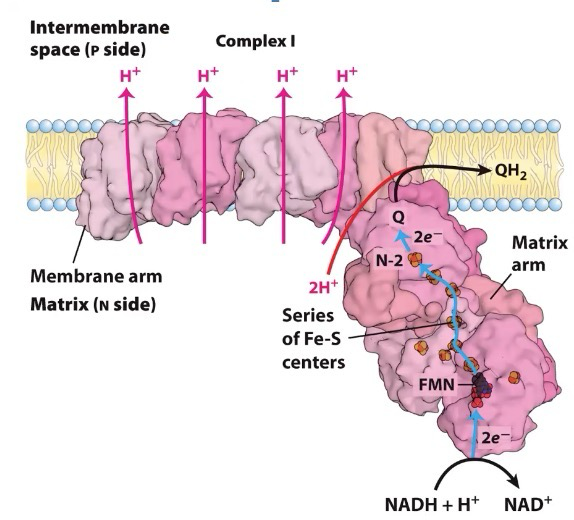
  • Large L shape enzyme

  • Firmly embedded in the inner membrane (integral)

  • Catalyzes NADH + H+ + Q → NAD+ and QH2

  • FMN accepts 2e- from NADH + H+

  • Pumps protons from matrix (n) to intermembrane space (p)

  • Creating a proton gradient which creates potential energy

  • Series of Fe-S centers accepts electrons

<p></p><ul><li><p><span style="background-color: transparent;"><span>Large L shape enzyme</span></span></p></li><li><p><span style="background-color: transparent;"><span>Firmly embedded in the inner membrane (integral)</span></span></p></li><li><p><span style="background-color: transparent;"><span>Catalyzes NADH + H</span><sup><span>+</span></sup><span> + Q → NAD</span><sup><span>+</span></sup><span> and QH</span><sub><span>2</span></sub></span></p></li><li><p>FMN accepts 2e<sup>-</sup> from<span style="background-color: transparent;"><span> NADH + H</span><sup><span>+</span></sup></span></p></li><li><p><span style="background-color: transparent;"><span>Pumps protons from matrix (n) to intermembrane space (p)</span></span></p></li><li><p><span style="background-color: transparent;"><span>Creating a proton gradient which creates potential energy</span></span></p></li><li><p><span style="background-color: transparent;"><span>Series of Fe-S centers accepts electrons</span></span></p></li></ul><p></p>
36
New cards

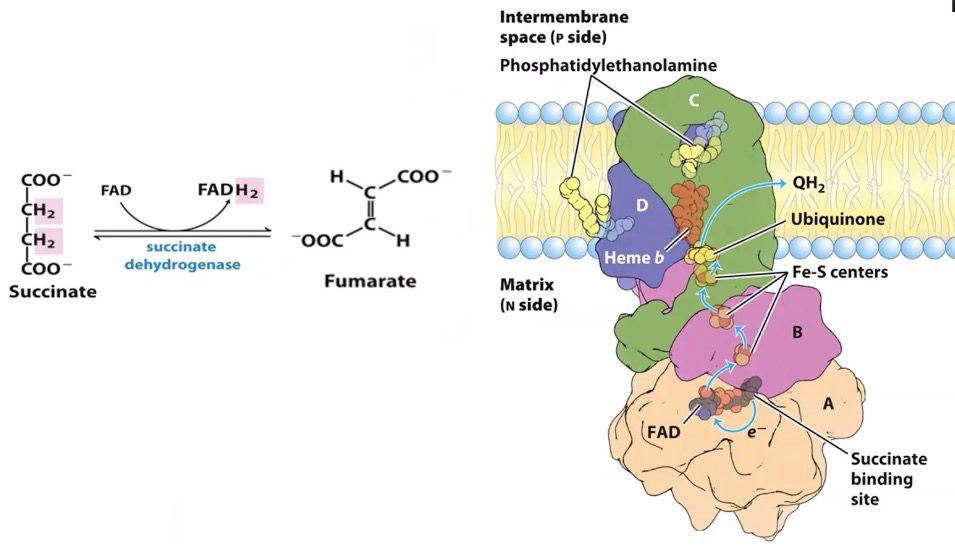
Complex 2


  • Succinate dehydrogenase converts FAD to FADH2 (Recall TCA)

  • Not pumping protons 

  • CoQ accepts electrons from complex two and is reduced to QH2

  • Series of Fe-S centers accepts electrons

  • FAD has less energy than NADH


<p></p><ul><li><p><span style="background-color: transparent;"><span>Succinate dehydrogenase converts FAD to FADH</span><sub><span>2</span></sub><span> (Recall TCA)</span></span></p></li><li><p><span style="background-color: transparent;"><span>Not pumping protons&nbsp;</span></span></p></li><li><p><span style="background-color: transparent;"><span>CoQ accepts electrons from complex two and is reduced to QH2</span></span></p></li><li><p><span style="background-color: transparent;"><span>Series of Fe-S centers accepts electrons</span></span></p></li><li><p><span style="background-color: transparent;"><span>FAD has less energy than NADH</span></span></p></li></ul><p></p>
37
New cards

Complex 3


  • QH2 oxidized

  • Proton pumping

  • Iron sulfur centers and cytochromes pass around electrons to cytochrome c where QH2 → Q

  • Cytochrome C is mobile and is an electron acceptor/carrier

  • Cytochromes present b and c

  • Cytochrome C - soluble peripheral protein of intermembrane space
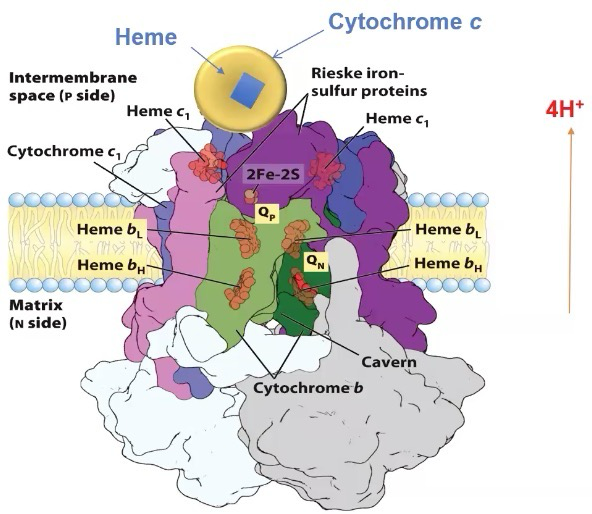

<p></p><ul><li><p><span style="background-color: transparent;"><span>QH</span><sub><span>2</span></sub><span> oxidized</span></span></p></li><li><p><span style="background-color: transparent;"><span>Proton pumping</span></span></p></li><li><p><span style="background-color: transparent;"><span>Iron sulfur centers and cytochromes pass around electrons to cytochrome c where QH</span><sub><span>2</span></sub><span> → Q</span></span></p></li><li><p><span style="background-color: transparent;"><span>Cytochrome C is mobile and is an electron acceptor/carrier</span></span></p></li><li><p><span style="background-color: transparent;"><span>Cytochromes present b and c</span></span></p></li><li><p><span style="background-color: transparent;"><span>Cytochrome C - soluble peripheral protein of intermembrane space</span></span></p></li></ul><p></p>
38
New cards

Complex 4


  • Cytochrome C in reduced form transfers electrons into complex four

  • Large dimeric 

  • 3 subunits

  • Contains Heme a and Heme a3

  • Passes electrons from a series of Hemes, O2 accepts electrons, makes water

  • Pumps protons

  • Cyanide (CN-) inhibits


<p></p><ul><li><p><span style="background-color: transparent;"><span>Cytochrome C in reduced form transfers electrons into complex four</span></span></p></li><li><p><span style="background-color: transparent;"><span>Large dimeric&nbsp;</span></span></p></li><li><p><span style="background-color: transparent;"><span>3 subunits</span></span></p></li><li><p><span style="background-color: transparent;"><span>Contains Heme a and Heme a</span><sub><span>3</span></sub></span></p></li><li><p><span style="background-color: transparent;"><span>Passes electrons from a series of Hemes, O2 accepts electrons, makes water</span></span></p></li><li><p><span style="background-color: transparent;"><span>Pumps protons</span></span></p></li><li><p><span style="background-color: transparent;"><span>Cyanide (CN</span><sup><span>-</span></sup><span>) inhibits</span></span></p></li></ul><p></p>
39
New cards

Glycerol 3-phosphate pathway

  1. NADH + H+ from glycolysis is oxidized via cytosolic glycerol 3-phosphate dehydrogenase.

  2. At the same time, it reduces Dihydroxyacetone phosphate to glycerol 3-phosphate.

  3. This is then oxidized by mitochondrial glycerol 3-phosphate dehydrogenase to reduce FAD to FADH2, which can then be transferred to Ubiquinone and then complex III in the ETC.

  4. Dihydroxyacetone phosphate is recovered during oxidation.


<ol><li><p>NADH + H<sup>+</sup> from glycolysis is oxidized via cytosolic glycerol 3-phosphate dehydrogenase.</p></li><li><p>At the same time, it reduces Dihydroxyacetone phosphate to glycerol 3-phosphate.</p></li><li><p>This is then oxidized by mitochondrial glycerol 3-phosphate dehydrogenase to reduce FAD to FADH<sub>2,</sub> which can then be transferred to Ubiquinone and then complex III in the ETC.</p></li><li><p>Dihydroxyacetone phosphate is recovered during oxidation.</p></li></ol><p></p>