Management Functions & Leadership Stages
 Studied by 0 people
 Call with Kai
 Learn
Learn Practice Test
 Spaced Repetition
 Match
Match Flashcards
 Knowt Play
1/21

There's no tags or description
Looks like no tags are added yet.
Name | Mastery | Learn | Test | Matching | Spaced | Call with Kai |
|---|
No study sessions yet.
22 Terms
Planning - list 3 approaches to planning
Strategic - 3+ year long term vision - SWOT, plan for the future, high level management (takes info from customers, etc.)
Tactical - 1 year plan, focus on specific branches/product of company - middle level management
Operational - use tactical plan to achieve strategic goals
What are seven things that a comprehensive plan explains?
What gets done
Who does it
How they do it
When they do it
What may impact the plan
How the team can manage issues that may impact the plan
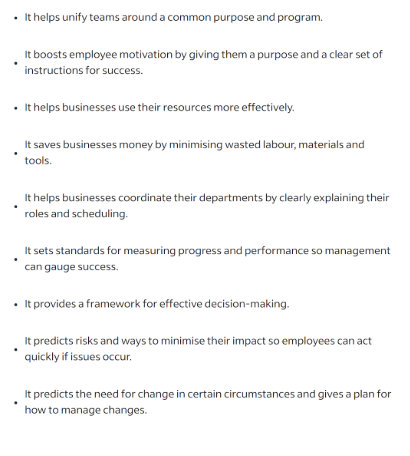
Why is planning is important in management?
List and describe 9 types of planning
Formal Planning
Structured and written planning process
Clear goals, timelines, and procedures
Usually used by management
Informal Planning
Less structured and often unwritten
Based on experience or discussion
Used for day-to-day decisions
Short-Term Planning
Focuses on near-future goals
Usually within one year
Long-Term Planning
Focuses on goals several years ahead
Guides overall business direction
Strategic Planning
High-level planning by top management
Sets mission, vision, and long-term objectives
Intermediate Planning
Connects short-term and long-term plans
Covers about one to three years
Operational Planning
Detailed and specific planning
Outlines tasks and activities for employees
Helps achieve short-term goals
Standing Plans
Ongoing and reusable plans
Includes policies, procedures, and rules
Single-Use Plans
Created for a specific purpose or project
Discarded after the objective is achieved
Examples: budgets, project plans
9 Parts of Planning
forecasting
defining objectives
outlining policies
developing programs
creating strategies
scheduling
outlining procedures
setting rules
budgeting
What are 6 steps that can be taken to be more effective in management?
Establish the company’s goals
Identify resources you may need
Create goal-related tasks
Assign tasks and timelines
Establish evaluation methods
Develop a contingency
Organizing - Give 2 examples of the organizing function
Allocating (dividing tasks) resources (teams/employees) that are best suited for jobs
Clearly communicating needs to hire or reallocate (who do we need to hire, how can we split them among different tasks by communicating)
What are 6 objectives of organizing in management?
Effective Allocation of Roles and Responsibilities
Efficient Implementation of Plans and Strategies
Efficient Implementation of Plans and Strategies
Direction Efforts Towards Common Objectives
Optimal Resource Utilization
Facilitating Goal Achievement
What are 5 Key Features of Organizing
Activities Identification
Division
Grouping of Activities
Authority-Responsibility
Basis of Coordination
What is the 5 part organizing process of management
job design
job grouping
establishing reporting relations
distributing authority
coordinating activities
What are 6 core reasons why the organizing function of management is important?
enhanced efficiency
optimal resource utilization
clarity in responsibilities
adaptability to change
effective decision-making
employee development
What are 5 valuable tips for effective organizing strategies? Explain them.
Set Clear objectives - Define specific goals and priorities
Establish Efficient Systems - Develop streamlined processes and systems
Delegate wisely - Delegate tasks according to skill sets and capabilities
Promote communication - Encourage open clear communication channels
Regular evaluation and adaption - Continuously assess and adapt organizational strategies
Leading - Give 4 examples of situational leadership styles. What are the best types of leaders?
Directing - usually new employees (minimal skill, low trust, little knowledge), specific instructions so they can clearly understand
Coaching - need support, developing trust, allow ideas, still oversight
Supporting - team decisions, “what do you need from me?”
Delegating - usually old employees (high level of trust, skill, knowledge), utilize strengths efficiently
***Best leaders are ones that know how to use all of these***
What are the differences between Leadership and Management? What do both roles require?
Leadership | Management |
Inspiring people around a shared vision | Executing the strategy |
Motivating employees | Focusing on the process |
Looking to the future | Focusing on the present |
Creating a positive culture | Performance management |
Focusing on the people | Focusing on results |
Both roles require good communication and decision making.
What are the Top 5 Skills Needed in Leadership, and then Management?
Leadership | Management |
Communication | Project Management |
Motivation | Goal Setting/Measuring |
Feedback & Coaching | Resource Allocation |
Emotional Intelligence | Strategic Thinking |
Empowerment | Problem Solving |
What are 5 sources of powers for leaders?
Coercive power
Reward power
Legitimate power
Expertise power
Charisma power
What are the 4 steps of leading? (L.E.A.D)
Lead
Engage
Accountable
Deliver
Controlling - Give 2 examples of where managers may need to make adjustments
Budget - ex: project going over budget
Staffing - hire based on needs, fire based on ineptitude, lay off based on demand
What are 5 key aspects of controlling in management?
Setting standards
Measuring performance
Comparing performance with standards
Taking corrective action
Feedback and continuous improvement
What are 5 reasons why controlling is important in management?
Ensuring goal
Resource optimazation
Enhancing organizational efficiency
Risk management
Facilitating decision-making
What are 6 tools & techniques commonly used in management control? Explain.
Budgeting - Financial plans that outline expected revenues and expenditures
Key performance Indicators - Specific metrics used to measure performance against strategic goals
Balanced Scorecard - Management tool that provides a comprehensive view or organizational performance
Adults - Examinations or an organization’s financial statements processes and operations
Management by Objectives - Managers and employees set specific objectives that align with organizational goals
Statistical Quality Control - Using statistical methods to monitor and control processes
What are the 6 steps of the Management by Objectives (MOB) process?
Define organizational goals
Define employee objectives
Continuous monitoring performance and progress
Performance evaluation
Providing feedback
Performance appraisal