Biomed Unit 1 SA #1
 Call Kai
 Learn
Learn Practice Test
 Spaced Repetition
 Match
Match Flashcards
 Knowt Play
1/108

Earn XP
Description and Tags
Regional terms, Directional terms, Definition of tissue, 4 major types of tissues, Facial muscles, Bone types, Fracture patterns
Name | Mastery | Learn | Test | Matching | Spaced | Call with Kai | Chat |
|---|
No analytics yet
Send a link to your students to track their progress
109 Terms
What does the orbicularis oculi muscle do?
closes eyelids
What does the orbicularis oris muscle do?
puckering lips
What does the Temporalis muscle do?
moves lower jaw to chew
What are all the parts of a skull?
Mandible, maxilla, zygomatic process, frontal, temporal, occipital, and parietal
Where is the mandible?
Jaw
Where is the maxilla?
Around nose area
Where is the zygomatic process?
cheek bones
Where is the frontal?
fore head/ front of head
Where is the temporal?
side of head (near ears)
Where is the occipital?
bottom of the back of the head
Where is the parietal?
top/ center of the back of the head

What does the pink part represent?
Frontal

What does the grey part represent?
Mandible

What does the purple part represent?
Temporal
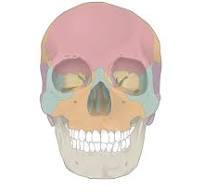
What does the green part represent?
Zygomatic process

What does the orange part represent?
Maxilla

What does the blue part represent?
Parietal

What does the green part represent?
Occiptial

What does the orange part represent?
Temporal
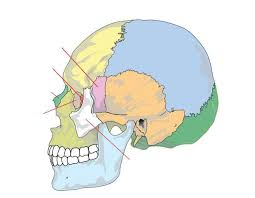
What does the yellow part represent?
Frontal
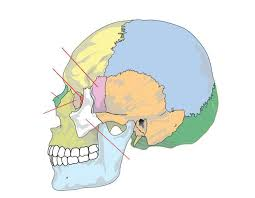
What does the white part represent?
Zygomatic process
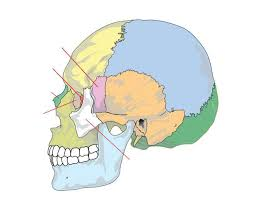
What does the light blue part represent?
Mandible
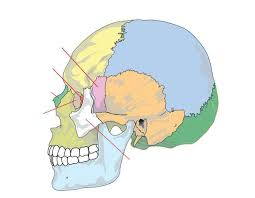
What does the lime green part represent?
Maxilla
Long bone description
Has a tubular shaft and articular surface at each end of the bone
Short bone description
Smaller version of long bone
Flat bone description
Thin and has broad surfaces
Irregular bone description
Irregular in size and shape
Compact
Long bone Examples
Femur
Humerus

Short bone Examples
Metacarpals
Metatarsals
Clavicle
Phalanges

Flat bone Examples
Ribs
Sternum
Scapula
Irregular bone examples
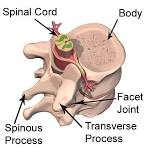
Vertebrae
Carpals
Tarsals
Petella
Epiphysis
End of the long bone
Spongy bone and red marrow

Diaphysis
Shaft of the long bone
Mostly compact bone

Cartilage
Smooth, flexible tissue
Reduces friction and cushions joints

Periosteum
Tougher outer membrane covering bone, nerves and blood vessels
Compact (cortical) bone
Dense, strong outer layer of bone (cortical bone)
Spongy (cancellous) bone
Porous, lightweight inner bone with spaces for marrow
Medullary cavity
Hollow center of the diaphysis
Where Marrow is stored
Red bone marrow
Marrow that makes blood cells
Found in epiphyses
Yellow bone marrow
Marrow that stores fat
Found in the medullary cavity
Directional Terms
Describes the location of one structure compared to another.
Anterior
Toward the front of the body.
Posterior
Toward the back of the body
Inferior
Below; toward the feet.
Superior
Above; toward the head.
Medial
Toward the midline of the body.
Lateral
Away from the midline.
Distal
Farther from the point of reference.
Proximal
Closer to the point of reference.
Superficial
Near the body’s surface.
Deep
Further into the body.
Ventral
Toward the belly side. (animals)
Dorsal
Toward the back side. (animals)
Regional Terms
Describes specific regions/ locations
Axial Skeleton
head, trunk, neck
Appendicular Skeleton
Bones of the limbs
Abdominal
Relating to the abdomen
Antecubital
Front of the elbow
Axillary
Armpit area
Brachial
Arm region
Buccal
Face cheek area
Calcaneal
Heel region
Carpal
Wrist region
Cephalic
Head region
Cervical
Neck region
Coxal
Waist/ belt line area
Digital
Fingers or toes
Femoral
Thigh area
Gluteal
Buttock area
Inguinal
Groin area
Lumbar
Lower back area
Metacarpal
Hand bones between fingers and wrist
Metatarsal
Foot bones between ankle + toes
Nasal
Nose area
Occipital
Back of the head
Olecranal
Back of the elbow
Oral
Mouth area
Orbital
Eye socket region
Patellar
Front of the knee (knee cap)
Pelvic
Hip area
Popliteal
Back of the knee
Sacral
Tail bone
Scapular
Shoulder blade region
Sternal
Brestbone region (sternum/ chest plate)
Tarsal
Ankle region
Thoriacic
Chest region (whole ribcage)
Umbilical
Naval region (belly button)
Vertebral
Spinal column region
Different body planes:
Coronal plane
Sagittal plane
Transverse plane
Median plane

Coronal plane
Vertical split into anterior + posterior halves (front + back)

Sagittal plane
Vertical split unequal left + right sides
Transverse plane
Horizontal split superior + inferior halves
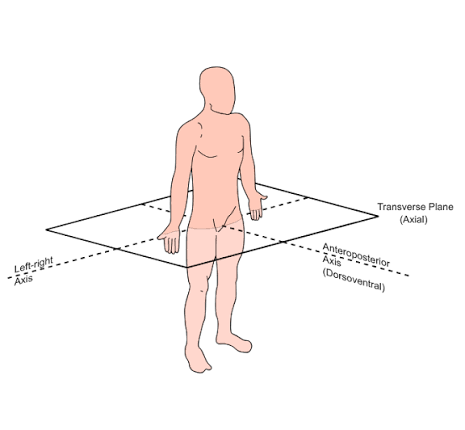
Median plane
Vertical split equal life + right halves
Definition of Tissue
Tissues are groups of cells that are similar in structure that work together to perform a specific function
4 main types of tissue:
Epithelium
Connective tissue
Muscle
Nervous Tissue
Epithelium examples:
Outer layer of skin
Air sacs
- Forms the linings, coverings and glandular tissues of the body
Connective tissue examples:
Bone
Cartilage
Adipose tissue (fat)
Blood
Muscle tissue examples:
Skeletal muscle
Cardiac muscle
Smooth muscle
Nervous tissue examples:
Nerves
Spinal cord
Brain
What are the parts of the vertebral column?
Cervical
Thoracic
Lumbar
Sacral
Coccyx
