d426 4
 Call Kai
 Learn
Learn Practice Test
 Spaced Repetition
 Match
Match Flashcards
 Knowt Play
1/75

There's no tags or description
Looks like no tags are added yet.
Name | Mastery | Learn | Test | Matching | Spaced | Call with Kai | Chat |
|---|
No analytics yet
Send a link to your students to track their progress
76 Terms
entity rrelationship model
a high-level representation of data requirements, ignoring implementation details.
model includes three kinds of objects:
An entity is a person, place, product, concept, or activity.
A relationship is a statement about two entities.
An attribute is a descriptive property of an entity.
attribute
is used in both entity-relationship and relational models. In the relational model, _____ is a formal term for column.
Since entity-relationship attributes typically become relational columns, the meaning of ______is similar in both models.
er diagram
depicts entities as rectangles with rounded corners, relationships as lines connecting rectangles, and optional attributes within entity rectangles.
glossary
also known as a data dictionary or repository, documents additional detail in text format.
includes names, synonyms, and descriptions of entities, relationships, and attributes.
type
is a set in relationship modeling
An entity type is a set of things. Ex: All employees in a company.
A relationship type is a set of related things. Ex: Employee-Manages-Department is a set of (employee, department) pairs, where the employee manages the department.
An attribute type is a set of values. Ex: All employee salaries.
instance
is an element of a set:
An entity instance is an individual thing. Ex: The employee Sam Snead.
A relationship instance is a statement about entity instances. Ex: "Maria Rodriguez manages Sales."
An attribute instance is an individual value. Ex: The salary $35,000.
conceptual design steps
Step | Name |
|---|---|
1 | Discover entities, relationships, and attributes |
2 | Determine cardinality |
3 | Distinguish strong and weak entities |
4 | Create supertype and subtype entities |
logical design steps
Step | Name |
|---|---|
5 | Implement entities |
6 | Implement relationships |
7 | Implement attributes |
8 | Apply normal form |
discovery entity
are usually singular nouns, but not all nouns are entities. Designers should ignore nouns that denote specific data or are not relevant to the database.
discovery relationship
are usually verbs. Designers should ignore statements that are not about entities, not relevant to the database, or redundant to other relationships. Designers should look for relationships that are not explicitly stated, since users may overlook important information.
Entity-Verb-Entity
verb should be active not passive
discovery attributes
are usually nouns that denote specific data, such as names, dates, quantities, and monetary values. must have suffix
EntityQualifierType
synonnym
non-official name for an entity saved in glossary.
should reflect common usage, not naming conventions.
cardinality
maxima of relationships and attributes
OR
as maxima and minima of relationships and attributes
modality
is the minima of relationships and attributes
binary relationship
is a relationship between two entity types
1:1
1:Many
Many:Many
one to one binary
one instance of the first entity is mapped with only one instance of the second entity. The primary key of one entity is available as a foreign key in the other entity. This type of relationship is less common in database design.
symbol: |—— |
one to many binary
one instance of the first entity is related to multiple instances of the second entity, but each instance of the second entity is related to only one instance of the first entity.
ex: Example − Consider two entities Department and Employee. One department can have many employees working in it, but each employee belongs to only one department
symbol: | ——<
many to many binary
one instance of the first entity is related to multiple instances of the second entity, and one instance of the second entity is related to multiple instances of the first entity. This type of relationship always requires a junction table (also called bridge table or associative table) to store the associations between the two entities.
Example − Consider two entities Student and Course. Many students can enroll in a course, and many courses can be taken by a student. A junction table Enrollment tracks which students are enrolled in which courses ?
symbol: >——<
intersected data
is information/ attribute that describes the relationship between two entities, not either entity by itself.
ex:If a salesperson sells a product, the quantity sold is ________ because it only makes sense when you know both the salesperson and the product.
associative entity
links two entities in a many-to-many relationship and holds any attributes that describe their relationship and intersected data
transitive dependency
occurs in a database when one attribute depends on another, and that second attribute, in turn, determines a third attribute.
when an indirect relationship exists between two attributes through a third attribute.
To avoid, break down the relationship into separate tables and use junction tables to connect them.
unary relationship
A relationship where an entity is related to itself (the same entity type).
Example: An Employee manages another Employee.
Types:
1:1
1:M
M:M
one to one unary
A specific type of unary relationship where each instance can be related to only one other instance, and vice versa.
Example: A Person is married to one other Person, and each person has only one spouse.
one to many unary
is when one instance of an entity is related to many other instances of the same entity, but each of those instances is related to only one original instance.
Example:
An employee manages many employees, but each employee has only one manager.
many to many unary
A many-to-many unary relationship is when many instances of an entity can be related to many other instances of the same entity.
Example:
A student studies with many students, and each student studies with many others.
n-ary relationships
Feature | Unary Relationship | Binary Relationship | Ternary Relationship |
|---|---|---|---|
Number of entity types involved | One | Two | Three |
Relationship connects | An entity to itself | Two different entities | Three different entities at the same time |
Possible cardinalities | 1:1, 1:M, M:N | 1:1, 1:M, M:N | Usually represents complex relationships involving three entities |
Associative entity needed? | Yes, if M:N has relationship attributes | Yes, if M:N has relationship attributes | Often converted into an associative entity to store relationship data |
Purpose | Shows relationships among instances of the same entity | Shows relationships between two different entities | Shows a relationship involving three entities where all three are needed to describe the event |
Example | Employee manages Employee | Customer places Order | Supplier provides Product to Warehouse |
ternary relationship
three different entities participate in a single relationship simultaneously.
When determining cardinality, we consider it in the context of two entities relative to the third.
all 3 converge to an associative entity
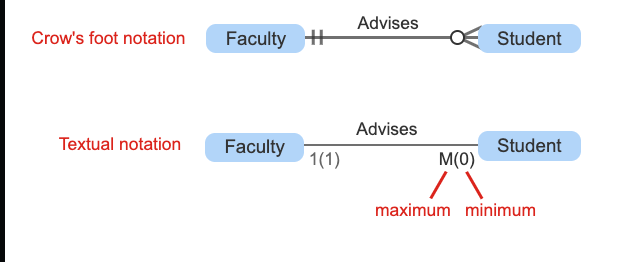
relationship maximum
is the greatest number of instances of one entity that can relate to a single instance of another entity
singular: maximum is one
plural maximum is many
crow foot notation
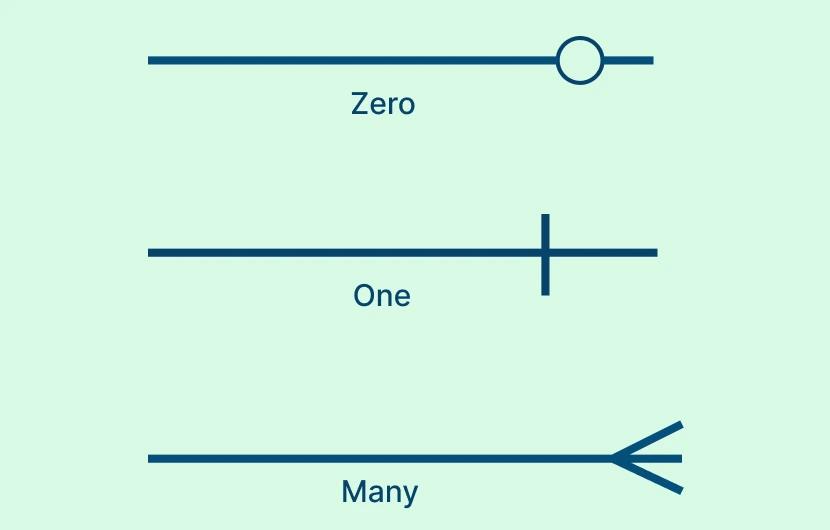
relationship minimum
is the least number of instances of one entity that can relate to a single instance of another entity. A relationship has two minima, one for each of the related entities.
optional: min is 0
required when min is 1
attribute maximum
is the greatest number of attribute values that can describe each entity instance.
specified as one (singular) or many (plural).
attribute minimum
is the least number of attribute values that can describe each entity instance.
specified as zero (optional) or one (required).
unique attribute
describes at most one entity instance.
identifying attribute
is unique, singular, and required. Identifying attribute values correspond one-to-one to, entity instances.
strong entity
has one or more identifying attributes.
only becomes an identifying entity when it is used to identify a weak entity.
weak entity
does not have an identifying attribute.
Instead, usually has a relationship, called an identifying relationship (includes, gives offers), to another entity, called an identifying entity. The identifying entity must be singular and required in an identifying relationship.
identifying entity
is a strong entity that provides the primary key needed to identify a weak entity.
A weak entity can be an ________ entity if it is used to identify another weak entity.
entities
Feature | Strong Entity | Weak Entity | Identifying Entity |
|---|---|---|---|
Has its own primary key | ✅ | ❌ (partial key only) | ✅ |
Exists independently | ✅ | ❌ | ✅ |
Depends on another entity | ❌ | ✅ | ❌ |
Identifies another entity | ❌ | ❌ | ✅ |
E-R notation | Single rectangle | Double rectangle | Single rectangle |
Example | Customer | Order Item | Order |
subtype entity
is a subset of another entity type called the supertype entity
highlight subsets of data with different attributes and relationships than the supertype. This clarifies database semantics and behavior
attributes only apply to ______
all are weak entities
supertype entity
entity usually has several subtypes
attributes apply to all subtypes. An attribute that is repeated in several subtypes becomes a single______ attribute.
similar entities
are entities that have many common attributes and relationships.
_____ entities become subtypes of a new supertype entity,
are often created when different groups of an entity have different optional attributes.
partition
divides a supertype into subtypes where only one subtype can be chosen within that group.
In diagrams:
Vertical alignment = Subtypes belong to the same (mutually exclusive/ cant be true at same time).
Horizontal alignment = Subtypes belong to different (can overlap).
partition attribute
optional. indicates which subtype entity is associated with each supertype instance.
isa relationship
A supertype entity identifies its subtype entities. The identifying relationship is called_______
the relationship is assumed and may be omitted from the ER diagram.
subtype and supertype design
Step | Activity |
|---|---|
4A | Identify supertype and subtype entities. |
4B | Replace similar entities and optional attributes with supertype and subtype entities. |
4C | Identify partitions and partition attributes. |
4D | Document supertypes, subtypes, and partitions in glossary and ER diagram. |
cardinality notation
< + o = OR
| + | = ONLY
| = one
o = zero
> and < = many
uml (universal modeling language)
is commonly used for software development. Software data structures are similar to database structures, so ___ includes ER conventions.
idef1x
model convention. became popular, in part, due to early adoption by the United States Department of Defense.
intangible entity
is documented in the data model, but not tracked with data in the database.
in er diagram are distinguished with special notation, such as a dashed rectangle or distinct color.
model conventions
ER modeling concepts also vary. Ex: Some ER models may:
Allow relationships between three or more entities.
Decompose a complex model into a group of related entities, called a subject area.
Refer to strong entities as independent and weak entities as dependent.
primary key selection
Stable – The identifier should not change over time. If it changes, every related record that uses it must also be updated.
Simple – should be easy to type and store. Small values are easy to specify in an SQL WHERE clause and speed up query processing. Ex: A 2-byte integer is easier to type and faster to process than a 15-byte character string.
Meaningless – The identifier should not contain descriptive information (such as a person's name or department). Descriptive information can change, but the identifier should remain the same.
always required and unique
strong table
derived from strong entity.
The primary key must be unique and required, and should be stable, simple, and meaningless.
artificial key
is a simple primary key created by the database designer.
are integers, generated automatically by the database as new rows are inserted to the table.
are stable, simple, and meaningless.
weak table
derived from a weak entity.
has a foreign key that references the identifying table and implements the identifying relationship.
weak table primary key
The key depends on the identifying relationship:
Plural weak entity: Primary key = foreign key + another column (composite key).
Singular weak entity: Primary key = foreign key only.
supertype table
A table created from a supertype entity. It is implemented like:
A strong entity if it has its own identifying attribute.
A weak entity if it is identified through an identifying relationship.
subtype table
A table created from a subtype entity. Its primary key is the same as the supertype's primary key and also acts as a foreign key.
subtype primary key
Is identical to the supertype primary key.
Is also a foreign key that references the supertype table.
implement entities
converts identifying relationships into foreign keys.
implement relationships
converts all other relationships into foreign keys or tables.
many to one relationship
is implemented using a foreign key in the "many" table.
The foreign key references the primary key of the "one" table and is required (NOT NULL) if the relationship is mandatory.
It is usually named after the referenced primary key, sometimes with a prefix to make its purpose clearer.
one to one relationship
is implemented using a foreign key.
The foreign key can be placed in either table, but it is usually stored in the table with fewer rows to reduce NULL values.
It references the primary key of the other table, must be unique, and is required (NOT NULL) if the relationship is mandatory.
The foreign key is usually named after the referenced primary key, sometimes with a prefix to make its purpose clearer.
implementing relationships
Feature | One-to-One (1:1) | One-to-Many (1:M) / Many-to-One (M:1) | Many-to-Many (M:N) |
|---|---|---|---|
Implementation | Becomes a foreign key. | Becomes a foreign key. | Becomes a new weak (junction) table. |
Foreign key location | Can be in either table (usually the one with fewer rows). | Always in the "many" table. | New table contains two foreign keys, one to each related table. |
References | Foreign key references the primary key of the other table. | Foreign key references the primary key of the "one" table. | Each foreign key references the primary key of one related table. |
Primary key | Original primary key remains; foreign key is unique. | Original primary key remains; foreign key is not unique. | Primary key is a composite key made from both foreign keys. |
Required? | Foreign key is NOT NULL if the relationship is mandatory. | Foreign key is NOT NULL if the relationship is mandatory. | Foreign keys are usually required, with primary key cascade and foreign key restrict rules. |
Extra attributes | Not applicable. | Not applicable. | Relationship attributes are stored as columns in the new weak table. |
Naming | Foreign key is usually named after the referenced primary key, with an optional prefix. | Foreign key is usually named after the referenced primary key, with an optional prefix. | Weak table is usually named using both related table names, with an optional qualifier to clarify its purpose. |
many to many relationship
becomes a new weak table:
The new table contains two foreign keys, referring to the primary keys of the related tables.
The primary key of the new table is the composite of the two foreign keys.
The new table is identified by the related tables, so primary key cascade and foreign key restrict rules are usually specified.
plural attributes
an attribute that can have multiple values for a single entity (e.g., a student can have multiple phone numbers).
It is implemented by creating a new weak table that stores the plural attribute and a foreign key referencing the original table.
The new table uses a composite primary key made up of the plural attribute and the foreign key, and is usually named using the original table name followed by the attribute name.
attribute type
During logical design, an SQL data type is defined for each attribute type. Attribute types and the corresponding data types are documented in the glossary.
Each attribute name includes a standard attribute type as a suffix. The attribute type determines the data type of the corresponding column.
attribute cardinality
determines how an attribute is implemented as a table column.
Required attributes become NOT NULL columns,
unique attributes become UNIQUE columns
attributes that are both required and unique become PRIMARY KEY columns.
If multiple columns form a primary key or unique constraint, they are defined as composite constraints in the
CREATE TABLEstatement.
functional dependence
Dependence of one column on another.
reflects business rules. Ex: "Each student receives one letter grade in a course" indicates the Grade column depends on the composite column (StudentID, CourseCode).
table symbol: →
B → A means A depends on B. Each value of B relates to at most one value of A.
redundancy
the repetition of related values in a table.
It occurs when a column depends on a non-unique column.
causes problems because updates must be made in multiple places, making queries slower and increasing the risk of inconsistent data.
normal forms
are rules for designing tables with less redundancy.each level reducing redundancy further.
1NF → 3NF: Commonly used to reduce basic data redundancy.
BCNF: Improves 3NF by removing dependencies on non-unique columns.
4NF: Removes multivalued dependencies.
5NF: Removes join dependencies.
normal form tables
Normal Form | Column Rules | Row Rules | Cell Rules | Purpose |
|---|---|---|---|---|
First Normal Form (1NF) | Every column represents a single attribute. No repeating columns or groups. | Each row must have a unique primary key. | Each cell contains exactly one value (no lists or multiple values). | Ensures data is atomic and rows are uniquely identified. |
Second Normal Form (2NF) | All non-key columns must depend on the entire primary key. No column depends on only part of a composite key. | Table must already satisfy 1NF. Each row is uniquely identified by the primary key. | Each non-key cell must contain values related to the whole primary key, not just part of it. | Removes partial dependencies and reduces duplicate data. |
Third Normal Form (3NF) | Non-key columns cannot depend on other non-key columns; they must depend only on the primary key. | Table must already satisfy 2NF. Rows are uniquely identified by the primary key. | Each non-key cell must contain values that describe only the row’s primary key. | Removes transitive dependencies and further reduces redundancy. |
Boyce-Codd Normal Form (BCNF) | Every determinant (column that determines another column) must be a candidate key. | Table must satisfy 3NF. Each row must be uniquely identifiable by a candidate key. | No cell value should depend on a non-unique column. | Eliminates dependencies on non-unique columns. |
Fourth Normal Form (4NF) | Columns should not contain multiple independent sets of values. | Table must satisfy BCNF. Each row represents one relationship between attributes. | Cells should not store combinations of unrelated multi-valued facts. | Removes multivalued dependencies. |
Fifth Normal Form (5NF) | Columns should only represent attributes that are necessary for the relationship. | Table must satisfy 4NF. Rows should not require unnecessary joins to reconstruct information. | Cell values should depend only on the key and not on hidden join relationships. | Removes join dependencies and minimizes complex redundancy. |
partial dependency
This occurs when you have a Composite Primary Key (a key made of 2+ columns), but a non-key column relates to only one part of that composite key.
keys
Concept | Meaning | Key Property |
|---|---|---|
Super Key | Any attribute set that uniquely identifies rows | May include extra attributes |
Candidate Key | Minimal Super Key | No redundant attributes |
Primary Key | Selected Candidate Key | Official unique identifier |
candidate key
is a simple or composite column that is unique and minimal. Minimal means all columns are necessary for uniqueness.
A table may have several
The database designer designates one as the primary key.
bcnf
A stricter version of 3NF where every determinant must be a Candidate Key.
The potential to violate may occur in a relation that:
Contains two (or more) composite candidate keys.
Has candidate keys that overlap (share at least one attribute).
denormalization
means intentionally introducing redundancy by merging tables.
eliminates join queries and therefore improves query performance.
results in first and second normal form tables and should be applied selectively and cautiously.