Sono Physics and Instrumentation (Week 3)
 Call Kai
 Learn
Learn Practice Test
 Spaced Repetition
 Match
Match Flashcards
 Knowt Play
1/31

There's no tags or description
Looks like no tags are added yet.
Name | Mastery | Learn | Test | Matching | Spaced | Call with Kai | Chat |
|---|
No analytics yet
Send a link to your students to track their progress
32 Terms
What are the 5 additional parameters needed to completely describe pulsed sound? Other than the 7 I already know
Pulsed Duration, Spacial Pulse Length, Pulsed Repetition Period, Pulsed Repetition Frequency, and Duty Factor
What is pulsed duration? What is it measured in? Is it adjustable? What is it determined by?
It is the actual time from the start of a pulse to the end of that pulse
Time such as microseconds
No
Source
What is the formula for pulse duration?
Number of cycles / MHz frequency
What are the relationships to pulse duration?
It is directly proportional to both the number of cycles in a pulse and to period. It is inversely proportional to frequency.
What characteristics distinguish pulses with long duration from those with short duration? Which is more desirable for imaging and why?
2 characteristics for both
Long: many cycles in the pulse, individual cycles with long periods
Short: few cycles in the pulse, individual cycles with short periods
Short is more desirable because they create images of greater accuracy
How is pulse duration related to transducers?
Each particular ultrasound transducer emits a pulse with a fixed duration. (The pulse duration cannot change for that transducer)
In clinical imaging, a pulse typically contains _______ cycles
2-4
What is Spacial pulse length? What is it measured in? Is it adjustable? What is it determined by?
It is the length or distance that an entire pulse occupies in space.
Distance (mm and meters)
No
Source and medium
What are the relationships to Spatial Pulse Length?
Directly proportional to the number of cycles in the pulse
Directly proportional to wavelength
Inversely proportional to frequency
What is pulsed repetition period? What is it measured in? Is it adjustable? What is it determined by?
It is that time from the start of one pulse to the start of the next pulse (It includes on pulse duration and one listening time)
Reported in time (ms)
Yes (when depth is adjusted, pulse repetition period is also altered
Determined by source
What are the 2 components of pulse repetition period? What is another name for one of the components?
Transmit time (on time), Receive time (off time)
Another name for transmit time is pulse duration
When the system is imaging a shallow depth, the time from one pulse to the next is _______.
When the system is imaging a deep, the time from one pulse to the next is _______.
Short; Longer
The pulse never changes the _______________________ increases.
Listening (waiting time)
What are the relationships to Pulse Repetition Period?
Unrelated to period
Directly related to the depth of view
What does depth of view describe?
It describes the maximum distance into the body that in ultrasound system is imaging (Sonographer controls depth of view)
Using pulse repetition period, what happens to the listening time and the PRP?
With deeper imaging, the listening time and the pulse repetition period lengthen
With shallower imaging, the listening time and pulse repetition period shorten
What is Pulse Repetition Frequency? What is it measured in? Can it be adjusted? What is it determined by?
It is the number of pulses that occur in 1 second
Hertz, per second
Yes
Source
What are the relationships for Pulse Repetition Frequency?
Not related to frequency
Inverse to depth of view
As imaging depth increases, pulse repetition frequency _________.
Decreases
When the system is imaging shallow, the pulse repetition frequency is _________.
When the system is imaging deep, the pulse repetition frequency is _______.
Higher, Lower
What is the relationship for Pulse Repetition Period and Pulse repetition Frequency?
They are inversely related.
A longer pulse repetition period results in lower PRF
A shorter pulse repetition period results in higher PRF
What is Duty Factor? What is it measured in? Can it be adjusted? What is it determined by?
It is the percentage of fraction of time that the system transmits a pulse
None (Percent is unitless)
Yes (changing the depth of view also changes the duty factor)
Source
What is the maximum value for Duty Factor? What is the minimum value for Duty Factor? How are they achieved?
Maximum: 1 or 100%; achieved only with continuous wave sound
Minimum: 0%; achieved only when the transducer is silent
What is the relationship to duty factor? Duty factor is _______ when the system is imaging at _________ depths, and _______ with __________ depths.
It is inversely related to imaging depth
Higher, shallow, lower, greater
What is the equation for duty factor?
Duty Factor % = pulse duration / pulse repetition period x 100

What parameter is this wave?
Pulse Duration
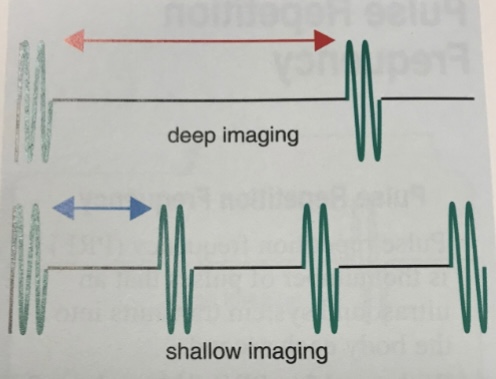
What parameter is this image?
Pulse Repetition Frequency

What parameter is this wave?
Duty Factor

What parameter is this wave?
Spatial Pulse Length

What parameter is this wave?
Pulse Repetition Period
Compare and contrast shallow and deep imaging.

List the 5 parameters, if they’re adjustable, what units they are measured in, what they are determined by, and their typical value.
