Vertigo/Dizziness
 Call Kai
 Learn
Learn Practice Test
 Spaced Repetition
 Match
Match Flashcards
 Knowt Play
1/20

There's no tags or description
Looks like no tags are added yet.
Name | Mastery | Learn | Test | Matching | Spaced | Call with Kai | Chat |
|---|
No analytics yet
Send a link to your students to track their progress
21 Terms
Describe Vertigo
Causes
Two Classifications
Vertigo
Cause
Acute asymmetry of the vestibular system.
inner ear,
vestibular nerve,
Nucleus w/in medulla
portions cerebellum
Two Classification:
Peripheral vestibular Disease
Central Vestibular Disease
List the causes of Peripheral and Central Vestibular Disease
Peripheral Causes
Benign paroxysmal positional vertigo
Vestibular neuritis/labyrinthitis
Herpes zoster oticus (Ramsay Hunt syndrome)
Meniere disease
Labyrinthine concussion
Perilymphatic fistula
Semicircular canal dehiscence syndrome
Cogan’s syndrome
Recurrent vestibulopathy
Acoustic neuroma
Aminolycoside toxicity
Otits Media
Central Causes
Vestibular migraine
Brainstem ischemia
Cerebellar infarction and hemorrhage
Chiari malformation
Multiple Sclerosis
Episodic ataxia
Compare Peripheral vs Central NYSTAGMUS
Visual Fix.
Types
Direction
Fatigue
Visual Fix
P: suppressed
C: Not Affected
Types:
P: Horizontal/ Vertical/ rotary/torsional
C: horizontal, torsional, or vertical + many others
Direction:
P: Fast phase away from affected ear
Intensifies when looking away from affected ear
C: may change directions
Fatigue:
P: Eventually Fatigues
Always beats in same or adapt
C: Doesn’t Fatigues
What is the Dix-Hall-Pix Maneuver
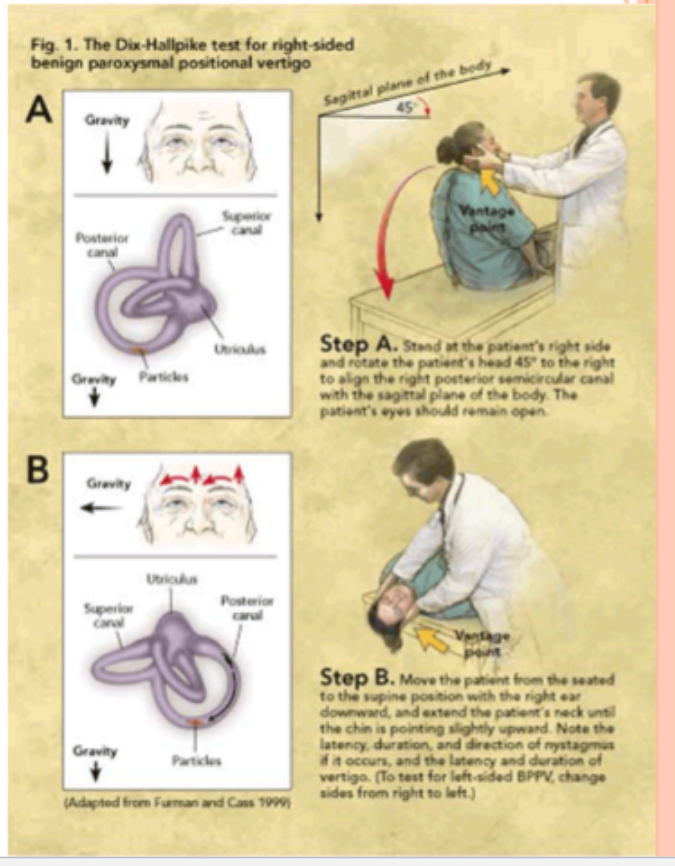
Describe BENIGN PAROXYSMAL POSITIONAL VERTIGO
STATs
Clinical Presentation
Patho
Dx
Rx
STATs
Most common cause of vertigo
Clinical Presentation:
Brief vertigo + nystagmus associated w/ position change
(often rolling over in bed).
Vertigo lasts 10-60 secs
Lag (few secs) after head movement before vertigo onset
May even awaken from sleep
No sustained nystagmus
Patho:
Secondary to abnormal stimulation of posterior semicircular canal (93%)
Dx:
History and Dix-Hall-pike
Rx:
Epley maneuver;
Vestibular rehab
Describe CANALITH REPOSITIONING PROCEDURE/EPLEY
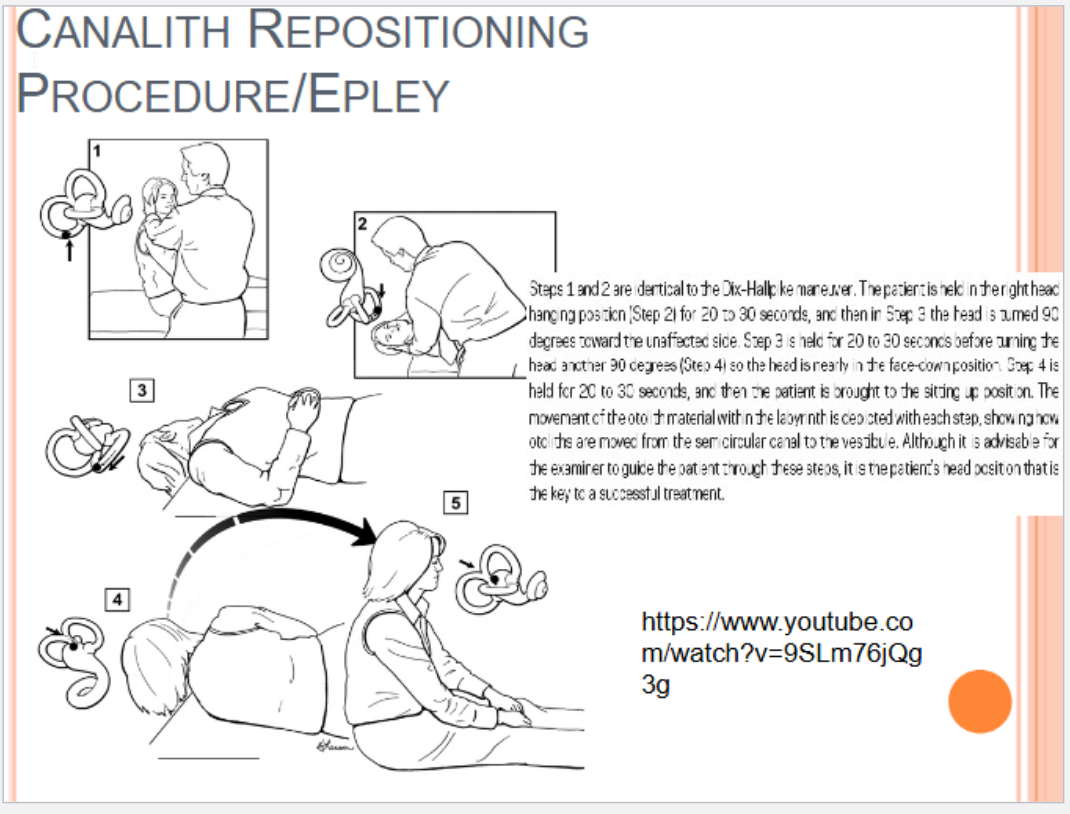
Describe MENIERE’S DISEASE
Patho
Symptoms
Dx
Treatment
Patho:
Secondary to increased endolymph pressure. ( abnormal fluid in inner ear).
“Endolymphatic hydrops”
Symptoms:
Experience fullness in ear -> low frequency hearing loss
Tinnitus – low pitch (roaring)
Vertigo
Dx:
Audiometric testing (low frequency hearing loss)
history
Nystagmus during an attack- otherwise nml exam.
Consider MRI.
Treatment:
Symptomatic
Low salt diet + diuretics
( ie. Hydrochlorothiazide or triamterene or acetazolamide).
Antiemetics
(Meclizine or dimenhydrinate or prochlorperazine or promethazine).
Surgery
remove bony/membranous labyrinth or vestibular neurectomy.
decompression or shunting of endolymphatic sac.
Nondestructive
Describe VESTIBULAR MIGRAINE
Duration
Occurrence
Symptoms
Duration:
Few hours -> days
Occurance:
Precedes, simultaneous, or follows head ache
Rarely Chronic
Symptoms:
Similar to BPPV
Mild-Severe
Associated w/ Aura
photophobia or phonophobia
NOTE:
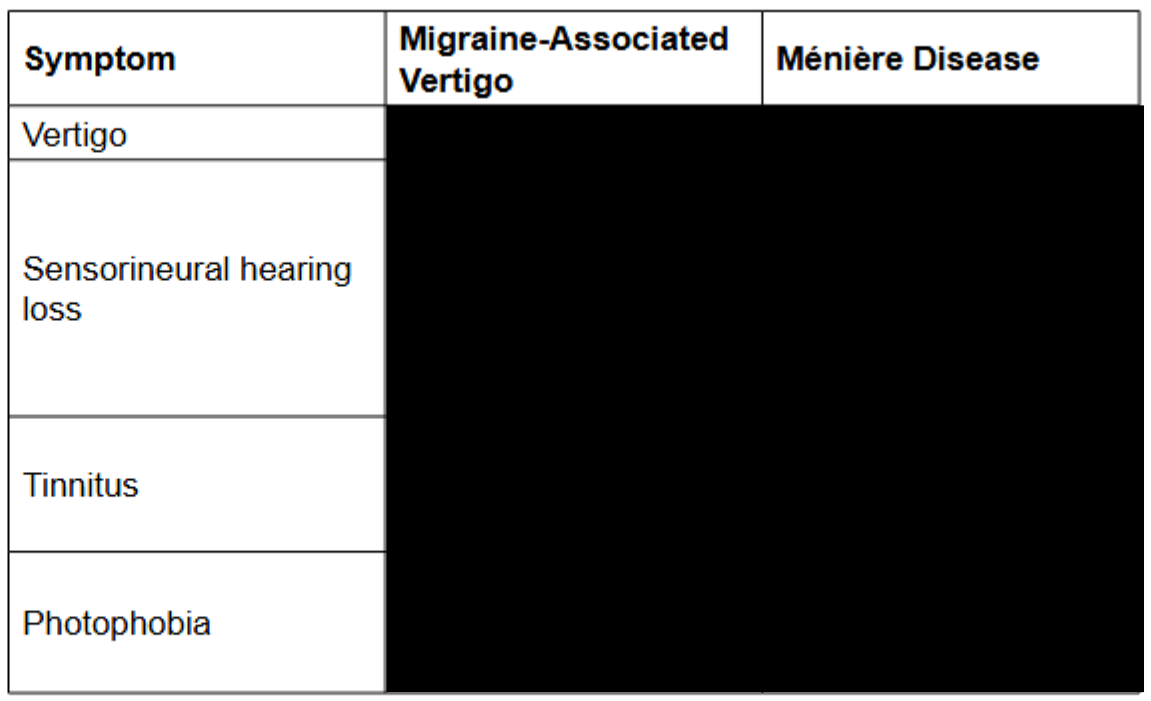
Timing and presentation similar to Meneire’s but Migraine much more common

How to do head thrust test/head impulse test

Describe VESTIBULAR NEURITIS/LABYRINTHITIS
What is it?
Timing?
Symptoms?
Why do brain imaging needed
Clinical Presentation
Treatments
What is it?
Viral /post viral inflammatory disorder affecting CNVIII (50%)
Timing:
Sudden onset
Lasts for several days
Symptoms:
N/V
Hearing loss
***this makes it labyrinthitis***
Tinnitus
Nystagmus
Clinical Presentation:
Pt initially suffer greatly for few-several days -> gradual diminution of symptoms and a return of equilibrium
Brain Imaging Needed
b/c clinical features of cerebellar hemorrhage/infarction = similar to vestibular neuritis
Need to RULE OUT
Treatment:
Prednisone
(corticosteroid therapy)
Symptomatic treatment:
antiemetics, antihistamines, anticholinergics, and benzodiazepines
Vestibular rehabilitation

HERPES ZOSTER OTICUS/RAMSAY HUNT
Describe HERPES ZOSTER OTICUS/RAMSAY HUNT
Patho
Symptoms
Rx
Patho:
VZV latent react. (shingles) -> infection of geniculate ganglion
Symptoms:
Acute vertigo + hearing loss,
ipsilateral facial paralysis,
ear pain
vesicles in auditory canal + auricle
Rx:
corticosteroids
acyclovir
Describe ACOUSTIC NEUROMA/ACOUSTIC SCHWANNOMAS
STATs
symptoms
STATs
Third most common primary intracranial neoplasm
Symptoms:
Imbalance or vague feeling of swaying or tilting
may be only manifestations
NOTE:
Because it is slow growing, typically has subtle imbalances.
[COMMON SENSE]

Describe Wallenberg Syndrome:
What is it?
Symptoms
Blood Supply affeced
What is it?
Lateral medullary infarction
Symptoms:
acute onset of vertigo and disequilibrium
abnormal eye movement,
Ipsilateral Horner syndrome
ipsilateral limb ataxia
dissociated sensory loss
Hoarseness and dysphagia
Blood Supply Affected
posterior inferior cerebellar artery
Describe STROKE
What is it
Symptoms
STROKE
What is it?
Cerebellar infarction/hemorrhage
Symptoms:
Sudden vertigo + N/V
LImb Ataxia
NOTE:
Older patients with risk factors
Describe Rotational vertebral artery syndrome
AKA
Patho
Dx
Rotational vertebral artery syndrome
AKA:
Vertebrobasilar Insufficiency
Patho:
symptomatic vertebral artery compression by bony elements of spine
(usually at C1-C2)
Causes vertigo or nonspecific dizziness w/ head turning
Dx
Vascular imaging
In Neutral/Symptomatic position
List the tumors that can cause vertigo
TUMORS Causing Vertigo
Tumors of internal auditory canal and cerebellopontine angle
Schwannomas – involve eighth crainal nerve
Meningioma
Epidermoid cysts
Cholesterol granulomas
Mets
Brain tumors
Brainstem
4th ventricle
Cerebellum
Describe Craniocervical junction disorders
Patho
clinical Presentation
Treatment
Craniocervical junction disorders
Patho:
Chiari I malformation: congenital anomaly -> cerebellar tonsils extend below foramen magnum
Clinical Presentation:
Vertigo is positionally induced – neck extension
Downbeating nystagmus
Treatment:
surgical decompression
Describe DISEMBARKMENT SYNDROME
AKA
What is it?
Treatment
AKA:
(MAL DE DEBARQUEMENT) Syndrome
What is it?
perception of self-motion + imbalance following exposure to passive motion.
Water travel = most usual trigger,
others (air or land travel, flight simulators, water beds)
Treatment:
Scopolamine
Promethazine
Anti-histamine
( dimenhydrinate, Diphendryamine)