Suprathreshold Vision
 Call Kai
 Learn
Learn Practice Test
 Spaced Repetition
 Match
Match Flashcards
 Knowt Play
1/33

There's no tags or description
Looks like no tags are added yet.
Name | Mastery | Learn | Test | Matching | Spaced | Call with Kai | Chat |
|---|
No analytics yet
Send a link to your students to track their progress
34 Terms
suprathreshold
refers to stimuli that are clearly above threshold
how bright is a light, how loud is a sound, how much pain is being experienced
What are three examples of measuring suprathreshold?
Weber fraction (k) x standard intensity
Review: How do we calculate difference threshold using Weber's law?
need to add/remove 3 cm from standard line to tell the difference
We have an experiment in which the subject compares test lines to a standard 100 cm long line in order to find their difference threshold. What does it mean if someone has a difference threshold of 3 cm?
Fechner's Law
Out of the two suprathreshold laws (Fechner's Law & Steven's Law), which one assumes that Weber's law can be applied to a suprathreshold situation?
**proposed that we can use JND as a quantification unit to quantify suprathreshold
12 units
(JND = 0.2 x 10 = 2 units, 2+10=12)
Assume the Weber fraction for brightness is 0.2 and the threshold for detecting a particular test flash is 10 units. How many units would a test flash need to be to be 1 JND brighter than the minimum detected 10 units?
14.4 units
(1 JND = 12 units, so new JND = 0.2 x 12 = 2.4 units, 12+2.4=14.4)
Assume the Weber fraction for brightness is 0.2 and the threshold for detecting a particular test flash is 10 units. How many units would a test flash need to be to be 2 JND brighter than the minimum detected 10 units?
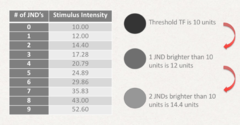
# of JNDs vs. stimulus intensity
Assume the Weber fraction for brightness is 0.2 and the threshold for detecting a particular test flash is 10 units. 1 JND above threshold is 12 units, but 2 JND above threshold is 14.4 units. How would we plot this relationship? (y-axis vs. x-axis)

more
According to Weber's law, as stimulus intensity increases, does it require more, less, or the same energy difference to differentiate a JND?

sensation
Which grows more slowly: sensation or stimulus intensity?

stimulus intensity
(results in a curve)
When sensation and stimulus intensity are both increasing, which one increases faster?
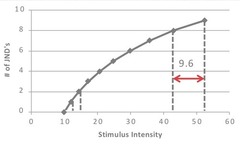
false
True or false: Sensation and growing stimulus intensity have a directly proportional linear relationship.

directly proportional
According to Fechner's law, what kind of relationship do sensation and log stimulus intensity have?
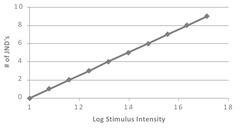
S=c*log(I)
According to Fechner's law, how can we calculate the magnitude of sensation (S) using a constant (c) and stimulus intensity (I)?
Weber's law holds for suprathreshold sensation, all JNDs are same magnitude of sensation
What are the 2 assumptions of Fechner's law?
yes
Fechner's law assumes that Weber's law holds for suprathreshold sensation. Is this true?
no
(Stevens' research showed that JNDs are not always physiologically equal)
Fechner's law assumes that all JNDs are the same magnitude of sensation. Is this true?
stimulus with certain intensity is presented to observer each trial, observer assigns number to indicate perceived sensation, repeated in random order
How can we perform an experiment in which an observer estimates the magnitude of a stimulus? (magnitude estimation method procedure)
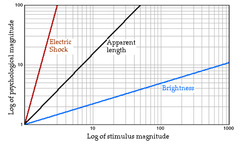
C
What is the characteristic graph pattern of line length perception when using the magnitude estimation method? (Which letter?)

B
What is the characteristic graph pattern of brightness sensation when using the magnitude estimation method? (Which letter?)

A
What is the characteristic graph pattern of pain perception (in response to electric shock) when using the magnitude estimation method? (Which letter?)

sensation magnitude raises to a power of the stimulus intensity
According to Stevens' law, what is the relationship between sensation magnitude and stimulus intensity?
S=k*I^a
According to Stevens' law, how can we calculate the magnitude of sensation (S) using a constant (k), stimulus intensity (I), and an exponent variable (a)?
linear (like with line length)
In Stevens' power law (S=k*I^a), if a = 1, what kind of function do we get on a graph?
concave downward function (like brightness)
In Stevens' power law (S=k*I^a), if a < 1, what kind of function do we get on a graph?
concave upward function (like pain from electric shock)
In Stevens' power law (S=k*I^a), if a > 1, what kind of function do we get on a graph?
becomes a straight line
What happens to the functions on a graph of Stevens' power law (S=k*I^a) when the data are plotted on log-log coordinates? (log scales on both axes)

directly proportional (linear)
According to Stevens' law, what is the relationship between log sensation magnitude and log stimulus intensity?
(S2=1 x 60^0.33) / (S1=1 x 30^0.33)
We have two different stimuli. The stimulus intensity for the first stimulus is 30 units and the second stimulus is 60 units. Using Stevens' law, how would we set up the equation to find how much brighter the second stimulus is perceived to be compared to the first stimulus? (Assume k = 1.0 and a = 0.33.)
set a predefined value to a standard stimulus, have subject assign number to other intensities relative to standard
What is a variation of the magnitude estimation method?
subject is given numerical value, they must adjust stimulus intensity to match what they think is the assigned value
How can we perform an experiment in which an observer produces a certain magnitude of a stimulus? (magnitude production method procedure)
magnitude estimation
Magnitude estimation and magnitude production are inverse methods of each other. However, which is used more often when measuring suprathreshold sensations?
C/D ratio, cataract progression scale, nuclear sclerosis scale
2-3 clinical applications of the magnitude estimation technique (1 we didn’t learn)
Stevens
Whose research utilized the magnitude estimation method: Fechner or Stevens?