Ch. 10 THE LAW OF CONTRACT
 Call Kai
 Learn
Learn Practice Test
 Spaced Repetition
 Match
Match Flashcards
 Knowt Play
1/9

There's no tags or description
Looks like no tags are added yet.
Name | Mastery | Learn | Test | Matching | Spaced | Call with Kai | Chat |
|---|
No analytics yet
Send a link to your students to track their progress
10 Terms
Two contracts involved in a real estate transaction
an agency contract (either a listing contract or an exclusive buyer’s agent contract) and
the contract of purchase and sale (contract of purchase and sale
a contract of purchase or sale of land which contains the obligations of the vendor and purchaser with respect to the purchase and sale)
Contract
an agreement between two or more persons which creates an obligation to do or not to do a particular thing
-The person who makes the promise is called the “promissor” and the person who can enforce that promise is called the “promissee”
-If the contract contains several mutual promises, each party will be both a “promissor” and a “promissee”.
-Contracts of purchase and sale of land usually contain many promises (bilateral contract)
7 essentials of a contract
• offer;
• acceptance;
• consideration;
• legal intention;
• capacity;
• legal object; and
• genuine consent.
-If any one of these requisites is lacking, a contract will not result.
-The form of contract may be oral, an exchange of letters or telegrams, a formal, lengthy written document, or any other exchange of communication.
Different types of ineffectual contracts
Void
-a contract which never had any legal existence or effect and which is not capable of being enforcedIllegal
-one (or both) which offends against public policy or against a particular statuteVoidable
-a contract which exists until repudiated by a party entitled to do so at which time it becomes void
-one (or both) of the parties has the option to rescind (cancel)
-Until the contract is rescinded, it is valid and binding on the partiesUnenforceable
- one which has the essentials of a valid contract but it cannot be sued upon for some procedural reason; e.g. oral contracts respecting land will not be enforceable in many instances.
OFFER
a proposal to do or refrain from doing some specified thing usually followed by an expected acceptance, counter offer, return promise or act. The person who makes the offer is called the offeror. The recipient of the offer is called the offeree
-At common law, if the offer contains a promise, it can be expressed in any form: in writing, orally, or even by conduct.
-However, contracts for the sale of land must generally be in writing
-important that an offer be made in clear and unambiguous terms
-If a dispute arises, the court must find that a reasonable person would feel there is only one reasonable interpretation which can be given to the “offer”.
-Normally, an offer is made to one specific person or group of persons and only that person or group can accept it
Standing Offers
-can be made to the public at large and can be accepted by anyone, e.g. offering of a reward to the public for providing information
Invitation to Treat
a type of advertisement used by one to induce the public or some individual to submit their own offers. An invitation to treat is not an offer capable of acceptance to form a contract, e.g. n advertisement in a newspaper to sell a house for $70,000
-Advertisers must be careful, however, because not all advertisements are considered invitations to treat.
Release or Expiry of an Offer
An offer is released or expires when any one of the following occurs:
• a time limit is specified in the offer and the offer is not accepted within the limit;
• no time limit is specified in the offer but a reasonable time has passed (example below);
• the person who made the offer communicates revocation (the term for the cancellation of an offer communicated by the offeror to the offeree prior to acceptance) before acceptance;
• either party becomes insane or dies before the offer is accepted;
• a counter-offer is made; or
• the offer is rejected.
-The reasonable time allowed for acceptance of an offer depends upon the circumstances in each case. It will be determined by the nature of the offer or of what is being sold
-Having a time limit in the offer avoids later disagreement about what is a reasonable time for acceptance.
-the offer can be revoked without waiting for the time limit to run out, as long as the offer has not yet been accepted.
-However, revocation must be communicated to the offeree (does not need to be in writing)
Option Agreement
-to ensure that an offer will be kept open for the stipulated time period by using a type of contract
-Separate consideration is given to keep the offer open (think of consideration as a payment of money)
-In effect, a separate contract must be formed.
-A licensee should have a lawyer review any option agreements prepared by the licensee.

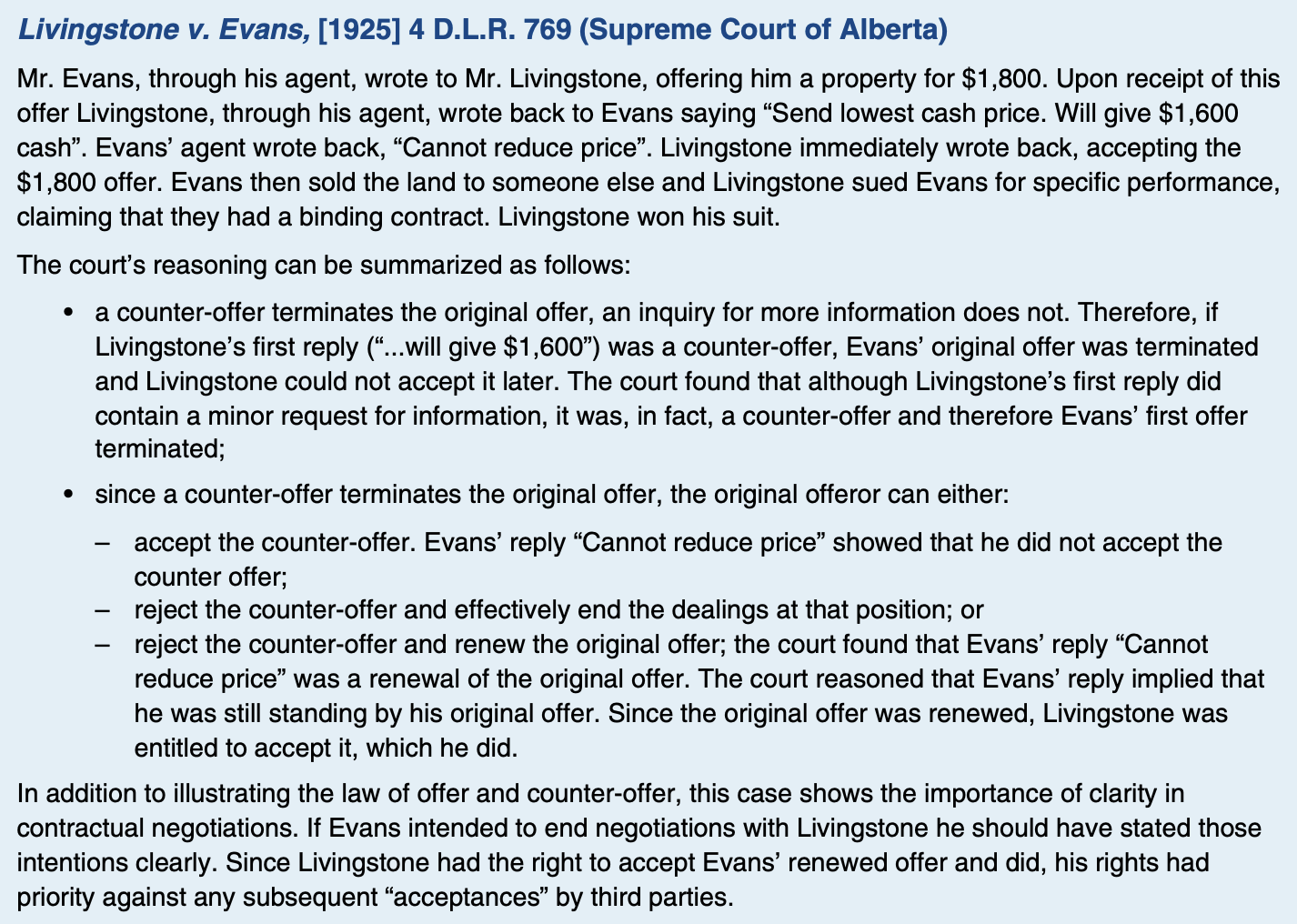
Counter-offer
a statement by the recipient of the offer which has the legal effect of rejecting the offer and of proposing a new offer to the offeror (who then becomes the recipient of the “new” offer)
-Legally, the counter-offer terminates the original offer.
-In effect, the counter-offer becomes the offer.
-If the counter-offer is not accepted, the offeree cannot accept the first offer because it has already terminated.
-different from an inquiry or a request for information. Such an inquiry or request does not terminate the offer
-When dealing with an offer to purchase real property you must be very careful about altering any of the terms of an offer. Such alterations can constitute a counter-offer which terminates the original offer, making it incapable of acceptance.