Biological Macromolecules, Chemistry of Life, and the Origin of Life Flashcards
 Call Kai
 Learn
Learn Practice Test
 Spaced Repetition
 Match
Match Flashcards
 Knowt Play
1/31

Earn XP
Description and Tags
Comprehensive fill-in-the-blank flashcards covering studying life, atomic structure, small molecules, biological macromolecules (proteins, carbohydrates, lipids, nucleic acids), and origin of life concepts.
Name | Mastery | Learn | Test | Matching | Spaced | Call with Kai | Chat |
|---|
No analytics yet
Send a link to your students to track their progress
32 Terms
Tyrone Hayes studies agricultural pesticides such as __________ that impact amphibian breeding and reproduction.
atrazine
Earth formed __________ billion years ago, though life did not evolve for another 600 million years or more.
4.6 to 4.5
Photosynthetic prokaryotes produced oxygen gas, leading to the formation of the __________ layer about 500 million years ago which absorbed damaging UV radiation.
ozone (O3)
A specific segment of DNA that contains information for making a protein is called a __________.
gene
The maintenance of a narrow range of internal environmental conditions that support survival is known as __________.
homeostasis
In a controlled experiment, the factor being manipulated by the researcher is called the __________ variable.
independent
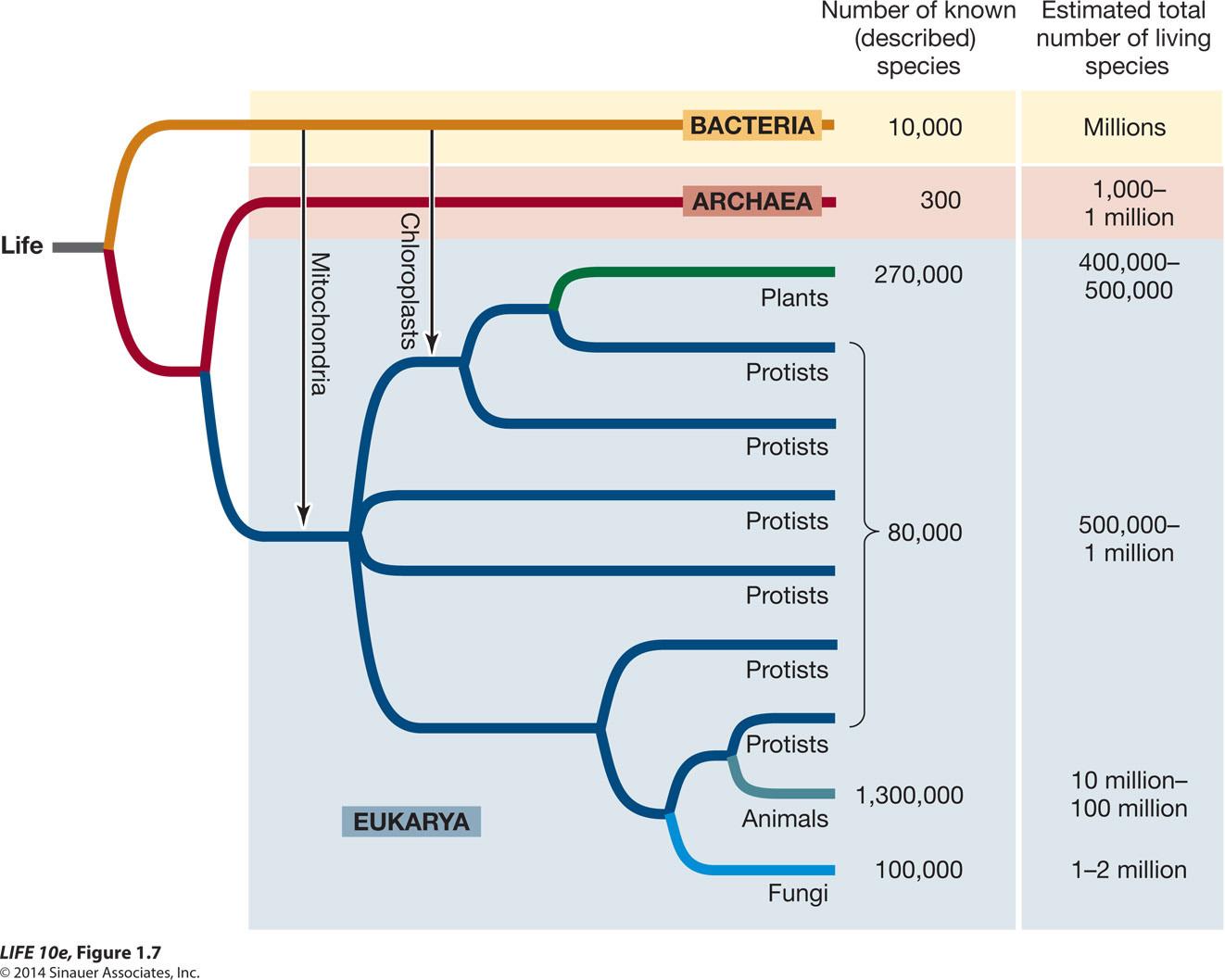
In the phylogenetic tree shown below, all multicellular plants, animals, and fungi belong to the domain __________.
Eukarya
The mass of one proton or one neutron is equal to 1 atomic mass unit, also known as 1 __________.
dalton
Forms of an element with different numbers of neutrons and different mass numbers are called __________.
isotopes
An electron orbital is a region where an electron is found at least __________ percent of the time.
90
The tendency of atoms to form stable molecules resulting in eight electrons in their outermost shell is called the __________ rule.
octet
The attractive force that an atomic nucleus exerts on shared electrons in a covalent bond is called __________.
electronegativity
Positively charged ions are known as cations, while negatively charged ions are called __________.
anions
One mole of any substance contains a constant number of molecules equal to Avogadro's number, which is __________.
6.02×10²³
Molecules with the same chemical formula whose atoms are arranged differently are known as __________.
isomers
Monomers are joined together into polymers through __________ reactions, which remove a water molecule.
condensation
The terminal sulfhydryl group of the amino acid __________ can react with another side chain of its kind to form a disulfide bridge.
cysteine
The primary structure of a protein consists of its specific sequence of __________.
amino acids
Secondary protein structures include the right-handed coil called an α helix and the aligned sheet structure called a __________.
β pleated sheet
Specialized proteins called __________ help prevent denatured or newly made proteins from binding to the wrong molecules during folding.
chaperones
In carbohydrates, monosaccharides are linked together by covalent bonds called __________ linkages.
glycosidic
Triglycerides consist of three fatty acids linked to one glycerol molecule by __________ linkages.
ester
A nucleotide consists of three components: a pentose sugar, a phosphate group, and a __________ base.
nitrogenous

In the diagram of nucleotide chemistry shown below, Adenine and Guanine belong to the fused double-ring base group called __________.
purines
Nucleotides in a single strand of nucleic acid are linked together by __________ bonds.
phosphodiester
The combination of transcription and translation to generate polypeptides from genes is called __________.
gene expression

The experiment depicted below disproved spontaneous generation and was conducted in 1668 by __________.
Francesco Redi
In the 1950s, Miller and Urey tested chemical evolution by using an experimental atmosphere composed of H2, NH3, CH4, and __________.
H2O
According to timeline models, the RNA world originated approximately __________ billion years ago during the Precambrian period.
3.8
Indigenous peoples of Vancouver Island prepare the underground bulb of the __________ flower by baking it in fire pits to convert inulin into digestible mono- and disaccharides.
camas
The fat-rich fish __________ contains 20 percent fat by body weight and was traditionally essential to First Nations diets.
ooligan
In sickle cell anemia, a single amino acid substitution occurs in the β chain of __________.
hemoglobin